
Who really wins the lottery?
45sOpens with a universal curiosity about lottery winners and hints at a hidden system, sparking intrigue and debate.
▶ Play ClipThis video reveals that lottery winners are not purely lucky; they use statistical analysis to identify patterns and biases in lottery machines. By analyzing factors like ball weight, diameter, and historical draw data, players can increase their odds of winning.
Millions play lotteries, but few win. There is a principle behind selection, and some people consistently win and make a living from it, similar to poker players.
Some balls are drawn more often due to imperfect conditions: lottery machines may not be calibrated precisely, ball diameters vary by microns, and ball weights differ by hundredths of a gram.
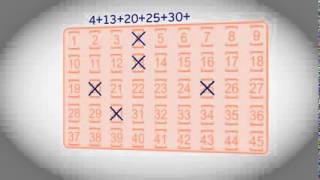
Using the 6/45 lottery as an example, the total sum of winning numbers typically ranges from 126 to 167. About one-third of winning combinations have three even and three odd numbers.
Dividing numbers into small (1-22) and large (23-45) groups, 70% of winning combinations have a ratio of 2:2 or 4:2 between small and large groups.
In 47% of games, a number from the previous draw repeats. Consecutive numbers appear in only 11% of games. Avoid combinations with more than three numbers having the same interval between them.
Winners use systematic betting based on analysis, calculation, and statistics, not random picks. The video promotes a free guide at prolato.info.
Lottery winners often rely on statistical analysis and systematic betting rather than pure luck. By understanding biases in lottery machines and applying mathematical patterns, players can improve their chances.
[00:00] Millions of people around the world play lotteries, but only a few out of the millions win . What is the principle by which these lucky ones are selected? After all, these are not fake players from the lottery organizers. Did you know
[00:16] that there is a category of people who consistently win lotteries and make a living from this income? Just like poker players, for example? And just like poker players? Many of them keep the secrets of their winnings a secret and never reveal them to anyone
[00:32] . But everything secret always becomes clear, and some secrets of winning the lotto come to light. Have you ever noticed that some balls are drawn more often than others, although, according to probability theory, all
[00:47] balls should have the same frequency distribution. But probability theory works under ideal conditions. In the lottery, the conditions are not ideal. First, lottery machines are not always calibrated with absolute precision.
[01:04] Second, the diameter of lottery balls is not the same. Even a difference of a couple of microns makes some balls fall out more often. Third. Also, in addition to the diameter, the weight of the balls can vary. The difference may again be hundredths of a
[01:20] The difference may again be hundredths of a gram. These are the main factors that cause some balls to be drawn more often than others. So how do you identify the balls that will be drawn in future draws? There are several factors you need to consider
[01:36] when filling out a lottery ticket. Let's analyze these factors using the example of the 6 and 45 lottery. Total amount. In the vast majority of draws, the total sum of numbers in winning combinations
[01:52] sum of numbers in winning combinations ranges from 126 to ranges from 126 to 167. The number of even and odd numbers. About a third of all winning combinations have a ratio of three even and three
[02:06] odd numbers, large and small groups of numbers. If we divide the total number of balls in the game in half, we get two groups: from
[02:18] in half, we get two groups: from one to 22 and from 23 to 45. So, in one to 22 and from 23 to 45. So, in 70% of winning combinations, the ratio of numbers in the small and large groups is 2: 2 or 4:
[02:32] 2. Repetition. In 47% of games, a number appears that has already been repeated in the previous draw. Consecutive numbers. If the balls drawn are 5, 6,
[02:48] 10, 14, 22, then 5 and 6 are consecutive numbers. There are no consecutive numbers in There are no consecutive numbers in 89% of games. The interval between numbers in a
[03:01] combination. If any of your combinations contains more than three numbers with the same interval between them, then you can safely delete such a combination. So, do you still think that lottery winners win by chance?
[03:17] How could it not? A chain of systemic bets leads them to win . Betting is not done . Betting is not done haphazardly, but through analysis, calculation and statistics collection. What are you waiting for? Enter your name and email at
[03:34] prolato.info and receive a free, more detailed guide to the lottery winning system straight to your inbox.
⚡ Saved you 0h 03m reading this? Transcribe any YouTube video for free — no signup needed.