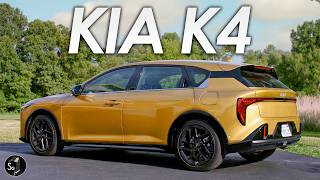

Budget car interior better than 911?
40sShocking comparison between a cheap Kia's interior and a Porsche 911's dash creates high engagement and debate.
▶ Play Clip"The title is accurate; the video thoroughly explains how Kia delivers a cheap, feature-rich car through cost-cutting strategies and manufacturing choices."
The 2026 Kia K4 hatchback offers exceptional value in the compact car segment, starting around $25,000 and topping out near $32,000 for a fully loaded GT Line Turbo. The video explores its trim levels, interior quality, cost-cutting manufacturing techniques, and driving impressions, comparing it to rivals like the Toyota Corolla and Honda Civic.
Base EX starts at $25k; GT Line with tech pack ~$28k; GT Line Turbo with tech pack ~$32k.
Interior materials and physical controls feel premium for the price, with soft-touch surfaces and intuitive layout.
HVAC controls are hybridized (physical for temp/fan, rest in touchscreen) with some lag; hidden panel behind steering wheel.
Built in Mexico using mostly steel; uses structural adhesive and body sealers to reduce NVH without expensive materials.
EX has torsion beam rear; GT Line and GT Line Turbo get independent rear suspension for better ride quality.
GT Line Turbo has 1.6L turbo (~190 hp) with 8-speed automatic; other trims use 2.0L naturally aspirated with CVT.
Very refined and quiet; better than Corolla, close to Civic hatch; good driving assist systems.
Long-term reliability concerns exist, but strong warranty and low financing rates make new purchase attractive.
What is the starting price of the Kia K4 hatchback (poverty spec)?
$25,000
0:28
What is the price of the GT Line Turbo with the technology pack?
$32,000
0:50
Where is the Kia K4 hatchback manufactured to keep costs down?
Mexico
4:14
What material is the Kia K4's body almost entirely made of?
Steel
4:19
What two methods does Kia use to reduce NVH (noise, vibration, harshness) in the K4?
Structural adhesive and body sealers
4:32
What type of rear suspension does the base EX trim have?
Torsion beam rear suspension
5:45
What type of rear suspension does the GT Line and GT Line Turbo have?
Independent rear suspension (multi-link)
5:55
What engine and transmission does the GT Line Turbo have?
1.6-liter turbocharged engine with 190 hp and a traditional torque converter automatic
6:14
How does the K4 compare to the Toyota Corolla according to the reviewers?
It is more refined, quieter, and has a better driving experience than the Corolla.
8:28
How does the K4 compare to the Honda Civic hatch in terms of refinement?
It is slightly less refined in ride quality and quietness compared to the Civic hatch.
8:19
Mastered commodity car interiors
The reviewer notes that Kia has mastered making cheap cars feel premium, with soft-touch materials and physical controls that rival more expensive cars. This is a key selling point.
1:35Manufacturing in Mexico
Explains how Kia keeps costs down by building the car in Mexico and using mostly steel, avoiding expensive composites and aluminum.
4:14Strategic use of structural adhesive
Kia uses structural adhesive and body sealers in key areas to reduce NVH without adding expensive materials, improving refinement.
4:32Suspension differences between trims
The base EX has a torsion beam rear, while GT Line trims get independent rear suspension, significantly affecting ride quality.
5:45Better than Corolla, close to Civic
The K4 is considered far better than the Corolla in driving refinement and quietness, and nearly on par with the Civic hatch, making it a strong competitor.
8:28[00:09] The 2026 [music]
[00:10] Kia K4 hatchback, not to be confused
[00:13] with K19 the Widowmaker, that's a
[00:14] completely separate thing. In this
[00:16] video, we're going to talk about the
[00:17] pros and cons, the price point, and who
[00:19] this is for, and some of the things this
[00:21] brand does great, and maybe why you
[00:22] would [music] consider it. But, let's
[00:23] get started with the trim levels and
[00:26] prices. This bad boy starts at about
[00:28] $25,000 for the poverty spec. You can go
[00:31] to the GT Line, which adds more
[00:33] features, and if you add the technology
[00:35] pack, which gets you heated and cooled
[00:37] seats, acoustic front glass,
[00:39] a moonroof, and a whole bunch of other
[00:41] stuff, it's at 28 grand. And that's a
[00:44] really, really good deal for what you're
[00:46] getting here. Then you go to the GT Line
[00:47] Turbo, which I'm in, and then you add
[00:49] the tech pack, it bumps it all the way
[00:50] up to about $32,000. That gives you more
[00:53] power, ambient lighting, and a few other
[00:55] niceties.
[00:56] But, again, there's a price spread here
[00:58] where you can get a brand new car almost
[01:00] like loaded for 28 grand and feeling
[01:03] really, really good. But, you've been
[01:04] looking at the outside this far, and the
[01:06] outside tells a different story. It
[01:08] looks very, very modern. It was clearly
[01:10] designed in the digital domain, and it's
[01:12] not something that's going to age well.
[01:13] It's very here and now, but really,
[01:16] there's a good amount of color options.
[01:18] There's something here for everybody.
[01:20] But, again, you know, I'll leave the
[01:21] looks to you. Let's talk about the
[01:23] interior space where you're going to
[01:24] live. What this brand has done really
[01:26] good here, and around 28 grand, as you
[01:28] look at the textures of the dashboard,
[01:30] the plastics, they have absolutely
[01:32] mastered the art of commodity cars.
[01:35] I was talking to Jack about this. When
[01:36] you look at the upper dashboard, it
[01:37] looks like higher quality in here at
[01:39] about 28 grand than we get in a base 911
[01:42] or like even a specked-out 911 with
[01:44] their plastic dash. They know where to
[01:47] put soft-touch materials. They know
[01:48] where to put hard textures that makes
[01:50] this look way more expensive than it is.
[01:52] And when you go to a dealership for the
[01:53] first time, you're going to be wowed by
[01:55] it. They've also mastered the use of
[01:57] physical controls. When you look at the
[01:58] door panel, your heated heated and
[02:01] cooled seats and your heated steering
[02:02] wheel and your memory buttons are all in
[02:04] a line, all easy to find. You're not
[02:06] going to mess with this. The steering
[02:07] wheel controls are physical. No haptics,
[02:09] super clicky, easy to use. Like
[02:11] everything's so intuitive about this car
[02:13] and that's why it is special for the
[02:15] price price point. I think they made you
[02:17] feel like you're spending a lot more
[02:19] money without overcomplicating it or
[02:20] making it hyper gimmicky. The only thing
[02:22] negative I can really say is because
[02:24] they hybridized the HVAC controls.
[02:26] There's physicals for temp and fan
[02:29] speed, but everything else is in the
[02:30] touchscreen. And they've kind of hidden
[02:32] this HVAC control model panel behind the
[02:35] steering wheel so you can't even see it.
[02:36] If you want to maximize it, oftentimes
[02:38] there's lag or delay. When I first turn
[02:40] on this car, it won't ever full screen.
[02:42] So, there is some frustration on the
[02:44] software side, but it's still way better
[02:46] than a lot of the other brands are
[02:47] doing. Overall seating comfort is pretty
[02:49] good. I find that they do a a pretty
[02:51] good job with their lumbar support. The
[02:53] the thigh cushion is pretty decent for
[02:56] most body types and the seats are just
[02:58] overall pretty comfortable. They don't
[03:00] have like a solid bottom cushion like
[03:02] Mazda. It It's a good blend between all
[03:04] the brands. I feel like again, the touch
[03:07] points and the things you interact with
[03:08] your are a joy to use. In terms of back
[03:10] seat space, very comfortable, easy to
[03:13] get in and out. If you opt for the
[03:15] upper trim levels with multi-link rear,
[03:17] it's more comfortable in the back and
[03:18] more refined. The hatch space is great.
[03:20] I mean, clearly you can see with the
[03:22] seats down, this is like small SUV
[03:24] levels of storage and usability without
[03:27] the footprint of a CUV or the boring
[03:30] nature of, you know, everybody and their
[03:31] grandma has an SUV now. That's it just
[03:33] feels played out. This gives you
[03:35] something unique and I think people are
[03:37] going to like that. But, we're going to
[03:38] take this in the shop. I'm going to
[03:39] explain how they got the price point to
[03:41] where it is and some of the things that
[03:42] they're doing here that are unique to
[03:44] Hyundai and Kia.
[03:49] Now that you understand the price point
[03:51] and the features, I'm going to explain
[03:53] to you how they were able to get the
[03:54] price point down. I'm going to give you
[03:55] a crash course here. You know, brands
[03:57] have tried to bring manufacturing back
[03:59] to the United States, but they can't get
[04:00] the prices low enough.
[04:02] Even in the Koreans are struggling with
[04:03] this despite them owning their own
[04:05] supply chain. They make their own steel,
[04:06] they make most of their own parts, but
[04:08] bringing it to the United States is now
[04:09] more expensive. So, this Kia and Hyundai
[04:12] counterpart is made in Mexico. That's to
[04:15] drive down cost. They've also done it in
[04:17] several different ways. This car is
[04:19] almost entirely steel. There's no
[04:20] composites, no aluminum. They've also
[04:22] had to balance a strategy of how to make
[04:24] it feel refined without just going off
[04:26] the deep end with covering every single
[04:28] piece of this car up. So, when you look
[04:30] at the body structure, they've used
[04:32] structural adhesive and body sealers as
[04:34] in many strategic places as possible.
[04:37] Like the front end, they really used a
[04:38] lot of body sealers around the front
[04:40] wheels and around the front subframe.
[04:42] And that's going to quiet down road
[04:43] noise for that driver and passenger and
[04:45] eliminate,
[04:47] you know, tire noise as much as
[04:48] possible. They've done a good job
[04:50] covering the wheel well arches in the
[04:51] front and the back. And this brand is
[04:53] really big on structural adhesive, which
[04:55] does reduce NVH. They They have a really
[04:58] good concept of how to control it. They
[05:00] also use acoustic panels where they need
[05:01] to in the middle part of the car, but
[05:03] that's about it. Now, they've taken
[05:05] panels off where they don't need it for
[05:07] a car of this price point. Like here,
[05:08] the entire engine underneath is
[05:10] uncovered, which is great for
[05:11] serviceability. If you're spending 25 to
[05:13] 30 grand for a car, you're probably
[05:15] doing your own oil changes or doing your
[05:16] own work. In that regard, you can strip
[05:18] everything off this car with minimal
[05:20] effort, which I really like. I like the
[05:22] fact you can just crawl under this thing
[05:24] and get at to wherever you need without
[05:26] having to pull off service panels. That
[05:28] is a big deal. Now, let me talk about
[05:30] some of the differences between the
[05:31] different trim levels. The EX is the
[05:33] lowest. You get a naturally aspirated
[05:35] engine and a IVT, which is their version
[05:38] of a CVT, which is excellently tuned. It
[05:40] is one of the better ones in the
[05:41] industry. The negative part of getting
[05:43] that lowest trim level is you only get a
[05:45] torsion beam rear end, no independent
[05:47] suspension in the back. So, if you're
[05:48] sensitive to ride quality or you have
[05:50] back passengers or kids that are
[05:51] sensitive in the backseat,
[05:53] it's going to have a choppier ride. When
[05:55] you go up to the GT Line and the GT Line
[05:57] Turbo, you get independent rear, which
[05:59] makes a huge difference in ride quality.
[06:01] You also get slightly bigger rear brakes
[06:03] and you get retuned dampers for the GT
[06:05] Line cars.
[06:07] So, the GT Line and the EX both get get
[06:10] the same naturally aspirated 2-liter
[06:11] with that CVT. And then the GT Line
[06:14] Turbo, the 1.6-liter turbo gets about
[06:16] 190-ish horsepower and torque and you
[06:19] get a traditional torque converter
[06:21] automatic. So, drivability-wise, if you
[06:23] really care about driving dynamics, you
[06:25] have to go to the GT Line Turbo.
[06:26] Otherwise, you know, that middle trim,
[06:28] the GT Line without the turbo, is a
[06:30] really good choice. But anyway, I'm
[06:33] going to leave it at that. I hope that
[06:34] gives you a better understanding of how
[06:36] they did what they did here. We're going
[06:37] to take this for a drive and talk about
[06:38] the pros and cons.
[06:44] Jack,
[06:46] Kia K4 [music] Hatchback.
[06:49] This is for a very specific clientele,
[06:52] but I want you to first, before [music]
[06:53] we get started, I want you to just feel
[06:54] this.
[06:56] Do you feel any NVH from the engine?
[06:58] >> No.
[06:59] >> It's incredible because the engine's on.
[07:01] >> Mhm.
[07:02] >> Like how smooth this thing is.
[07:04] >> I think in a world where everything is
[07:06] becoming increasingly too expensive,
[07:09] the value proposition of this car, how
[07:11] it sits with all its options,
[07:13] is incredible. I'm really, really,
[07:16] really impressed by this car.
[07:18] >> Yeah, I you know, when I got in it, I'm
[07:20] like, obviously you get past the looks
[07:22] and the paint color and you know, thank
[07:24] god it's unique, but uh truthfully, um
[07:27] when you drive this,
[07:29] you appreciate just how much work they
[07:32] put into this for like an affordable car
[07:35] because it basically fixes all the
[07:37] things that we've complained about this
[07:38] brand in terms of refinement for so
[07:41] long. The engine is disappears into the
[07:44] background compared to the Toyota
[07:45] equivalents and Hondas. The trans is
[07:48] you know,
[07:49] >> It's fine.
[07:49] >> It's fine. It's an eight-speed torque
[07:51] converted version.
[07:52] >> I would take this over the CVT in a like
[07:55] Corolla any day of the week though.
[07:57] >> And I think this becomes the argument.
[07:58] And I I I talked about this in the shop,
[08:00] how they did it, why they did it. But
[08:03] from a practical perspective, um
[08:06] why would you choose this or would you
[08:08] consider choosing this over a Corolla or
[08:10] a Civic? Cuz that becomes the argument
[08:12] for this.
[08:12] >> From a feature set, from a refinement
[08:14] perspective, from a driving side of
[08:16] things,
[08:17] I mean, this and a Civic hatch,
[08:19] I still think the Civic's a touch more
[08:21] refined in the ride quality. I even
[08:22] think in the quietness, though we
[08:23] haven't done them back-to-back.
[08:25] Um but I think from a Corolla
[08:28] comparison, this thing blows that car
[08:29] out of the water, at least from a
[08:31] driving perspective.
[08:32] I the the
[08:34] engine, when it decides to downshift, is
[08:36] far less anemic. It's more importantly
[08:38] really quiet.
[08:39] >> Yeah.
[08:40] >> Can't hear it at all. The steering's
[08:41] well weighted. The the basic inputs for
[08:44] like throttle mapping and brake pedal
[08:46] mapping
[08:47] are good. Like I think it's a very easy
[08:51] car to drive where there isn't one thing
[08:52] that sort of sticks out. When you tell
[08:54] it to downshift and you put it in a
[08:55] sport,
[08:57] it's not going to blow you away in
[08:59] speed, but that's not what you're asking
[09:00] for in a car like this.
[09:02] How is it You've driven this longer than
[09:04] me though. And obviously sat in this car
[09:05] for like 2 hours and you were on the
[09:07] highway.
[09:07] >> Yeah.
[09:08] >> How is it when you actually push it hard
[09:09] with something I can't do on the street
[09:11] too.
[09:11] >> know, like the the engine calibration of
[09:13] this and then the NVH team that worked
[09:16] on this, I think has a really good idea
[09:17] of how to eliminate the shitbox feeling
[09:19] of a four-cylinder. And this is
[09:21] something that we complain about with
[09:22] Toyotas specifically. You get in it and
[09:24] it just sounds horrible. Like they don't
[09:26] know how to isolate it out. It finds It
[09:28] sounds like it vibrates and excites
[09:31] every panel and every piece of metal.
[09:33] They this They They have the the torque
[09:36] curve of this engine set up where it
[09:38] doesn't necessarily need to downshift
[09:40] and that's what I found on the highway
[09:41] is you just go into it a quarter and
[09:43] it's instantly got power. It almost has
[09:45] an electric feel to it without having
[09:47] any hybridization and I think for a
[09:49] majority of the public that's going to
[09:50] drive it is going to appreciate that
[09:53] part of the refinement of it cuz it
[09:54] never really has to wind up and when you
[09:56] need it to get going it just does. The
[09:58] transmission, you know, mostly blends
[09:59] into the background. This isn't
[10:01] pretending to be a sporty car. It's just
[10:03] something that's like pointed at me.
[10:05] Does it do the refinement part? Does it
[10:07] do the comfort part? Does it do the
[10:08] technology part? And I would say it's
[10:10] like eight out of 10 out of all of those
[10:13] including the driving assist functions
[10:15] when you get to this high trim level. It
[10:17] It's one of the best for the price point
[10:19] if not the best.
[10:20] >> No, this is way better than the Honda
[10:22] system.
[10:23] >> It's way better than the Honda system.
[10:24] It's really I think it's better than the
[10:26] Toyota and it like blows away the Mazda
[10:28] stuff.
[10:29] >> Well.
[10:29] >> Because it does the driving assist part
[10:32] where it's an assist that you can lean
[10:34] on, right? You don't have to second
[10:36] guess it. It just does it without being
[10:38] in your face like the Toyota It's
[10:39] like it's constantly bothering you on
[10:41] the Toyota. This just it kind of works.
[10:43] >> So my question I pose to you
[10:46] is while this car is a value from an
[10:49] initial purchase perspective Kia and
[10:52] Hyundai have really suffered in
[10:54] long-term residuals.
[10:55] >> Yes.
[10:55] >> So my
[10:56] my [clears throat] assumption is if you
[10:58] paid let's say a Civic hatch
[11:01] with all the bells and whistles which
[11:03] are which is still less features than
[11:05] this car has to say low 30s
[11:07] would you still buy this over say a
[11:10] Corolla or like a Mazda 3?
[11:12] >> Well,
[11:13] yes and no. Look, the 10-year plan
[11:15] because of the warranty, right? If
[11:17] they're going to honor the warranty and
[11:18] you're not going to have a bunch of
[11:19] drama with you know, theft crap and
[11:22] reliability
[11:23] you know, you keep this for 10 years
[11:25] it's not going to matter that much.
[11:27] >> That's because you have your powertrain
[11:28] warranty.
[11:28] >> Yeah, assuming everything's going to
[11:29] work properly on here and this is a
[11:31] lower trim level car. There's not a lot
[11:32] of complication to it. You know, these
[11:35] you know, of course, not knock on wood,
[11:37] but you know, assuming the engine's not
[11:39] going to eat itself, the trans is a
[11:41] known quantity in these cars. I mean,
[11:43] there's just not a lot for that for it
[11:44] to go wrong unless something major we
[11:46] don't know. But for 10 years, I think
[11:50] because you're going to get the fine the
[11:51] interest rate so low, it's going to be
[11:53] so subsidized out that you can get a low
[11:55] payment on it. It doesn't scare me that
[11:56] much. This would be a different
[11:58] discussion if we were talking about a
[11:59] used car. But as a new product, I think
[12:02] it delivers a lot more than what the
[12:03] existing Toyota lineup offers for other
[12:06] small compact cars, and that's going to
[12:08] >> 3, too.
[12:08] >> And the And the Mazda 3, like, you know,
[12:10] the Mazda 3, the problem with the Mazda
[12:12] is they haven't been able to keep it up
[12:15] to date like the Koreans have, right?
[12:17] Like, it's fallen behind. There's
[12:18] nothing wrong with it, but
[12:20] refinement-wise and the back seat, you
[12:22] know, like, this is a refined car. And
[12:24] does it have issues with jounciness and
[12:26] some of that it can't control like some
[12:29] of these higher-amplitude impacts? Yes,
[12:31] but at this price point, it's not
[12:32] egregious. And if that's good enough for
[12:35] most people
[12:36] >> And you can't get a hybrid yet, which is
[12:37] the other thing.
[12:38] >> this is front-wheel drive only. You
[12:40] know, like, you still have those same
[12:41] arguments with some of the other
[12:42] competition, but um I don't know, Jack.
[12:45] I I think it's time to sum all this up.
[12:47] >> All right. Take me to the final
[12:49] thoughts.
[12:50] >> [music]
[12:54] >> Here we are, the conclusions of the K4
[12:56] hatchback.
[12:57] Hyundai and Kia have done a a really
[12:59] good job now at understanding how to buy
[13:03] all the things they need for their
[13:04] supply chain and drive the price down
[13:07] across all their cars, cars and SUVs.
[13:09] And this is a perfect example of how
[13:11] they figured out how to cut costs
[13:12] everywhere to get the price point down
[13:14] to like the mid $25,000 range and upper
[13:17] 20s, and you get all the features that
[13:19] really would cost you about $35,000 with
[13:21] the other brand. Now, they've had to
[13:23] make concessions in certain places, but
[13:25] as a customer, most people don't realize
[13:27] it. And yes, they've had more issues
[13:29] with reliability of their gasoline
[13:30] engines. I mean, it's not just perceived
[13:32] reliability. We drive everywhere and
[13:34] we're seeing a lot of the the older cars
[13:36] puffing out oil or black smoke from
[13:38] their engines. I hope they get some of
[13:39] these quality issues mechanically under
[13:41] control, EVs and the regular gasoline
[13:44] cars. But assuming you don't care about
[13:46] that, the the one thing you want to the
[13:49] reason why you'd want to buy a new car
[13:51] like this in this climate is not
[13:52] everybody has the money to buy a used
[13:54] car and in the United States, your
[13:56] financing rates can be a lot lower and
[13:58] more favorable for longer terms with
[14:00] less money down and driving down your
[14:01] payments if you really need that new car
[14:03] experience. And this really does
[14:05] deliver. It's more refined than the
[14:07] Toyota and Honda counterparts, at least
[14:08] on the pure internal combustion engine.
[14:10] The engine and transmission just
[14:11] disappear in the background. It's it's
[14:13] really quiet and it is super comfortable
[14:15] and it's feature-packed. So, it's it's
[14:17] giving you so much there and it's a good
[14:19] blend of physical controls, usability
[14:21] and with the hatch, I mean, you can
[14:22] store so much stuff in here without
[14:23] having that footprint of an SUV. Really
[14:26] like that part. I I wish that they would
[14:28] figure out a way just to to go back for
[14:30] the to the basics for their regular cars
[14:32] and going more physical HVAC controls.
[14:35] This is hybridized and the software,
[14:37] like I talked about in the interior,
[14:38] does have some lag and it gets
[14:40] frustrating, but other than that, it's
[14:42] very hard to find complaints about the
[14:44] K4 hatchback. Check it out if you're in
[14:46] the market for an affordable new car.
⚡ Saved you 0h 14m reading this? Transcribe any YouTube video for free — no signup needed.