
AI Summary
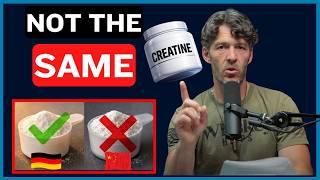
This video compares the purity of creatine manufactured in China versus Germany, focusing on mercury content. The presenter uses third-party lab testing to show that Chinese creatine contains detectable mercury, while German creatine is non-detectable, attributing the difference to manufacturing processes. He concludes that higher cost reflects cleaner quality, advising consumers to be aware of potential heavy metal impurities in cheaper products.
Chapters
The video presents third-party lab results from Light Labs in Ann Arbor, Michigan, comparing mercury content in creatine from China and Germany.
Chinese-manufactured creatine raw material shows 2.68 parts per billion of mercury, translating to 0.003416 micrograms per serving, which is a neurotoxin linked to health issues.
German creatine (Crea Vitalis) is micronized, making it more water-soluble, bioavailable, and less likely to cause gastrointestinal distress, with non-detectable mercury levels.
Chinese manufacturing uses electrodes that off-gas mercury during the process, leading to contamination in the finished product.
Large companies prioritize low cost, paying $6-$8 per kilo for Chinese creatine versus $22-$24 for German, resulting in a 70% cost difference but potential impurities.
The creator recommends German micronized creatine for its cleanliness and absorption, while suggesting activated charcoal or sauna use if consuming cheaper alternatives.
The video emphasizes that higher-priced German creatine is cleaner and safer, while cheaper Chinese alternatives may contain heavy metals like mercury. Consumers should weigh cost against potential health risks.
Mentioned in this Video
Study Flashcards (5)
What is the mercury content in Chinese-manufactured creatine?
easy
Click to reveal answer
What is the mercury content in Chinese-manufactured creatine?
2.68 parts per billion, translating to 0.003416 micrograms per serving.
00:27
What is the mercury content in German creatine?
easy
Click to reveal answer
What is the mercury content in German creatine?
Non-detectable.
01:10
Why does Chinese creatine contain mercury?
medium
Click to reveal answer
Why does Chinese creatine contain mercury?
The manufacturing process uses electrodes that off-gas mercury.
01:38
What are the benefits of micronized creatine?
medium
Click to reveal answer
What are the benefits of micronized creatine?
More water-soluble, more bioavailable, and less likely to cause gastrointestinal distress.
01:10
What is the cost difference between Chinese and German creatine?
hard
Click to reveal answer
What is the cost difference between Chinese and German creatine?
Chinese creatine costs $6-$8 per kilo, while German creatine costs $22-$24 per kilo, a 70% difference.
02:33
💡 Key Takeaways
Mercury Detection in Chinese Creatine
Provides concrete lab data showing heavy metal contamination in a common supplement.
00:27German Creatine Purity
Highlights the benefits of micronization and non-detectable mercury levels.
01:10Manufacturing Process Impact
Explains the root cause of mercury contamination, linking production methods to product quality.
01:38Cost-Quality Trade-off
Reveals the economic incentive for cheaper, potentially contaminated products.
02:33Full Transcript
[00:01] cleanest creatine in the world. And many of you are like, "Look, it's more expensive." But I want to share with you some thirdparty testing, testing creatine that was manufactured in China versus creatine that is manufactured in
[00:14] Germany. And so what we're going to look at here is a special focus on the mercury content. And so, uh, this screenshot here is from a company called Light Labs that we use. They're based out of Ann Arbor, Michigan. And you can
[00:27] see the mercury content in the creatine manufactured the raw material in China. What you see here is the 2.68 parts per billion uh which translates into 003416
[00:41] micrograms per serving. Now this is not a lot of mercury. Uh I will say there's probably no safe level of mercury to have. We know that mercury is a neurotoxin. It's linked with all sorts of uh health issues and
[00:55] so forth. But there is definitely mercury uh in the material uh from the raw material made uh in China. Now when you look at the raw material that that we offer through myioscience, this is the micronized creatine that's
[01:10] manufactured end to end in Germany. The raw material is known as crea vitalis. been micronized. Why do [snorts] you care about micronization? It's more water soluble. It's more bioavailable. It's less likely to cause
[01:24] gastrointestinal distress. And as you see here, no mercury uh on this and so it's non-detectable. Now, why might that be? Well, as you might notice, we recently did this show with Robert over at uh uh Als and the director of the
[01:38] mercury in there because the way that it's manufactured, uh it turns out that the way that the Chinese have figured out how to make creatine, they [snorts] need electrodes during the process. uh and these are just for testing out I
[01:54] some electropharesis and it turns out that these electrodes uh do sort of off gas some mercury and so that's why you get mercury in the finished product there really shouldn't be any mercury or any heavy metals uh in creatine and so
[02:08] you know I point this out because many of you have said look I I'm just buy that's been manufactured in China like this is no secret many of the big companies you know they are owned by private equity groups or they're
[02:21] publicly traded. Uh they're very bottom line focused. Cost of goods has to be incredibly low, high profit margin to pay for all the middlemen to make these companies work. And so, you know, they're not going to pay 22 or $24 a
[02:33] kilogram for German creatine. They're going to pay $6 or $8 a kilo for the stuff made in China. Uh it's like, you know, literally cost 70% less. Like, why existing sales, you know? So, you get what you pay for and that's what it
[02:49] [snorts] just buy this cheap stuff, that's fine. But if you're taking 5, 10, 15, 20 grams a day, I just want you to be aware of the fact that you might be, you know, inadvertently giving yourself some heavy metals. So you got a sauna,
[03:04] know, have some charcoal, activated charcoal when you take the the creatine. So I just wanted to share with you, you know, why, you know, over at BioScience, we've made a decision to offer the more expensive German creatine. We have a
[03:18] relationship with these individuals. We trust them and we do a lot of testing on finished product on raw material and we found it just to be cleaner. So, I just Can't really make this stuff up. I guess you know, you get what you pay for. So,
[03:31] if you want the cleanest creatine money can buy, you can check out the link in mentioned, we uh really like the micronized material from Germany. Very clean, easy to absorb, minimal gastrointestinal distress. And so that's
[03:47] something that we stand behind. And uh lo and behold, it does not have any mercury in it. So there you have it, friends. You get what you pay for. If out the link in the description below. Uh if you do take the the cheaper stuff
[04:01] and Costco and things like that, well, just know that, you know, [snorts] you might be inadvertently uh getting some impurities that could harm your health. And so it's just something to be aware of. So what are your thoughts? Let me
[04:14] we'll catch you on a future video down the