
4 Ways to Set Auth ID in Laravel
43sQuick, practical coding tips are highly shareable, and the multiple approaches spark debate in comments.
▶ Play Clip"Title promises '4+ ways' and delivers exactly that, with a bonus of community alternatives — solid, on-topic content."
This video presents four distinct methods for automatically setting the user ID from an authenticated user in Laravel, based on a Twitter poll. It compares approaches ranging from direct array manipulation to using Eloquent relationships and model events, highlighting the flexibility and potential pitfalls of each.
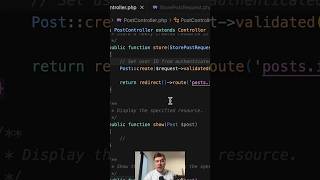
The most straightforward method involves adding the user ID directly to the validated data array within the controller.
A similar approach uses the splat operator (...) to merge the validated array with an array containing the user ID, offering a more concise syntax.
Utilizing a hasMany relationship (e.g., User hasMany Posts), you can create the post directly through the relationship, automatically setting the user ID.
Setting the user ID within the model's booted method or an Eloquent observer (e.g., creating event) centralizes the logic but requires checking if the auth user exists, as it may not be present in all contexts (e.g., queue jobs).
A Twitter poll showed 43% prefer the Eloquent relationship method. Community members suggested other approaches like explicitly setting properties, using Laravel Actions, or DTOs.
Laravel offers multiple valid ways to set an authenticated user ID, each with trade-offs. The choice depends on context and preference, reflecting the framework's flexibility.
What is the most straightforward way to set a user ID in a Laravel controller?
Add the user ID directly to the validated data array.
00:02
What is the splat operator in PHP and how is it used to set a user ID?
The splat operator (...) merges arrays; it can combine validated data with a user ID array.
00:14
How does the Eloquent relationship method set a user ID?
By using a hasMany relationship, e.g., $user->posts()->create($validated), which automatically assigns the user ID.
00:28
What caution is advised when setting user ID in a model event or observer?
Check if the authenticated user exists, as it may not be present in all contexts like queue jobs.
00:43
What was the most popular method in the Twitter poll?
The Eloquent relationship method, chosen by 43% of voters.
01:11
Multiple Approaches Exist
Highlights Laravel's flexibility in solving a common task, which is both a blessing and a curse.
00:02Context-Aware Logic
Emphasizes the importance of checking auth existence in model events, a subtle but critical detail.
00:43Community Preferences
Shows real-world developer preferences and alternative patterns like DTOs and Actions.
01:11[00:02] if you need to automatically set user ID from authenticated user? There are at least four ways I will show in this video. Option number one, probably the most straightforward. You have the validated array and then add another
[00:14] item to that array. Option number two, similar but with different PHP syntax. Instead of adding the item to the array, you use dot dot dot universally called splat operator to merge those two arrays together. The third option is to use has
[00:28] many relationship of eloquent which is user then it has many posts and then create the data that assumes that in the user model you have post has many option number four is to set that user ID not in the controller but in the model
[00:43] itself or similar would be eloquent observer so booted method creating event and then you set that user ID. Keep in mind if you're doing that in the model or observer you need to double check if that session o even exists because
[00:57] controllers usually check that in the routes or in the middleware and in this case it's global things. So that may come from a Q job from artisan command or somewhere else. So add if statement to check the o and I ask my audience
[01:11] which option do they prefer. This is the tweet and the result of the poll is option C with eloquent relationship is chosen by 43%. And also people replied with their own options. So Will is explicitly setting
[01:24] the properties. Punopal is creating Laravel actions and Humbberta is voting for DTO's. So this is one of those cases in Laravel that there are so many ways to write the same thing which is a blessing and a curse at the same time.
[01:38] What do you think? Which way do you prefer?
⚡ Saved you 0h 01m reading this? Transcribe any YouTube video for free — no signup needed.