
Laravel Cloud Invoice: $605 for Hobby Projects?
45sThe surprising invoice amount and the promise of a breakdown create immediate curiosity and engagement.
▶ Play Clip"Delivers exactly what the title promises — a transparent invoice breakdown with real numbers and practical insights."
The video provides a detailed breakdown of the creator's first full month invoice on Laravel Cloud's new Starter plan, showing that hobby projects with minimal traffic can run for just $5 plus taxes. The creator demonstrates how scale-to-zero pricing works, including costs for compute, storage, and databases, and highlights the plan's suitability for low-traffic projects.
The creator previously received a $3.71 invoice for a partial month after Laravel Cloud implemented scale-to-zero pricing. Now, after a full month on the new Starter plan, the invoice is $5 plus VAT, covering two demo projects.
Two projects are hosted: one for sending a newsletter and another for inspirational notes sent twice daily. Both are internal with almost no traffic, so sleep mode is enabled, waking only when needed.
The core idea is paying only for active minutes and compute, which now includes both web and database. PostgreSQL has supported scale-to-zero for months, and MySQL was recently added on July 20th.
The $5 Starter plan includes $5 of compute usage. Actual spending: 12 cents for one project's server, 5 cents for another, and 40 cents for the PostgreSQL database, totaling 57 cents in usage.
Storage costs were negligible, with one storage slightly more expensive than the other. The total spent was 69 cents, but after deductions, the effective cost was 57 cents, leaving room for more projects.
Laravel Cloud is ideal for hosting package websites or low-traffic projects. The creator plans to add more demo projects, as the $5 plan covers multiple low-usage apps.
Laravel Cloud now includes a secrets manager in all plans. A success story shows a 65% cost drop when migrating from Vapor (serverless) to Cloud, suggesting benefits for enterprises too.
To mitigate the risk of exceeding the plan, spending limits and alerts are available (e.g., at 80% or 90%). The creator set an alert at $5, with current spend at 4 cents, providing protection against unexpected costs like DDoS.
Given rising Hetzner prices, the creator suggests trying Laravel Cloud for a month to see if it fits hobby project needs, emphasizing he is not sponsored and is sharing real user experience.
Laravel Cloud's Starter plan offers a cost-effective solution for hobby projects with minimal traffic, costing just $5 plus taxes per month. With scale-to-zero pricing, spending limits, and new features like MySQL support, it's a viable alternative to traditional hosting for low-usage apps.
What is the cost of the Laravel Cloud Starter plan per month?
$5 plus VAT (taxes).
00:16
What does scale-to-zero pricing mean in Laravel Cloud?
You pay only for active minutes and compute of your server, which includes both web and database.
01:32
Which databases support scale-to-zero in Laravel Cloud?
PostgreSQL and MySQL (MySQL was added on July 20th).
01:47
What was the total actual spend on the two projects for the full month?
57 cents (after deductions), with a total of 69 cents before deductions.
03:49
What feature was recently added to all Laravel Cloud plans?
A secrets manager.
04:59
What percentage cost drop was reported when migrating from Vapor to Cloud?
65%.
05:14
Scale to Zero Explained
Clarifies the core pricing model, showing how users pay only for active compute, which is key to understanding the cost savings.
01:32Actual Spend of 57 Cents
Provides concrete evidence that hobby projects can run for under $1 on the $5 plan, making it highly cost-effective.
03:4965% Cost Drop from Vapor
Demonstrates significant savings for enterprises, suggesting Laravel Cloud is not just for hobbyists.
05:14Spending Limits as Safety Net
Highlights a practical feature to prevent unexpected costs, addressing a common concern with usage-based pricing.
05:44[00:01] channel, I released this video when I received the invoice from Laravel Cloud after they implemented their scale to zero new pricing and this was 371, but it wasn't truly fair because it was only part of the month. Now I received after
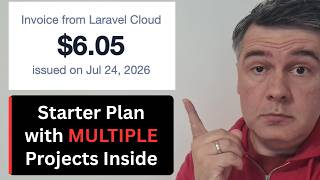
[00:16] a month new invoice for full month on the new starter plan and this is what I the new starter plan and this is what I received 605, which is $5 plus VAT for taxes and I have a few demo projects inside. So let me show you the breakdown
[00:31] what's inside of that invoice and what can you fit inside of that $5 starter plan, which is probably the most useful for hobbies, for hobby projects that don't get much attention or traffic. So for those cases Laravel Cloud is a
[00:46] really good option and let me show you. So currently on Laravel Cloud I have two projects, one for sending my newsletter and one for inspirational notes that I send to myself a few times per day. So it's basically internal projects without
[01:00] almost any traffic and this is why the sleep mode is enabled. So the last time the server actually woke up was a few days ago when I did send a newsletter. In case of my notes, it's not sleeping because 3 minutes ago it sent me an
[01:16] email with inspirational notes for today. I do it twice a day, so twice a day that server wakes up, does something and then goes to sleep after 5 minutes. And this is the whole idea of scale to zero, basically you pay only for active
[01:32] minutes and compute of your server, which now includes both web and database and recently they used PostgreSQL for a few months only with scale to zero. Now they launched MySQL as well, which is more popular in Laravel community. So on
[01:48] more popular in Laravel community. So on July 20th, this is the tweet. Now MySQL database also can automatically go to sleep. So this is my invoice and let's break it down. And by the way, side note, I'm not sponsored here. I do have
[02:01] sponsorships now on my channel, but I'm not sponsored by Laravel or Laravel Cloud. I'm just a user reporting from the field, so to speak. So, I paid $5 for the Cloud Starter plan. But, that Starter plan actually includes $5 off
[02:17] usage of compute. So, basically have those $5 to spend. And now, what did I actually spend? For those two projects, I have two so-called environment computes. So, two droplet servers, environments, whatever you call them.
[02:32] And this was the price per hour or per minute, some kind of unit, whatever. So, 12 cents I paid for one of the projects, the server, and 5 cents for another for
[02:44] the time that it woke up. When I actively worked on those, like sending a newsletter or when some queue job launched some artisan commands to send an email. In both cases, the server and the database woke up. Speaking of the
[02:57] database, this is the database cost, which is this amount of units in one case in PostgreSQL. At the time of creating those projects, PostgreSQL was
[03:09] the only option for automatic sleep, so I didn't use MySQL, but I would start initially. So, 40 cents for the database and for other database, basically I didn't pay anything. Or actually, it's
[03:22] PostgreSQL compute, so I paid for compute for server resources. Then, storage is so small that I didn't pay anything. And only now I notice that one storage is more expensive than the other. Probably I chose something when
[03:36] creating that server, that database cluster. But, yeah, so I spent this cluster. But, yeah, so I spent this amount of money over the full month. So, amount of money over the full month. So, this is the actual number I spent, 69
[03:49] cents on compute, storage, traffic, or whatever for the hobby projects. And they are deducted as free credits. Or actually, the math is a bit different actually, the math is a bit different with account and stuff, so 57 cents was
[04:03] what I actually spent because I calculated 40 + 5 + 12 = 57. So, this was my kind of subtotal, but then the deduction comes 57 + VAT deduction. But
[04:17] in a simple words, basically, if you don't exceed the $5 usage, you pay $5 plus taxes depending on your country. That's it. So, technically, on the same Laravel Cloud plan, I could add a few more demo projects or hobby projects,
[04:33] which I probably will actually. But yeah, the full month on this starter plan, and this is the proof that Laravel Cloud for storing, for example, your package websites, so you have Laravel package and you need to store the
[04:46] website somewhere, and that would not receive a lot of traffic, Laravel Cloud is a good candidate for that. And also, they keep releasing new features, so recently on Twitter, I saw this, a Laravel Cloud now includes secrets
[04:59] manager available in all plans, probably including starter, so you can read about secrets here as well. But also, I recently saw another tweet, another kind of success story by Stephen here who moved from Vapor to Cloud, basically
[05:14] from serverless, which Vapor is, to Cloud, and 65% drop. So, if you are a Cloud, and 65% drop. So, if you are a company owner or enterprise, you should also take a look at Laravel Cloud because I've seen quite a few success
[05:29] stories over the years of people saving money, organizations saving money with Laravel Cloud. Again, I don't get paid for this video, but I generally saw quite a few stories of saving the money with Laravel Cloud. Now, of course, with
[05:44] Cloud, there's a danger, a risk, and people pointed out in my YouTube comments that you exceed your plan and then you pay more. But with that starter plan they also introduced spending limits so you can add a limit at alert
[06:00] when you reach like 90% or 80% or something and at some point you may choose to not go over that budget like hard limit. So in my case I will receive alert on $5 and current spend is 4 cents. So if you have some kind of DDoS
[06:15] or something like that, you at least will get alert and maybe hard limit will help there. And bought traffic in general is a separate topic for future video probably for DevOps guys and network guys not for Laravel developers.
[06:31] But anyway, Laravel Cloud is a good starting point. That's the overall point of this video. I wanted to show my numbers. What do you guys think? Are you using Laravel Cloud or if not, what are you using? Maybe you plan to migrate to
[06:45] Laravel Cloud? Because one of the alternatives, this is kind of unrelated news but I saw on Twitter all over Twitter, Hetzner pricing is getting ridiculous and too expensive for new members for new servers. So yeah, if you
[06:58] are on Hetzner or any other actually place for like the cheapest server for hobby projects, just take a look at Laravel Cloud. Try it for a month and you will see how it works for your case. Again, I don't get paid. I keep
[07:12] of Laravel Cloud. What do you guys think? Let's discuss in the comments below. That's it for this time and see you guys in other videos.
⚡ Saved you 0h 07m reading this? Transcribe any YouTube video for free — no signup needed.