
Why Logs Make Exponential Curves Easy
45sThis segment introduces the practical use of logarithms in a relatable context (COVID-19 data), making the concept immediately relevant and engaging.
▶ Play Clip"The title 'Logarithm Fundamentals' is accurate and the video delivers a thorough, engaging lecture on the topic, exceeding expectations with interactive quizzes and real-world examples."
This video is a comprehensive lecture on logarithms, covering their definition, properties, and applications. The instructor explains how logarithms are used to handle multiplicative growth, using examples like the Richter scale and the COVID-19 pandemic. The lecture includes interactive quizzes and a final challenge problem to reinforce learning.
When data grows exponentially, a linear y-axis makes patterns hard to see. Using a logarithmic scale (multiplicative steps) makes trends clearer and helps project future values.
A logarithm answers the question: 'To what exponent must the base be raised to produce a given number?' For example, log base 10 of 1000 equals 3, because 10^3 = 1000.
Exponentiation, roots, and logarithms are three ways to express the same relationship. The inverse of 10^x is log base 10, while the inverse of x^10 is the 10th root.
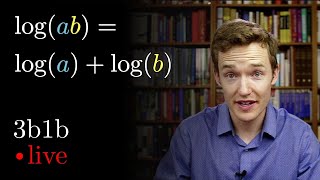
The log of a product is the sum of the logs: log(A*B) = log(A) + log(B). This is intuitive when thinking of logs as counting zeros in base 10.
The log of a number raised to a power is the power times the log: log(x^n) = n * log(x). This is because raising to a power multiplies the number of zeros.
Log base a of b equals 1 divided by log base b of a. This allows conversion between different bases, which is essential for computation.
There is no simple property for log(a + b). It does not simplify to log(a) + log(b) or any other combination. This is a common misconception.
The Richter scale is logarithmic: each integer increase corresponds to a 32-fold increase in energy. A magnitude 4 earthquake is 32 times more powerful than a magnitude 3.
The decibel scale is also logarithmic, where a 10-decibel increase corresponds to a 10-fold increase in sound intensity.
Since 2^10 ≈ 10^3, log base 10 of 2 is approximately 0.3. This approximation is useful for converting between base 2 and base 10 logs.
The change of base formula allows computing logs in any base using a calculator that only has one base (e.g., base 10 or natural log).
The sum of 1/log_base_n(100!) from n=2 to 100 simplifies to 1, using the change of base formula and the product rule.
Logarithms are a powerful tool for understanding multiplicative growth and are essential in various scientific fields. Mastering their properties and the change of base formula enables solving complex problems and interpreting logarithmic scales in real-world contexts.
What is the definition of a logarithm?
A logarithm answers: 'To what exponent must the base be raised to produce a given number?' For example, log base 10 of 1000 = 3 because 10^3 = 1000.
06:47
What is the inverse of 10^x?
The inverse is log base 10 of y.
12:55
What is the product rule for logarithms?
log(A*B) = log(A) + log(B).
23:35
What is the power rule for logarithms?
log(x^n) = n * log(x).
28:27
What is the change of base formula?
log_base_a(b) = 1 / log_base_b(a).
33:25
Does log(a + b) have a simple property?
No, there is no simple property for log(a + b). It does not simplify to log(a) + log(b) or any other combination.
41:30
What is the approximate value of log base 10 of 2?
Approximately 0.3, because 2^10 ≈ 10^3.
01:00:17
How does the Richter scale relate to energy?
Each integer increase on the Richter scale corresponds to a 32-fold increase in energy.
46:08
What is the decibel scale?
A logarithmic scale where a 10-decibel increase corresponds to a 10-fold increase in sound intensity.
52:43
What is the sum of 1/log_base_n(100!) from n=2 to 100?
The sum simplifies to 1.
01:24:22
Logarithmic Scales for Exponential Growth
Explains why logarithmic scales are essential for visualizing exponential data, a key concept in many fields.
01:31Definition of Logarithms
Provides a clear, foundational definition that underpins all subsequent learning.
06:47Product Rule for Logarithms
One of the most important properties, turning multiplication into addition, which simplifies many calculations.
23:35Real-World Application: Richter Scale
Demonstrates how logarithms are used in a real-world context, making the concept tangible.
46:08Change of Base Formula for Computation
Shows how to compute logarithms in any base, a practical skill for students and professionals.
01:12:08[00:00] ...
[01:00] you you you you you you you you you you you you you you you you you you you you you you
[01:12] you you you it ends up looking like this, you know, classic exponential curve that curves upward and I can sometimes make it hard to see
[01:31] where it's going or what the overall pattern is so a common trick is to say instead of
[01:44] looking at this y axis that increases linearly as in here I'm going from 5k to 10k,
[01:56] 10k to 15k, 15k to 20k each step is additive, we're adding 5000 instead use a y axis
[02:08] where each step is multiplicative so you're going from 10 to 100, 100 to 1000, 1000 to 10, 10,000 all of these are increases by multiplying by 10 and what you can say
[02:32] is the y axis is now plotting not the total number of cases but the logarithm of the
[02:44] total number of cases and this actually makes it kind of easier to see on a plot if you
[02:56] wanted to project out what that trend would do and, you know, it's a little bit of a naive model to say oh it's going to grow exactly exponentially but
[03:18] in the early phases of something like this that is what it is so I kind of fast forward
[03:30] in the animation I made for that video and what's interesting is if back then I think I
[03:43] posted it on March 6th if you just found a line of best fit and you stretched it out and
[03:55] you said when is that line going to cross a million which because the y axis is growing
[04:08] with multiplicative steps each time that you step up you're multiplying by 10 so even if
[04:20] it might seem like the 20,000 cases or so that it was back then is very far from a
[04:32] million you know when you understand logarithmic scales it actually didn't seem that far
[04:45] it was only 30 days away if you naively just drew out that line and in fact fast forward
[04:58] to around April 5th which is when that would have predicted we hit a million cases outside China that's pretty much the day that it happened I think plus or minus a day but
[05:22] I don't remember exactly but it was right in that neighborhood because I remember
[05:34] thinking wow it was kind of a naive model for the video to even use and it's shocking
[05:46] that it matched so exactly thankfully since then the growth has stopped being exponential
[05:59] so if you look at it on a logarithmic plot instead of going up in a straight line it
[06:11] starts to taper off but point being any time that you're coming across something in
[06:23] nature or even in a man-made construct where what's natural to think about are multiplicative increases logarithms come in to help you so let's go ahead and think about
[06:47] what these actually are how are they defined and actually there was a question asked on
[06:59] Twitter right before we started that I think hits this very perfectly so Max 182 asks us
[07:12] additions inverse is subtraction multiplications inverse is division but I never truly
[07:24] understood if exponentiations inverse was nth rooting or logarithms if either one could
[07:37] be you know if either one could really be called that way can they that is such a fantastic question Max and I think it comes down to the fact that with addition and
[08:00] multiplication you're not I'll just draw it out for you actually this is going to be
[08:12] easiest if we have some kind of exponential relationship let's say 10 to the power 3 is
[08:25] equal to 1000 there's three different numbers at play here we're showing a relationship
[08:37] between the 10, the 3 and the 1000 and aside from writing it with an exponent there's two
[08:50] other ways we could write that same relationship we could also say that the cube root of
[09:03] 1000 is equal to 10 this is asking 1000 what number raised to the third is equal to 1000
[09:15] that's sort of what the cube root is asking and another way that you could phrase the
[09:28] exact same thing is to say the log base 10 of 1000 is equal to 3 okay three different
[09:40] notations the same exact relationship a while ago I made this video about an alternate
[09:52] possible notation that would center in the idea that you think of this relationship
[10:04] between the three numbers with a triangle where you'd have our 10 sitting down here the
[10:17] power sitting at the top 10 to the third and the thing they equal sitting to the lower
[10:29] right and whenever you want to talk about a function or an operation between two of these
[10:42] numbers you indicate which one of them you're leaving out so to write 10 cubed we would
[10:54] include the 10 on the lower left the 3 on the upper right and then we leave out that
[11:06] bottom one so this is indicating that we're taking a power 10 cubed for that radical what
[11:19] you would say is we know what's on the bottom right something to some power equals 1000
[11:32] we even know what the power is something cubed equals that 1000 but the thing we don't
[11:44] know is on the bottom left that is the sense in which radicals are an opposite of
[11:56] exponentiation where if the thing you don't know instead of being on that bottom right is
[12:08] on the bottom left but what logarithms are it's an inverse in another sense because what
[12:21] it's saying is in this triangle relationship we know the base, it's 10 we know the power that it should be 1000 but the thing we don't know is what's in
[12:43] that exponent so to answer your question maybe even more briefly we could say that 10 to
[12:55] the x the inverse of that the inverse is the log base 10 you know, of y of some other variable whereas if you're taking x to the 10th some unknown raised to
[13:18] a power the inverse of that is going to be the 10th root of some other value and on the
[13:30] triangle it's basically asking which of the things do we consider to be a variable so are
[13:43] you considering that lower right to be a variable quantity are you considering that top
[13:56] to be a variable quantity and what is the unknown but I really liked this idea of making
[14:08] explicit how we have three totally different notations for the same exact fact one of
[14:20] them you're using relative positions of the numbers one of them we introduce a new symbol
[14:33] this radical and one of them we introduce a new word, log so these three syntactically different ways to communicate the same idea seemed wrong
[14:54] and so I made this video about an alternate possible notation and while I don't necessarily think that oh we should teach logarithms with this triangle because
[15:16] convention is what it is so it's better to start getting people used to the usual
[15:28] expression what I do like about it and starting off with it is when you see and think
[15:40] about this triangle it's really emphasizing that what the log wants to be is that
[15:52] exponent every time that you see log of some value you should think in your mind okay
[16:04] whatever this number is it really wants to be an exponent it wants to be an exponent and
[16:17] we'll see more of what that means as we go on okay so every time you see a log it wants
[16:29] to be an exponent this value three and more specifically it should be an exponent sitting
[16:42] on top of whatever that base is now in terms of convention for the first part of this
[16:54] video I'm just going to be using log without a base written on it to be the shorthand for
[17:07] log base 10 because log base 10 will be the most intuitive thing out there you should
[17:19] know that often in math the convention instead is that log without anything might mean
[17:32] log base e there's also another notation for that ln for natural log we're going to talk
[17:44] all about the natural log next time so don't worry too much about that right now and
[17:56] there's also yet another convention often if you're in a computer science setting log
[18:09] without any added sugar to indicate what it is defaults to meaning log base 2 so this can
[18:21] sometimes be a source of confusion but it basically depends on what discipline you're in
[18:34] in math, not moth, math people really like a base of e we'll see why next lecture in,
[18:46] I don't know, I'll say engineering but really it's anything where you want good intuition
[18:59] with our normal base 10 number system log means log base 10 and if you're curious often
[19:11] in computer science settings log base 2 comes up all the time so like I said,
[19:23] in the back of your mind if you're trying to think of some of these properties just resting on the idea that log counts the number of zeros at the end of a number that can
[19:47] get you a really far way so we're going to start going through a couple of these properties and I want to do this just with a set of practiced examples so we'll
[20:10] transition away from the poll and this time to the first proper question and the question
[20:23] asks you which of the following is true a. the log of 1000 times x is equal to 3 times the log of x and remember we're using the convention that it's base 10 log b.
[20:39] log of 1000 times x equals log of x cubed c. log of 1000 times x equals 3 plus the log of x d. log of 1000 times x equals 3 to the power of log of x and e.
[20:54] none of the above and remember like I said earlier we should fully expect that all of those people at the beginning who said they understand logs well they're going to be
[21:06] answering immediately, they're going to be answering correctly but if you're someone who doesn't, don't let that intimidate you when you're looking at a problem like this one
[21:19] what I would encourage you to do is just plug in various powers of 10 and think in terms of the idea that the log function counts the number of zeros so I'll give you a little
[21:31] moment to think about that great ok so I'll go ahead and grade it and as always if that's faster than what you're comfortable with know that it's only because I want to proceed
[21:43] forward with the lesson so in this case the correct answer comes out to be log of 1000 times x is the same as taking 3 plus the log of x and now let's think about that for a
[21:56] moment and like I said when you're just getting started with them I think the best thing to do is just be comfortable plugging in various numbers and the best numbers to plug in
[22:08] are the ones that are already powers of 10 so if you're asking something like log of 1000 times x well I don't know, let's just plug in something for x log of 1000 times 100 ok,
[22:21] well we know how many zeros are going to be in the final answer here well 1000 times 100 is 100,000 we already intuitively have this idea that when we multiply 2 powers of 10
[22:33] we're just taking the zeros, the 3 zeros from that 1000 the 2 zeros from that 100 and we're putting them next to each other so it should be 5 total zeros but if you really
[22:45] reflect not just on how did the number turn out but why did it turn out that way it was the 3 zeros from that 1000 plus the 2 zeros from that 100 which we could also write by
[22:58] saying the number of zeros in 1000 plus the number of zeros in 100 so this idea that a logarithm of the product of two things is the sum of the logarithms of those two things
[23:10] in the context of powers of 10 that's just communicating what's already a super intuitive idea for a lot of us if you take 2 powers of 10 and you multiply them you just take all
[23:23] of their zeros and kind of cram them onto each other so the way I've written things out here is actually indicative of a slightly more general fact which is going to be our very
[23:35] first property of logarithms which is that if we take the log of A times B it equals the log of A plus the log of B now anytime you see one of these logarithm rules if you find
[23:48] yourself squinting your eyes or you're a little bit confused by how to remember it just plug in examples I'm being redundant, I'm saying this a lot but it's because I think it's
[24:00] very easy to forget once you're swamped in the algebra itself and you're sitting on some kind of test and it's just got a lot of symbols to remind yourself you are okay to just
[24:13] plug in some numbers that's a fine thing to do and often it's a great way to yield intuition so in this case, saying log of A times B and breaking it apart we could just
[24:25] there's 5 zeros in it and it breaks up in terms of the number of zeros in each given part great, wonderful so carrying that intuition further,
[24:39] let's try another practice problem and again, if you know it, great, you'll be able to answer it fine but maybe think, not just what is the answer but how would I explain this answer to someone or how would
[24:53] I try to get a student to come to this answer on their own without me having to tell them what the answer is so there's two potential audience members there's those who are
[25:05] interested in the lesson itself and then those who are interested in the meta lesson so our question asks, again, which of the following is true A, log of x to the n is equal to log of x to the power n C,
[25:23] log of x to the n is equal to n plus log of x or D, log of x to the n is equal to log of n times log of x or none of the above so again, take a moment to answer as people do answer, we'll start to see them roll in and if you
[25:39] are struggling to think of where to even start just plug in some powers of 10 and see what intuition you might get from it you alright, so it looks like just about everybody is landing on one particular answer hopefully it's
[25:55] the right answer, like I said, all to be expected so let's go ahead and see if our majority ended up correct and they did so the correct answer here is A, which it looks like 4000 of you got congratulations,
[26:10] telling us that log of x to the power n is equal to n times log of x so again, let's say that you're trying to teach this to someone or if you're trying to come to grips with what it means yourself I think a fine place to start is plugging something in
[26:28] and in this case, for log of x to the power n let's just try it with 100 to the power 3 and you could try it with other ones to see if the patterns you're doing actually work
[26:40] but if you're thinking it through not in terms of simply seeing what the answer is but trying to think of why the answer turned out that way sometimes one example will do
[26:52] because 100 cubed, we can think of that as taking well, that's 3 copies of 100 I'm taking 3 copies of 100 and when I multiply all that out and I think of log as counting the number of zeros we say, oh,
[27:06] it's going to be some number that just has 6 zeros on it that's what it means to take 100 times 100 times 100 I can just think of grouping all of those zeros together to get a
[27:19] million so this number is going to be 6 but if we think actually why was it 6 not just that's the number of zeros inside the million where that 6 came from is that we had 3
[27:31] copies of that 100 and each of those 100 had 2 different zeros so that way it's a more general way you can think about it where if instead of taking 100 cubed we were looking
[27:44] at 1000 cubed or 1000 to the n or x to the power n you can think that it's whatever that value of n was the number of copies we were multiplying in times the number of, well let's see, it's not x times the number of zeros that were in whatever we substituted
[28:02] for x which in this case was 100 so if instead I had taken something like log of 10,000 to the power n this would be the same as taking n copies of that 10,000 counting the
[28:14] number of zeros in each one of them which is 4 so it would be n times 4 and of course the general property that most of you correctly answered is that you have this lovely little
[28:27] effect where when you see the log of something raised to a power that little power hops down in front of it and you just have log of what was on the inside now one of the maybe
[28:39] most important implications of that I don't know if you'd call it an implication or if you'd call it a restatement of the definition if I'm taking log, and I'll just re-emphasize it's base 10 of 10 to the power n we can kind of think of that
[28:56] little n as hopping down in front and it becomes n times the log base 10 of 10 which is of course 1 this expression you can think of as either counting the number of zeros at
[29:09] the end or more generally it's asking 10 to the what equals 10 and the answer is simply 1 which is very reassuring because another way that you could go back and just read this
[29:21] original expression is saying 10 to the what equals 10 to the n oh well the answer is n now with every given logarithm property that we have so in this case we just found one,
[29:34] log of x to the power n involves that n hopping in front there's always going to be a mirror image exponential property and that's another way that we can help to get ourselves a little bit of intuition for these so let me just cover up some of the future
[29:52] properties we're going to get to here try to hide where we're going what we just found, raising something to the n that hops in front this corresponds to the exponential
[30:04] property that if I take 10 to the x and raise that whole thing to the power n that's the same as taking 10 to the n times x and this gets us to another intuition that you might
[30:16] have for logarithms which is they kind of, they're like exponentiation turned inside out and here's what I mean by that the thing sitting on the inside of the log,
[30:28] if I'm taking log of a you should be thinking of that as the whole outer expression for something that's exponential in this case the a, the thing on the inside, corresponds to 10 to the x the output of the function whereas the entire thing itself,
[30:45] the log of a corresponds to what's on the inside over here just what's the exponent of you should be thinking that plays the role of an exponent on the right side and every
[31:01] time you see an exponential the entire 10 to the x expression, the whole outer component on the right side that corresponds to something that's sitting on the inside of one of the logs and we saw this above,
[31:16] right the idea that when we're multiplying on the inside, that's adding on the outside well if logs kind of turn exponentials inside out that's telling us that multiplying on the outside, multiplying the outputs of the function is
[31:32] the same as adding on the inside because each of these logs, like log a and log b is playing the role of the x and the y in the expression on the right okay, so with that, let's keep playing let's just do a couple more of these and see
[31:49] how many of these properties that we can build up an intuition for so this last one, very nice, thinking of exponents hopping down the next one is something that might look
[32:01] a little bit weird to those who are not necessarily familiar with logarithms but again, plug in some numbers to gain some intuition for it and we'll give it a little bit more,
[32:13] a moment to pull up which of the following is true? log base a of b is negative log base b of a log base a of b is 1 divided by log base b
[32:27] of a log base a of b is 1 minus log base b of a log base b of a is log base a of 1 divided by b or none of the above so it's asking what happens when we swap the base with
[32:47] what's sitting inside of the logarithm and I'll just give you a minute or two to answer that so let's do a couple more okay, so it seems like answers have kind of stabilized
[33:08] out there so let's go ahead and grade things and in this case, the correct answer of the choices we have comes out to be b that the log base a of b
[33:25] involves taking 1 divided by the log base b of a again, let's think this through both in terms of an example and then in terms of a more proofy,
[33:42] systematic reason why it should be true so if we're swapping our bases let's just start off with our good old friend log base 10 and let's plug in a nice power of 10 like 1000
[34:02] counting the number of zeros, we get 3 so let's try swapping the bases and see what this should mean log base 1000 of 10 okay, well what is this asking?
[34:21] maybe you think of drawing the little triangle saying something like we know 1000 to something is equal to 10 1000 to the what equals 10?
[34:33] well, if 10 cubed is 1000 that is the same thing as saying 10 is equal to 1000 raised to the 1 third doing the inverse here involves the multiplicative inverse of the
[34:46] exponent and the way that pans out is that it looks like 1 divided by 3 and that 3 corresponds to the log base 10 of 1000 it's 1 divided by the log base 10 of 1000 so
[35:00] more generally, you might guess based on this single example that when we swap the base with what's on the inside it corresponds to taking 1 divided by what's on the
[35:14] outside there and again, you can think this through in terms of looking at the corresponding exponential rule now what happened to my lovely little log and exponentials?
[35:28] wonderful so, again let's hide where some of the things some of the other properties that we'll get to here and I'll keep it in the same order I had it before here I was thinking that having it pre-written could keep me a little bit cleaner than usual but
[35:44] maybe it just involves playing this weird game of paper cutting shuffling around so what it's the same as dividing by 1 what this corresponds to,
[35:56] off an exponential land is if you take b to some power and say that that equals a that's the same statement as saying that a to the inverse of that power equals b again, it's kind of helpful to take a moment and think of the logarithms as turning things
[36:12] inside out the expression log base b of a is playing the role of that x and the expression log base a of b is playing the role of whatever sits on top of the a and then symmetrically, the whole expression b to the power x is playing the role of the inside
[36:28] on the left, it plays the role of the a and the whole expression, a to the power of something plays the role of what's sitting inside the log base a there so you can see just by plugging in some examples and by corresponding it to the
[36:43] exponential rules we can already think through three different logarithm rules which if they were just handed down as pieces of algebra to be memorized you know, you could memorize them but it's very easy for them to kind of slip out of your head
[36:59] and it's also very easy to get frustrated by the task at hand but you might want to remind yourself that the reason we care about these sorts of things is understanding the rules of logarithms helps us do math in contexts where it's like a virus growing
[37:15] things tend to grow multiplicatively understanding the rules of logarithms helps you to get a better feel for that kind of stuff so before we do a nice real world example of
[37:29] what that can look like let me just do one more quiz question in this vein to ask about properties of logarithms one last one before we transition to a little bit of a real world example get rid of what we had here and now, which of the following is true?
[37:46] log of a plus b is the same as log of a plus log of b log of a plus b is equal to log of a times log of b log of a plus b is equal to one divided by log of a plus log of b or log of a plus b is equal to one divided by log of a times
[38:03] log of b or none of the above ah, and now we don't have as much consensus, do we? very interesting we've got a horse race between two so I will give you a moment
[38:20] to think this through while people are answering actually I have a little question for the audience so you know I was just talking about how we might think in terms
[38:41] of multiplicative growth and that doesn't just have to be powers of 10 we could also do something like powers of 3 or if you're going from 1 to 3 to 9 to 27 to
[39:02] 81 all of these we could say that the log base 3 of these numbers just grows in nice little steps so log base 3 of 1, 3 to the what equals 1? the answer is 0
[39:23] Log base 3 of 3, 3 to the what equals 3 is 1 Similarly log base 3 of 9 is 2 You might wonder what my question is,
[39:36] but it'll help to draw all of these out and For my own pleasure here. Let me just write out one more log base 3 of 81 is 4. Now I've heard that ostensibly if you ask a child's let's say
[39:49] around like 5 or 6 years old What number is halfway between 1 and 9? Okay, you say what number is halfway? Their instincts for how to answer are Logarithmic whereas our instincts tend to be more
[40:04] linear So we often think 1 and 9 you've got a bunch of evenly spaced numbers between them 2, 3, 4, 5, 6, 7, 8 And if you go right halfway in between you'll land on 5 But if you're thinking in terms of multiplicative growth where to get from 1 to 9 It's not
[40:19] a matter of adding a bunch of things But you're growing by a certain amount you grow by a factor of 3 then you grow by another factor of 3 supposedly a kid's natural instinct lines up with saying 3 and supposedly this also lines up with If you have anthropologists
[40:34] studying societies that haven't developed Counting systems and writing in the same way that modern societies have they'll answer 3 for this So my question for the audience if any of you watching right now have access to a small child Let's say in the range
[40:49] of 5 years old See if you can go ask them What number is halfway between 1 and 9 and if you can let us know on Twitter what the What the child says what their actual answer skeptical of whether that Actually pans out in practice.
[41:05] I understand this is not a super scientific way to do it asking people watching a YouTube live stream to Survey their own children and then tweet the answer but for my own sake it would be interesting to see some kind of validation there Back to our
[41:18] This is the first one that doesn't seem to have a huge Consensus in one direction, but let's go ahead and grade it to see what the answer turns out to be Great okay,
[41:30] so 2400 of you correctly answered that it's none of the above okay that log of a plus B doesn't satisfy any of these nice properties And in general unless we're going to be working with Certain kinds of approximations especially when the natural log comes into
[41:47] play we might talk about this next time Adding the inputs of a logarithm is actually a very weird sensation It's a very weird thing to do and to get a sense of that weirdness plug in some powers of 10 If I ask you log of a plus B What you might start thinking
[42:04] Let me just plug in some examples like 10,000 and 100 and I asked myself if I do this zero counting function of what's in that input how many zeros are in it?
[42:19] we're no longer at a clean power of 10 and okay That's fine. You know often you're taking logarithms of things that aren't clean
[42:32] powers of 10 but it becomes very strange to ask how you express this in terms of log of 100 which was 2 and log of 10,000 Which was 4?
[42:45] because if you look at log of 10,100 it's asking 10 to the what is equal to 10,100 you might say, I don't know, it's going to be a little above 4 because it's kind of close to 10,000 so the best you might guess here is oh this is going to be something
[43:02] That's kind of like The log of 10,000, but that just feels like a coincidence based on the two numbers that we happen to put in There's not a nice systematic reason coming there, so maybe you guess oh if the numbers A and B are very different It's kind of close
[43:17] to Whatever the maximum of them is But it's very bizarre and most importantly for the sake of the quiz If you just look at the options that it's giving you if you try this out with any particular numbers You'll find that none of those actually work So all is good
[43:31] sometimes you get something that looks like it's going to be a nice property But it doesn't end up being a nice property, and I also think that's important rather than just finding yourself Only working with the various You know log of A times B or log of X to
[43:46] the power N these things that have a nice rule Sometimes you're out in the mathematical wild you're working on some problem You have a logarithm expression And it's adding things in the input and you want to be able to Have familiarity with the fact that that's
[44:00] kind of weird that you're not going to be able to simplify But if you you know if you hadn't thought about that before you might wonder Oh is there just some formula that I haven't seen before So with all of that let me go ahead and take a couple questions from
[44:15] the audience Before we transition to a different sort of example So it looks like Uma That's an interesting question okay? Well in terms of our triangle we might think of that as saying You know zero to
[44:32] some kind of power X is equal to some other value Y Right this is something that we could write either by saying zero to the X equals Y Or we could write the
[44:44] same thing by saying log base zero of Y Is equal to X zero to the what equals X? Now the issue here is that zero to anything ends up being zero right so?
[44:56] If we're just going to be thinking of log base zero of Y for any other input Y. You know you want to input something like one or two or pi Anything you might
[45:09] want you're asking the question zero to the what is equal to one or two or pi? Or whatever number you might have there, and there's just not going to be an answer so at best You could try to say oh yes log of zero.
[45:25] but even then you'd have trouble Trying to finagle what you want there because saying zero to the what equals zero. It's like anything anything applies to it So your arm is going to be twisted
[45:39] behind your back However you want to make that work and it corresponds to the fact that the exponential function with base zero Is entirely zero it doesn't it doesn't map numbers in a nice one-to-one fashion on to each other?
[45:55] So that's a great question can you have a log base zero now back to the idea of where these things come up in the real world One one example I kind of like is the Richter scale for earthquakes so the
[46:08] Richter scale Gives us a quantification for how strong an earthquake is okay? numbers like I think the largest earthquake ever measured And this
[46:20] is just a chart that comes from Wikipedia was a nine point five okay? And to appreciate just how insane that is it's worth looking at the relationship between What these numbers mean and then something like the equivalent amount of
[46:34] TNT some sort of measure of how much energy there is in it And then what we can try to do here is see if we can get an expression for the Richter scale number in terms of the amount of energy and Why logarithms would be a natural way to describe this?
[46:49] So the key to focus on is as we're taking steps forward how much do things increase? So for example if we go from two Well in this case it doesn't show us where three is so maybe we think of Taking a step from two up to four which is kind
[47:02] of like taking two steps What does that do in terms of the amount of energy? Well it looks like it takes us from one metric ton of TNT Which is I guess a large bomb from World War two and it takes us up to a kiloton a thousand times
[47:16] as much Okay Which is a small a small atom bomb so just two steps on the Richter scale Going from an earthquake of magnitude two to an earthquake of magnitude four takes us from large bomb from World War two Up to the nuclear age, right?
[47:30] so that is noteworthy and The first clean step that we get is going from four to five at least in terms of what this chart is nicely showing us And evidently a single step up from four to five Corresponds to going from one kiloton to
[47:44] 32 kilotons And that was evidently the size of the city destroying bomb that land on Nagasaki So this is maybe one thing that can be counterintuitive about logarithmic scales if you're just hearing in the news the difference between
[47:59] oh there Was an earthquake that was a 4.0 versus an earthquake that was a 5.0. It's easy to think yeah four and five Those are pretty similar numbers But evidently in terms of TNT amounts that corresponds to multiplying by 32 to get from one to the
[48:14] next And going from two to four was evidently multiplying by about a thousand okay, and the only reason that's bigger is because here our chart wasn't showing what three was so we were taking two steps and You can verify for yourself that if you take a
[48:29] step of 32, and then you multiply by another 32 That's actually pretty close to a thousand So the idea that additive steps on the Richter number correspond to multiplicative steps in the TNT Seems to suggest that something logarithmic is at play
[48:44] here, and it's a little interesting to just keep going here and say How how much does Because of the the world phenomena. Yes, not a huge surprise that as we take another step It's
[48:58] multiplying by about 32 again But raining that in to our intuitions. That's the difference between 32 kilotons a small atom bomb And then one megaton which we might think of as not small atom bomb Nagasaki atom bomb Which I guess
[49:14] is 32 of the Nagasaki atom bombs For one megaton that is evidently the magnitude of the double string flat earthquake in Nevada, USA 1994 I didn't know what that was. Thanks Wikipedia in terms of frequencies by the way I Also looked these up
[49:29] evidently ones that are less than two those happen all the time There's like 8,000 of those per day, but as soon as we're in the realm of atom bombs things like 3.5 and 4 Those evidently also happen quite frequently somewhere on the earth.
[49:44] There's around 134 of those happening somewhere every day who knew But as we get even more intense into this 5 and 6 range which you know we're well above the atom bomb scale now we're only merely at around 2 per day and You know I'm sure that a geologist could
[50:00] come in and explain why we all shouldn't be super worried about the fact that there's two atom bomb equivalent Disruptions to the Earth's crust happening every day, but presumably it's particularly rare for those to be concentrated on some Some spot like
[50:16] a city where what lots of people live Now just verifying that I thought that each step involves a growth of 32 Let's look at what the step from 6 up to 7 looks like and here It's giving us lots more examples in between maybe giving the illusion that that's a
[50:32] bigger step than it actually is and indeed That's the difference between 1 megaton and 32 megatons, so that's multiplying by 32 One of the things I found most interesting on this chart by the way was Look at how far we have to go before we get to the largest
[50:48] nuclear weapon that's ever actually been Tested This was height of the Cold War the Tsar bomb That was 50 megatons, and I believe they actually had original plans to have a 100 megaton bomb but talked themselves down from that 50 megatons we're talking start off at
[51:05] that 32 kilotons of the Nagasaki bomb Multiply by 32 to get a megaton multiply by another 32 Right so we're talking about a thousand times the strength of the World War two ending explosion And you're still not at the 50 megatons of what humanity is capable of And that
[51:21] is evidently you know the Java earthquake of Indonesia so 7.0 is not just a little bit It's a lot bigger and The point here of course is just that when you have a scale giving
[51:33] you multiplicative increases It's worth appreciating that what look like small steps Can actually be huge steps in terms of the energy implied or the absolute values implied here So it I mean when we're thinking about the fact that there was ever a 9.5 That
[51:47] actually seems absurd given that it's only in the 7.0 range that we're talking about the largest thermonuclear weapon ever put out And this is indicative of one area where logarithms tend to come about it's When humans want to create a scale for something
[52:01] that accounts for a hugely wide variance in how big things can be So in the case of size of earthquakes you can have things from what happens Just all the time around the earth the size of a large hand grenade And you want that to be on your scale and
[52:14] something to think about ranging all the way up to you know the largest disruption that we've Seen in human history right and in order to have that in a way that you're not just Writing a whole bunch of different digits in your numbers for one case and a whole
[52:29] bunch of different a smaller number of digits For your number in another case It's nice to take logarithms And then just put that on a single scale that basically puts squishes those numbers between 0 and 10 You see something very similar going on with the decibel
[52:43] scale for music that one actually Works a little bit differently where every time you take a step up of 10 decibels that corresponds to multi multiplying by 10 So rather than a step of 1 multiplying by 10 It's a step of 10 that multiplies by 10 so that kind
[52:57] of makes the math of it a little bit screwy But the idea is the same that if you're listening to a sound that's 50 decibels for 60 decibels It's a lot quieter in terms of the energy being transmitted and going from you know What would it be 60 to 70 or 70
[53:11] Those steps you know from 60 up to 80 that involves multiplying the amount of energy per square area By a factor of 100 so every time you see a logarithmic scale Know in your
[53:23] mind that that means whatever it's referring to under the hood grows by a huge amount This is again why we saw a lot of logarithmic scales used to describe the coronavirus outbreak so How might you describe a relationship like this where every time you grow the
[53:39] we could think in terms of a log with base 32. I Could say if I take the log of I'm just gonna call our the number for the Richter scale.
[53:54] I might think of this as log base 32 and That's going to correspond to No, no, no, I'm doing this wrong That's not the thing that's logged We take the log
[54:07] base 32 of the big number of the the TNT number something that was like You know one Gigaton or one megaton It's one million Tons The log base 32 that
[54:20] should correspond to the Richter scale number But there might be some kind of offset. we're adding to this Richter scale number and this expression
[54:35] is exactly the same Excuse me for going off the bottom there. This expression is exactly the same as saying 32 to the power of some offset times our Richter scale number, which is the same as taking you know 32 to that offset which
[54:50] itself is just some big constant times 32 to the Richter scale number so you might think of this as just being some constant Times 32 to the power of the number you see
[55:02] So this way of writing it really emphasizes the exponential growth of it that if this is what corresponds to the TNT amount that you see as You increase that R step by step you're multiplying by 32 But another way of communicating the exact same fact is to
[55:19] take the log base 32 of whatever that amount is Alright now the next thing I want to talk about is how we don't always have to Worry about how to compute logs of different bases and it's a little weird here that we were talking about log base 32 I referenced
[55:36] earlier how mathematicians really like to have a log with base e computer scientists really like to have a log with base 2 and it turns out for Computational purposes or
[55:48] for also thinking about how these things grow if you have one Log if you're able to compute one type of log whether that's base 10 base 2 base e you can compute pretty much anything else That you want Okay now to get our intuitions in that direction,
[56:05] let's turn back to our quiz and go to the next question and I believe that this question This should be nice This is just going to get us prepared to translate from base 2
[56:20] contexts to base 10 contexts and it's also a good intuition for understanding powers of 2 to have in general The relationship that it has with powers of 10 because it's this lovely kind of coincidence of nature that these two sort of Well,
[56:36] they play nicely with each other so our question asks, given the fact that 2 to the 10th is 1024, 1024 which is approximately 1000, okay,
[56:48] so you can if you're being a little bit loose with your numbers and you're just making approximations 2 to the 10th, basically 1000, which of the following is closest to being
[57:01] true? log base 2 of 10 is approximately 0.3 log base 2 of 10 is approximately, sorry, log base 10 of 2 is approximately 0.3 log base 2 of 10 is approximately 1 third or log
[57:14] base 10 of 2 is approximately 1 third okay, which of these is closest to being true based on the fact that 2 to the 10th is essentially 1000? I'll give you a little moment for that log base 2 of 10 is approximately 0.3 interesting
[57:31] that we've got kind of a split on this one so I'm wondering if they're going to be numerically pretty similar or if they're going to be conceptually similar or if there's
[57:44] even a difference between those two so since answers keep rolling in, I'm going to give this a little bit more time so anyone at home watching, hopefully you already have a pencil and paper out to be noodling through these yourself,
[58:02] that is the spirit of the lectures that we're doing if you don't, now is the time to take out a pencil and paper and see if you can think this one through and write it out some of the problems that we're going to build to here definitely will
[58:20] require pencil and paper so now is as good a time as any and if you're watching this in the future, even if you can't participate in the live poll I really do think it's a lot of fun to kind of throw your own hat into the mix even
[58:43] if it's not going to contribute to one of the numbers that you see growing on the
[58:55] screen I'll give you a little bit more time here as the answers seem to continue
[59:07] rolling in so now is the time to take out your pencil and paper and write it out so
[59:19] now is the time to write your own paper and write it out so now is the time to write
[59:31] your own paper and write it out so now is the time to write your own paper and write
[59:43] it out so now is the time to write your own paper and write it out so now is the time
[59:56] to write your own paper And then I'm ready to move on to the google Okay, so I'll go ahead and grade it now and let's see how people did on this one.
[1:00:17] So the correct answer is B, Which is that the log base 10 of 2 is around 1 third so that's good They're very numerically similar right that It's either 0.3 or around 1 third which is 0.3 3 3 3
[1:00:30] repeating But the question was asking which one is closest to being true, and let's see how we can think about this so It points out that you have a power of 2 which is 1024 awfully close to a power of 10 about 10 cubed and the question is how we
[1:00:44] can leverage this to understand something like Log base 2 of 10 or log base 10 of 2 as we saw earlier those are just the reciprocals of each other So what does this mean if It's asking us 2 to the what equals 10 So what we have here is an
[1:01:00] expression 10 cubed is approximately equal to 2 to the 10th so what I might write out is we know that 2 to the 10th Instead of writing it as a 10. I'm going to write that 10 as 2 to the X Where X is the
[1:01:16] number such that 2 to the X is approximate is equal to 10? So if that cubed is the same as 2 to the 10th This is I'll just write out the full details the same as saying 2 to the 3 X is equal to 2 to the 10th
[1:01:30] so it's okay to just Say whatever is going on in the input if the outputs are the same the inputs must also be the same You can't do that with every
[1:01:42] function people seem to think you can do that with any function But you just can't and what that means is that? X is about X is about 10 thirds, okay which Ah Great so log base 2 of 10 is about 10
[1:01:58] thirds, so if we looked at our answers though That's not actually any of the options. We've got various things asking log base 2 of 10 being around 0.3 or 1 third so it
[1:02:13] looks like instead we should try to re-express this as log base 10 of 2 and Well enough what we saw earlier is that log base 2 of 10 we could also say log base 10 of 2 is Just
[1:02:26] 1 over that amount 1 over X and you can see this pretty easily by writing 2 is equal to 10 to the 1 over X if we're asking 10 to the what equals 2 the answer is 1 over what
[1:02:40] we just got there, so Log base 10 of 2 is 1 divided by this amount Which is 3 tenths? Which is 0.3 great So this is kind of a nice constant to think about because there's this wonderful pattern that happens when
[1:02:55] we're looking at powers of 2 so if I ask What is the log base 2 of? 1,000 Like we just saw it's approximately the case that 2 to the power 10 Is equal to a thousand and because we're doing things at logs I'm just going to be writing
[1:03:12] it in that way a log 2 of a thousand is approximately 10 Similarly log base 2 of a million Well, let's see if we have to multiply 2 by itself about 10 times to get to a thousand we should have to multiply it by itself around 20 times to get
[1:03:27] up to a million and Indeed log base 2 of a million is approximately 20 It's a little bit smaller, but this is kind of a nice approximation to have in your mind And then similarly you'll see why I'm writing out this as a pattern in just a
[1:03:42] moment if we wanted to go up to a billion Saying how many times do I have to multiply 2 by itself to get to a billion This is about 30 And any computer scientist out there who's thought about you know just how much as a kilobyte or a megabyte
[1:03:58] they'll be familiar with the idea that powers of 2 are nice and close to Now what I want to do is just write all of the same things with log base 10,
[1:04:10] not approximately equal to, this is actually equal to 3. what's log base 10 of a million? It's equal to 3 Log base 10 well you tell me what's log base 10 of a million It's
[1:04:25] counting the number of zeros it ends up being about 6 and log base 10 of a billion Counting the number of zeros it ends up being 9 Now the reason I wanted to write all of this out is to just emphasize an interesting pattern here Which is we're just growing
[1:04:41] by these increments right as we go from a thousand to a million to a billion with log base 2 We're stepping up by steps of 10 But when we're playing the same game with 10
[1:04:53] we're stepping up by these increments of 3 So there's this nice relationship and in fact for all of them to go from log base 2 to log base 10 It seems like we're just multiplying So 10 times 0.3 is 3 20 we scale down by that same amount 30 we
[1:05:11] scale down by that same amount Okay now this is an intuition worth remembering if you have Your numbers described with one base.
[1:05:23] but there's some rescaling constant Okay, and then the next question is going to start getting us at that direction But it's going to be framed in a way that just
[1:05:36] looks like a whole pile of algebra And again, I will encourage you to plug in numbers if you want to to gain a little intuition for it So as our third to last question, this will be a long lecture We have which of the following is true and
[1:05:49] then just a whole pile of Various possible ways to combine log base C of B times log base C of A Does that equal log base B log base B of A and rather than me I'll just let you look through them plug in some numbers I'll give you I'll
[1:06:07] give you a meaningful time on this one because it's not it's not obvious unless you're already familiar with logarithms and It's worth thinking through
[1:06:20] a little bit You We have an outstanding question from the audience Which is does the bar length of the pole use some kind of log function and healthily?
[1:06:34] It looks like Ben Eater has gone ahead and directly answered in the form of the code involved where the chart max is mapped up is the raising 2 to the power of a Ceiling of a log base 2 of the maximum attempt count which I think is to say unraveling If
[1:06:51] you're looking at the maximum number I'm not I'm not great at Vanna whiting this thing if you look at the maximum number in our poll It's asking what's the log base 2 of that?
[1:07:03] so as it crosses different powers of 2 then that rescales it and Yes, yes is the answer what a fantastically apropos question Thank You Karen All right,
[1:07:25] so answers are still rolling in and I think like I said I just want to give you
[1:07:37] some more time to think this through because it's looks like a big pile of algebra
[1:07:50] plug in some numbers to see what seems to work well and See which answer fits You
[1:08:02] You You Okay, so even if you are still thinking about it I'm gonna go ahead and
[1:08:14] grade it here and then start talking about Why it's true and then also why we should
[1:08:27] care why this is an operation that actually tells us something so the correct answer
[1:08:39] which it looks like around 1700 of you got congratulations is Log base C of B times
[1:08:52] log base B of A is equal to log base C of A great Now that's just a big ol pile of things.
[1:09:06] Now phase one, like I said, we might plug in an example, but let's try to actually think about why the example holds. So let me Pull out we've got this as one more of the log rules This is just
[1:09:20] repeating the end what the correct answer turned out to be where we've got an expression for Log base C of B log base B of A and this ends up being log base C of A It's gotten rid of the B's which is kind of interesting so Some examples
[1:09:36] you might plug in here would be things like let's use a different color. Let's use green Instead of C. I'm gonna go ahead and plug in 10 Log base 10 of 100 which is kind of asking
[1:09:52] how many times does 10 go into a 100 in a multiplicative sense how many times do I multiply 10 by itself to get to 100 where the answer is 2 and then log of 100 of Let's plug in another power of 10 It'll be nice if it's also a power of
[1:10:08] 100 So I'll do a million So This one is asking 10 to 100 to the what equals a million How many times do I multiply a hundred by itself to get to a million? Phrasing the same thing 10 different ways now the claim is that this is
[1:10:27] the same thing as taking log base 10 of a million That if I ask how many times does 10 go into 100 and how many times does 100 go into a million? Multiplying those should give me the answer to how many times 10 goes into a million
[1:10:44] now just checking the numbers this certainly works 10 goes into a hundred two times 100 goes into a million three times in a multiplicative sense in that a hundred
[1:10:57] cubed is equal to a million and Indeed how many times does 10 go into a million? well six Now we could think of this property in terms of the corresponding
[1:11:09] exponent rule which is going to look a little bit stranger But it's actually just saying the entirely the same thing So here we're if we have a base of C and a base of B And we're trying to relate those to each other the whole statement
[1:11:24] is equal to saying that um suppose that B to the X is equal to a Got some number B. It's also the case that C to the Y equals B. Those two together are the same as saying C to the XY equals a Now that's kind
[1:11:39] of a mouthful to say out loud But if you plug in some numbers to translate what all of that is really saying in the context of the example we just did Saying if you can write a hundred is ten squared and if you can write a million as a
[1:11:52] hundred cubed Well that lets you write a million in terms of a power of ten Okay, so sort of asking this question How many times does one number go into another? but letting you layer it on top of each other. Now if we rearrange that expression,
[1:12:08] we get what is probably the second most important of all of our log rules. The most important is this top one, that when you multiply the inputs, which is known as the change of base formula, lets us write that if you want the log base
[1:12:26] it doesn't actually matter what log you have in your pocket. If you use that other log, and you take the log c of a, divided by the log c of b, that gives you log base b of a.
[1:12:40] is let's say I wanted to be able to compute log base 100 of things. I just really want to. It's not a button on my calculator, but I would love to be able to do it.
[1:12:53] Well even if I don't have the log base 100 button on my calculator, what I can do is say I'll use the log base 10 button and evaluate what's on the inside
[1:13:06] here, which at least positionally it's kind of above the 100. It has a higher altitude as we write it. So this can line up with the notation a little I use the log base 10 button that's in my calculator on the base, on the 100.
[1:13:23] And then I can evaluate both of those and it'll give me the answer. In this case it gets you 6 divided by 2, which will be 3. I know I've said it many different times, but it's a convoluted enough way to write
[1:13:39] things, but an intuitive enough fact that I think just coming at it from a bunch of this is probably the second most important log rule.
[1:13:51] We're asking how many times does 100 go into a million? In a multiplicative sense, But division is asking that same question in an additive
[1:14:03] Log of a million that's what division means it's saying how many times do I add this bottom number to itself to get to the top? But anything additive in the logarithm realm is the same as anything multiplicative
[1:14:17] in terms of what's inside the parentheses So both of the left-handed side and the right-hand side are just saying how many times does 100 go into a million? but going about that in different ways. So this is extremely nice because it
[1:14:29] actually lets us compute things. Next time we're going to talk all about the natural logarithm, which is log base e, often written ln. And turns out, this is much easier to compute. There's nice math behind it such that if you want
[1:14:42] it's actually a lot easier to think of log base e of numbers. I don't know let's say we popped over to something like Desmos Always happy to have
[1:14:57] as a friend, and you wanted to compute log base 10 of Some number you know let's say we're doing log base 10 of 57 and it looks like that's you know it should make sense. It's between 1 and 2 because 57 was between 10 and 100 What's going on under the hood?
[1:15:14] It's going to use somewhere in there a change of base formula Which is going to be that the natural log of 57 divided by the natural log of 10 is the same thing These are two different ways of writing it so if you know one logarithm.
[1:15:29] let's just use that fact to answer one more of our quiz questions And this will be the second to last quiz question, so thank you all for sticking it through I think we will be
[1:15:43] I Think you'll be pleased by the last question because the last question will actually be like a fun Problem-solving puzzle II thing and it'll involve a lot of what we've used up to this point kind of a culminating thing So before that though just to make sure that
[1:15:59] What do we have? Use the approximation that log base 2 of 10 is around 10 thirds so using that approximation Which of the following is approximately true?
[1:16:13] Log base 2 of X is about 10 thirds of log base 10 of X Log base 2 of X is log base 10 of 10 thirds of X log base 2 of X is log base 10 of X to the power 10 thirds or Log base 2 of X is 10 thirds times the log base 10 of X and finally
[1:16:29] none of the above So I'll give you a moment to think about that you might want to think to the chart that we were drawing earlier and thinking about log base 2 and log base 10 as we're looking at powers of 1000 and how each of those
[1:16:44] grows that can leverage some of The intuition but I'll let you think about it. Stop talking You While answers are rolling in it looks like a number of
[1:17:03] people have been asking on Twitter about Basically how complex numbers play
[1:17:17] into this so you know we've got Jamil asking What if the base is imaginary?
[1:17:31] Wouldn't z to the x is walking around the spiral? Wouldn't it hit every complex number? Well, it won't hit every complex number. But your instinct that it's hitting multiple things is pretty spot on. Doesn't make sense to talk about logs with imaginary numbers
[1:17:47] It's actually a very Nuanced question the short answer is yes complex logarithms absolutely exist But each one of them has multiple different outputs so a good a good analogy here is how?
[1:18:03] If we have the square root function if I ask something like the square root of 5 You know we have the convention that you always do the positive amount, but that doesn't quite feel honest It feels like the right answer is to specify
[1:18:17] that there's two different outputs for the square root function two solutions to x squared equals 25 And this is actually true in complex numbers as well one of the things we talked about in a complex number lecture Was that you can
[1:18:31] take the square root of I and you actually get root 2 over 2 plus root 2 over 2 I? But that there's two solutions you can do plus or minus this value and so you could but it's a multi-valued function It always has two different outputs now something
[1:18:48] funky happens when we have exponents at play So if you're just like someone who We talked about it in previous lectures I'm obviously jumping around on the complexity level a lot here where if in lecture 5 I'm talking about Like
[1:19:02] plays into physics and then lecture 6 We're back to the basics of logarithms. I acknowledge that might be a little bit jarring to potential audience members,
[1:19:16] but just continuing on with the answer if you note that e to the 2 pi times you know some number times I This basically walks you around a circle so that the output will Walk
[1:19:29] around a circle and just keep repeating as n goes from 0 up to 1 It'll walk around one cycle and end up back where you started as n goes from 1 to 2 You'll end up back where
[1:19:43] you started so for example e to the 0 sits here e to the I pi Is at negative 1 but e to also at 1 same with Excuse me same with e to the 4 pi I that also Equals 1
[1:20:02] so in general if you wanted to ask something like what is the log base e of 1? You know on the one hand we want to say the log of Log base anything of 1 should
[1:20:18] be 0 because anything to the power 0 equals that 1 But if we're letting complex numbers into the mix you would have to honestly say well 2 pi I is another pretty good answer to this question because e to the 2 pi I also equals 1 and Same with
[1:20:33] 4 pi I and you could even go in the negative direction and in general n times pi Times 2 times I kind of wrote that in a weird order for any integer in Feels like a valid answer to this question So there's a couple ways that you can deal with
[1:20:49] that in math and before we get back to our usual lesson Just on logarithm rules. I kind of want to pull it up Let's see what if we have complex logarithm
[1:21:01] uh Great Wikipedia always to our aid probably it'll have a nice like visual of some kind for us look such fancy color diagrams What I want okay. Let's zoom out a little bit Great, so there's this notion of what's called a Riemann
[1:21:19] surface That's basically trying to capture the idea that you have a function with multiple outputs and intuitively Maybe you can understand what it's getting at where the input would be something on the XY plane and the output There's just many different
[1:21:35] outputs sitting there so when you have a complex logarithm you have to account for that, but it's used It's actually a very useful idea To do but it takes a lot more nuance than than you might expect So with all of that hopefully that helped At least partially answer
[1:21:52] some of people's questions same same by the way with Logarithms with based negative numbers because if you're asking like negative 1 to the X and really noodling on what that means it's It gets you into the realm of Complex numbers,
[1:22:07] so you have to deal with the same multiple output idea now answers are rolling in more slowly so this seems like a fine time to grade things and the answer turns out to be You rescale it if you want to go from log base 2 of something to log base 10 of something
[1:22:23] It involves rescaling and one way you could think about this is with the change of base formula, so let's say we have Let's get rid of our e stuff Let's say you have Log base 2 of X, but we want to write it in terms of log base 10 We can write that as log base
[1:22:40] 10 of X Divided by log base 10 of 2 saying how many times does 2 go into X in a multiplicative sense is The same as saying how many times does the log of 2 go into the And Well, what is 1 divided by the log base 10 of 2?
[1:22:59] so we're going to keep our log base 10 of X out here and From what we found earlier We found that log base 10 of 2 was approximately 3 tenths was approximately 0.3.
[1:23:12] and this lines up with what we were looking at a little bit earlier with powers of 1000. where was it? Where was it?
[1:23:25] Great. So when we're converting from log base 10 of something up to log base 2, you know here we were thinking of multiplying the top by 0.3 to get to the bottom. But you could also think of multiplying by 10 thirds to get to the top.
[1:23:37] Anytime you have log base 10 of some number you just rescale it and you have log base 2 of that number. And the rescaling constant comes from the log base 2 of 10. Like I said it's very important. It lets you put everything into a nice universal
[1:23:53] language. And that should be all of the hint that you need for the last question So if anyone's been watching and they've been like I know logarithms. I've got this completely down Let me pull up the last question which
[1:24:07] came up on let's see It's not the AMC, but it's whatever the predecessor to the AMC was I believe So it's you know, it's gonna involve a little cleverness and manipulation We've got this long Sequence of fractions.
[1:24:22] Okay, you take 1 divided by the log base 2 of a hundred factorial And remember 100 factorial is a hundred times 99 times 98 on the way all the way down to 1 so 1 divided by the log base 2 of that plus 1 divided by the log base 3 of 100
[1:24:38] factorial Plus 1 divided by log base 4 of 100 factorial on and on and on up until 1 divided by the log base 100 of 100 factorial So this looks rather intimidating, right?
[1:24:51] Certainly adding fractions is never fun adding 100 fractions seems even worse Dealing with a bunch of logs of different bases seems like a pain and the factorial is playing into this So I'm just gonna give you you know, given that this is the wind down time.
[1:25:06] I'm gonna give you Two or three minutes to start thinking about this and if you don't
[1:25:23] get it, it's totally fine We're gonna walk through what the answer is,
[1:25:37] but I'm just gonna let people think about this final challenge question before we call
[1:25:55] it a day You You You You You So I'm gonna give you a little bit more time on this one
[1:26:12] because it's definitely It's definitely fun to work out and I think if you know how to
[1:26:30] start then great But if you don't know how to start just letting yourself kind of work
[1:26:47] with a couple of the different rules that we've worked out before Change of base it
[1:27:04] comes into play if you'd like to use that And just kind of keep manipulating and if it
[1:27:22] feels like you're getting something that's a little too messy see if you come at it from
[1:27:39] a different angle and Because answers are rolling in a little bit more slowly now What
[1:27:57] I'm going to do is just start to describe the explanation here and then come back to
[1:28:14] grade it in just a moment here. So the expression that we have Looks like I just started writing it out while you guys
[1:28:26] were working on it one divided by log base two of a hundred factorial Plus one divided by log base three of a hundred factorial and before you even start the fact that the thing on the inside of The log involves a big product of stuff should actually feel
[1:28:40] good because logs like to take in things that look like products because of the most important property that we have which Is the idea that it turns products into addition? thing You notice is that it's uncomfortable to have all of these different
[1:28:57] something so Translating it all into the common language should be helpful. Well asking how many times does to go into a hundred factorial is the same as asking?
[1:29:11] How many times does the log of to divide into the log of a hundred factorial? It doesn't even matter what logarithm you use this log could be base 10 base e base 2 doesn't matter this change of base formula Still holds now what that means for
[1:29:27] our expression is instead of taking one divided by log base 2 of 100 factorial I could write that as log of 2 Divided by so let me draw a little dividing line between
[1:29:39] what I'm doing here log of 2 divided by log of 100 factorial Okay, and then similarly? log of 3 divided by log of 100 factorial so all I'm doing here is taking The reciprocal
[1:29:52] so instead of taking log of 100 factorial over log of 2 I have inverted it log of 2 over 100 factorial because that's what this reciprocal is doing so with that as the beginning
[1:30:05] I'm gonna go ahead and just grade this lock in the answers and See how see how everyone's doing So it looks like awesome around 1796 we always we always draw a little bit north of
[1:30:18] Ramanujan's number around 1800 of you Answered that it's one which is correct congratulations 70 of you answered 100 which we can maybe see where where that our error
[1:30:30] would have come from Those of you that answered zero that's interesting it would imply that somehow you have cancellation at play Because these are all positive numbers so
[1:30:42] thinking one of them was negative So you could probably gut check against the idea that it would be zero 41 of you want me to come up with a number fun numerical fact about 69,
[1:30:55] but I won't 28 of you said 2 and I think yeah, I think that's I Think the the difference between 1 and 100 maybe would be interesting to try to analyze, but if we go back to our answer I Realize it may be a little bit
[1:31:11] confusing how I've heard this this isn't this is not a big fraction this was just a dividing line between Not true ironically trying not to confuse my fractions with each
[1:31:23] other so rewriting our expression up on the top here as we add all of these things and we can continue up until log of 100 all divided by log of 100 factorial The key is that now
[1:31:36] all of the denominators are the same so we can add the numerators No more plus sign is just going to equal something that top is going to look like log of 2 Plus log of 3 plus
[1:31:49] on and on up to log of 100 all divided by the log of 100 factorial and it seems like the only little contention among those answering the question is whether this should simplify
[1:32:02] to be 1 or should it simplify to be a hundred and Really the way we can think about this is to just break down that bottom part in terms of what a factorial means I'll go ahead
[1:32:15] and do this on the bottom part since I didn't manage my paper real estate very effectively here the log of 100 times 99 times 98 on and on times 2 times 1 is the same
[1:32:27] as adding all of them and You can probably see this mostly cancels out with the top the only question you might have though Is that in the factorial can we keep multiplying down
[1:32:39] until we get that one? about it too much you might wonder Hang on you know on the bottom. but on the top from what we found before I never saw that log of 1,
[1:32:56] because log of 1 is saying 10 to the power of what equals 1, and the answer is 0. So in fact, taking the log of 100 factorial is the same as adding the logs of all the numbers from 2 up to 100 and it simplifies down to 1. So to those of you who got it,
[1:33:12] congratulations. To those of you who feel like you maybe have better intuitions for change of base formulas for the fact that logarithms turn multiplication into addition, that's my hope. In the next time, with this as a foundation of logarithms that can be
[1:33:25] pointed back to, what I would love to talk about is what's known as the natural logarithm, log base e. And try to give an instinct for why that's something that we care about. Why is it that mathematicians just seem to really love the number e sitting in
[1:33:39] Why does it show up in nature? So that will happen on Friday at the same time as this lecture, and I look forward to seeing everyone there.



⚡ Saved you 1h 34m reading this? Transcribe any YouTube video for free — no signup needed.