
Lottery Number Patterns Explained
45sReveals a statistical pattern in lottery draws that suggests a potential winning strategy, sparking curiosity and debate.
▶ Play Clip"Title promises a winning strategy but only offers speculative pattern analysis with no proven results."
The video analyzes lottery number patterns, focusing on numbers ending in '1' (like 1, 11, 21, 31, 41) and their frequency. The presenter examines historical draws to identify sequences and relationships, proposing a betting strategy based on observed patterns.
Numbers ending in 1 (1, 11, 21, 31, 41) appear 39 times, while numbers ending in 0 appear 4 times. The analysis covers 45 such numbers from 1 to 5 and 4 numbers from 6 to 0.
Dividing 3,000 draws by 42 occurrences gives an average of one occurrence every 75-80 draws. However, actual intervals vary chaotically.
In draw 568, betting on ones would have required waiting 229 draws for a win, which is impractical for sustained betting.
Observed sequences like 10-11, 20-21, 32-33, 40-41 appear. In draw 797 and 1300, similar sequences (11, 21) appeared, with other numbers shifting.
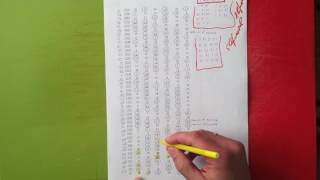
The first and last columns show correlation: if 10 appears, later 10 appears again; if 33 appears, 32 appears later; if 14 appears, 13 appears later; if 40 appears, 39 appears later.
The presenter suggests two betting options: all numbers ending in 1, and a general method based on the current draw (e.g., including 33 if 34 appears). The experiment starts from June 26.
The video concludes with a proposed experiment to test the observed patterns, but acknowledges the inherent randomness of lottery draws.
How many numbers ending in 1 appeared in the analysis?
39 times
00:30
What is the average frequency of numbers ending in 1?
Every 75-80 draws
00:43
In which draw did the presenter start betting on ones?
Draw 568
01:12
How many draws did it take for the ones to appear after draw 568?
229 draws
01:12
What sequence pattern was observed in draws 797 and 1300?
11 and 21 appeared in both draws, with other numbers shifting.
03:44
What correlation was found between first and last columns?
If a number appears in the first column, a related number appears later in the last column (e.g., 33 leads to 32, 14 leads to 13).
04:39
What two betting options does the presenter propose?
All numbers ending in 1, and a general method based on the current draw.
05:52
Frequency Fallacy
Highlights the gap between theoretical probability and real-world randomness.
00:43Patience vs. Probability
Demonstrates the impracticality of waiting for a pattern to hit.
01:12Column Correlation
Suggests a potential but unproven relationship between draws.
04:39[00:03] numbers that end the same way, and today I offer you such an analysis today I offer you such an analysis out of 45
[00:18] such numbers from one to five, five numbers from six to 0, four numbers, for example, 1 11 from six to 0, four numbers, for example, 1 11 21 31 41 or 2 12 22 32 42, and so on. I
[00:30] 21 31 41 or 2 12 22 32 42, and so on. I decided to consider one. Three numbers decided to consider one. Three numbers came up 39 times, and Che numbers came up three came up 39 times, and Che numbers came up three times. If you divide 3,000 draws by 42
[00:43] times they come up, it turns out that approximately every 75-80 draws this happens. If everything were strictly exactly like this, then you and I would have become
[00:55] billionaires long ago, but this is not the case. On the left, you see the one see the one with which they came up after a different with which they came up after a different chaotic number of
[01:12] If I started betting, for example, in the 568th 568th draw in search of these units, they would have draw in search of these units, they would have come up after 229 draws, and I simply would
[01:25] not have been able to stand betting for so long. After all, if I want to get in in three numbers, then there are if I want to get in in three numbers, then there are five of them, I wrote them down, you see from above, five of them, I wrote them down, you see from above,
[01:43] exist. Here they are, and these are eight
[01:58] options, a lot, and if you bet on Poche ones, then sometimes there are
[02:13] options, too, a lot. Well, it's just that for me, in terms of money, this is a lot, maybe for someone it's acceptable, you can bet all five ones, after all, four have come up three times and will definitely come up again. And it seems to me that this
[02:27] come up again. And it seems to me that this option, this one, all five ones, is a good start, wait until good start, wait until all five come up, and this will happen. What about the
[02:40] sixth number? In different forms, I tried to deduce one draw from another and see some kind of relationship, all in vain, but I saw two more
[02:53] points. Firstly, there is a sequence sequence of numbers. That is, this is 10 of numbers. That is, this is 10 11, then there are 20
[03:07] 11, then there are 20 21, well, 32 33. And here is 40 [music] 41 again 10
[03:30] And so on. Pay attention to the 797 draw, here it is, and the 1,300 draw, here it is.
[03:44] [music] and here it turns out and here it turns out that here we got one 11 21 here it
[03:56] that here we got one 11 21 here it came up exactly the same 11 21 here was the sequence 2021 And here it changed
[04:11] this side the two remaining numbers are 40 and 302 That is, this is howl and here nine came up That is, if we added one to this sequence and
[04:24] added one to this sequence and 22 would come up then here we could add one and it would come up and if 20 were added to and if 20 were added to 40 then we would get
[04:39] 15 I don’t know somehow all this is of course far- fetched probably and the second point of the analysis is the analysis of the first and last
[05:00] look it means The first column is the last one is exactly the same as the first if 10 came up here then once upon a time
[05:13] if we follow the method they come up if 33 came up once 32 came up in the future If
[05:25] 14 came up When 13 falls out, where is it? Here it is. 13. If 40 falls out, then 39 falls out in the future. then 39 falls out in the future. If this falls out, then six falls out in the future,
[05:39] or here it is, another six to these six to these units. I think that this is also interesting, so units. I think that this is also interesting, so finally, I propose an experiment.
[05:52] finally, I propose an experiment. If I followed this method, I would If I followed this method, I would put two options. The first is all n put two options. The first is all n units and the second
[06:09] general method, I would put it even based on this draw. Here is the number 34. I would include 33 in my layout and
[06:22] put this option: 21. 33 is just not here and there are no falls.
[06:35] 33 is just not here and there are no falls. A 4re and A 4re and 42 and from now on, from June 26. 42 and from now on, from June 26. Let's check. When you
⚡ Saved you 0h 06m reading this? Transcribe any YouTube video for free — no signup needed.