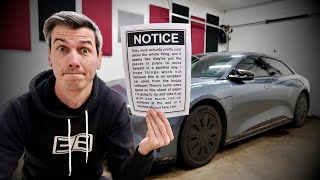

Lucid's hilarious fake birthday card
40sHumor and shocking twist grab viewers immediately.
▶ Play Clip"Delivers on the promise of Lucid's response, but also includes extensive analysis and future plans beyond just the response."
In this video, Jason responds to Lucid's reaction to his critical review of the Lucid Air, discussing software and hardware fixes, upcoming improvements, and a major UX overhaul planned for 2026. He also addresses common questions about profile switching, vehicle-to-home power backup, and the balance between Lucid's brilliant engineering and poor software.
Lucid reached out after Jason's critical video about his Lucid Air. They acknowledged problems and announced organizational changes, with Emad Dalaala now overseeing product development.
Three issues already fixed: OTA update loading, plug and charge at Electrify America, and heated seat activation for rear passengers (due to auto climate control).
Frunk opening problem caused by striker misalignment due to temperature changes; adjusted and now works. Charging door difficulty explained as a later-added feature; redesign for Gravity.
Lucid admitted cup holders are too grippy (9 lb force to remove can). New design removing baffles will roll out in H1 2026 with retrofit option.
List of improvements in progress: phone key, door handle behavior, mirror positions during reversing, percentage vs miles mismatch, auto-lock geo-fencing, Tesla Supercharger plug and charge.
Major UI update planned for early fall 2026 for cars after April 2024 or with $950 processor upgrade. Includes multitasking, quick controls, improved CarPlay, faster profile switching (<8 sec), audio stability, voice commands.
Lucid cannot switch profiles while driving due to Android-based system, unlike Tesla's Linux. Ultra-wideband for Gravity improves profile detection but Air may not get switching while driving.
Lucid plans V2H kit in H1 2026, providing up to 17 kW peak (14 kW continuous) to home. 92 kWh battery gives ~4 days of average home usage. No external inverter needed; conversion done in car.
Jason defends Lucid's engineering excellence (efficiency, packaging, ride quality) while acknowledging software is a mess. He plans to continue lease and hopes for improvements.
Lucid has acknowledged its software shortcomings and is actively working on fixes and a major UX overhaul, but the current experience remains frustrating. The car's hardware and engineering are exceptional, but the software needs significant improvement to match its potential.
What is the battery capacity of the Lucid Air Touring?
92 kWh
14:17
What is the peak power output for Lucid's planned vehicle-to-home backup?
17 kW peak (14 kW continuous)
14:01
How many days of average home electricity can the Lucid Air's battery provide?
About four days (based on 21 kWh/day average usage)
14:30
What is the cost to upgrade the infotainment processor to receive the UX 3.0 update?
$950
08:28
Why does Lucid use Android-based OS instead of Linux?
Lucid chose Android for its operating system, which makes certain customizations (like switching profiles while driving) more challenging compared to Tesla's Linux-based system.
13:19
What technology does Lucid Gravity use for accurate phone key detection?
Ultra-wideband (UWB) technology
11:19
How much force is required to remove an empty can from the Lucid Air's cup holders?
Nearly 9 lb of force
06:01
When is the UX 3.0 overhaul planned to roll out?
Early fall of 2026
07:19
What is the email address for Lucid software feedback?
10:10
Humorous Parents' Card
Shows Jason's personality and the tone of the video.
00:30Three Software Fixes Already Implemented
Demonstrates Lucid's responsiveness to issues.
03:04Cup Holder Redesign
Lucid admitted the design flaw and is changing it based on feedback.
05:57Profile Switching Limitation Explained
Technical reason for missing feature compared to Tesla.
09:45Vehicle-to-Home Power Backup
Promised feature that sets Lucid apart from many competitors.
13:33Brilliant Engineering vs Poor Software
Key tension in the video, highlighting the gap between hardware and software.
15:12[00:01] disappointment with my new car, this Lucid Air, and a million of you watched it. So, as one might expect, Lucid reached out. Jason, you dumb sack of
[00:14] It was clear from the beginning you were never good enough to be a real engineer, so what did you do? You quit, you gave up, you chose to spread your useless voice on the internet, bringing incredible shame to our family. Oh.
[00:30] Whoops, sorry. That was a birthday card from my parents. All right, back up for a second. Getting into what they actually said, it's worth mentioning that about a month before my video was released, Lucid announced a bit of an
[00:42] organizational shake-up with Emad Dalaala, who previously led powertrain, who is now going to oversee all of product development, which includes software. I've met and spoken with Emad multiple times. He is a great, brilliant
[00:56] dude who has put out popular academic hits such as Efficient algorithms for the inclusion of the Preisach hysteresis model in non-linear finite element methods, while getting his PhD in Finland. That's
[01:10] just to say the dude's smart. I feel like I understand how electric motors work, and then I talked to Emad, one of the geniuses behind Lucid's insanely power dense electric motors, and I realized I don't know anything about
[01:24] electric motors. Okay, so Emad is now overseeing everything, and you might wonder why. Well, Lucid told me in response to my video and in response to their organizational changes, "It's fair to say we're not happy with where we've
[01:38] been, and we know we have to do better as well, and so we're hard at work at that." Great. At this point, that's really all you can ask for. Admit there's a problem, work on addressing it. So, I had a long, information dense
[01:52] conversation with Lucid, and companies are usually very hesitant to share information about future products. But perhaps in this case they felt it would be beneficial. As Emad said to me, "I am excited to give you as our very first
[02:06] journalist insider a preview of the following significant upgrades." So, we're going to get into that, but a quick recap in case you missed the first video. I leased a brand new Lucid Air Touring in June 2025. Very quickly, I
[02:21] experienced a lot of problems. Lucid service fixed many, but not all of the problems, and so the car is still quite buggy. And while I was quite excited about buying this car, that enthusiasm has dwindled because of the poor user
[02:35] experience. So, I made a video about my disappointment, and here we are. So, in this video we're going to cover what software problems Lucid has already fixed, what problems Lucid plans to fix, what problems are unlikely to change,
[02:49] and then, very exciting, we'll discuss Lucid's UX 3.0, a complete overhaul of their user interface. And, perhaps even more exciting, vehicle-to-home power backup, both of which are planned to launch this year, 2026. All right,
[03:04] starting off with software problems, three of them Lucid has already fixed. Those being some cars, including mine, couldn't properly load over-the-air software updates. They have now fixed that, and sure enough, my car can easily
[03:17] update anytime an update comes through now. Lucid issued a cloud update for plug and charge. So, the first time I tried using plug and charge at an Electrify America station, it didn't work. I only tried it once. They said
[03:29] they implemented a fix. I went in and tried it again, it works. So, plug and charge has been fixed. I had an issue with the heated seat coming on for my dog, who was sitting in the back. Now, a bunch of you said, "Jason, you're an
[03:41] idiot. Of course your dog is just pushing the button." But guess what Lucid told me? They think my dog wasn't pushing the button, just as I suspected. the correct answer. There is an automatic climate control setting that
[03:57] can activate the heated seats. You can disable this, so when my dog is detected in that seat, it no longer turns on the heated seat. Problem solved, great. Okay, now let's move on to hardware. One of my first issues was that the frunk
[04:11] couldn't open, and I complained that this should have been caught at the factory or upon inspection at the showroom. Lucid mentioned this is actually a common problem and something they're working to address that has to
[04:23] do with the unique front end design. Basically, the car might actually leave it could even arrive to the service center with everything working, but over time everything eventually settles into its permanent place, and for whatever
[04:38] reason, you could have really small shifts in the location of different components. For example, Lucids are built in Arizona, a very hot climate. Now, I live in a much colder climate, and so that could cause a small shift in
[04:52] where these strikers sit versus where they latch, and just a small shift in that striker's position can prevent this from opening up, and that's exactly what happened with my car. They adjusted the striker, and now it opens every time.
[05:05] And Lucid readily admits this is an engineering challenge they need to solve. They're not saying this as an excuse, but just so that I understand why it happened. Another problem that I had is that the charging door was
[05:17] difficult to open, but there's a very logical explanation for this, and that's that initially it wasn't designed to be used this way. In fact, from the beginning, the intent was to either use the app or the button inside the car to
[05:31] open the charging door. So, this charging door needs to be able to detect pinches, as you see demonstrated here. And actually, they figured out they could use that same logic for detecting pinches as a way of enabling you to open
[05:44] the charging door. So, it was later added as a feature. So, for that, I say better to at least have it than not have it at all, as it does work consistently if you push hard enough. And for Gravity, they did away with electronics,
[05:57] have to worry about the charge door being finicky. I also mentioned, kind of jokingly, that the cup holders are far too grippy, requiring nearly 9 lb of force to remove an empty can. And to my surprise, all three Lucid employees on
[06:14] the call with me said, and I'm embellishing a little bit, but the cup embellishing a little bit, but the cup holders suck. And also to my surprise, they're changing the design. They have a new design that removes the baffles,
[06:26] which they've tested and say functions much better. They said this will roll out in new vehicles in the first half of 2026, and they said they'll likely offer a retrofit option for customers, and said they'd offer me an early version
[06:39] for feedback. Amazing. And final note on hardware, the facial recognition bar gets blocked by the steering wheel for tall drivers who have the steering wheel at its highest position. Now, while this probably won't change for Air models,
[06:53] they have redesigned this for their second car, the Gravity, and it's now always have a clear view of the driver for selecting profiles. Great. Okay, let's move on to software, the big
[07:06] category. I already mentioned the three problems they already fixed. There are two other things we need to discuss here. First, what they're actively working on fixing and improving, and second, a complete overhaul of their
[07:19] user experience, which is planned to roll out by early fall of 2026. So, here's what I've been told they are working on improving. I'll put the whole list on the screen, but to mention several of them, improving access
[07:32] controls using the phone as a key, improving the door handle behavior, much needed in my opinion, adjusting the positions of both mirrors during positions of both mirrors during reversing. Yes, thank you, Lucid.
[07:44] Removing the mismatch between percentage versus miles, depending on which you've selected. Turns out I'm not crazy. Allowing users to prevent their vehicle from automatically locking at certain geo locations, in a garage, for example,
[07:57] and enabling plug and charge with Tesla superchargers for
[08:14] 2026. So, first of all, who will this update be for? Anyone who has purchased update be for? Anyone who has purchased or leased their car after April 2024, so my car will qualify, or anyone who upgrades their infotainment processor to
[08:28] Lucid's second generation unit, which you can have done at Lucid service for $950. This update will allow for things like multitasking, so you can use the two different screens for separate
[08:40] functions, a quick controls menu at the bottom of the screen for highly used buttons, improved CarPlay and Bluetooth consistency. This will be huge. I've had a lot of problems with CarPlay and Bluetooth, faster profile switching.
[08:52] Currently, it takes about 10 seconds or more, it's quite tedious and annoying, and they're saying this will get it down to eight or fewer seconds. Still seems long, but any improvement I will take. Audio stability improvements. This is
[09:05] much needed. I still have problems with my speakers cutting out while I'm driving, and voice command improvements. And they've actually already changed something after watching my previous video. So, previously, I asked it to
[09:18] open the glove box, and it tells me, I can't open the glove box for you, but you can do it by pulling the handle. But the glove box doesn't have a handle. So, now when you tell it to open the glove box,
[09:31] box, open the glove box. pilot panel and select menu symbol, glove box. Close it by pushing the glove
[09:45] glove box. Close it by pushing the glove box cover until it latches. Okay, a bit tedious, but look at that. I, Jason, have created change within the automotive world. Take that, Mom and Dad. And yeah, hopefully eventually
[09:58] it, but of course there's the button. So, if all of those changes actually happen, great. We will see. I'm not here to say everything's fine. It's not.
[10:10] Lucid agrees. In fact, Lucid recently launched an email address launched an email address [email protected], experiencing software problems, you can email them directly with your issues.
[10:23] There's a team behind this compiling the information to help guide and prioritize improvements. And Emad tells me he gets a summary of these emails every week. So, if you want to add Lucid software beta tester to your resume, now there's
[10:37] a way. Now, in my previous video I mentioned my biggest complaint was that you can't switch driver profiles while driving. And there's a lot to discuss here, but I realized that's not really the core problem. If it properly detects
[10:51] who is entering the driver seat, and it properly switches all of the settings to that profile, then switching profiles while driving really isn't necessary. Well, much of that has been addressed with the Lucid Gravity. You see, on
[11:05] Lucid Air they use Bluetooth low energy for the phone key. Whichever phone is first detected that unlocks the car, that is what selects the driver profile. So, if you have two people approaching the car, it's a bit of a gamble which
[11:19] profile it picks. On Lucid Gravity, they're using ultra-wideband technology, so it can accurately determine where the phone is coming from, from which direction, and how far away it is. So, it knows who is entering the driver
[11:31] seat. As a result, it can accurately pick which profile. But, Gravity also has a better backup. Because the face scanner has an updated mounting location, it can easily recognize who's sitting in the driver seat. So, profile
[11:45] switching really shouldn't be an issue on the Gravity if it accurately switches over the user settings. But, let me push back on Lucid a bit here regarding switching profiles on the Lucid Air. Since for my car, there really aren't
[11:59] reliable solutions for it selecting the correct profile. Lucid told me that you couldn't maintain navigation while switching profiles for data privacy requirements outside of their hands. And that you can't change profiles while
[12:13] driving for legal safety reasons. And they told me that they'd benchmarked competitors, and this was generally true with small caveats like while the car isn't moving or at very low speeds. But,
[12:26] actually this isn't true. This is inside of a 2025 Tesla Model 3. And while the car is driving at speed, you can easily switch profiles. Amazing. And if you
[12:39] have the car navigating to a specific destination, you can switch profiles and it will maintain that navigation. Now, I don't believe Tesla should be our North Star for data privacy and safety considerations. Although they do make
[12:53] incredibly safe vehicles. But, the point remains, if you switch from a Tesla to a Lucid, you'd have this feature that you were once used to and suddenly it's disappeared. And it would even be more valuable in the Lucid because unlike
[13:06] Teslas, the Lucid Air does a poor job of selecting the correct user profile. Now, Lucid did explain why you see such a big difference in profile switching from Lucid to Tesla. Teslas use Linux-based operating systems with the user
[13:20] interface being designed by Tesla, whereas Lucids are Android-based operating systems, and there are certain customization settings that are more difficult to change. The short story is, while both Linux and Android have their
[13:33] pros and cons, Lucid's chosen path makes customization a bit more challenging. So, I don't expect to see profile switching while driving or maintaining navigation implemented anytime soon, if ever. All right, moving on from
[13:47] software, there's one feature that really, really excites me because it feels like this feature was promised as part of the great electric future, only for few companies to actually implement it, and often requiring expensive
[14:01] installs. And that is vehicle-to-home power backup. So, Lucid says in the first half of 2026, they are planning to release their kit for vehicle-to-home charging. Meaning you can supply up to 17 kW peak or 14 kW continuous to your
[14:17] home. That's enough to power absolutely everything. AC, fridge, microwave, whatever. At least for my home. Now, this car has a 92 kW hour battery pack.
[14:30] And in my home, our average electricity use, including charging this car, is 21 kW hours per day. So, using the battery pack from this car, depending on efficiency, we could expect to get about four full days of electricity out of
[14:47] that car. And that's if I'm not conserving energy at all. You could easily go a week or two if you're only running essentials. And Lucid already thought about all of this in advance. So, any Lucid Air is capable of it.
[15:00] You'll have to install the kit to hook up to your home's electrical panel, but unlike the others, like Ford for example, you don't have to install an expensive home inverter to take the battery's direct current and turn it
[15:12] into alternating current. Lucid converts the battery's DC to AC right in the car. So, this should be a much lower cost option than competitive offerings. We will see about cost, but I hope to make it work out in my house. Now, there is
[15:26] one frequent comment that I really want to address, and that is for the many to address, and that is for the many people that seem confused or even angry that in my previous video I suggested that Lucid has brilliant engineers. All
[15:39] the while, their software is a hot mess. And first of all, two things can be true, right? Like, I'm pretty good at math, and so because of that people might say, "Oh, he's a smart guy." But, also I don't know how to read, and so
[15:51] because of that people might say I'm an idiot. I like to think both are true. In this case, denying Lucid has brilliant talent is simply an uninformed take. Let me explain this as quickly as possible. Making cars is an insane endeavor. Cars
[16:08] are the most complex consumer product. They are infinitely complex. Genuinely infinitely complex. There is no such thing as perfect. There will always be ways to improve them. And perfection could cover many areas. Safety, driving
[16:25] could cover many areas. Safety, driving dynamics, ride quality, NVH, efficiency, dynamics, ride quality, NVH, efficiency, packaging, user experience, blah, blah, blah. Of these different qualities that make a car a car, Lucid has pushed
[16:38] several of them closer to perfection than anyone else before them. And they did it with the first car they ever put out. They created, their claim, the out. They created, their claim, the world's most efficient car. That is an
[16:52] unfathomably difficult task. Every single component of a car plays a role in efficiency. And that they did it with something this large and this heavy is remarkable. Also, packaging. Porsche is a pretty smart company. I think we all
[17:06] agree. They've created some of the most enjoyable cars I've ever driven. The Taycan, excellent car, happens to be nearly identical in dimension, length, width, height, and wheelbase as the Lucid Air. And yet the Lucid Air has
[17:21] real rear seats with tons of legroom, while the Taycan is cramped. Somehow, even with those spacious rear seats, they've managed to pack in nearly double, nearly double the cargo capacity of the Taycan into this car. That is
[17:35] remarkable. And the Lucid has more power and more range than the Porsche. And again, I think the Porsche is a great car. The Lucid is an absolute delight on long road trips thanks to many reasons. The interior is super quiet. The ride
[17:50] quality is amongst the best I've ever driven. Both of those are leagues ahead of the Tesla that I had. Albeit, they are at different price points. So, it's very comfy. It has tons of range, excellent response, genuinely
[18:03] mechanically, it's an absolutely brilliant car. And it is an uninformed take to state otherwise. Simultaneously, my personal experience has been the software sucks. But, it does, at least on paper, sound easier to fix a great
[18:19] car with poor software than to fix a terrible car with great software. Time will tell. Now, some folks in the previous video said I didn't have a conclusion and wondered what my plans are for this car. I have a 3-year lease,
[18:32] remainder of that lease. Then at the end, depending on how I feel about the car, either buy it out or return it. Currently, I lean towards returning it, in 2 and 1/2 years depending on how different it is. Do I regret buying it?
[18:47] No, in the same way that I don't regret selling any of the cars that I've sold. I don't think my brain works like a lot of people assume it does. Regret implies I can't do anything about it. I could get rid of this car if I wanted to, and
[19:01] I haven't. I could have bought other cars, and I didn't. And I'm fine with that. Is it hard to recommend in its current state? Absolutely. But, basically, I bought this car because I thought what Lucid was doing was really,
[19:14] really clever. It's the same reason I bought the other cars I currently own, my GR Corolla and my Ford Maverick. I think they're really cool, clever cars, and I thought I would love the Lucid. But, it turns out currently the software
[19:27] is pretty crap. So, I had all this excitement when I was buying this car, buy a new car. But, then because of it having so many software issues, that excitement and that enthusiasm about the car is completely drained out. And I
[19:41] think that's super disappointing because I had such high expectations. Just generally, I'm a happy person. I'm not here to complain like, "Oh, my car doesn't work right." But, I do think Lucid could do a much better job, and I
[19:55] think they need to if they want people to buy these cars. Just the other day, the trunk button stopped working. The frunk button stopped working, and the phone app stopped working. I had to close the trunk and the frunk with my
[20:09] close the trunk and the frunk with my bare hands. That's hard for me. I struggle enough just getting a can out of the cup holders. This car has a lot of problems. Painfully frustrating problems. But, Lucid has had an
[20:22] organizational shake-up, and it really does seem like they're working to make this car great. I really do hope they succeed. Oh, and if you're worried about my parents not loving me, here's what they actually said. "Happy birthday,
[20:34] Jason. There's a light inside of you, and every year it just gets brighter. All because you're such a happy, personable, intelligent guy with a personable, intelligent guy with a positive attitude. So, go ahead. Leave
[20:47] your nasty comments, cuz I got something better than friends. I got family."


⚡ Saved you 0h 20m reading this? Transcribe any YouTube video for free — no signup needed.