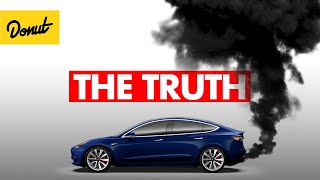

EV vs Gas: The Shocking Truth
45sPresents a direct, controversial debate in the comments, hooking viewers with a promise to settle the argument.
▶ Play Clip"Title accurately reflects the investigation; video delivers a balanced, fact-based answer."
This video investigates whether electric vehicles (EVs) are truly better for the environment than internal combustion engine (ICE) cars. The host examines production emissions, operational impacts, and common myths, concluding that despite higher initial manufacturing emissions, EVs have a significantly lower overall environmental footprint.
The host notes recurring comments arguing EVs are worse for the environment than ICE cars, prompting this investigation.
EV production emits 8-10 metric tons of CO2 on average, with larger batteries up to 17 tons, compared to 7 tons for ICE vehicles.
Lithium mining in the 'lithium triangle' uses 65% of local water in Salar de Atacama, requiring 750 tons of brine for one ton of lithium.
Cobalt mining involves child labor in some regions, posing ethical concerns.
Lithium-ion battery recycling is underdeveloped, with storage and fire risks due to volatility.
ICE cars emit 7 tons during production and 5.2 tons per year, totaling 57 tons over a lifetime.
Oil refining emits 767 million tons of CO2 daily, with 95 million barrels produced per day.
EVs emit 28 tons over their lifetime vs. 57 tons for ICE cars, becoming cleaner after 6 months to 2 years.
False: Even with coal-powered charging, EVs beat ICE cars in overall emissions.
False: US grids can handle 25% of cars being EVs without disruption.
Partially true: Federal rebate up to $7,500, but luxury EVs get only half, making it more equitable.
Despite higher production emissions, EVs have a lower overall environmental impact than ICE cars. The host encourages acknowledging facts without division between EV and gas car enthusiasts.
How much CO2 does EV production emit on average?
8-10 metric tons of CO2.
03:18
How much CO2 does ICE vehicle production emit?
Around 7 metric tons of CO2.
03:36
What is the 'lithium triangle'?
An area between Chile, Bolivia, and Argentina that supplies more than half of the world's lithium.
03:52
How much brine is needed to produce one ton of lithium?
750 tons of brine.
04:19
What percentage of a battery is lithium?
Around 6%.
04:32
What ethical issue is associated with cobalt mining?
Child labor in some mines.
04:47
How many metric tons of CO2 does an average ICE car emit over its lifetime?
57 metric tons (7 production + 50 operation).
07:00
How many metric tons of CO2 does an average EV emit over its lifetime?
28 metric tons.
08:23
After how long does an EV become cleaner than an ICE car?
Between 6 months to 2 years of driving.
08:51
Can the US electric grid handle 25% of cars being EVs?
Yes, without disruption.
10:01
EV Production Emissions Higher
Key fact that EV production emits more CO2 than ICE production, countering common assumptions.
02:19EV Lifetime Emissions Half of ICE
Crucial comparison showing EVs are significantly better over their lifespan.
08:23Myth Busting: EV vs ICE Emissions
Directly addresses and debunks a common misconception with evidence.
09:32Grid Capacity Myth Busted
Reassures about infrastructure readiness for EV adoption.
10:01[00:00] Every time we do a video on electric cars, the same debate shows up in my comments. Some people argue that electric vehicles are worse for the environment than internal
[00:13] combustion engines. Others say that EVs are not even close to as bad as internal combustion. I don't know. So I set out to find out once and for all our electric vehicles were worse for the environment.
[00:28] What I found genuinely surprised me. A big thanks to Keeks for sponsoring this episode of Wheelhouse, okay? I've got a good head of hair I think, okay? I'm pretty proud of it. I'm going to try to keep it as long as I can.
[00:41] But guess what, I'm young. And sometimes things change. I get worried sometimes about losing my hashtag, FitBoyLarks. Luckily, Keeks is here to help prevent me from losing my curly, FitBoyLarks, okay? You don't even have to go to the doctor anymore.
[00:54] You can just talk to a doctor online and bow your hair loss medication delivered right to your door. Look guys, the truth is with hair loss prevention is key. So it's better to start now with a full head of hair and be sorry about it later.
[01:07] Find out why Keeks has more five star reviews than any of its competitors and start your treatment today. If you're ready to take action and prevent hair loss, go to Keeks.com slash Wheelhouse50 or click the link in the description below and receive 50% off your first door.
[01:22] So I'm sorry, 50% off. That's amazing. That's keps.com slash Wheelhouse50. Support the companies that support Donut and thank you, Keeks, for supporting this show. In this video, we're going to do our best to compare the environmental impact of electric
[01:37] vehicles versus gas power ones. And look, I'm going to try to be as impartial and unbiased as possible because I am a car going. I love gas cars and I love electric cars and I have no agenda to push.
[01:51] I just want to know what's true and what's false, okay? This could have easily been an hour long video because honestly, this is a lot more complicated than I initially thought. But I know you're busy and get time for that. So we're just going to look at some facts for both types of vehicles and try to draw a conclusion
[02:05] from that. First, let's take a look at some ways electric cars are bad for the environment. Let me tell you, there's a few. One of the biggest arguments against electric vehicles is that battery production for
[02:19] an EV is much more detrimental to the environment than the production of internal combustion vehicles. So is that true? Yes. The initial environmental footprint from current electric vehicle production is greater than
[02:34] production of internal combustion engines. The large batteries EVs use are made with lithium, which like any raw material needs to be mined. And the mining process produces lots of greenhouse gases.
[02:47] It's a problem that's only going to grow unless the manufacturing process becomes more efficient. Sales of EVs topped 1 million per year for the first time in 2017. Some estimates predict that by the year 2030, there will be more than 125 million EVs on
[03:04] the road and those vehicles are going to need batteries. Needless to say, lithium isn't high demand and it all has to come from somewhere. It takes on average about 8-10 metric tons of CO2 to produce an electric vehicle.
[03:18] That's a lot. Obviously, the bigger the battery, the more CO2 it takes to produce it. Some smaller batteries in economy-sized EVs may take as few as 2 metric tons to produce, but larger EVs with long-range batteries could be responsible for up to 17 metric tons
[03:36] of CO2 emissions. Good lord. Firstly, the average production for an internal combustion vehicle produces around 7 metric tons of CO2. Why does EV production lead to a bigger environmental footprint?
[03:52] More than half of the world's lithium supply comes from the quote, lithium triangle, an area between Chile, Bolivia, and Argentina. In the arid salt plains of the Autocomad desert, high up in the Andes mountains, workers drill
[04:04] through the crust of the salt to get to the mineral-rich brine below the surface. This process leaches massive amounts of groundwater from the surrounding area, resulting in a decreased water supply and less accessible water for local agriculture.
[04:19] In a region of Chile called Salar de Autocomad, mining companies have used 65% of the region's water. It takes 750 tons of brine to produce just one ton of lithium. Bolithium is just one of the components of a battery.
[04:32] It's actually a smaller percentage than you might think, too, at around 6%. A growing concern surrounds the sourcing of another element used in batteries, cobalt. But the issue is more of an ethical dilemma, as some cobalt mines use child labor, which
[04:47] is reprehensible. And then there's the problem of recycling these things. The process in which lithium ion batteries are recycled is not at the point it needs to be to deal with the growing number of spent batteries from electric vehicles.
[05:00] There are plenty of different challenges associated with recycling these batteries. Relatively-enamed things like storage becomes a huge issue because of the volatility of elements in a lithium battery. There have already been a number of fires in facilities that process old batteries.
[05:16] Is the number of potentially catastrophic fires and explosions going to go up as more batteries or stockpiled in the future? It all depends on how quickly the industry evolves to deal with these issues. The fact of the matter is modern electric vehicle production is in its relative infancy
[05:30] compared to gas engines. So as time goes on and new processes come into play, the environmental impact will get better. I hope. The same can be said about where electric vehicles get their electricity.
[05:42] Right now, many regions of the US are still getting their power from coal power plants, so the impact of driving a zero emissions car in those regions is more detrimental to the environment than driving an EV in places with clean energy such as wind, solar and hydroelectric power
[05:58] plants. But as those types of energy become more common, the efficiency at which an EV operates will only get better. So now that we know the very real problems of electric vehicle production, how do they compare
[06:10] to the internal combustion engine? Let's start where we did with electric vehicles production. Manufacturing the average internal combustion vehicle produces 7 metric tons of CO2.
[06:23] This number takes into account everything from the mining ore for steel to the moment the car rolls off the production line. That number is lower than EVs because of the absence of lithium ion batteries.
[06:35] It also has to do with how efficient ice manufacturing has become. We're talking about the industry that is responsible for inventing the assembly line. After the car rolls out of the factory, greenhouse emissions from gasoline powered cars average
[06:48] are on 5.2 metric tons per year. And that's if the car drives the national average of about 11,800 miles per year. Over the lifespan of a car, it's responsible for 57 metric tons of CO2.
[07:00] That's 7 for a production and 50 in emissions. Gasoline, like lithium, has to be mined. The average car in the US goes through about 500 gallons of gas per year. And that gas, like the lithium in the batteries, has to come from somewhere.
[07:14] There's a lot of steps between the extraction of crude oil to you filling your car at the gas station. And each step has an environmental impact. Crude oil extraction starts with drilling into the earth, either on land or on the ocean
[07:28] floor. After the crude oil is mined, it needs to be refined into gasoline and other petroleum products such as jet fuel, petroleum jelly, and plastic. This process releases tons of greenhouse gases, including not only CO2 but methane and nitrous
[07:43] oxide as well. Every day around the world, close to 95 million barrels of oil are produced. And every day, oil refinement is responsible for emitting 767 million tons of CO2 into the
[07:56] atmosphere. Sure, the average car is responsible for 5.2 tons of CO2 every year. But oil refineries release a whopping 280 billion metric tons of CO2 in that same time frame.
[08:09] F***ing chargers driving by, dude. Alright, let's dial it back and get some more manageable numbers, ok? We know that over the average lifespan of a car with an internal combustion engine, it will emit roughly 57 metric tons of CO2.
[08:23] Over the same time period, the average EV is responsible for 28 metric tons of emissions, less than half of that of an ice engine. Despite the fact that electric vehicles make more CO2 during their production, they more
[08:35] than make up for it by not having any emissions during use. Taking into account the emissions produced by electric power plants that electric vehicles source their power from, the national average for an EV is around 2 metric tons per year.
[08:51] So that means the average EV will become more efficient than a gas powered car between 6 months to 2 years of driving it. In fact, even the least efficient electric vehicle with the dirtiest power source like a cold
[09:04] power plant will be better for the environment than the most efficient gas engine after a certain period of time. Electric vehicles in states with access to cleaner electricity like windmills, solar and hydroelectric
[09:17] power plants are significantly more efficient. Like I cross referenced everything in this video and have no agenda to push, I just wanted to put that out there because, you know, it's kind of tiring seeing the same bogus facts being regurgitated in the comments every time we make a video on EVs.
[09:32] Let's take a look at a few more myths. Myth number one, electric vehicle production and charging from cold powered plants produces more emissions than gas car production and operation. False. If you need a little more convincing, here's an amazing app that can calculate and compare
[09:46] the emissions of any gas car versus any electric car and in the long run, any EV beats any gas car inefficiency. I'll put the link right here and in the description if you want to check it out for yourself. Myth number two, our electric grid can't handle the onslaught of EVs.
[10:01] This one is also false. Even if a quarter of the cars on the road were electric tomorrow, the electric grids in the US can handle all of them without a disruption. Myth number three, government subsidies for electric cars are unfair to poor people, they only
[10:15] benefit the rich. Now, this is a pretty prescient insight, okay? It's true that if you buy an electric car, you can get a federal rebate of up to $7,500. That benefits everyone, but if you're rich enough to buy an expensive luxury EV like a Tesla
[10:29] Model X, you'll actually only receive about half of that amount. Yeah, kind of surprising, huh? Look, man, I love my gas powered Mustang, I'm gonna own a gas powered car for the rest of
[10:41] my life. Nothing matches the sound of a V8 turning gas into noise. I'm gonna get that tattooed on me someday, but I still have to acknowledge the truth. No matter how you spin it, electric vehicles have less of an environmental impact than gas powered
[10:55] cars. I'm not gonna say you're bad personally if you don't like EVs, because you're not, I just want to put the facts on the table, if this video helped you learn, I'm very happy for that. And I welcome you forward. There doesn't need to be any sort of separation.
[11:07] Hey, if you like this video, hit that subscribe button down there, hit the bell too, so you never miss another donut video. We're uploading every day now, which is kind of stressful, but we're having fun. Follow me on all social media at Nolan J. Sykes, follow donut at donut media on all social.
[11:23] Be kind, be kind, and see you next time. All right. All right, Christy, still water coming here.
⚡ Saved you 0h 11m reading this? Transcribe any YouTube video for free — no signup needed.