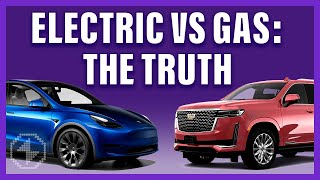

Electric cars save $15k in fuel over 10 years
60sThe huge cost difference between gas and electric fueling is surprising and makes viewers reconsider their car choice.
▶ Play Clip"Title accurately reflects the balanced comparison of electric vs gas cars, delivering on the promise."
This video compares electric cars (EVs) and gas-powered vehicles across cost, maintenance, environmental impact, and practicality. It highlights that while EVs save significantly on fuel and maintenance over a decade, they come with higher upfront prices, range limitations, and charging infrastructure challenges. The verdict depends on individual driving habits, access to charging, and local energy sources.
EVs save about $15,000 over 10 years compared to gas cars ($500/year vs $2,000/year).
EVs avoid oil changes, belts, spark plugs; maintenance costs ~$13,000 vs $21,000 over 10 years.
US rebates up to $7,500 can reduce purchase price.
EVs offer smoother acceleration and no tailpipe emissions, but electricity generation may cause carbon pollution depending on source.
Mining metals (cobalt, nickel, lithium) for batteries damages the environment; carbon deficit from manufacturing.
Average EV costs ~$68,000; cheaper models like Chevy Bolt EUV exist but still expensive for many.
Battery degrades 5-10% over 10 years; replacement costs five figures outside warranty.
Latest models travel 250+ miles per charge, but range drops 20-30% in winter and on highways; public charging infrastructure is underdeveloped.
Over a decade, EV ownership is lighter on the wallet than gas cars when combining purchase, maintenance, and fuel.
EVs not ideal for long distances, cold climates, or areas with fossil-fuel electricity; hybrids offer lower running costs without charging issues.
How much does the average gas car owner spend on fuel over 10 years?
Approximately $20,000 ($2,000/year).
01:40
How much does the average EV owner spend on electricity over 10 years?
Approximately $5,000 ($500/year).
01:40
What is the estimated maintenance cost difference over 10 years between a gas car and an EV?
Gas car: ~$21,000; EV: ~$13,000.
03:02
What is the maximum US government rebate for purchasing an EV mentioned?
Up to $7,500.
03:29
What metals are mined for EV battery production that harm the environment?
Cobalt, nickel, and lithium.
04:47
What is the average price of an electric car mentioned in the video?
Around $68,000.
05:14
What is the typical battery degradation range for an EV over 10 years?
Between 5% and 10%.
05:50
How much range do EVs typically lose during winter?
20% to 30%.
06:58
How long does it take to fully charge an EV on regular level 2 power without DC fast charging?
Around 8 to 10 hours.
06:43
What alternative vehicle does the video suggest for people who cannot charge at home or drive long distances?
A hybrid car.
08:16
Fuel cost comparison
Provides concrete dollar savings over a decade, a key decision factor.
01:00Maintenance savings
Highlights the simplicity of EV mechanics and long-term cost benefit.
02:08Environmental cost of battery production
Balances the green image of EVs with real mining and manufacturing impacts.
04:47Range and charging anxiety
Addresses the biggest practical barrier to EV adoption.
06:04Hybrid as a pragmatic alternative
Offers a middle-ground solution for those not ready for full EV.
08:16[00:00] are electric cars worth it. If you're thinking about buying an electric car, you might want to consider some of these questions before you commit. In recent years, electric cars have been increasingly popular. Some experts say they're the future of transportation.
[00:14] Others warn that EVs are too risky. Electric cars are generally seen as environment-friendly vehicles, which has already been proven. But what are the downsides to owning one? Will you be better off with a traditional gas-powered car?
[00:28] In this video, we are going to compare gas-powered cars versus electric cars, and you decide what best suits your needs. If you like what you see, don't forget to like this video.
[00:47] Click the subscribe button and hit that bell to get notified of new videos. Let's dive into the advantages of owning an electric car. The first and most obvious is that you're never going to have to worry about how much money you'll spend on gas again,
[01:00] given how expensive it is to keep gas-powered vehicles running. It's no surprise that not having to pay for gas is a major selling point for electric vehicles. And it's also true that the cost for charging an electric vehicle
[01:12] is much cheaper in the long run compared to paying for gas. The amount of money you save will be determined by a wide variety of factors, including the type of vehicle you decide to purchase, the price of gasoline
[01:24] in comparison to the price of electricity in your area, and whether you choose to charge your vehicle during the day at home or at night during off-peak hours. Study suggests that the typical gas-powered car owner will spend approximately $20,000 on gas over the course of 10 years,
[01:40] which is approximately $2,000 per year. On the other hand, the typical owner of an electric car will spend approximately $5,000 on electricity over the course of 10 years, which is approximately $500 per year.
[01:54] These are just estimates, but you now have an idea of how much you'll spend if you decide to own either an electric or a traditional car. That's right, an electric car can save you around $15,000 over a period of 10 years.
[02:08] Aside from being able to save money on gas, you won't have to worry about spending an entire paycheck's worth for maintenance. You won't ever have to spend money on oil changes, other fluid changes, spark plugs, belts, or any other maintenance items typically
[02:21] seen in a gas-powered vehicle, because electric cars have very simple mechanical structures. But you still want to ensure that your brakes, tires, and other important parts function properly. Still, it will save you money in the long run
[02:35] compared to a gas-powered vehicle. Certain major problems that gas-powered cars have will not be experienced with electric cars. You won't ever have to face problems like oil leaks or gasket leakage. Don't get too excited, though, since these kinds of problems
[02:49] will be replaced with problems associated with electric vehicles. Traditional cars and electric cars also have common issues, such as with the sensors, the touchscreen, electronics, and others. When it comes to maintenance, 10 years of driving
[03:02] a gas-powered vehicle will cost you about $21,000, whereas an electric car will cost you about $13,000. Additionally, the savings with electric cars are not limited to only the costs of running and maintaining the vehicle.
[03:16] You also have the opportunity to save some money on the overall purchasing price. However, one problem you'll hate to come across are those that involve your car's batteries. Moving on to the next advantage of owning an electric car,
[03:29] government rebates, and incentives. If you live in an area where government rebates are available, you may be able to save yourself thousands of dollars in purchasing a car which can reach up to $7,500 in the US.
[03:41] Electric cars also give users a generally better driving experience because their acceleration is somewhat muffled, smoother, and they can generate more power that allows for easier maneuvering. No harmful gases are released from an electric vehicle's
[03:55] exhaust. However, carbon pollution may occur due to the process of generating the electricity required to charge electric cars. The amount varies depending on the method that is used to generate local power, such as using coal or natural gas,
[04:09] both of which emit carbon pollution as opposed to using renewable resources such as wind or solar, neither of which contribute to carbon pollution. Despite the inevitable emissions stemming from electricity,
[04:21] the levels of greenhouse gases emitted by electric cars are lower than those coming from the latest gas powered car. It is possible that the total greenhouse gases caused by electric vehicles could be reduced even further
[04:34] if renewable energy sources such as wind and solar were used more to generate electricity. The manufacturing of electric cars and the battery packs that are needed to get them running also poses a lot of concerns for the environment.
[04:47] These battery packs negatively damage the environment since they require the mining of metals, including cobalt, nickel, and lithium. A carbon deficit is the result if you can buy the mining of the metals and the manufacturing of the batteries
[05:00] and the vehicles. Just remember, if the area you live in gets its electricity from renewable energy, then that's a good step towards helping the environment when it comes to buying an electric car. Given this info, do you really think it's the right time
[05:14] for you to be an electric car owner? The next issue with electric cars is their price tag. The average American wouldn't even think of buying an electric car as the average price goes for around $68,000.
[05:26] There are some cheaper models like the Chevrolet Bolt EUV, but that's about it. Buying an electric car is simply too expensive for the working man. Speaking of prices, the types of problems you wouldn't want
[05:38] to deal with are those involving your car's battery pack. Most of the time you won't even have to deal with these problems and battery packs come with an eight to 10 year warranty. Battery failure is rare, but what you don't want
[05:50] is battery degradation. The battery pack will gradually degrade the more you use it, typically between 5 and 10% over the course of 10 years. Expect to shell out five figures if your battery pack experiences significant degradation
[06:04] outside of your warranty. Another issue with electric cars is their driving range. Initially, electric cars were practically seen as useless since they only had a limited driving range of around 100 miles or 160 kilometers,
[06:18] but on just one charge, the latest models are able to travel at least 250 miles. This makes electric cars more attractive to consumers who only want one car. Sadly, if you intend to drive long distances
[06:31] or you live in an area where public charging is not prevalent, or you don't have the capability to charge at home or at work, then the driving range will be in nuisance. You'll only get more anxious with charging issues
[06:43] as you'll be bothered by thoughts of possibly being stranded. The absence of a DC fast charging will also take you around eight to 10 hours to fully charge an electric car on regular level 2 power, because electric cars are expected to lose 20 to 30%
[06:58] of their range during winter time, having the capacity to regularly charge will still leave you anxious. Electric cars also lose range when driving on long highways as they were designed to be city cars.
[07:10] The EV industry still has a lot of room to grow. One proof of that is that most public charging infrastructures are still undeveloped, even those found in the most developed cities. Because of this, you may not want to rely heavily on public charging
[07:23] and might as well charge at home. DC fast chargers are also rarely reliable. Wait after a few years and maybe the issues associated with public charging infrastructures will be fixed. An electric car is perfect for someone who can charge at home,
[07:37] sees no problem with the usual charging issues and the inevitable decline of range in EVs during cold weather and driving long distances. It's a big plus if the area you're in has electricity sourced from renewable energy.
[07:51] When you add together the initial purchase price, ongoing costs for maintenance and repairs, you'll see that owning an electric car is lighter on your pockets than owning a comparable gas powered car over the course of a decade.
[08:03] An electric car is not ideal for people that do long distance driving, those who have difficult access to public charging, and those who live in cold climates. As mentioned earlier, your electric car won't help the environment
[08:16] if you live in an area wherein electricity is sourced from fossil fuels. If you feel like you belong in this group, then opt for a gas powered car or a hybrid. Hybrid cars are more cost effective than electric cars
[08:28] with a price tag that's on par with that of a standard gas car but significantly lower running costs. You won't have to deal with charging or range issues because hybrids require no charging,
[08:40] also eliminating concerns about your electricity being powered by fossil fuels. Many buyers are aware of these advantages, which is why hybrids are selling so well. Waiting a few years or maybe a bit longer
[08:52] to purchase your next electric car can only benefit you as the technology will only get much better in the years to come. This was EV News Network. Comment down below if you'd rather by an electric
[09:05] or a traditional car for your next vehicle.
⚡ Saved you 0h 09m reading this? Transcribe any YouTube video for free — no signup needed.