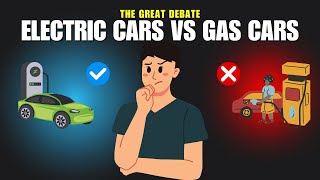

Gas vs Electric: The Basics
45sThis segment provides a clear, educational comparison of how gas and electric cars work, appealing to viewers curious about the fundamental differences.
▶ Play Clip"The title suggests a balanced debate, but the content clearly favors electric cars, delivering on the comparison but with a strong pro-EV bias."
This video compares gas-powered and electric cars, focusing on fuel consumption, cost, range, and environmental impact. It explains the key differences between internal combustion engines and electric motors, ultimately concluding that electric cars offer significant long-term savings and environmental benefits despite higher upfront costs.
Gas cars run on internal combustion engines, measured in miles per gallon. Average gas car gets 20-30 MPG, depending on make and model. Gasoline prices fluctuate, leading to unpredictable fuel costs.
Electric cars run on electricity stored in batteries, measured in kilowatt-hours per 100 miles. Most EVs consume 20-30 kWh per 100 miles; about 24 kWh needed for 100 miles.
Gas: $3.50/gallon national average, at 25 MPG = $0.14/mile. Electric: $0.13/kWh average, so a 100-mile trip costs $3.12. Electric is significantly cheaper per mile.
Gas cars have 300-400 mile range, refuel in minutes. Electric cars have 200-350 mile range, charging takes 30 minutes to hours depending on charger type.
Electric cars produce zero emissions during operation, reducing air pollution and global warming. Gas cars are significant pollution sources. Even with electricity production, EVs have smaller environmental impact, especially with renewable energy.
Despite higher upfront price, electric cars are more cost-effective over time due to fuel and maintenance savings.
Electric cars win on fuel consumption, cost savings, and environmental benefits compared to gas cars. The future of driving is electric.
What is the average MPG for a gas car?
20-30 MPG.
0:10
How is electric car fuel consumption measured?
In kilowatt-hours per 100 miles.
0:44
What is the typical kWh per 100 miles for most electric cars?
20-30 kWh per 100 miles.
0:48
At $3.50/gallon and 25 MPG, what is the cost per mile for a gas car?
$0.14 per mile.
1:20
How much does it cost to drive 100 miles in an electric car at $0.13/kWh and 24 kWh usage?
$3.12.
1:35
What is the typical range difference between gas and electric cars?
Gas cars: 300-400 miles; electric cars: 200-350 miles.
1:49
How long does it take to charge an electric car compared to refueling a gas car?
Gas: minutes; electric: 30 minutes to a few hours.
2:07
What environmental advantage do electric cars have over gas cars?
They produce zero emissions during operation.
2:24
Cost per mile comparison
Provides concrete dollar figures showing electric cars are much cheaper to run than gas cars.
1:07Range vs refueling time trade-off
Highlights a key practical disadvantage of electric cars despite lower fuel costs.
1:46Environmental impact comparison
Explains the zero-emissions benefit of EVs and acknowledges the nuance of electricity production.
2:20[00:02] gas cars run on internal combustion
[00:04] engines which rely on gasoline to power
[00:06] the
[00:07] vehicle gasoline is typically measured
[00:10] in miles per gallon and the average gas
[00:13] car gets between 20 to 30 m per gallon
[00:16] depending on the make and model of
[00:18] course the fuel efficiency varies
[00:21] depending on whether you're driving a
[00:22] compact car a sedan or an
[00:25] SUV but one thing's for sure gasoline
[00:29] prices can fluctuate significantly
[00:31] leading to unpredictable fuel
[00:35] costs electric cars on the other hand
[00:38] don't burn gasoline they run on
[00:41] electricity stored in their batteries
[00:43] and their fuel consumption is measured
[00:44] in kilowatt hours per 100 m most
[00:48] electric cars consume between 20 to 30
[00:51] kwatt hours per 100 m this means on
[00:55] average you'll need about 24 kwatt hours
[00:58] to travel 100 miles in a typical EV but
[01:02] this can vary depending on the model and
[01:04] driving
[01:07] conditions now let's talk about costs
[01:11] gasoline prices fluctuate but the
[01:13] national average in the US is about
[01:16] $3.50 per gallon so if you're getting 25
[01:20] M per gallon you're paying roughly 14
[01:23] cents per mild driven meanwhile
[01:26] electricity costs are far more stable on
[01:29] average electricity costs about 13 cents
[01:31] per kwatt hour so for that same 100 mile
[01:35] trip an electric car would cost you
[01:37] around $3 to5 in electricity
[01:40] significantly cheaper than filling up
[01:42] with
[01:44] gas but there's more to consider than
[01:46] just the per mile cost gas cars
[01:49] typically have a longer range on a full
[01:51] tank usually around 300 to 400 m on
[01:54] average While most electric cars have a
[01:57] range of 200 to 350 MI per full
[02:02] charge however charging an electric car
[02:05] takes more time than filling up a gas
[02:07] car while it only takes minutes to
[02:09] refuel a gas car charging an electric
[02:12] car can take anywhere from 30 minutes to
[02:15] a few hours depending on the charger
[02:19] type and it's not just about the dollars
[02:21] and cents electric cars are much cleaner
[02:24] for the environment they produce zero
[02:27] emissions during operation while gas
[02:29] cars are a significant source of air
[02:31] pollution contributing to global warming
[02:33] and respiratory
[02:35] diseases while the production of
[02:37] electricity for Ev still has an
[02:38] environmental impact it's much smaller
[02:41] compared to burning gasoline especially
[02:43] if the electricity comes from renewable
[02:45] sources like solar or
[02:48] wind in the long run electric cars are a
[02:51] much more cost-effective option even
[02:54] though they may have a higher upfront
[02:56] price the savings on fuel and
[02:58] maintenance quickly add up making them
[03:00] more affordable over time so whether
[03:03] it's the cost of fuel environmental
[03:05] benefits or just the savings over the
[03:08] years electric cars win when it comes to
[03:10] fuel consumption the future of driving
[03:14] is
[03:16] electric thanks for watching don't
[03:19] forget to like subscribe and hit the
[03:21] bell for more car comparisons and
[03:23] eco-friendly tips
⚡ Saved you 0h 03m reading this? Transcribe any YouTube video for free — no signup needed.