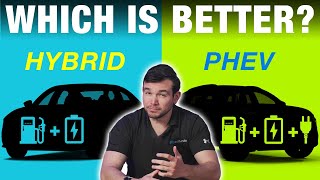

Can't Own an EV? Hybrids Save Thousands
43sRelatable problem of apartment living and high EV prices makes viewers want to learn about a cheaper alternative.
▶ Play Clip"Title accurately promises a clear comparison and buying guide, and the video delivers exactly that with detailed explanations and recommendations."
The video explains the differences between conventional hybrids and plug-in hybrids (PHEVs), helping viewers decide which fits their lifestyle. It covers how each system works, cost implications, and provides recommendations for best models in each category.
Living in an apartment without charging options makes a full EV impractical. High average transaction prices also deter buyers.
Both combine gas engine and electric motor, but only plug-in hybrids can be charged externally. Conventional hybrids self-charge via braking and engine power.
The current Prius battery is 99% smaller than the Tesla Cybertruck battery. PHEV batteries are larger than conventional hybrids but smaller than full EVs.
Most plug-ins offer 20-25 miles of pure EV range; some reach up to 40 miles. Charging takes 6-12 hours on a standard outlet.
At $3.60/gal and 10,000 miles/year, a gas car at 25 MPG costs ~$1,400/year. A 50 MPG hybrid cuts that in half.
Electricity at ~$0.15/kWh makes a full charge cost a few dollars. The EPA offers a calculator to estimate savings; a Prius Prime example shows significant reduction.
Some plug-ins qualify for federal EV tax credit (up to $7,500) for purchase or lease. Rule changes in 2024 expanded eligibility.
Car: Prius (2024 Edmunds Top Rated Car). Crossover: Kia Sportage Hybrid (Top Rated SUV). Three-row: Toyota Grand Highlander (Hybrid MAX offers 27 MPG).
Car: Prius Prime (30+ miles EV range). Crossover: Hyundai Tucson PHEV (33 miles EV range). Minivan: Chrysler Pacifica PHEV (32 miles EV range, full $7,500 credit).
For buyers wanting electrification without full EV commitment, both hybrids and plug-in hybrids offer significant fuel savings. PHEVs provide more electric range and potential tax credits, but require home charging access.
What is the main difference between a hybrid and a plug-in hybrid?
You can only plug in a plug-in hybrid to charge its battery; a conventional hybrid self-charges via braking and the gas engine.
0:42
How much smaller is the Prius battery compared to the Tesla Cybertruck battery?
99% smaller.
1:04
What is the typical pure EV range for a plug-in hybrid?
20 to 25 miles; some models reach up to 40 miles.
1:23
How long does it take to charge a PHEV on a regular household outlet?
6 to 12 hours for a full charge.
1:46
If you drive 10,000 miles per year at 25 MPG with gas at $3.60/gallon, what is your annual fuel cost?
Approximately $1,400.
2:14
What was the average electricity price per kilowatt-hour in the US last year?
About $0.15 per kilowatt-hour.
2:38
Name the three top hybrid picks mentioned in the video.
Prius (car), Kia Sportage Hybrid (crossover), Toyota Grand Highlander (three-row).
3:46
Which plug-in hybrid qualifies for the full $7,500 federal tax credit?
The Chrysler Pacifica plug-in hybrid.
5:15
Core Distinction: Plug-in vs. Conventional
This is the foundational concept of the video, clearly separating the two technologies.
0:42Dramatic Fuel Savings with Hybrids
Provides a concrete, easy-to-understand example of how a hybrid cuts fuel costs in half.
2:09Expert Picks for Hybrids
Offers actionable buying advice backed by Edmunds awards, adding credibility.
3:46Top PHEV Recommendations with Tax Credit Info
Highlights best models and a $7,500 savings opportunity, directly helping purchase decisions.
4:30[00:00] If you're not sure in EV's right for you right now, trust me, I get it. I live in an apartment and I don't have a place to charge. In EV just doesn't make sense for me right now either.
[00:12] Also, the average transaction price of an EV is well over 50 grand at the moment. But but but gas ain't cheap either. So what if you want a little electrification in your life?
[00:25] The average transaction price of a hybrid is around $42,000. It's almost 10 grand less, so let's find some middle ground. We're going to run down the differences between the hybrids and the plug-in hybrids of the world, and at the end we're going to show you which ones we think are the best of each.
[00:39] So what's the difference? Oh, see, both hybrids and plug-ins combine a gas engine with an electric motor, but you can only plug one of them in.
[00:52] A conventional hybrid's only fuel source is the gas you put in the tank. They take care of their own battery by recapturing energy during braking and using some power from the gas engine. Hybrids can charge themselves up because their batteries are tiny relative to a full electric
[01:04] car. The current Toyota Prius, for example, uses a battery that's 99% smaller than the battery in the Tesla Cybertruck, seriously. Now plug-in hybrids have much bigger batteries than regular hybrids, but they're still smaller
[01:17] than fully-veased. They take gas and you can plug them into charge of the battery. So you can drive a plug-in on pure electricity. These plug-ins will get you somewhere in the neighborhood of 20-25 miles of pure EV range.
[01:29] Some of them you can get up to 40 miles on a full charge, and you still got hundreds of miles of gas powered range left. You can plug AP-heav or plug-in hybrid electric vehicle into a level 2 or level 3 charging station, but you don't have to.
[01:42] Even if all you have is a regular outlet in your garage, that's enough to charge a plug-in hybrid overnight. Most will take anywhere from 6-12 hours to get a full charge. That said, the goal here isn't to drive everywhere on electricity alone, but rather
[01:56] to blend gas and electric propulsion as efficiently as possible. If you want to learn a lot more about how hybrids, plug-ins, and EVs work, check out our explainer video. Now let's talk about what this means for your wallet. In simple terms, you're going to be saving money either way.
[02:10] The average price of gas in the US right now is around $3.60 a gallon. If you drive around 10,000 miles a year and get an average of 25 MPG in a regular gas powered car, you're going to spend around $1,400 a year on gas on average.
[02:23] A hybrid that gets 50 MPG immediately cuts that cost right in half. Plug-in hybrids are a little bit trickier to calculate the savings on because charging it up at home will add to your electricity bill. Everyone's situation is different, but simply put electricity is cheaper than gasoline.
[02:37] Last year, the average price of electricity was about $0.15 per kilowatt hour, which means most plug-in hybrids only cost a couple of dollars for a full charge. So if you can plug-in a p-heat at home, you'll cut your gas usage even more and save
[02:49] that much more money. The EPA has a handy calculator that you can use to figure out how much you'll save if you take the plunge on a plug-in hybrid. We'll link that down below so you can see how it works. I included a hypothetical scenario for me if I were to buy, say, a Prius bribe.
[03:03] Here's what that looks like per the EPA. It's worth figuring out how much you'll save over time because you'll pay more up front for a hybrid, and even more for a plug-in.
[03:16] Another thing you might want to keep in mind is that some plug-ins qualify for the federal EV tax incentive if you're financing or buying, which can help bring down that price. Thanks to some rule changes this year, a lot more of them qualify for at least a partial credit if you lease, so keep that in mind when you're shopping.
[03:31] If you want to learn more about the EV tax incentive rules for 2024, guess what, we've got a video for that too. Just click right up here. Okay, now that that's all out of the way, here are some of our favorite hybrids and plug-in hybrids.
[03:44] When it comes to hybrids, our picks are the Prius if you want a car, the Kia Sportage Hybrid if you want a crossover, and the Toyota Grand Highlander if you want a three-row. The Prius won the Edmunds Top Rated Car Award for 2024, and the Sportage Hybrid, that won
[04:00] the Edmunds Top Rated SUV for 2024. They get great fuel economy, are pretty good to drive, and manage to pack in a bunch of value in their own ways. The Grand Highlander is super spacious and can be had with two different hybrid systems.
[04:13] The basic hybrid gets great MPG, but I'd go for the hybrid max. Not only is the most powerful Grand Highlander you can buy, it's also so seamless the whole hybrid thing just falls away into the background, and you can still get up to an EPA estimated 27
[04:26] MPG. That's really impressive for something so big. When it comes to plug-ins, well, your choices are a bit slimmer since they're not as popular. The Prius Prime is a great option for a car.
[04:40] It takes the sleek lines and fun to drive nature of the current Prius, adds an even larger battery, even more power, and in our real world testing it managed more than 30 miles of EV-only range.
[04:52] If you're going for a crossover, the Hyundai Tucson Plug-in Hybrid is a great choice. It's about as spacious as the Sportage we just mentioned, comes with a ton of great tech and safety features, and gets up to an estimated 33 miles of electric-only range.
[05:05] When it comes to people hauling though, nothing delivers quite like a minivan. The Chrysler Pacific of Plug-in is our pick if you need three rows. It's not only hugely spacious and gets an estimated 32 miles of EV range, it also qualifies for
[05:20] the full $7,500 EV tax credit. And there you have it, thank you so much for watching, be sure to do all the likey subscribey stuff down below. Word round here is it's worth like five minutes of good luck or something.
[05:33] We'll see you next time. Bye. And show you which ones we think are best between hybrids and febs, but that's also not the like. Even if all you have is a regular outlet in your gorilla, what if you want a little electric
[05:45] lit it? So you can drive a feb, God plug in. So what's the difference? That's good.
⚡ Saved you 0h 05m reading this? Transcribe any YouTube video for free — no signup needed.