[00:08]
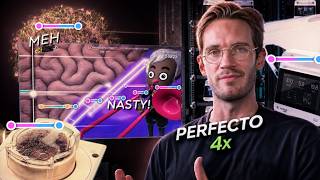
human brain cells from a lab on a petri dish. I got access to it and [music] I made them play the trombone.
[00:24]
did it. Now, I usually pitch video ideas to friends just to kind of gauge. I don't really have the best sense of what's right or wrong. And the unanimous expression has sort of been this phase like
[00:40]
to me, buddy. You probably have a lot of questions. So did I go in into this. So I contacted a lab. They said yes. >> Great. Well, lovely to to meet you and chat with you.
[00:53]
>> It's been really fun like just kind of throwing myself into these [music] these projects that are way too complicated for me, but I thought it was I was living in the future or something. Like I wasn't sure if this is even real.
[01:05]
It's like what do you mean bio computation is a real thing? Are you saying I can replace my 16 GPUs with an actual brain instead? No more of this GPU insanity? Sign me up. So when
[01:18]
running the experiments, I didn't run it on my own computer because it needed to run for a longer time, sometimes overnight. I put these neurons to work, okay? So I ran it with Hostinger's VPS, the sponsor of this video. Yay.
[01:32]
I love [music] this sponsor. You guys need to listen up, okay? They reached you guys existed. This is amazing. One click, easy everything. Thank you. Thank you. It gives you access to a computer in the cloud that is powerful [music]
[01:46]
and you can do whatever you want with it. It's yours. You have root access. Regardless of your technical skill, you can do so many things. They basically have like an [music] app store so you can self-host and replace anything. Open
[01:58]
source right now is amazing. There is so many options to [music] self-host. Get on board. No more Netflix. We use Jellyfin. No more password manager. You pay for that? Google Drive? You pay You pay? We're both cringing. We're making
[02:14]
earlier. I genuinely use Hostinger all the time it for my own websites. I use it for my sister's website. It It's just a guys will enjoy it. And they sponsored this video, so I'm so so thankful. Did I
[02:29]
mention that there's already a massive Black Friday sale with a huge discount? And if you add the coupon code PewDiePie, you get 10% on top. It's PewDiePie, you get 10% on top. It's basically free. Take it I'm salivating.
[02:42]
Take advantage. Test it out. You'll be amazed. I forgot the best part. Odysseus. If you haven't installed it or checked it out yet, Hostinger has now made it super simple. One click install. Maybe more than one click, but it's
[02:54]
on your own server, which is the way it's meant to be and you can finally use it's meant to be and you can finally use it. Ajax any [music] day now. Here it's coming along. Check them out, support the channel, and just get a
[03:07]
great service in return. Done deal. You're welcome. Shake on it. >> I hate how I do that. I don't shouldn't have So I sat down and I got to talk with Cortical Labs, the ones that did this.
[03:21]
They actually previously taught human neurons to play Pong. They also taught the neurons to play Doom. And that's actually how I found out about this cuz I saw someone write about like wait, so you're saying that there's real human
[03:34]
brain cells in a lab and their entire existence is to play Doom? Is that not a little bit messed up? [sighs] No, that's awesome, okay? I wish I was those brain cells. What have your brain cells done today, huh? That's what
[03:48]
Now, [music] I realized that going into this, I kind of had the same like something sketchy about this, right? There has to be. But as I got to sit down with Dr. Elon, which I thought for sure would be 50-year-old dude who's
[04:03]
like begrudgingly accepting me doing this for the promotion. But no, he was awesome, super excited, super on board, and I just had so much fun just talking and asking questions about this whole thing. And he explained how the the two
[04:16]
main misconceptions is that Well, I'll let him say it. sure we're in front of all ethical [music] concerns. Now, using stem cells technology. [music] It's been around since 2012 with the idea of how you
[04:32]
reprogram [music] stem cells into any type of cell. Just taking skin or blood >> Oh, I thought that's what you did actually. Exactly. It It's like a well-developed
[04:44]
embryonic [music] stem cells, which had a lot of people, you know, around that. The brain has 100 billion [music] neurons. We grow 100,000 on a chip. So you're [music] thinking at
[04:57]
0.002% of the brain's capacity without any structure, without any, you know, connection to different regions. [music] It's a very, very basic kind of building block that we're starting. So the people
[05:10]
[music] and the ramifications, A, they're thinking of embryos, and B, mini human [music] brains. >> So it's made from human blood cells, basically. He brought up a good example that it's about as much as the bug. My
[05:23]
pet bugs stink. I have a Japanese kabutomushi. It's about the same level think about. But it doesn't have the same sort of structure of the brain, so it's not nearly as intelligent as a bug. A cool thing about the neurons is the
[05:36]
fact that they are intelligent in the sense of adapting to their environment. again, my bug. If you put it in a different tank, it's still going to adapt. Whereas if I train a model to be good at a game and change any form of
[05:50]
parameter of it, it's not going to know how to do it. But that's also one big difference between training human brain cells as opposed to traditional AI. You would spend all this GPU power on it, which also takes a lot of power, right?
[06:02]
These brain cells actually takes no power whatsoever. The more I think about it, then I'm like, let's make mini brains. I want mini brains. No more AI insanity, okay? It makes more sense than whatever heck is going on right now,
[06:15]
>> And the difference with training neurons as opposed to typical machine learning is way quicker. Am I right? Seriously? >> Exactly. Exactly, right. And machine learning will always outperform this in [music] certain tasks if you allow for
[06:28]
unlimited resources, unlimited time, that kind of thing. >> If you constrain it to have the same, you know, single [music] instance, same amount of time, they cannot learn well at all compared to
[06:41]
They learn really, really quick within [music] 5 to 10 minutes, right? >> That's crazy. Yeah. >> There's no retention of memory on these That's one big distinction as well with AI. So imagine in AI, you kind of
[06:54]
the weights, and then you use it for inference, right? So here it's like brilliant strategy, but you shift your thinking in a way that instead of trying to get frozen weights, we want to [music] learn the best algorithm to get
[07:07]
>> Interesting. >> Does that make sense? >> Yeah, it does. Yeah. That's really cool. >> Another really funny, quirky thing about have to eat. >> Now the cells are embedded in this
[07:20]
really cool chip with [music] something called media. Media is like a something called media. Media is like a synthetic cerebral spinal fluid/gatorade [laughter] which they eat, right?
[07:33]
>> Oh, okay. Right. Yeah. Okay. >> Yeah, and they they also produce waste, so you need to then pump [music] fresh media in and pump the old media out. >> Wow. >> Because they eat, they also
[07:46]
Don't make that face, okay? All right. So I teach them to play trombone. Imagine this, your brain cells sitting in the dark, you have nothing to do in your life, no reason, no rhyme. You're Sisyphus, but you don't even have a
[08:00]
boulder. But then I come in from the light, drop down, trombone, my child. You will play the trombone. But there was going to be some time before that happens. It would take a little bit
[08:13]
a couple months actually, and in the meantime I did everything I could to set realized everything I've done so far completely pointless because the way neurons learn is going to be completely different.
[08:28]
finding the quickest [music] algorithm. So the idea is that we will teach it more progressively. It will start with a simple toot. Then it will go into that there has to learn how to move, and we can change the
[08:42]
hit zone as well to to see like this will count as a hit. There you go. It didn't hit, but it counts as a hit. So that it will learn [music] progressively this is that how quickly the neurons learn. That's the real mind-blowing part
[08:55]
about this. The fact that I got access to this technology at all is insane. And actually they even sell the bio computer itself, which is very tempting. But I opted for the API version. Their goal is to open this up for more people
[09:09]
to connect, which is super super cool. This is cutting edge cutting edge technology. It's brand new basically. So I was so excited to get a chance to do as I could and and as well as I could. So basically I built a mini version of
[09:24]
trombone champion called mini toot that is identical backend basically, but without all the CPU backend whatever. This is a mini mini version so I can play the game without playing the game. And based on its performance the hit box
[09:36]
slimmer. And then finally a couple months have passed. It was time for me to train. And I was getting a little bit panicky for two reasons. Number one, what am I doing? Why do I have access to this? This is insane. But Dr. Alan was
[09:51]
so excited and helpful in general it just made me also kind of yes, we're matter what. So yeah. Number two, he sent me an invoice. How much is this going to cost? >> Yesterday I got the email from them and
[10:06]
they were like, oh yeah, we are going to send you the invoice. And I was like, going to cost? Like, human brain cells? 200 bucks. [laughter]
[10:24]
not that good. >> Literally less than renting GPUs. Okay, sure. [laughter] You can connect directly or you can use their web version of their web UI. Yeah, this is so cool. I love how they
[10:38]
designed it because it's kind of like the Matrix. You can see all the spikes for the neurons. Basically, they are living on a a computer chip with different channels which you can send electrical impulses to and they respond.
[10:50]
That's how it works. We can visualize it here. I love it. It's like the Matrix. This is like the coolest thing ever. The first couple days, I just kind of played to make sure everything was working. >> I just ran some smoke tests and basic
[11:03]
>> I just ran some smoke tests and basic tests and I have not seen any positive reinforcement learning whatsoever so far that I can really worry about. But right now, I'm working so that the workflow is a
[11:15]
bit more dynamic. We can do an ABU, set the reward ladder, change the reward ladder, and then swap it with the B session. [music] And the goal is just to teach it to toot better. I wanted to become better at that and and see it as
[11:29]
a first sort of training example. If I can do that, that would be so honestly so sick if I could do that. So >> We're on day three on me trying to train neurons [music] and that they suck. They are stupid neurons. And I don't want to
[11:41]
watching this video. It's not going well. And I had to ask Dr. Alan for help. His help was basically keep trying. He's helping me actually with the decoder to find out which channel is
[11:56]
more responsive, which is what I've been trying to do anyway. So I think the reality is this is new technology and part of their opening this up is to sort of expand the learning of how to do this. So this is great news and bad
[12:09]
news. The great news is that there's a million things to explore and I'm an extremely obsessive person that will leave no rock unturned. The bad news is [laughter] So let's keep trying.
[12:23]
>> I could see moderate level of learning but sort of in the noise zone like it okay that's cool. Now I just got to teach it how to move down again but then just was stuck up there and I was just like okay.
[12:36]
You see I can kind of a little early manipulate these poor brain neurons.
[12:52]
of rest but I put these neurons to work. I'm sure they were happily obliged to. Who wouldn't want to play the trombone for 20 hours per day, okay? I would love for 20 hours per day, okay? I would love to do that. I started to decode the
[13:07]
different spikes sort of I send a signal, I see what comes back, I can decode that into a different lever in the game. So I have all these things to play with. That's when I could finally finally make my first [music]
[13:20]
recognizable tune which might be actually the first time in ever human brain cells have played a melody. I don't know if that's true now. That's don't know if that's true now. That's probably not true but still it's the
[13:44]
could do more different type of songs and melodies. I did lasagna.
[13:56]
good maybe like 70% accuracy and I could actually make it play real songs.
[14:14]
speed it like four to 16 times cuz they just don't respond that quickly. Uh, the just don't respond that quickly. Uh, the GameCube theme.
[14:28]
The Wii menu theme. [music]
[15:09]
for the neurons to play and I'm sure they are having so much fun as well. Of course. But before I knew it, my month was up. What a privilege this has been. I had so much fun. This is such cool technology that I find so exciting and
[15:25]
so interesting and I'm so happy I can share the fact that this technology even exists with you guys. Thank you Cortica Labs. Huge thanks and uh I will play one final song for you guys, the my favorite one as an outro. But also I wanted to
[15:39]
share Dr. Alan's sort of future take on this cuz I think that's really technology actually go. But I think we all know it has peaked with this song. All right, thank you guys for watching. Take it away neurons.
[16:03]
general intelligence, but we already are general intelligence, right? Like we want to try and unlock with limiting the ethical ramifications as much as possible, unlock the power of biology. We We want to create conscious beings,
[16:17]
right? We don't want to build big brains that can do these amazing things, but if we can even unlock small amounts of this adaptability and learning, which we've shown in Pong, we've shown in Doom with tiny amounts of cells, that's a whole
[16:31]
new technology with who knows what it could do, right?
[17:02]
The internet is worse than ever. Everything is free, free apps, free Everything is free, free apps, free services, but remember, if it's free, you're the product. And companies have taken full advantage
[17:16]
of this. Your name, your phone number, your address, your relatives, your shopping habits, they trade this and sell this. And you might be like, I don't really care, whatever.
[17:28]
They make money off your data. And it's not just like a little bit either. You're worth a lot more than you think. An estimate was at 250 billion every year, and per person in the US is around $700. That's crazy. The good news
[17:43]
is that you can clear yourself from these companies. You have the legal right to do it. Yes. Problem, it will take you forever and you have have other problems in your life. I understand. That's where Incogni comes in. They do
[17:56]
all the work for you. You just sign up, give them the authority, and then you sit back and relax and you watch the updates come through. Oh, another one I think it's so cool cuz it used to be a
[18:08]
and you just [music] had to accept. But now you can actually regain control. otherwise someone else is going to do it for you. They also have this custom removal for their unlimited and family unlimited plan where basically if you
[18:23]
won't remove online, you can direct them to do it for you, which is an amazing was completely impossible before. Check out incognito.com/pewdiepie for 60% off. Take advantage of that
[18:37]
deal. It's an amazing deal. Take privacy seriously in 2026. That's incognito.com/pewdiepie. Thank you for sponsoring this video. Let's get you for sponsoring this video. Let's get back to anime.