

Pareto's 80/20 Principle for Life
46sExplains a powerful, counterintuitive concept that 20% of efforts yield 80% of results, sparking curiosity and self-reflection.
▶ Play Clip"Title promises a minimalist habit system that feels like cheating; video delivers exactly that with a clear Notion-based method."
In this video, Wesley addresses the chaos of global conflicts, AI, and politics by focusing on personal habit management. He introduces the Pareto principle (80/20 rule) and proposes a temporary solution: becoming an expert on your own habits. He demonstrates his Notion-based system for tracking primary habits—like water intake, exercise, sleep, and nutrition—arguing that mastering these basics is essential before tackling larger life goals.
Pareto's 80/20 principle states that 20% of efforts determine 80% of results. Most people waste energy on many things, but only a few actions truly change life.
Wesley proposes a temporary solution: define and list all habits, prioritize the most important ones (primary habits), and track them daily. This builds a solid foundation for life.
Top: ultimate happiness/peace. Middle: career/projects. Base: primary habits (health, sleep, nutrition). Without the base, nothing else can be built.
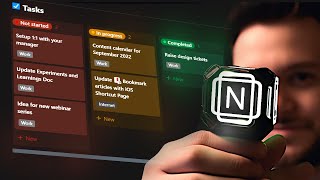
Wesley shows his Notion dashboard with habits categorized: beauty/hygiene, physical activity, digital entrepreneurship, people, and study (philosophy, AI, minimalism).
Primary habits are the most important ones that form the base of the pyramid. Examples: physical activity, digital entrepreneurship, water intake, sleep ritual, and nutrition.
Wesley shows his January 2025 tracker: water (2L/day), training (100% days), sleep (daily check), food (healthy eating), project work, and life bureaucracies.
Tracking reveals the gap between perception and reality. Most people think they do well but data shows otherwise. Even paper tracking works.
Daily list: stretch, drink water, record habits, check calendar/emails, physical activity, project work, secondary cycles. Weekly checklist teased for comments.
Mastering basic habits is the foundation for any larger success. Without a solid base of health and routine, worrying about global issues is futile. Track your habits to gain control and build a better life.
What is the Pareto principle?
20% of efforts determine 80% of results.
01:19
What are primary habits according to Wesley?
The most important habits that form the base of the life pyramid, such as water intake, exercise, sleep, and nutrition.
08:39
What is the temporary solution Wesley proposes for managing chaos?
Become an expert on your own habits: list all habits, prioritize primary ones, and track them daily.
03:28
What are the three levels of Wesley's pyramid model?
Top: ultimate happiness/peace. Middle: career/projects. Base: primary habits (health, sleep, nutrition).
04:21
What does Wesley recommend if you don't use Notion?
Use paper or Excel to track habits; the method is more important than the tool.
16:53
Pareto Principle in Life
Introduces a key productivity concept that underpins the entire video's approach to habit prioritization.
01:19The Pyramid Model
Provides a clear visual framework for understanding why basic habits are foundational to all other achievements.
04:21Primary Habits Definition
Clarifies the critical step of selecting a few key habits that have outsized impact on life quality.
08:39Tracking Reveals Reality
Highlights the common gap between perceived and actual behavior, emphasizing the value of data-driven self-awareness.
16:53[00:02] We talked about war, artificial intelligence, global domination, politics, and all that nonsense. No, not nonsense. In that video, amidst all these international conflicts between major powers, some people commented on
[00:17] my video, "Wesley, what can we do about it?" My response was, " For now, make some popcorn and watch the show." But in this video, I'm going to kill to remind you, I'm against animal abuse, except for a few
[00:32] with one stone? Because the last few videos were chaotic, and people asked what we could do. I'm going to talk about what we can do, and at the same time, I'm going to answer Daniel's comment. Actually, it's not really a
[00:48] comment, but a request. He asked me to make a video about habit management. He commented on my video about my life philosophies, and what does that have to do with the causes? What do my habits have to do with
[01:03] all this chaos of world conflict, war, artificial intelligence, the United States, and China? Calm down, give it a like! First thing... You've probably heard of Pareto's
[01:19] Pareto's 80/20 principle before. This sociologist and economist, Pareto, from Italy, noticed that 20% of families noticed that 20% of families owned 80% of the wealth. That's where
[01:32] Pareto's principle came from, which we still use today for almost everything in life. Basically, we can extrapolate this to mean that 20% of your efforts determine 80% of your results. Very few things
[01:49] results. Very few things you do actually change your life. The big question is: which decisions can truly improve my life? Actually, it's worse than that. We have
[02:02] many decisions and many things we can do in our lives. We put in a lot of effort and do a million things, but only a small percentage of everything we do will actually bring results. The
[02:17] will actually bring results. The big question is: what is this 20%? How can I decide what is most worthwhile to invest my time and energy in? We run into a serious problem: do we
[02:33] serious problem: do we really know how to prioritize? Do I have the ability to choose? What are the 20% that...? It will really do what I 20% that...? It will really do what I have to dedicate myself to, what I strive for, what
[02:46] will really change my life. Sometimes we don't know this; it's a matter of we don't know this; it's a matter of prioritization, and unfortunately, most people don't know how to prioritize. You simply force yourself, you dilute your
[03:02] energy in many things in your life when in reality you should concentrate your effort on a few things, and these few things will ultimately bring you what:
[03:16] happiness, success, in quotes. You will be able to get where you want to be. So, regardless of whether you know how to prioritize things, perhaps I have a
[03:28] temporary solution to this problem, something we can do. Regardless of whether you know how to prioritize or where you want your life to go, or what you need to strive for at this moment
[03:42] to change your life amidst all this chaos of economics, politics, war, and artificial intelligence, the job market is changing, where do
[03:54] I go, what do I do? I propose a temporary solution, and you will understand why it's temporary: to be an expert on your own habits. That is, to
[04:06] on your own habits. That is, to define and list all your habits, your entire routine, to know how to prioritize which are the best or most important ones. I'll call them primary habits, and I'll dedicate myself to them, and
[04:21] I'll show you exactly all of that in this video. Maybe this video will be a little longer than I imagined. At the top of this pyramid is where you top of this pyramid is where you want to get to, your complete happiness, at the
[04:35] end, achieving everything. You'll die in peace. You're in a hospital bed, you're about to die, you're in your last hours, you'll die like this: "It was worth it, I
[04:47] did what I could, I achieved what I had to achieve, what worked, worked, what didn't, didn't, I did my best." This is the peak, you give your best. In the middle of this pyramid are the steps you will follow in your life, whether it's a
[05:03] career, a personal project, or financial independence, whatever it may be. financial independence, whatever it may be. But there's something very important, which is But there's something very important, which is this part here: the base of the pyramid. Without
[05:17] this base, you can't build anything in your life. What is this base? Let's go to the video on life philosophies. I showed you this, I told you that
[05:30] my life is entirely built on my life philosophies. From these philosophies, I define what my vision is, where I want to go, and
[05:42] where I want to go will be... It depends on two things: my habits and my projects. Basically, that's it. And in this philosophy video, someone commented, "Wesley, make a video showing how you manage your habits,"
[05:57] habit list, habit management, weekly checklist, daily checklist. Let's go! So this video doesn't get as long as I think it will. This here is Notion, my core dashboard, my whole life.
[06:11] Oh, Wesley, what is Notion? What software are you using to organize your whole life? Calm down. If you're at that stage, there's a playlist here on the channel called "Productivity with Notion," where I come from scratch, building
[06:26] my entire life here, and you can see all the details of my life. This was built over years. So that playlist is there if you want to learn about Notion. If you don't want to learn about Notion, that's okay.
[06:40] The important thing is the macro, is for you to understand how I organize. So today our focus is this: habit management. First thing: my habits, I have to create a list of all my habits, and that's
[06:54] list of all my habits, and that's simply it. Nothing fancy, nothing simply it. Nothing fancy, nothing too beautiful, a wonderful template, raw material. What is this? Here I have my beauty-related habits, bar
[07:06] hygiene, and here I have my physical activity habits. A habit is something you do regularly. Here I have my digital entrepreneurship habits, for example, 2 hours of work a day. I try to do this every
[07:21] day. I also have some notes or things I want to do related to people, whether family or not. And other words, I like to study, I like to increase and improve my intellect,
[07:37] so I read books and sometimes I focus on more specific areas like productivity, technology, Artificial Intelligence, minimalism, philosophy. This is a general list. So this is the first point I would like you to
[07:51] make: create a general list of habits. Oh, Wesley, if I want to copy all your things, all these templates, these things, in the description of this video there's a link to my newsletter. In this newsletter, when
[08:05] you subscribe to it, you immediately receive an email with a link to all my templates for free, simple as that. And I hardly bother you with emails. I think I send an email every two
[08:21] to three months, but that's because of the amount of... The feedback I received from the last newsletter was good, and it was worthwhile. But it's only for those over 18. There's one thing missing now. Actually, once I have all these habits here, I need to make a decision.
[08:39] habits here, I need to make a decision. Which habits are so important that they will be promoted to primary habits—the
[08:51] most important habits in my life? For example, in my case, I have physical activity as a primary habit, and personal projects related to digital entrepreneurship as a primary habit. In terms of
[09:07] digital entrepreneurship as a primary habit. In terms of nutrition, meeting my water intake goal is a primary habit. So what are these primary habits? This is the base of the pyramid. If I don't have a set of habits that I'm going to dedicate myself to and
[09:25] habits that I'm going to dedicate myself to and track, I'm going to account for whether I'm really doing this or not, whether I 'm falling short or not. These are the habits that, without them, your life is worthless. It's no use dreaming, it's no
[09:41] use thinking about a career, it's no use the United States versus China, it's no United States versus China, it's no use the global crisis, the international market, or the job market. If your life is a mess and you don't even take care of the
[09:56] basics, it's no use worrying about the future. That's why this is a solution I'm giving you. This is temporary because once you become an expert on your own habits and are tracking and
[10:12] habits and are tracking and correcting them month by month, then this won't be necessary anymore, and you can move on to other aspects of your life. So, on my page, the next thing is
[10:26] managing these primary habits. If I go here, I'll filter If I go here, I'll filter for January. Let's go, the rule is between January 1st and January 31st.
[10:42] between January 1st and January 31st. Okay, this was my January Okay, this was my January 2025. First, what were the habits I chose to be my primary habits? Water. Hey Wesley, you were
[10:59] talking about the United States versus China, you were talking about espionage agencies, and now you're talking about drinking water. That's right, exactly, drinking water is my habit. It's a primary habit. Training is my primary habit. Training, not just at the
[11:15] gym, but doing any physical activity, running, etc. Sleep is physical activity, running, etc. Sleep is a primary habit. I need to sleep well. If I don't sleep well, my life will be a mess. And in my case, for
[11:30] many years my life was a mess, but through medical treatments and medication, I sleep a little better. Because I have a little problem that I wo n't talk about here because it's not the subject of this video, which makes it difficult for
[11:46] me to sleep, so I need to follow a sleep ritual to be able to sleep at the right time, do the right things, stop using the computer at the right time, turn off the lights at the right time, eat properly so that I do
[12:01] n't end up sleeping stuffed and feeling sick at night. That's what I call my sleep ritual. If you want, we can talk about the details of something that's here in another video. Sleeping well,
[12:16] even though I follow my sleep ritual, might not have slept well. So I check every single day if I slept well that day or not. Because sleep is one of the most important things there is. A
[12:31] primary habit is food. What food is that? Eating well. I ate well that day, so I mark that day with a check. If I didn't eat well that day, I don't mark that day with a check. So I had a healthy breakfast, a healthy lunch, a
[12:46] a healthy breakfast, a healthy lunch, a hamburger. I won't mark the food check because... Last night I hesitated. Of course, obviously this isn't terrorism. Oh, so you live for this? Obviously, there wo
[13:04] n't be a day when I'm going to eat pizza, or a hamburger, I'm going to eat everything, and I'm not going to write off my food allowance that day, simple as that. There are days when you have to indulge,
[13:18] There are days when you have to indulge, but your life can't be one but your life can't be one big indulgence 100% of the time, big indulgence 100% of the time, that complicates things. Look, it has to
[13:32] be correct. Another primary habit for me is the Project, the project of my life, what I want for my life. I divide this vision into projects and I fulfill each project. One of my projects, for example, is this
[13:48] YouTube channel. This is a project, right? So probably today, on this date, I'm going to write off the check that I worked on my project because I recorded this video for you. And other secondary things in life, this secondary thing
[14:03] secondary things in life, this secondary thing is the following: life's bureaucracies, being organized. What are my life's bureaucracies? Paying bills, making investments, solving things. Oh, taking the car for maintenance and, I don't know,
[14:18] car for maintenance and, I don't know, cleaning. The house being dirty, etc., are secondary things, but they should be done in an organized way to save time. So I count this type of activity
[14:32] in my primary habits. So if I get here at the end of the day, look, I have this down here, for every day of January. If you
[14:44] look here, for all my days in January, I drank 2 liters of water, at least 2 liters of water. I trained every day of January 100%. See?
[14:57] trained every day of January 100%. See? Right, in this workout here, there 's an exception that maybe only one person on this planet Earth will know what it was, because I marked this day as a workout when I didn't train. It would be
[15:12] good, actually, if I stopped talking nonsense in the videos. Wesley, can I copy this template of nonsense in the videos. Wesley, can I copy this template of yours? It's free. If you use Notion, you can click a button, just subscribe to MinisLare
[15:26] that's down there, and you'll receive an email with a link to this, an email with a link to this, completely free, obviously. Anyway, I think it's unreasonable for me to charge to give you a template. There are many
[15:39] templates out there that are paid, but... 100% of my templates are completely of my templates are completely free, from the heart. I don't know, I don't free, from the heart. I don't know, I don't know a better way for you to put
[15:51] your habits there and be a better person without keeping track. Oh Wesley, but better person without keeping track. Oh Wesley, but I'm just doing it off the top of my head, and so on. Maybe you're an exception, that's fine. You can do all this
[16:07] without writing anything down, great, but I think for 99% of people, if they write it down, for 99% of people, if they write it down, they'll see that they thought they were doing everything right and it's a mess. I thought I ate well, but when
[16:23] you see the result in the spreadsheet, it shows that you ate well on 20% of the days, and what did you do on the other 80%? You think you drink water every day, yes, but think you drink water every day, yes, but you don't count the daily amount, let alone the
[16:38] monthly amount. Are you really drinking water every single day of the month? So, I don't know what you want for your life, I don't know where you want to go, I don't know if your life is already great or a mess, but these
[16:53] kinds of habits, which are the base of the pyramid, need to be tracked. Let's try, even if it's in a notepad. Even if it 's in Excel. Oh, I don't use Notion, I don't use those software programs, it's too complicated. Do it on paper, send it to me in a
[17:08] Direct Message. Go to Direct Message and send me a picture of it, I'd love to see and like your photo there. And if you're not managing to keep up with these habits, send it to me in a Direct Message too, and I'll do this habit with you. Wesley, I'm
[17:23] day. I go to my Instagram, which I do n't usually use much, I'm usually absent, those who follow me on Instagram know that sometimes I appear very rarely. But if you want to help me, I'll go to my Stories and
[17:38] say, "Guys, today I'm going to drink water with so-and-so," and I'll tag you every time someone completes 500 ml. We'll make a Story and tag each other, and you to drink water. I'll do this
[17:51] with you if you want, in habit management, obviously. There are things I want, I need to do every day, so I need a daily list. What is this daily list of mine? This here, look how interesting, just this.
[18:06] here, look how interesting, just this. This is the main thing: water, food, random things I do in the moment, like taking medicine, taking my medication that I need to take every day. So what I do every single day is
[18:21] do every single day is stretch and drink 400 ml of water when I wake up. I record my habits. That is, I mark in the primary habits what happened the previous day, I see the
[18:34] day's commitments, I go to my Google Calendar, see the appointments, okay, what do I have to do today, great, I check my emails, WhatsApp or Instagram depending on the situation, I do my physical activity, work on my
[18:47] projects, do the secondary cycles which are the bureaucracies of life, cleaning the house, paying bills, etc. And that's my day. I also have a weekly checklist. But
[18:59] I only show the weekly checklist if you comment now on the video: weekly checklist and the goals I have for the month, which in this case has already changed months, right? We're in another month. If you do these two things: a
[19:15] general habit list for all areas of your life, everything you do recurrently, like I showed mine, and define which are the primary ones that you will really are the primary ones that you will really dedicate yourself to writing down day by day, if you
[19:30] do... That's life, you're cheating because cheating because 99% of people don't do this, they have a shitty life, they're always having some problem, they're never happy, and their health isn't good, they
[19:44] 're worried that the United States and China are fighting, but the guy United States and China are fighting, but the guy doesn't drink
[19:57] motivation, doesn't know why he doesn't have energy, doesn't know why he doesn't have discipline, can't concentrate on anything because his health and his basic habits are a mess. Without that, it's difficult to decide what
[20:14] future you want, to make good decisions because your brain isn't even working properly because you're not eating well, so you don't have energy, you're tired or sleepy every day, you don't sleep well, uh, uh. Then
[20:29] sadness sets in and that feeling that your life isn't going anywhere because you're worried about so many things happening in the world and you're not doing the basics. If you want to continue with this line of reasoning,
[20:44] take a look at this video here where I show you what my perfect productivity system is, and it's minimalist. A kiss on your butt, give it a like.


⚡ Saved you 0h 20m reading this? Transcribe any YouTube video for free — no signup needed.