
The Boy Who Beat the World, Then Vanished
56sThe emotional rise-and-fall story of Unmukt Chand, from World Cup hero to retirement, resonates with anyone who fears wasted potential.
▶ Play Clip"Delivers a solid framework with research backing, but the 30-minute promise is padded with anecdotes and repetition."
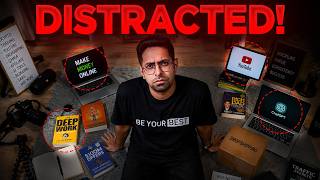
The video explores the concept of distraction, arguing that it is not merely about phone usage but any action that deviates from one's intentions. It identifies three types of distraction—external, internal, and attention switching—and introduces the FIT formula (Find your trigger, Implement friction, Train your traction muscle) to manage them. The content draws on psychological research and personal anecdotes to provide a framework for improving focus.
Unmukt Chand, who led India to win the Under-19 Cricket World Cup in 2012 with an unbeaten 111 in the final, was hailed as the next Virat Kohli. However, he failed to replicate success at higher levels, retiring from Indian cricket at age 28, illustrating how talent alone isn't enough without sustained focus.
The video highlights similar cases: Ronaldinho, a football genius, lacked discipline; Vinod Kambli had a higher test average than Sachin Tendulkar but his career ended early; Byju's, once India's most valued startup, collapsed. All share a common error: distraction.
The common error is termed 'The Distraction Code.' The video promises to decode this error and provide methods to overcome it, turning the brain from an enemy into a weapon.
Research by Dr. Gloria Mark (UC) shows average attention span on a screen dropped from 150 seconds in 2004 to 75 seconds in 2012, and to 47 seconds in 2024—a threefold decrease in 20 years.
Distraction is not just doom scrolling; it's any action that takes you away from your intention. Nir Eyal's definition: 'distraction is any action that takes you away from your intention.' Traction is the opposite—actions that move you toward your intention.
Distraction comes in three forms: external (notifications, environment), internal (pain: physical, emotional, incomplete tasks), and attention switching (multitasking). Each steals focus without our realization.
A UC study found that after a distraction, it takes an average of 23 minutes to fully regain focus. With 10 distractions a day, that's 230 minutes (almost 4 hours) lost.
Phones trigger dopamine release due to variable rewards, making us check them habitually. App icons use bright colors to stimulate the brain's reward system, similar to Cocomelon's effect on children.
Internal distractions stem from physical pain (headache, lack of sleep), emotional pain (rumination, heartbreak), and incomplete tasks (70-90 open loops). These act like background tabs slowing down the brain.
Multitasking is a myth; it's actually attention switching. A 2010 study found only 2.5% of people are 'supertaskers'; the rest suffer from switching costs, reducing performance on all tasks.
No, distraction cannot be completely eliminated. The goal is to manage it, not remove it. The video introduces the FIT formula: Find your trigger, Implement friction, Train your traction muscle.
Identify what triggers your distraction. Ask three questions: What was I doing? What did I go to do? When did I return? Track patterns for 3 days to understand your triggers.
Add friction to make distractions harder. Physical friction: keep phone in drawer, use DND, use an alarm clock. Digital friction: remove social media apps, use app timers. Time friction: time boxing, schedule tasks.
Focus is like a muscle; train it with the Pomodoro technique (25 min focus, 5 min break). Focus is a daily decision, not a destination.
Distraction is a pervasive issue that can derail even the most talented individuals. By understanding its mechanisms and applying the FIT framework—finding triggers, implementing friction, and training focus—you can regain control and improve productivity.
What is the definition of distraction according to Nir Eyal?
Any action that takes you away from your intention.
08:32
What was the average attention span on a screen in 2024 according to Dr. Gloria Mark's research?
47 seconds.
05:46
How long does it take to regain focus after a distraction, according to a UC study?
An average of 23 minutes.
12:02
What are the three types of internal pain that can cause distraction?
Physical pain, emotional pain, and incomplete tasks.
17:00
What percentage of people are 'supertaskers' who can multitask effectively?
Only 2.5%.
19:58
What does the 'F' in the FIT formula stand for?
Find your trigger.
24:27
What are the three questions to ask yourself when you get distracted?
What was I doing? What did I go to do? When did I return?
25:35
What is the Pomodoro technique?
25 minutes of focused work followed by a 5-minute break, with a longer break after four rounds.
34:54
Attention span dropped to 47 seconds
Shocking statistic showing a threefold decrease in focus over 20 years, making the problem urgent.
05:46Distraction is any action away from intention
Reframes distraction beyond phones, making it a universal concept applicable to all areas of life.
08:3223 minutes to refocus
Quantifies the hidden cost of distractions, emphasizing the need to minimize them.
12:02Only 2.5% are supertaskers
Debunks the myth of multitasking, showing that most people suffer from attention switching.
19:58FIT formula introduced
Provides a memorable, actionable framework for managing distractions.
24:27[00:03] final [music] of the ICC Under 9 Cricket World Cup 2012 The match is going on [music] Australia has scored 225 runs please about pressure so much that even the best players get nervous.
[00:19] pressure so much that even the best players get nervous. But not a single wrinkle is visible on this boy's face. Shot by shot. Star over by over last boundary seems.
[00:38] 111 not out and India win the Under-19 World Champions. Give Biggs a celebration.
[00:50] whole country is chanting one name. The main headline is that India's next Virat Kohli has arrived. After Virat Kohli, if anyone is to be named as one of the most promising cricketers [music] in India, it
[01:04] scoring back to back centuries [music] in the semi-finals and finals. This boy had to be nurtured because he was a big player. The world is watching the trophy, watching the celebrations, watching the birth of a hero, but
[01:17] watching the birth of a hero, but no one sees what happens next. Virat wins the Under-19 in 2008 and he gets into the Indian team in a year.
[01:34] Selection does not come. Sounds come from outside. People start talking but he still continues playing. Six IPL seasons, 21 matches and just 300 runs. The same defeat which had led to his 111 not out in the World Cup final. Now I am
[01:51] 111 not out in the World Cup final. Now I am not able to hit consistent shots. He retired from Indian cricket in 202 at the age of just 28. If he gets the tag of Next Mukhriz Chand. I believe that I am one above the rest. I've been that
[02:07] possible. Unroukh Chand has announced his retirement. Unroukh Chand has announced his retirement. And today in 2026, no one is taking that boy's name. And today in 2026, no one is taking that boy's name.
[02:24] This is a pattern that repeats over and over again in every generation, in every sport, in every field and in our lives. For example, Ronaldinho was once one of the top talented football players in the world who made football an art. Turned that into [music].
[02:39] made football an art. Turned that into [music]. also missed. Coaches say Ronaldo would have been a better player than Ronaldo if he had the
[02:52] discipline of Ronaldo [music]. Vinod Kamli was the cricketer whose test average was more than Sachin. Yet his career ended at the age of 23. Yet his career ended at the age of 23.
[03:07] Or BJJU, which became India's most valued startup but The fall of bjjuice has [music] become one of the most dramatic stories in Indian startup history. Unmukt Ronaldino Kamali Byju's Different
[03:21] people in different fields, there was one thing that was stopping all of them, a common human error. My team and I tried to understand what that error is and how it happens.
[03:34] We read some papers related to psychology and neuroscience, still lost it. We analyzed their patterns, decisions and their thinking. We tried to decode those moments where they were at their peak and slowly everything
[03:49] started falling apart. And in this entire research, one thing came up again and again. An error that is not visible but happens everywhere. That error due to which even talent does not work.
[04:02] That error due to which even hard work becomes weak. The error that Unmukt had, Kamali had and Ronaldinho had. And maybe you have too. The name of this error is The
[04:14] maybe you have too. The name of this error is The Distraction Code.
[04:31] Pros My name is Kumar Bhai Aaj omelette nahi banaunga Tel ka omelette Bhai Aaj omelette nahi banaunga Tel ka omelette banaunga
[04:46] Now watch this for a second and tell me how many times I tapped.
[05:21] This problem is not just yours but it has become the problem of the entire world. According to a research paper from the American Psychological Association, University of California professor Dr. Gloria Mark measured for 20 years
[05:34] measured for 20 years In 2004, its result was 150 seconds i.e. 2 minutes. But in 2012 it fell to
[05:46] 75 seconds. This means that in eight years it has reduced to half and in 2024 it has reduced to 47 seconds. This means that in just 20 years, something so dangerous changed that a person
[05:59] 's focus dropped three times. Now let me ask you some questions. You should answer them honestly. Has it ever happened that you are talking to someone? He is speaking. You are listening and suddenly you realize that your mind has gone somewhere else. You
[06:12] move on somewhere else in the middle of the conversation. Or maybe I watched a movie, a show, watched it together with someone and later when something is being discussed with you, I don't even remember when it happened. You were doing something and in the middle you went to your phone and you did not even realize how
[06:25] much time was spent on the phone. If you are trying to concentrate on something but are emotionally disturbed from within, then you are not able to concentrate. And most importantly, how many times did your attention shift from this screen in the last few minutes. If you went to some other voice,
[06:40] or some thought came to your mind, think honestly and see. If the answer to any of these questions is yes, then this video is very important for you. Because today after watching this video you will know exactly when you get distracted. Even when
[06:56] when you get distracted. Even when tell you the things that steal your focus from within [music] without making you realize it. I will tell you the methods by which the work which has been stuck for months will be done. You will start doing those
[07:09] goals which I will do again and again from tomorrow but get stuck. managed and eliminated my distractions, thereby multiplying my productivity results
[07:21] and growth. In fact, by the end of the video, the biggest thing is that your brain, which till now you consider your enemy, will become your biggest weapon.
[07:34] What is distraction? Now before I answer this question, tell me what do you think some person or some thought that comes and settles in your mind.
[07:50] 99% of people think that distraction means doom scrolling on the phone. means doom scrolling on the phone. staying socially engaged. Whereas nothing like this happens. These are just tools of distraction.
[08:06] This is not the distraction itself. For example, you are sitting with your best friend. He is sharing something important with you about his captivity. You are physically with him at that time. It is not in the phone in your hand. Your notifications are also
[08:19] off. But if your mind goes somewhere else. He is stuck in something else. Is stuck in something else. Is [music] is a distraction. Nir, author of Indistractable,
[08:32] says that distraction is any action that takes you away from your intention [music]. Distraction is any action that takes you away from your intention. This means that if you thought that you have to do this work today and
[08:48] you keep doing something else, then that is a distraction. Whether there was a phone or not. Whether the bar was noisy or not. Whether you had one or not. Distraction is not a thing. Distraction is a direction, a wrong direction. And Nir himself has proposed a word here,
[09:04] traction. That is, any action that takes you towards your intention. For example, it could be doing a big project , getting enough sleep, exercising,
[09:16] eating right, spending time with someone special, meditating, or even enjoying yourself. It could all be traction. You should understand that traction means what you thought of doing and did it as a distraction. That which you did not think of doing
[09:30] and did. Whatever I thought of doing, I got traction; whatever I did not think of doing, I still got distraction. And notice that it is not bad to use the phone in traction. Watching Netflix isn't bad. It is
[09:43] not bad to rest. Playing games is not bad. Because if you have intentionally decided that I want to watch Netflix right now. This is my time to enjoy. I need to talk to someone. This is my time to relax. Now it's time for me to play games.
[09:55] You have the intention and you are doing it. This is traction. But if you sit down to work and turn on your phone, that's a distraction [music]. You are sitting to do something else but you keep watching Netflix, that is a distraction. Is this difference clear? Because whatever is coming next is
[10:11] in the next chapter we will know where this distraction comes from. What are the three ways through which it reaches your focus? Every day without knocking or
[10:23] informing, and unless you know these three ways, it will be difficult for you to close the door. 2006 A high security museum in Mumbai where security is tight, there are guards, cameras, even alarm systems are installed.
[10:38] Everyone thinks that no one can come inside. But then a thief comes to that museum again. Absolutely confident, polished and trusted. No one suspects him because he does not look like a thief. And by the time the security gets to know about it, the theft has already taken place.
[10:51] This was Mr. A, the thief from Dhoom 2, who did not break the door but came inside the museum in disguise. Your focus is also stolen exactly like this.
[11:03] What is your focus here? That precious collection and distraction of the museum is Mr. A. Meaning, distraction does not come by breaking the door. She Comes in Disguise. Meaning she comes in disguise. And by the time you realize it, the day is gone.
[11:18] So now we're going to unmask these three different faces. These three disguises that come in three different faces, their only job is to steal your focus. Let's unmask them one by one. The first face of Distractions , the first Disguise External. Imagine a scene. It is
[11:34] 9:00 in the morning. Your tea or your coffee is in your hand. The laptop is open. In fact, your to-do list is also ready as to what needs to be done today. You're sitting there focused and then [music]
[11:47] And you immediately think, let me check it for a second. And you don't even realize when that 1 second gets converted into 16 minutes or 18 minutes. In fact, a research by the University of California revealed that if our focus is lost once, it takes
[12:02] revealed that if our focus is lost once, it takes seconds to bring it back to the same level. This means that a single notification can have so much power that it can take 23 minutes to get yourself back to concentration. And if there are 10 such distractions
[12:18] in a day, then 230 minutes are gone, which means almost 4 hours, that too just because of notifications. Look, phone is a very important part of our life. We cannot leave it and notifications are a major part of our phone. Therefore, here I would like to tell
[12:34] you two very important things around notifications. I would like to make you aware. One is the thought loop. Many people feel that the more notifications they receive, the more Because the problem is not just the notification. The problem is the thought loop that
[12:48] starts after the notification. Some notification came, who messaged and if the message came in the notification then what should be the reply to it? If you haven't done it. You might be read the notification and you've got a distraction [music]. You have taken a thought loop.
[13:03] After reading one thing, 3 4 5 10 thoughts are coming into our mind. Now notifications also have a scientific face which is the dopamine loop. And to understand this, answer a simple question. Why don't you feel the same happiness
[13:18] while working as you do when you pick up the phone ? And the answer lies in the screen. In this regard, researchers from John Hopkins University conducted an experiment in 2016. People had to find red and green objects on the screen. Finding something red gave
[13:33] more rewards and finding something green gave less. Now next time there was no reward, no task. But whenever a red object appeared on the screen, the participants' brains automatically released dopamine. This research
[13:48] reveals an important thing about our brain: that we do experiences gave us happiness, gave us dopamine, gave us a brain hit. Because of that our attention moves there and this is what is happening with our phones.
[14:04] Every time we picked up the phone, we saw something new, got something new, felt something good saw something new, got something new, felt something good and the brain made an association that this is a phone, holding it means a reward. It feels good to hold it. Now see
[14:17] what happens next. Dopamine is released as soon as we see the phone, that is why we hold the phone. When the screen is on, the brain becomes alert. And now look how things are planned. This is not happening accidentally. Have you ever wondered why app icons aren't pastel colors
[14:31] ? Why not beige, mint, green, white ? This is because they do not work on our brain. Whereas red, yellow, pink, blue colors further hit the reward system of the brain. Whether you look at the gradient of Instagram, the
[14:44] red of YouTube, or the bold icons of notifications. All this [music] stuff is designed daily on purpose. So that every time you pick up the screen, your brain becomes more alert and responds. It's the same Cocomelon psychology.
[14:58] stimulating for children that the child cannot move away from the screen. He will eat the food while watching and his parents will feed him. The same thing is happening with us also. Just the packaging is a little different. Now here the brain has picked up a pattern that if you pick up the phone, you will feel good. But you will feel
[15:13] effort while working. Well, it will feel very late. The game is over here. The brain becomes intelligent. That program is such that what is the shortcut to like it ? He has to like himself. He will repeatedly choose where the reward is higher
[15:28] and the effort is lower. That's why your hand automatically goes to Instagram, YouTube reels automatically goes to Instagram, YouTube reels and then you say that I am not interested in work. But the fact is that it is not your mind that is wandering but your brain is
[15:43] wandering you. That too for the reward. But do you know what the most dangerous part is? This thief is not someone outside. It's in your hand, in your pocket, on the side of the bed. And the most important thing is that we ourselves invited him to our house. Just like Mr. A. The second
[16:00] disguise is internal. There is a girl named Tara whose life is fine from outside. He has work, routine, people. She wakes up in the morning , opens her laptop and within 5 minutes
[16:12] , her eyes are off the screen. know why? The problem is not work. The problem is that a part of it is still stuck somewhere else. She randomly stops working and wonders what he might be doing at this time ? Was all that happened true
[16:29] ? Then she says to herself, leave it, leave it, move on and focus. But the more she pushes herself, the more that feeling comes back. This is the same thing that happened in Tara's life after Ved left her in Tamasha. The work was possible but the connection was broken from inside.
[16:44] And when the connection from inside is broken then no work from outside gets connected. So look, Tara is not getting distracted by her phone, nor by Instagram, nor by any social media platform, rather she is getting distracted by herself. His head was here
[16:57] and his mind was somewhere else. And this is the other face of distraction which comes in disguise and that is pen. Look, there are three types of pain that can distract us. The first is the physical pen. Think for yourself, if you have stomach ache or headache, then no matter how much you
[17:12] try, you cannot concentrate. The entire processing power of your brain gets shifted towards the pen. His entire attention goes towards the pen. Many times you feel that you are not able to concentrate but the reason is that you have not got enough sleep. I am not able to focus
[17:25] nutrition is not complete. I haven't eaten properly. You ate junk or there is a deficiency of vitamins in the body or there is a deficiency of supplements. No matter how much you try, no matter how hard you work, if your body is not in good shape, it is not possible for your brain to focus. The
[17:40] second is emotional pain. Sometimes someone says something that just won't go out of your mind, or you can't sleep thinking about that one thing all night, or you break up like Tara. When something is stuck in our heart, we want to say something to the other person but are
[17:55] unable to do so, or there is some guilt or resentment or regret going on inside us, then to get away from all this, we divert our mind here and there. But there is only cycle of overthinking, which psychologists call rumination. This
[18:08] means that a background process keeps running in the brain 24 hours a day without turning off. In fact, research says that the more rumination, the less focus. The more rumination, the less focus. The more rumination, the less focus. And the
[18:20] third aspect of these internal distractions is incomplete life. This face is not the most hidden but is the most heavy. he has to pay a bill, he has to make a call to her , someone's reply is pending. These are all
[18:35] small things. But research says that there are 70 to 90 incomplete things in the life of an average person at all times. And even if you forget these things with your conscious mind, your brain does not forget them. He is very powerful. He has the
[18:49] capacity to remember. All this continues in the background like an open tab. You are sitting to focus but think, 70 tabs are already open. And just like a computer slows down when 70 tabs are open, your brain functions the same way. Let's
[19:05] come to Third Disguise. What was the biggest twist in Dhoom 2? Mr. Ek himself became a hero. He was a villain. But I felt like a hero after seeing him. Attention Switching Our Third Disguise is exactly that. It makes you feel productive. But actually
[19:20] this is the biggest distraction. Let me tell you how many of you think saying no, yes I multitask. I can handle a lot at once. I have a habit of doing multiple tasks simultaneously, so it is possible that
[19:33] you are telling yourself a big lie. In 2010, two psychologists from the University of Futa, Jason and David, conducted a very interesting experiment. They took 200 people and put them in a high fidelity driving stimulator. Made it feel exactly like
[19:45] real driving. There is speed , there are brakes, there is traffic and along with that a complex memory and math task is also given to solve. Meaning, simultaneously handle the car in that simulation. Run that as well and solve this problem as well. The
[19:58] researchers wanted to know whether a person could do both tasks simultaneously without sacrificing performance. The result was that only 2.5% people were able to do this experiment. Meaning that out of 200 people, only five people were able to do it whose driving was perfect
[20:12] and also the memory task and they were named Super Taskers and the remaining 97.5% went to them. His break reaction time increased. His memory performance dropped. Meaning,
[20:24] given two tasks, performance drops in both. Meaning that he was multitasking, so to speak. But actually he was jumping from one work to another. He is jumping as fast as possible, which we call multitasking. But actually its
[20:39] name is attention switching. And because of attention switching, you have to pay switching costs. Switching cost means that when the mind is going from one task to another and when it is going back to that task, it has to restart again. The
[20:53] you're doing both. But actually you are doing it half-half, neither is this thing being done properly nor is that thing being done properly. Both are becoming half-finished and useless. And when we were doing research, a big concern came up which I would
[21:06] very commonly see people switching their attention, while doing one task they pick up the phone in the middle and are switching their attention on the phone as well. You know that it has a very dangerous side effect, the
[21:20] more switches there are in our life. The more you switch, the less your ability to focus becomes. The brain learns a habit of not staying on one task for too long, as soon as you switch to another task, you gradually remember those 47
[21:35] seconds, this is a big reason for this. So these were three faces, three disguises but the thief is only one – distraction. The external came from outside, he was invited. Was familiar. The internal one came from inside and was in your own voice. Attention switching, which became the hero, made me
[21:52] feel productive but was the most dangerous. Now, as important as it is to know about the thief, it is equally important to stop the thief from stealing. Because the door is still open and the thief is standing outside. So we have to understand how to close this door.
[22:07] So let us understand from the angle of neuroscience, from the angle of psychology, from my example, how we can eliminate our distractions. You can deal with them. You can hack your brain [music]. Mr. A's most dangerous Disguise in Doom 2 was
[22:23] when he transformed into himself. There was a new face, a new identity. No one could recognize him and internal distraction also does the same. She becomes like you. Speaks in your voice. It lives in your thoughts. That's why it doesn't come under your control.
[22:38] First a question: Can distraction be eliminated? The answer is no. And whoever claims that it can be eliminated is lying because in reality, neither can you completely remove the distractions of the world,
[22:52] nor can you easily override the biology of the brain, nor then what can you do, the real focus is not in removing distractions but
[23:06] not in removing distractions but when 4-5 hours passed. Or our favorite cartoon would come on TV. And at that time, even if there was mother's voice, it was
[23:20] not audible. If I was so focused or liked a book very much, I would keep reading it at night under the blanket with the torch on. I couldn't sleep. For this I am giving you a the advantage of frameworks is that they are remembered. Become a part of your life.
[23:35] Even after the video, you are able to implement these things in your life because of the framework. That or videos I try to make the solution a framework. Because I will not just give you motivation, you can remain focused or I will just preach. If I just
[23:49] tell examples of people then there will be no result. But whatever the framework is, it will come into effect in life. That will be practical. That will be remembered. That [music] will be executable in your life. So the framework I'm giving you is the FIT Fit
[24:01] formula. And the things that I will tell you about in these three are some of the things that I have used in my personal life, used regularly, due to which I was able to reduce my distractions, increase my focus and because of increasing focus, the
[24:14] results increased, productivity increased, growth increased. These are the things that just didn't talked about these in my workshops, when I told corporates, people used them, the productivity of companies increased, the results of people increased. So, these are the tried and tested
[24:27] things that I am going to share with you. F stands for Find Your Trigger. I have F stands for Find Your Trigger. I have Indistractable by Jo Ni Rial. He says in his book that you can't call something
[24:39] a distraction until you know what it is distracting you from. Meaning, first know where you wanted to go? What is your goal? What were you trying to do ? Only then will you know where you have gone. This means that unless you know your trigger,
[24:55] searching for a solution to something will be like groping in the dark. a research from the University of California. Where people were told not to keep their phones locked the whole day and not to check how many times they checked their phones. The result is
[25:09] visible that people said that they checked their phones 15-20 times throughout the day. But the actual number checked their phones 15-20 times throughout the day. But the actual number was 96. That means once every 10 minutes. The problem is not that people are distracted. The problem is that they do
[25:21] n't even realize that they are getting distracted. So the first step is to find your trigger and for this you have to do a simple thing. I would say the next few days, especially three days. Whenever you get distracted, do one thing after that. Don't get angry yourself. Don't
[25:35] scold yourself. Don't speak ill of yourself. Do one thing. Ask three simple questions. What was I doing? What did you go to do and when did you return? For example, Gaurav got distracted. realized that I was distracted. He asked himself, what was I doing? I was
[25:51] doing a college assignment. What did you go to do ? I picked up the phone and started scrolling through the reel. When did you come back? Came back after 26 minutes. If Gaurav observes for just 3 days
[26:03] , he will see his pattern. Very important. You will understand your pattern. Half the problem will be solved. He would notice that every time a that every time a difficult question came up in the assignment, the phone would be picked up.
[26:17] Because when he repeatedly reflected and asked questions, he noticed a pattern of when he was getting distracted. So the trigger here is not a notification. trigger here is not a notification. That is a difficult question. Meaning, as soon as the
[26:31] difficult question came, there was discomfort and Gaurav picked up the phone. Someone's trigger may be emotional pain. You may not have had enough sleep. There could be some weakness in the body , there could be notifications, there could be boredom, there could be some uncomfortable task
[26:44] , there could be some work which you do not feel like doing. But when you know the trigger, it will be But when you know the trigger, it will be implement friction.
[27:01] less people will do it and the easier it is, the more they will do it. BJ Fogg says in Tiny Habits that behavior happens when motivation, ability, and a purpose converge at the [music] same point. Meaning that
[27:15] distraction occurs when these three things come together. What is he saying? Look, they say first of all there is no motivation. Meaning there is some feeling inside that pulls you away from work. It could be boredom , it could be fatigue. It could be a
[27:27] difficult task that causes you discomfort. There is an emotional discomfort and this internal signal comes from within to do something else. There must be some reason. There must be some motivation. Then comes ability. This means
[27:41] distraction is available to you. The phone is in hand. Opened the lock screen and opened some application. It's just a click away because you're able. You have that ability that if motivation comes then I have that ability. Now the third thing is Prap.
[27:57] Motivation came. It could be boredom. That could be being uncomfortable. That task may seem difficult. And ability is achieved. Phone may have the ability. There may be an option to play [music] outside at home. There may be some game lying nearby.
[28:11] Meaning, I have the ability to get involved in something with that motivation. I have that possibility. And the third is Prap. I'm not going inside her until I'm saying yes. What is my PREP? Yes.
[28:24] Motivation came. There is the ability. Now I will do this. The prop can also be external. You were getting bored. Motivation happened. Ability You have a bike parked outside. You can go somewhere. And then you get a call from your friend saying let's go play
[28:37] or go out for a walk. You say let's go. Now you see that if you remove even one of these three things, there will be no distraction. It is important to have motivation. It is important to have ability and it is important to have preparation. So
[28:51] what is the solution now? Suction I Implement Friction. Frictions will have to be applied to break this MAP. So the first wall to prevent a thief from entering is physical friction. Meaning, how can we physically create some friction due to which there is
[29:06] no distraction. For example, when I sit down to work, I keep my phone inside the drawer next to me in the office. I keep the ringing on DND mode so that if something urgent happens, the other person will call twice. In that case, I'll
[29:20] pick up the phone and check. Everything else is muted. Research shows that simply putting your phone aside can improve your focus by 26%. Meaning, if the phone is not visible then the mind does not go towards it. Many years ago, I had a habit of
[29:34] looking at my phone as soon as I woke up, checking my phone. The day used to start with the phone, which I did not feel right, why should I give so much to my phone as soon as I wake up. I did a small thing. I figured I had to set an alarm so I
[29:47] kept my phone nearby. But since the phone is nearby, I go inside the phone as soon as I wake up. So I got an alarm clock. Got the solution for ₹2 ₹250. Focus worth crores of rupees was saved. I started keeping my phone far away on the study table or on the TV
[30:01] table and kept a cute alarm clock beside it. If you get emotionally distracted and remember your ex, then see what things make you remember them. If you can remove them from your environment. If there are any such photos in your phone, then
[30:14] delete them or if something stressful is going on in your life, then at that time do not keep stressful is going on in your life, then at that time do not keep junk food, liquor bottles or cigarettes so accessible in the house. Got a little upset motivation access is
[30:26] availability lying around. Hey Dan Prep, friend, if you want to use your brain somewhere then let's go. If you get distracted because of switching, if your attention keeps wandering, then you can make physical changes, right? Sit in front of the wall. Sit there and work so that when you look up, you can only
[30:39] wear noise-canceling headphones. Put white noise inside it. So these are some physically possible ways to add friction and break the cycle of your MP. Let me add friction and break the cycle of your MP. Let me
[30:54] digital distractions, so friction is also very important digitally. I will give my example here also. I did a small thing but again it was of great benefit. When I realized, there came a time when I was standing in the lift,
[31:08] Insta opened. You are sitting idle, Insta is open. So whenever I am free, I am checking how many views it got. Did the DMs come? So I noticed that brother, something is going wrong, you are also becoming addicted, so this has to be solved. Now there was a way
[31:22] I vow. I wo n't open Instagram and every time my hand is going away and I don't know when it will go away. So what will your vow do? So I found a very easy solution in which my brain did not have to test my will power.
[31:36] I had an old phone. I put that phone to use. All my social media inside of it, Instagram, Facebook, everything inside of it. And my main phone, which I use regularly, does not have social media. So I do Instagram.
[31:50] go on social media. I check Twitter. But that's part of my traction. Not of distraction. I open the bag and now it's my social media time. Time to check Instagram. Opened the bag and grabbed the phone. Grabbed the phone, checked it. I
[32:04] looked at it for the time I thought I would and then put the phone back down. Whether it happens twice but it is not happening out of habit, it is happening out of traction, not out of distraction, so it is not necessary to get another phone, you can put all the social media in a folder,
[32:17] you can remove the face lock so that you have to enter the code every time, you can turn off the notifications, you can set an app timer, this feature in the phone that whenever you open an app, a notification comes up that do you
[32:33] habit, you can customize any such notification. So imagine every time you habitually opened an app and a notification came up. You remembered it, right? No, no, something went wrong. If you get emotionally distracted by some people, then
[32:49] distracted by looking at their feed and their posts, then unfollow them, block them. And if you get distracted while multitasking, then Make a rule. One task, one tab. Only one browser tab will open.
[33:03] Another browser will open for other work. Multiple tabs will not open. Let's talk about the third wall, time friction, which gave me a lot of benefit. I recommend this to my entire team. When they use it, they also get a lot of benefits. And when I do
[33:16] podcasts with Accomplish people and I ask them how do you manage time. 5000 people work for you. The turnover is worth crores of rupees. They also tell the same thing that I am going to tell you.
[33:32] call time boxing. Because when the time is scheduled, the brain considers it as a commitment that this focused work of mine will be done from so and so time. This is my my social media time so it will be only social media. This is my meditation
[33:46] time. I will meditate at this time. When you divide your day into time blocks. You can get many times more returns and output on the same day. Meaning you can live 36 hours in 24 hours. The time that used to get wasted earlier is
[33:59] not realized. That same time now runs according to you. What you cannot track you cannot grow What you cannot measure will not be tracked and what will not be tracked will not grow, so block your time,
[34:12] track that only then you will grow and train your traction muscle, train the traction muscle, the distraction muscle is trend, remember that 47 seconds, why did that happen, it did
[34:24] not happen because people are lazy, it happened because the focus muscle was not used, so it automatically became weak, an example is an athlete who stops playing sports for 10 years and then comes back to play, will he perform the same on the first day? He won't do it, right?
[34:39] And this is exactly what happens with our focus. So there is a science backed method called Pomodoro Technique which I also use. I will suggest you to do the same. is a very simple system. You might already know that 25 minutes of focusing on just one task is
[34:54] followed by a 5-minute intentional break to do whatever you want to do. And after four such rounds, there is a big break of 15 to 20 minutes. I tell everyone to do it as per your wish. If you can focus for a long time, you can do 45 minutes or 15 minutes.
[35:07] focus for a long time, you can do 45 minutes or 15 minutes. But you have to train your focus like a muscle. Day one can be very weak. But if you keep doing it, it will become stronger. If you keep doing it, it will become your superpower. Remember that focus is
[35:21] not a destination. Focus is a daily decision. It is Daily 's decision whether the day will go into traction or distraction. Every day you have the choice of whether to live life with traction [music] or distraction. Just think about where you would be if the next 10 years were
[35:35] spent in distraction and where you would be if they were spent in traction. Distractions are increasing in the world and staying focused in a distracted world is not a matter of luck that you can wait and one day you will get focus. This is a skill and
[35:49] skills are learned and practiced. There are frameworks for that. It is important to be aware of that. It is important to understand the problem. And that was the effort of this video that you should know about the problem in detail. Know about his solution
[36:02] in detail. I covered all kinds of examples. practice, from my examples to accomplished people. With a purpose. The same purpose as every video of mine. The same purpose that has been
[36:17] driving me and making me work for the last 16 years. To help you move forward. See you again in the next video. Till then stay happy and keep sharing happiness. I love stay happy and keep sharing happiness. I love you all.



⚡ Saved you 0h 36m reading this? Transcribe any YouTube video for free — no signup needed.