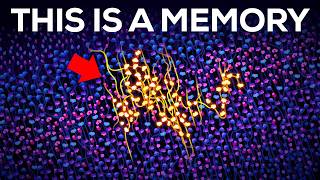

What IS a memory?
44sOpens with a profound question about the nature of memory and its role in identity, instantly engaging viewers.
▶ Play ClipThis video explores the biological and neurological basis of memory, explaining how memories are formed, stored, and retrieved in the brain. It emphasizes that memories are not static but are malleable and change each time they are recalled, influencing our identity and perception of the past.
Memories allow us to experience past moments repeatedly, encoding, storing, and retrieving information about the world and ourselves.
Like dioramas made from wax, memories can melt and change each time they are brought into the spotlight of attention.
The human brain consists of about 86 billion neurons, each connected to up to 10,000 others, forming hundreds of trillions of connections.
When two neurons fire at the same time, their synapses change and their connection gets stronger, forming patterns.
Neurons organize into columns that process basic sensory information like light, sound, and touch, located in different brain regions.
A new pattern of synchronized activity across different brain regions creates the experience of a moment, called the assembly.
The hippocampus creates a blueprint of the winning assembly, saving its configuration and indexing it with related memories.
Without reinforcement, the assembly fades and synapses weaken, leading to forgetting most moments of life.
Novelty, repetition, and emotions are key mechanisms that strengthen memories by making neurons more changeable and solidifying connections.
Recalling a memory makes it malleable again; new context and emotions can alter the original memory, so the more you remember, the less accurate it becomes.
Therapy can help by revisiting hurtful memories in a safe context, literally rewiring the brain to change the narrative of one's life.
Memories are not perfect recordings but are dynamic and change over time, shaping our identity and decisions. Understanding this can empower us to actively influence our memories and personal growth.
How many neurons are in the human brain?
About 86 billion.
1:00
What happens when two neurons fire at the same time?
Their synapses change and their connection gets stronger.
1:48
What are cortical columns?
Basic information processing units that process tiny pieces of sensory input like light, sound, and touch.
2:06
What is the 'assembly' in the context of memory?
A new pattern of synchronized activity across different brain regions that gives the experience of a moment.
3:22
What role does the hippocampus play in memory?
It creates a blueprint of the winning assembly, saving its configuration and indexing it with related memories.
4:50
Why do we forget most moments of our lives?
Without reinforcement, the assembly fades and synapses weaken.
5:47
Name three ways to strengthen a memory.
Novelty, repetition, and emotions.
7:18
How does recalling a memory change it?
The memory becomes malleable again, and new context and emotions can alter the original memory.
10:11
What does the phrase 'the more you remember something actively, the less of the original experience remains' mean?
Each recall updates the memory, so the original experience is gradually replaced by the recalled version.
11:58
How can therapy help change memories?
By revisiting hurtful memories in a safe context, it can literally rewire the brain to change the narrative.
12:31
Memories Are Not Static
This insight challenges the common perception of memory as a fixed recording, highlighting its dynamic and malleable nature.
0:15Neurons Strengthen Connections
Explains the fundamental mechanism of learning and memory formation at the neural level.
1:48The Assembly Concept
Provides a clear model for how different brain regions coordinate to create a unified conscious experience.
3:22Ways to Strengthen Memories
Offers practical, actionable insights for improving memory retention through novelty, repetition, and emotion.
7:18Therapy and Memory Rewiring
Connects the malleability of memory to therapeutic practices, emphasizing the potential for personal change.
12:31[00:00] Memories are biological magic that enable you
[00:07] With them, your mind can encode, store and
[00:12] But memories are not static like photos.
[00:15] Like dioramas made from wax,
[00:19] spotlight of your attention they
[00:23] Which is a bit concerning because they
[00:28] They are the personal lore a lot of your
[00:30] identity is based on – and the basis
[00:35] What does it mean if they change?
[00:37] And more fundamentally… What IS a memory? How
[00:45] Your Brain is Weird Madness
[00:48] The human brain is the most complex thing in the
[00:54] Scientific models work but are not
[00:57] It's a bit like talking
[01:00] But in a nutshell, what makes you think and feel
[01:07] Extremely complex electrochemical root
[01:12] through synapses – tiny gaps between cells, where
[01:18] bridges the distance, is received
[01:23] This is how neurons talk to each other.
[01:25] And it's a busy conversation because a typical
[01:31] Together they’re a network of
[01:35] A hundred times more than galaxies
[01:40] From these connections the
[01:44] To create purpose in this chaos some
[01:48] Whenever two neurons fire at the same time their
[01:51] synapses change and their
[01:55] They become buddies if you want, and
[01:59] If we zoom out, patterns emerge.
[02:01] Dozens or thousands of neurons
[02:06] These columns are very basic
[02:09] that process a tiny piece of all the
[02:13] like dark and light, a location in space, how
[02:19] You have columns for sound, images, touch etc,
[02:25] These columns are the gears of the
[02:30] It’s the fundamental hardware you emerge from.
[02:33] Everything you see, hear, or feel causes the gears
[02:36] to move – which means your
[02:40] But for you to have a coherent experience,
[02:42] these very different gears
[02:45] Any moment you perceive is
[02:48] As you are watching this video, your eyes
[02:52] your visual cortex, your ears transmit
[02:57] language areas are decoding my words, while other
[03:03] All these signals are processed in deeper
[03:07] boosting what seems important right
[03:12] Vastly simplifying, this concert of all
[03:16] wheels and screws comes together to create a new
[03:22] A new pattern of synchronized activity
[03:28] This assembly of very different
[03:30] is what gives you the experience of
[03:35] So the assembly active in your brain
[03:39] hearing my voice and learning about memories.
[03:41] But this is only activity
[03:45] like ripples on a pond, nothing will remain.
[03:48] Without memories you will forever
[03:51] To become a being that transcends
[03:56] sensory inputs, these temporary moments,
[04:01] And how does your brain decide what becomes
[04:07] How To Store The Past
[04:10] In reality there is not just one
[04:13] Your brain can’t process everything in the
[04:17] so different assemblies
[04:19] The details are complicated, but at any moment,
[04:22] one assembly is winning and deemed
[04:26] This is what you are aware of right now.
[04:29] In your brain, the assembly
[04:32] speaking to you seems to be
[04:35] Your brain thinks this matters
[04:39] Two things are happening right now:
[04:41] The neurons of the winning assembly are bathed
[04:46] to change and tie them closer together,
[04:50] And the memory center and librarian of your
[04:56] The details here are super complicated and
[05:01] But in a nutshell, your
[05:04] saving the rough configuration of the assembly.
[05:07] The assembly is saved and put
[05:11] memories that are associated with
[05:14] Like “everytime I was confused by
[05:19] Finally you have a memory!
[05:21] An activation pattern of millions of neurons,
[05:26] Activating any part of the pattern now
[05:31] are able to relive a moment of the past
[05:36] But this new memory is very
[05:40] Your hippocampus holds its blueprint,
[05:42] but without reinforcement, the assembly will
[05:47] This is why you forget most moments of your life,
[05:50] why you don’t remember how your coffee
[05:55] You experience most of your life
[05:59] And you don’t just forget what happens to you
[06:04] Most news stories disappear within days,
[06:06] and often you never even saw the
[06:09] This is why we’ve partnered with Ground News,
[06:12] a media literacy tool whose
[06:15] Their app and website let you compare coverage,
[06:18] explore context and see how
[06:22] You can even see how bias shapes the narrative.
[06:25] Take this study on Alzheimer’s risk in women.
[06:28] More than 40 articles were published on it: some
[06:33] others highlight the benefits of hormone therapy.
[06:35] You’re actively weighing
[06:38] deeper engagement helps your brain to remember.
[06:41] Most importantly, Ground News reveals "blind
[06:46] showing you what your usual news feed is hiding.
[06:49] As information bubbles become the norm, thinking
[06:55] And Ground News makes it easier to do just that.
[06:58] Try it via the QR code on the screen or
[07:03] Our link below gives you 40% off
[07:07] and directly supports our channel.
[07:10] And now, back to your brand-new memory!
[07:13] For the past to be truly saved, the
[07:18] There are many ways this can happen:
[07:20] One of them is novelty.
[07:22] If you walk to the bus, listening to
[07:26] this assembly’s signal is too weak.
[07:29] This moment in time will be
[07:33] But if one day you see a crow and
[07:36] only for a mouse to steal it – the assembly will
[07:42] Another one is to reactivate the memory
[07:46] Thinking about the animal fight all
[07:49] strange event will etch it deeper into your brain.
[07:52] Similar to doing loads of repetition
[07:56] And a major way to make a memory
[08:01] Emotions are really strong mechanisms
[08:03] to guide our behavior that evolved
[08:07] They motivate you to avoid danger,
[08:11] You experience this as
[08:14] Whenever you feel something strongly, your
[08:18] on is important for your survival,
[08:23] So many of your strongest memories
[08:27] The humiliation when you acted
[08:30] The joy when you beat your dad at Mario Kart.
[08:33] The devastation when your dog died.
[08:36] The overwhelming love when
[08:40] If we just made you feel something, we increased
[08:45] Strong activation, repetition and
[08:49] We said before that chemicals made the neurons
[08:55] Like wax warming up and melting together,
[09:00] to fit more tightly – neurons grow more
[09:06] They become closer and more solid.
[09:08] A lot of this happens while you sleep.
[09:10] Your hippocampus replays the assembly over and
[09:16] – which also means that if you don’t sleep
[09:21] Think about that when you have to study for
[09:25] you’ll be wasting your time.
[09:27] But in the end you have a proper long term memory.
[09:30] A diorama of hardened wax,
[09:34] A scene etched into a pattern
[09:38] Now you can remember it forever! Well…
[09:42] Why Remembering Changes Your Memories Forever
[09:45] To remember you need a cue for the memory,
[09:50] A smell, sound, word or maybe
[09:55] Your hippocampus searches its index for the cue,
[09:57] hopefully finding the right
[10:00] It fires.
[10:02] Your past experience is retrieved.
[10:04] The diorama appears in your mind and you
[10:09] So far so good.
[10:11] But as the diorama plays for
[10:15] Recalling memories is not like
[10:19] Under the light of your attention
[10:22] Moldable.
[10:23] Which means that as you experience
[10:27] involved are bathed in chemicals that make
[10:32] Your hippocampus organizes memories based
[10:36] the context of the experience.
[10:38] And the context is now very different.
[10:41] When you formed the memory you were tired, in a
[10:46] Right now you are pulling the memory as you
[10:50] and are telling them your hilarious
[10:54] And this new context seeps into the memory.
[10:58] New connections form, some synapses
[11:03] The diorama changes, becomes
[11:07] Not because you want it to,
[11:08] your brain is just incorporating the new
[11:13] As you finish your story, the
[11:16] the diorama hardens again, now in a new form.
[11:20] The next time you remember the animal fight,
[11:22] you will remember it as way funnier
[11:26] And it is the same with all your
[11:29] your brain adds new information or forgets some,
[11:35] In a sense it updates your past life to
[11:40] Over time, even core memories can shift, combine
[11:46] Your memory system is deeply intertwined with
[11:51] designed to create an accurate
[11:54] So your memories are updated as you
[11:58] Ironically, the more you
[12:01] the less of the original experience remains.
[12:04] This also means that just because you remember
[12:06] something really well it does
[12:10] It just means that its assembly
[12:14] It’s not a sudden process, your
[12:18] It is a slow shift in the overall
[12:22] You are who you are today, but your
[12:26] they will think and feel differently
[12:31] This is also why therapy can be so helpful.
[12:34] By revisiting hurtful memories in a safe context,
[12:38] ideally with helpful introspection,
[12:42] Literally rewiring yourself
[12:46] Because yes, your memories may be the lore
[12:52] But it turns out, with some help you may be able
[13:02] And if you want to rewrite the lore of your home,
[13:04] new human made, original Art Prints
[13:09] Choose a dramatic meteor shower,
[13:14] powerful volcanic eruption –
[13:18] Each print is created with bold neon colors and
[13:23] The sturdy frame is designed to stand solo on
[13:29] when the light hits it just right, it
[13:33] Get yours now and literally
⚡ Saved you 0h 13m reading this? Transcribe any YouTube video for free — no signup needed.