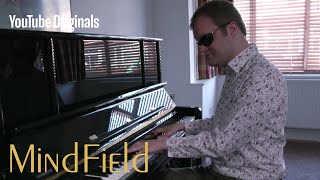

What is Blindsight?
50sThe concept of blindsight is mind-blowing and counterintuitive, sparking curiosity and debate.
▶ Play Clip"The title accurately reflects the video's exploration of unique brains and abilities."
This video explores the concept of divergent minds, focusing on individuals like Derek Paravicini, a blind autistic savant with extraordinary musical abilities, and Jason, who developed savant skills after a brain injury. It delves into how different brain structures can lead to remarkable talents and challenges our understanding of normalcy.
A tray of brains is shown; a sagittal slice reveals that different parts of the brain control different functions. Damage to specific areas can affect specific abilities.
Some people who are blind due to visual cortex damage can still sense objects unconsciously, a phenomenon called blindsight. This shows that unconscious visual processing exists.
Derek Paravicini is a blind autistic savant with extraordinary musical talent. He can play complex pieces by ear and has performed worldwide.
Paul Broca discovered that damage to a specific brain region (Broca's area) impairs speech production, leading to Broca's aphasia where patients understand language but cannot speak fluently.
Damage to Wernicke's area causes fluent but nonsensical speech, as patients cannot comprehend language properly.
TMS temporarily disrupts brain activity in targeted regions. The host undergoes TMS to temporarily impair his Broca's area, but it fails to work on him.
Derek has perfect pitch and can identify all notes in a chord within 0.4 seconds. He is a prodigious savant, one of fewer than 100 in the world.
Adam Ockelford explains that Derek's premature birth and blindness led to enhanced auditory processing. Autism amplified his focus on sensory details.
Babies experience the world in raw perception, but most quickly learn to categorize. Autistic individuals may retain this vivid perception longer, leading to exceptional abilities.
Some people acquire savant skills after brain injury. Jason, after a severe concussion, developed an intuitive understanding of geometry and calculus, despite no prior math background.
Jason sees the world in discrete frames (akinetopsia) and perceives objects as composed of straight lines and triangles, which inspired his mathematical insights.
Jason believes everyone has latent savant abilities that can emerge after brain injury, as the brain reorganizes and accesses new ways of processing information.
Derek is a hero to disabled children and adults, showing that divergent minds can achieve remarkable things and should be celebrated rather than hidden.
Divergent minds, whether from birth or acquired after injury, reveal the brain's incredible plasticity and latent potential. Understanding these minds helps us appreciate the diversity of human cognition and the value of all kinds of brains.
What is blindsight?
The ability of people who are blind due to visual cortex damage to unconsciously sense objects they cannot see.
01:49
What did Paul Broca discover?
A brain region (Broca's area) important for producing speech; damage leads to Broca's aphasia.
04:11
What is Wernicke's area responsible for?
Language comprehension; damage causes fluent but nonsensical speech.
05:21
What is Transcranial Magnetic Stimulation (TMS)?
A technology that temporarily disrupts brain activity in targeted regions using magnetic pulses.
07:44
What is a prodigious savant?
An autistic savant with exceptional abilities that would be considered spectacular even among savants; fewer than 100 exist worldwide.
12:29
How fast can Derek Paravicini identify all notes in a chord?
Within about 0.4 seconds.
14:34
What is categorical perception?
The process by which the brain categorizes sensory information, losing raw perceptual vividness; autistic individuals may retain this vividness longer.
15:56
What is Acquired Savant Syndrome?
When a person develops savant skills after a brain injury, revealing latent abilities.
20:39
What visual condition did Jason develop after his brain injury?
Akinetopsia, seeing the world in discrete frames like a slideshow.
21:35
What mathematical concepts did Jason intuitively understand after his injury?
Integrals and calculus, despite having no prior math background.
22:58
Blindsight Phenomenon
Demonstrates unconscious visual processing, challenging assumptions about consciousness.
01:49Broca's Area Discovery
Foundational discovery linking specific brain region to speech production.
04:11Prodigious Savant Definition
Highlights extreme rarity and exceptional nature of Derek's abilities.
12:29Categorical Perception in Autism
Explains how autistic individuals may retain vivid sensory perception, leading to talents.
15:56Acquired Savant Syndrome
Suggests latent savant abilities exist in everyone, accessible after brain injury.
20:39[00:06] [ambient music playing] on YouTube? [Michael] Okay.
[00:20] that I'd love for you to listen to I would like to listen to it, Michael. All right. Just load this up here.
[00:33] [theme music playing] [playing piano]
[01:08] This is a tray of brains. Here is a sagittal slice I prepared earlier. Just looking at it, it would be impossible to know
[01:22] or that different parts did different things at all. you can often affect specific functions. that would be pretty bad.
[01:36] have just become cortically bind. and stabbing people's brains but they can study the behavior and abilities of people
[01:49] For instance, in rare cases, but who are blind due to damage to their visual cortex of blindsight
[02:03] to objects they cannot see. is consciously blind on his right side. he's able to sense the presence and motion
[02:18] [man] You're moving it up and down. no color, no depth, no form, no contrast. which is associated with conscious vision,
[02:32] that get information from the eyes unconsciously. because of blindsight. has revolutionized our understanding of the brain
[02:47] People who differ from the norm that we didn't even know were there. [ambient music playing]
[03:01] [upbeat music playing] is that of Derek Paravicini. [both] One,
[03:15] [Michael] Derek is both blind and autistic. Now for the live music you were promised. and social impairments,
[03:28] than what would be considered normal. for his latest album. [playing "Flight of the Bumblebees"]
[03:40] He's performed all over the world for other autistic individuals.
[03:57] Later, we'll take a deeper look into Derek's unique mind. [upbeat music playing]
[04:11] if different parts of the brain did different things. that we discovered that there are different modules
[04:23] The first major discovery was made by a doctor named Paul Broca in the 1800s. understanding language,
[04:38] The only thing the patient could say over and over. tan, tan, tan, tan, tan, tan, tan, tan, tan, tan, tan.
[04:50] and found that the patient's brain Broca concluded that this brain region, must be important for producing speech
[05:05] This language deficit called Broca's Aphasia who get strokes in the left side of their brain. but struggles to get the words out.
[05:21] Scott. Oh, no. And how old are you?
[05:38] -[woman] Try. -I can't. is Wernicke's Area Patients who damage this region
[05:52] or use it in a meaningful wa. Right at the moment a darn should-- a darn thing.
[06:04] [woman] With the iPad that we were doing. I'd like my change for me and change hands for me. We're all with them.
[06:18] I'm very happy with them. about the neural basis of language. based only on specific patients.
[06:32] and the brain can reorganize itself So to get a more precise picture of how changing the brain I went to UCLA
[06:46] But not permanently. Instead, I'm going to have part of my brain tissue by a technology called
[07:01] Here I go. by saying I'm glad to be here.
[07:14] I'm a little anxious about what's about to happen. a brain lesion, temporarily. Right.
[07:28] I like to be in control, especially of myself. Should I be worried?
[07:44] or TMS for short, such as Broca's Area. in the part of the brain that is stimulated.
[07:58] But as soon as the pulse is over, While it's not guaranteed that TMS Dr. Iacoboni has successfully stimulated
[08:12] Transcranial magnetic stimulation, -[clicking] -[indistinct speech] [Michael] Now it was time to have my speech disrupted.
[08:29] first, we had to find it Hopefully, we'll be able to find Broca's Area and shut me up.
[08:42] somebody tapping on your scalp, some superficial muscle stimulation. probably be a little bit uncomfortable.
[08:54] If it becomes too much, Okay. the first chapter of Pride and Prejudice
[09:07] and I'll just start reading, "'My dear Mr. Bennet,' said his lady to him one day, "Mr. Bennet replied that he had not.
[09:22] "'and she told me all about it." "cried his wife impatiently. This was invitation enough."
[09:36] but my Broca's Area seemed to be playing hard to get. New trajectory. "'You and the girls may go,
[09:49] 'which perhaps will be better still, 'Mr. Bingley may like you the best of the party. we were still unsuccessful at finding my Broca's Area
[10:03] "...married, its solace was visiting and news." I beat it.
[10:18] While neuromapping allows us to locate the brain is one of the most complex organs in our body TMS didn't work on me this time,
[10:34] but different test subjects produce different results. Is find out what.... [indistinct] [Michael] TMS is currently being evaluated
[10:49] One day, it may even be used to reduce the effects of traumatic brain injury. [upbeat music playing]
[11:02] who was using his divergent mind Derek, it's Michael. I'm fantastic. I would love to come in.
[11:16] I wanted to find out what Derek could teach us about all brains. Do you know psychology? Your brain is different than mine.
[11:31] -It's different than my brain, yes. -Yes. that this was going to be an atypical interview. about how spectacular your abilities are.
[11:47] when you first started to interact with a piano? when I first started to interact with a piano... a condition which causes him to repeat back words
[12:02] It's his way of trying to understand You can learn music just by listening to it. I can learn music by listening to it, Michael.
[12:15] he has no problem communicating through music. There are about seven million autistic savants worldwide
[12:29] but Derek is what's known as a prodigious savant... that they would be considered spectacular
[12:41] There are probably fewer than a hundred prodigious savants in the whole world. that I think any performer would envy.
[12:54] Uh, maybe pop music or... A bit of jazz, yeah. Derek has been mentored by Adam Ockelford.
[13:07] [Michael] Adam is a music psychologist, at the University of Roehampton. Go on.
[13:24] Twenty-six weeks, And they didn't have any equipment So they rushed him into the nearest hospital
[13:36] wasn't thought able to survive, and yet he did. Because of the circumstances of his birth his brain developed in a particular kind of way.
[13:51] not being able to see. and that was like a eureka moment for him processing ability.
[14:05] perhaps understanding how people feel, And yet his music is way above average. -I have, yes. -If I go like...
[14:21] or... [Michael] That's impressive, Derek. Yeah, no, the response to pitch that you make, Derek,
[14:34] We've measured the time between playing even a big chord, say like this one. to an eight-note chord within about 0.4 of a second.
[14:48] -Wow. -Derek's sense of pitch is very unusual. Something like 40% of babies have perfect pitch as opposed to
[15:01] So you can see that has a massive effect on the way the brain develops. Well, autism is an added factor.
[15:16] And in Derek's case, of course, And what autism tends to do is to give children whether it's a sound or a--
[15:30] That's the quality that we all have as babies, that we experience the world in this sheer perception. Now most babies very quickly come out of that
[15:42] They're starting to categorize things So you're born, and your body is, like, -Yeah. -[Michael] And then it learns that's crazy.
[15:56] We only need to understand what's important [Adam] It's called categorical perception, that's why the brain does it.
[16:09] absolute qualities for longer. got those fantastically vivid absolute memories, but it's built on this-- on this foundation of perceptual
[16:26] vividness that we can only grasp at. to identify all of the individual notes Derek is able to do this with ease,
[16:42] than he can play at once with two hands. -We could combine. -Yes, yes, yeah. -[Michael] Yup. -And those two with that hand.
[16:58] And we'll count for it, okay? One, two, three, four. [Adam] Well, the fiddling was to make it--
[17:10] [Michael] He's just playing-- but they were all-- But as amazing as his musical ear is, Derek's cognitive abilities are less than rudimentary.
[17:25] -So can you play this for me? -[Derek] Yes, Adam. Good. And do you know how many notes there are, Derek? -Is it one? -[Adam] Yeah, a bit more than one.
[17:41] four, five, six. [Adam] Good. Now try this one then, Derek.
[17:53] [Derek] Is it one note, Adam? [Derek] One, two, three, four, five. It is one, two, three, four, five, Adam.
[18:06] Derek's everyday abilities are. that you or I do without thinking really difficult. getting washed in the morning are tricky for him.
[18:22] he finds really difficult. [Derek] Could you clean my mouth now, Cynthia? [Derek] I can come to the sink.
[18:35] "Well, does it really matter if Derek And-- and yet when he touches the piano, So things that we would find inconceivably difficult,
[18:50] And if you ask him, "Derek, how'd you do that?" how we breathe or how we speak or... [playing ragtime]
[19:13] with his remarkable abilities, to scientists who study the mind. about this thing in our head?
[19:26] is the almost infinite capacity of the human brain but thrive in incredibly difficult circumstances. really was no different from anyone else's.
[19:41] So in a sense, you could say that we all have But fortunately, of course, we don't have his disadvantages and what gave Derek his massive advantage
[19:55] [upbeat music playing] One of the many theories for the cause
[20:08] is that it's at least partially due to an abnormality permitting a vast amount of sensory details Neurotypical brains may receive all the same sensory details
[20:25] but block them from awareness. that all of us have savant skills And they may be on to something,
[20:39] people can actually acquire savant skills. Acquired Savant Syndrome. as adults and their brain damage
[20:54] that weren't there before. After a brain injury left him with damage Jason started seeing precise geometric patterns
[21:08] which led to an intuitive perception of math How did you get a brain injury? these two guys that were in there singing
[21:21] Well, I just heard this deep thud, bouncing on the inside of my skull. [Michael] So now you have Akinetopsia,
[21:35] meaning you see the world now in frames. When I say discreetly, I mean seeing one picture watching TV right now, they can hit pause
[21:48] It's just like that, but in real time. So boundaries of objects don't look curved little straight line edges.
[22:02] Yes. So like, if you're not moving, so it's not nearly as profound, So after the injury,
[22:15] What makes you decide that you need to start drawing? what I was seeing in any terms with triangles and straight lines.
[22:30] Geometry is-- to me is the one thing everything has, It just seemed obvious. [Michael] Are these thoughts that you would've had before the injury?
[22:43] this type of stuff and now I can't stop thinking about it and I'm drawing, and this guy next to me, And I started telling him, you know, my ideas.
[22:58] space, time, and limits." "and I've never heard anybody try to do that before." What I was doing was integrals and calculus.
[23:12] -[Jason] Yes. -So would you say that you're still the same person or did you become a different individual?
[23:24] Before the injury, I didn't have any background in math. All I did was party and chase girls. almost blissfully ignorant life.
[23:40] were always in your brain or did the injury give you something new? I 100% believe that we all have this in us.
[23:53] but a lot of it is your brain gets damaged and by seeing the world differently, [Michael] We can learn so much from divergent minds,
[24:06] who developed his divergent mind [Ashleigh] Hello, Derek. whose divergence came
[24:18] with other disabled people and disabled children. They love him. Derek is a hero,
[24:33] For anyone with severe learning difficulties, to meet hundreds of people, on the internet is--
[24:47] He's a trailblazer, but we should never forget and tends to be hidden away from society. [upbeat music playing]
[25:05] about the diversity of minds. are not alien; they're human minds feel, and behave.
[25:19] for all kinds of minds and brains. so too will all minds. And as always, thanks for watching.
[25:36] [theme music playing] [theme music playing]
[25:50] [humming]

⚡ Saved you 0h 26m reading this? Transcribe any YouTube video for free — no signup needed.