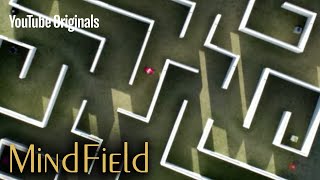

Tech is rewiring your brain!
45sThe bold claim that technology physically changes our brains sparks curiosity and debate, perfect for a hook.
▶ Play Clip"The title promises an exploration of tech's effect on the brain, and the video delivers with experiments and results."
This video explores how technology, particularly video games, can physically alter the human brain, enhancing spatial memory and cognitive abilities. Through a series of experiments including brain scans, memory tests, and a real-world maze, the host investigates whether playing 3D video games for ten days can improve mental skills. The video also touches on human empathy towards technology and the historical context of technological impact on the brain.
Our brains have been profoundly transformed; information once stored in the brain is now stored in phones, acting as an external organ.
The hippocampus is crucial for rapid formation of new arbitrary associations, like remembering where you parked your car.
A study split participants into three groups: no gaming, 2D gaming, and 3D gaming. Those who played 3D games showed improved spatial memory.
The host undergoes brain scans and a real-world maze test to measure changes in hippocampal size and connectivity after gaming.
Participants view objects and later identify them among similar items, testing memory for details.
A virtual version of a water maze tests spatial navigation using mountain shapes as guides.
The host navigates a physical maze to find objects, building a mental map based on angles and turns.
The maze is reversed, and the host must find objects from a different entrance, testing adaptability.
Humans often show more empathy towards robots than people, as demonstrated by a robot that elicits personal confessions.
A study shows that giving a backstory to a bug-like robot makes people reluctant to smash it, highlighting human empathy for technology.
After ten days of gaming, brain scans and tests are repeated to measure changes in memory and spatial skills.
The host improved 30% on the virtual maze test and made fewer errors in the real maze, equivalent to 20 years of age-related decline reversal.
MRI scans show some brain regions changed shape, though changes are small due to the short duration.
Socrates worried writing would harm memory, but written language enabled civilization. Technology extends our minds, not limits them.
The video concludes that technology, including video games, can positively impact brain function and structure, enhancing spatial memory and cognitive abilities. It encourages embracing technology as an extension of the mind rather than fearing its effects.
What part of the brain is crucial for rapid formation of new arbitrary associations?
The hippocampus.
02:29
In the study mentioned, which group showed improved spatial memory?
The group that played 3D video games.
03:23
What did the object recognition memory test involve?
Viewing objects and later identifying them among similar items.
05:26
How much did the host improve on the virtual maze test after gaming?
30% better the second time.
23:21
What did Socrates fear about writing?
That it would cause people to not use their memories and not remember themselves.
26:02
What was the result of the empathy study with the hexbug?
Subjects were reluctant to smash the bug after being given a backstory and name.
16:15
What did the MRI scans show after ten days of gaming?
Some brain regions appeared to have changed shape, though changes were small.
24:29
Brain Delegation
Highlights how smartphones act as an external memory organ, changing cognitive processes.
01:103D Gaming Improves Spatial Memory
Provides scientific evidence that video games can enhance cognitive abilities.
03:23Empathy for Robots
Demonstrates how easily humans form emotional connections with technology.
16:15Significant Cognitive Improvement
Shows a 30% improvement in virtual maze performance, equivalent to reversing 20 years of age-related decline.
23:08Historical Perspective on Tech
Draws parallel between fears of writing and modern tech, arguing technology extends the mind.
25:47[00:07] Technology isn't just changing our lives. Not just how they think, It's been shown that playing certain video games for hours
[00:21] your ability to navigate space well, certain parts of it-- bigger. can change our brains in ways that improve our ability
[00:37] To find out, we've built a giant maze outside the world of computers. I'm the lab rat.
[00:58] [theme music playing]
[01:10] Our brains have been profoundly transformed A lot of the information that I used to have to store in my brain is now stored in my phone.
[01:23] In many ways, I've delegated to this new external organ. for other things that matter
[01:36] So while we all don't have implants in our brains yet, which is why you may find it deeply disturbing
[01:49] to see me do something like this. [music playing]
[02:01] by having enriching experiences, To learn more about this, in the field of learning and memory.
[02:15] - What about them? - So the lab is trying to figure out how memory works, how it works in the brain. that we know is important to memory is
[02:29] So what does the hippocampus do? and, really, a certain kind of memory. when you need to rapidly form new arbitrary associations.
[02:44] definitely needs the hippocampus. and we need to be able to remember "I parked my car in this exact spot in the lot."
[02:57] that's what the hippocampus seems to be really be bubblegum on the book, is that a hippocampus? Is this the whole thing or is it symmetric...
[03:11] That looks just like this? conducted a study to show They gathered participants
[03:23] and split them up into three groups. any video games for two weeks, an active control group and an experimental group
[03:35] Beforehand, they had all the participants to measure their spatial memory. And what we found was that the people who played the 3D game
[03:48] whereas the control group but we can speculate that there were changes So what are we going to be doing to me here?
[04:03] in our past studies, Uh, the first is we're gonna add some brain scans, We've never actually looked at somebody's brain scans
[04:16] is we're gonna put you through a real-world space. [Michael] This truly untested territory. has never been studied in a physical environment
[04:32] I will have to navigate my way Will playing video games improve my mental skills If so, society may start looking
[04:47] First, we had to get Welcome to the MRI Center. to then see what's gonna be happening to your brain
[05:01] Changes in the size and shape of your hippocampus and also changes in the connectivity between brain regions. with a special emphasis
[05:14] [music playing] is a standard memory test that we do. [Michael] This test began by showing me
[05:26] I did my best to commit every one of them to memory. What we're gonna do now though, is we're gonna test And this is actually where it starts to tap
[05:41] [Michael] This time, I had to view another series of objects The catch, some of the items were very similar
[05:55] This tested my memory for details [Michael] Next up, a virtual version of a water maze [Dane] The idea is that you are trying to locate
[06:11] I'm so glad I'm not a lab rat. I had to find the same invisible underwater platform using only the shapes of the mountains as my guide,
[06:27] Hey. [Craig] These are the sorts of tasks that we've been able to do after you've done the video games.
[06:39] But we also have a really great opportunity here now and actually get it into the real world. No. We don't get to do this kind of thing.
[06:52] [music playing] [Craig] This is what we brought you here for,
[07:04] You're gonna be a lab rat in a maze. [Michael] So how do you think that'll effect which is that moving around in a 3D environment
[07:18] in a video game can actually physically affect your brain? train your hippocampus to be better at spatial memory in some of these areas.
[07:30] You've got objects embedded inside here, Oh, and build a mental map of whatever's inside there. and learn the objects.
[07:45] [Michael] Because the walls were six feet tall, My task was to create a spatial memory based entirely on the angles and turns of the white walls
[07:59] outside the maze. The entrance is that way. I'm considering this the right side, that the left side.
[08:13] that I feel like exist along the outside edge, [Craig] And time. find out where the objects are.
[08:27] - Okay. - Okay. You ready? - Go. - [Michael] Pump. Okay. hugging the rightmost part of-- pump.
[08:45] Now, I guess I do the opposite to get out. There it is.
[08:57] Item two, the basketball. would evaluate my performance and whether I took the most optimal route each time.
[09:10] [Michael] Here kitty, kitty, kitty. [Michael] Retracing my steps. [Dane] The boot.
[09:24] - Go. - [Michael] Water bottle. Yeah, it was back here.
[09:38] No? Oh, shoot. That's-- no?
[09:50] It was down some sort of... a long corridor like this in this area. [Michael] Until this point, things had gone pretty well,
[10:02] With most of the items now gone, between the various white corridors. Got it.
[10:17] - [Michael] Got it. Nice. - That one was a little tougher, huh? [Dane] Now, we're gonna make it a little bit more difficult. [Craig] Navigating the maze in reverse
[10:32] We're gonna give you a list of four things to get, the bottle, the crayon, I think--
[10:47] That's the ball. but now I remember which alley to go down. Boot. Don't want that.
[11:04] Oh, I just saw the boot, Got it. I'm done. I'm coming back. [Dane] The pump, the pillow,
[11:18] - [Craig] All right. Excellent. - [Dane] All right. Nice job. This experiment could use a control. with daily video game playing,
[11:32] Well, luckily for that, Okay, one of them has too much hair, - You ready? - [all] Ready.
[11:45] My look-alikes had to go through the exact same tests The difference would be that they would play Then any change in my performance
[12:00] [music playing] starting from an ideal baseline, Would ten days of gaming really make a difference?
[12:18] [music playing] - [whirring] - It's also playing with the empathy
[12:34] In fact, in many cases, than we are to people. Roboticist and MIT Media Lab alum,
[12:47] a miniature robot equipped with a camera of unsuspecting pedestrians. what would it be?
[13:01] [Michael] The majority of people [BlabDroid] Tell me something that you've never told I'm scared I won't be able to love
[13:13] and to let myself go in a love relationship. than to a human. I mean, it's often easier to say
[13:27] instead of in real life, isn't it? wasn't a friend or a significant other, A mental healthcare startup called Talkspace
[13:41] to text therapists for advice. should be anonymous, stigma-free, Texting can give users the distance they need
[13:56] And messages can be sent when the user wants, [woman] Talkspace, therapy for how we live today.
[14:08] Better now that my phone is working. Sometimes, however, we aren't looking for technology to comfort us. we're finding ourselves wanting to comfort technology.
[14:24] Cute little fellow, isn't he? Well, why? metal and wires and computer chips.
[14:38] But we spend a lot of time with technology. But the degree to which we empathize with it [music playing]
[14:52] was invaded by bugs-- These bugs are made of plastic, metal, But could certain conditions
[15:05] A 2015 MIT study and a personal backstory which can lead to an emotional connection
[15:19] - Thank you for your help today. - Of course. Pleasure. our subjects think they're focus testing In this case, they're given a lifeless hexbug
[15:34] This thing kind of looks like a bug, It's light. [Michael] Then it was time to test their empathy.
[15:47] is place the item in the middle of that block. And I would like for you to take this mallet Yeah. Really? Okay. This is cool.
[16:02] to smashing this lifeless object. Many of them even seemed to enjoy it. Not really. I felt indifferent to it.
[16:15] [Michael] While these subjects exhibited no empathy look what happened when we gave the exact same bugs I'm gonna place Margaret down here.
[16:30] And you could feel free to pick her up. - She's honestly one of our favorites. - [woman, laughing] Okay. A little erratic right now,
[16:46] [Michael] Notice how the subject has already Maybe she feeds off my energy. Go towards the middle.
[17:00] and maybe when I go like that, That's Aaron. - No way. - Yes.
[17:13] It really depends on who's holding him. Oh, yeah. He's got a lot of energy. [Michael] Now that you've interacted with Eli a bit more,
[17:26] - He doesn't know what's going on. - Hey, Joe. Amy, I'm gonna place Margaret right here,
[17:40] and I'd like you to smash it. I don't wanna hurt it. [music playing]
[17:58] and I'd like for you to smash it. And, Chris... Ugh.
[18:14] Oh, Joe. Joe. [music playing]
[18:27] Now, how did it feel to smash Aaron? It didn't feel good, you know, Even though it's lifeless
[18:41] because when I put it in my hand, - Do you feel bad? - I do. Oh, he's back.
[18:55] Would you smash him again to make sure I mean, he survived it. He survived it once. [Michael] Clearly, it doesn't take much for humans
[19:09] But after my ten days of video-gaming-- I was about to find out if technology had and my physical brain.
[19:24] Exactly, so we're gonna look at the difference between to see do we see any change. the object recognition memory test
[19:37] both of which had been revised with different content Dane and I will analyze all this data and see how you did. [music playing]
[19:54] Tore down the old one, built a new one So it has sort of the same level of difficulty. the same number of turns,
[20:06] to try to have a similar maze, but that's new. Three, two, one, go. As before, I was given five minutes
[20:20] and where all of the objects were. so if I hug the second right wall Was my hippocampus working better?
[20:33] Thirty seconds. all the objects hidden here. [Michael] Then my test began.
[20:45] - Go. - Rubber duck was way over here. Second item is the hat. Go. Top hat.
[20:59] like I did last time, Second right, hug the turn, got it. turns, and straightaways.
[21:13] Oh, wow. It's actually a cool vase. But would this improve my overall performance? So we've gotten all the objects.
[21:25] We're gonna go around to the other side of the maze is the blue seahorse the flashlight, Go.
[21:39] even though I was working from the opposite entrance, which seemed to serve me well. Nice.
[21:52] [Dane] All right. Your next sequence is the blue vase, and the baseball glove. - [Craig] Hit it. That was not as hard as I expected.
[22:05] I was literally thinking, "Oh, okay. The glove's the first one. I didn't even plan that at all. It just kind of happened.
[22:19] Have you been playing video games? would be the control, if any, measured against theirs.
[22:32] [Michael] Finally, my brain was scanned once again Dr. Stark and Dr. Clemenson would analyze the MRI [music playing]
[22:52] Yep. Actually, no, I don't know. I guess let's start off first And it's important to note that in our control test without video-gaming,
[23:08] people did not improve in this task, but... Ten points is actually 20 years' worth Oh, wow.
[23:21] in someone who's getting really old, So the second one we did was the virtual version 30% better the second time you did it.
[23:34] I could tell that I was using better strategies. - We also had the real maze. - [Michael] Yeah. Despite our efforts to try to equate them,
[23:47] If we took a look at things how many errors you made, and we looked So on all of them,
[24:01] and all but one of them made more errors. You didn't get slower from maze one to two. exact number of errors.
[24:15] And even though this experiment the results are consistent with our virtual maze study - [Craig] All right. - Thank you, video games.
[24:29] [Craig] Inside your brain, it's a little tougher to really tell. is going to be small. because then it would have to be pushing something else out.
[24:43] So it's just not going to be a large change. What we saw is there were some regions that appear to have changed shape
[24:57] What's really surprising to me is that as an adult, That makes me wanna take better care of my brain. I'm not just stuck with what I have now, today.
[25:16] is that doing things, something to do, something to figure out, keeping your brain sharp.
[25:30] [Craig] Exactly. [music playing] people are bound to worry about what it will do to our brains.
[25:47] to our machines make us dumber? Will our empathy for machines have negative consequences Well, let's look back to another time
[26:02] to fundamentally change our brains. worried that the wide use of writing He said that writing would, to quote his student, Plato,
[26:19] because people will not use their memories. and not remember themselves." Written language did fundamentally change our brains.
[26:33] modern civilization has accomplished. is that this is not the boundary of my body, and this is not the boundary of my mind.
[26:48] And, as always, thanks for watching. [theme music playing]



⚡ Saved you 0h 27m reading this? Transcribe any YouTube video for free — no signup needed.