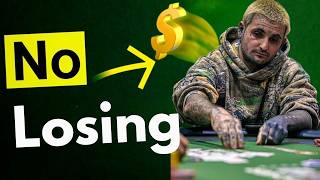

The $32M Baccarat Player Banned from 150 Casinos
45sThe extreme claim of winning millions and being banned from numerous casinos immediately captures curiosity and controversy.
▶ Play Clip"Delivers a detailed breakdown of the strategy and bans, but the title oversells the 'banned' aspect without proving the strategy's effectiveness."
This video analyzes the controversial gambler Mickey Mace, who claims to have won $32 million playing baccarat and been banned from over 150 casinos. It breaks down his publicly stated system—pattern recognition, dealer observation, and strategic timing—and evaluates whether his approach is replicable or effective for the average player.
Michael David Miterman, known as Mickey Mace, built and sold a business in rehabilitation facilities across Florida by his early 20s, generating significant wealth before discovering high-stakes baccarat in 2018.
Mickey claims $32 million in documented baccarat wins and bans from over 150 casinos. Independent analysts estimate his net worth between $10 and $40 million, with the lower end more defensible. The casino bans are real and documented on video.
Professional poker player Jake Ormond confirmed Mickey extracted over $10 million at a single baccarat table at the Venetian. Casino surveillance found no cheating, yet he was banned anyway.
Mickey's system rests on pattern recognition, dealer observation, and strategic timing. He spent months watching baccarat shoes for patterns, arguing that physical shuffling and dealing introduce subtle non-randomness that can be exploited, despite mathematical independence of hands.
Mickey studied individual dealers' shuffling and handling techniques, identifying 'tells' in behavior. He would watch a dealer for hours before betting, building a profile of their patterns.
Mickey did not grind sessions; he identified optimal conditions, placed bets at maximum ($100k-$250k per hand) on high-conviction reads, and left. He disappeared for weeks to prevent casinos from profiling him.
The Wynn banned him despite him being a net losing player (dropped $4M, net loss of $1.5M). Casinos ban players not for past losses but for future risk, indicating they took his system seriously.
Casinos treat advantage players differently from cheaters: they are politely redirected to games where their edge doesn't apply, as seen when Mickey was told 'We can't afford you' and offered slots instead of table games.
The direct answer is almost certainly no. Replicating his system requires an enormous bankroll, months of observation, rare analytical focus, and access to high-limit tables—access that is increasingly hard to obtain.
What is replicable is the meta strategy: bet selectively, only with high conviction, know when to walk away, and treat session length as an afterthought. These principles improve any player's approach, though they don't overcome the house edge.
Mickey Mace's system is likely not replicable for most players, but the underlying principles of selective betting and disciplined timing offer valuable lessons for any gambler. The video emphasizes that no strategy eliminates the house edge, and responsible gambling is paramount.
What are the three pillars of Mickey Mace's baccarat system?
Pattern recognition, dealer observation, and strategic timing.
02:28
How much did Mickey Mace win at a single baccarat table at the Venetian?
Over $10 million.
02:02
Why did the Wynn Las Vegas ban Mickey Mace despite him being a net losing player?
Casinos ban players based on future risk, not past results; they concluded his system posed a greater future threat than his current losses were worth.
05:07
What is the documented quote from a casino when banning Mickey Mace?
'We can't afford you.'
06:12
What is the main reason Mickey Mace's system is not replicable for most players?
It requires an enormous bankroll, months of observation, rare analytical focus, and access to high-limit tables that is increasingly hard to obtain.
07:06
Verified $10M Win
Confirms the scale of Mickey's success and the casino's response despite no cheating found.
02:02Casino Risk Assessment
Illustrates how casinos evaluate advantage players based on future risk, not past losses.
05:07Meta Strategy Principles
Provides actionable, replicable advice for any gambler, separating useful tactics from the unattainable system.
08:14[00:01] controversial figures in the gambling world right now, Mickey Mace, a man who claims [music] to have won $32 million playing baccarat, been banned from over 150 casinos, and developed a system so effective that casinos would rather lose
[00:15] >> [music] >> We're breaking down who he is, what his banned him, [music] and the honest truth about whether any of it is replicable. Let's get into it. Before we start, [music]
[00:28] baccarat is a gambling product with a house edge. No strategy eliminates that edge. [music] This video is educational and covers Mickey Mace's publicly documented approach. Never [music] gamble more than you can afford to lose.
[00:41] Michael David Miterman, known publicly as Mickey Mace, didn't come from the >> His background is in business. By his early 20s, he had built and sold a and rehabilitation facilities across Florida, generating significant wealth
[00:55] careers figured out. He discovered high-stakes baccarat in 2018 and approached it the way he approached everything else, as a business problem to be solved rather than a game to be enjoyed.
[01:09] >> [music] >> $32 million in documented baccarat Bans from over [music] 150 casinos across the United States. Sessions playing at $100,000 to $250,000 per hand.
[01:23] He describes himself [music] as one of only four baccarat players in Las Vegas has been. Whether every number he cites is precisely accurate [music] is debated. Independent analysts put his verified
[01:36] net worth somewhere between 10 and $40 million, with most settling on the lower end of that range as [music] more defensible. But the casino bans are real, documented on video, and the fundamental story of a
[01:49] player being excluded for winning too consistently is verified. One specific session stands out as the most documented. Professional poker player Jake Ormond was [music] present and later confirmed
[02:02] that Mickey extracted over $10 million at a single baccarat table at the Venetian in Las Vegas. Casino surveillance reviewed the footage. They found no cheating, [music] no card manipulation, no illegal
[02:14] activity. They banned him anyway. Here is where the story gets genuinely interesting [music] and genuinely complicated. Mickey Mayes does not claim >> [music] >> Card counting in baccarat provides
[02:28] describes. His publicly stated system rests on three [music] pillars: pattern recognition, dealer observation, and strategic timing. Let's [music] break each one down.
[02:41] Pattern recognition is the foundation. Mickey spent months before placing [music] significant bets watching baccarat shoes play out at high-stakes He was looking for patterns in how cards [music] distributed across hands, how
[02:54] runs of banker or player wins behaved, and how specific conditions within a and how specific conditions within a shoe correlated with specific outcomes. Traditional gambling mathematics says baccarat has no exploitable patterns.
[03:06] Each hand is independent, and past results have no influence on future ones. Mickey's counter argument is that while individual hands may be independent [music] in a pure mathematical sense, the physical
[03:18] properties of how cards are shuffled, cut, and dealt introduce subtle non-randomness that a sufficiently [music] attentive observer can identify and exploit. Dealer observation is the second pillar.
[03:30] Mickey studied individual dealers, how [music] they shuffled, how they handled the shoe, how their physical technique influenced card [music] distribution. He specifically identified what he calls tells in dealer behavior [music] that
[03:43] He would watch a dealer for an extended period before placing any bet, [music] sometimes for hours, building a profile of that specific dealer's patterns [music] before committing significant money to a hand.
[03:57] Strategic timing is the third and perhaps most practically interesting element. Mickey did not grind sessions for hours. He identified his optimal placed his bets at the specific moments those conditions aligned, and left. He
[04:11] significant amounts in a short [music] window and then deliberately disappear for weeks before returning. This approach served two purposes. It prevented casinos from building a complete behavioral profile on him, and
[04:25] active sessions was dramatically higher than his time at the table would The strategic timing extended to bet sizing. On hands where his system indicated [music] favorable conditions, he bet at his maximum, 100,000 to
[04:40] 250,000 dollars. On hands where conditions were unclear [music] or unfavorable, he either bet the minimum or didn't bet at all. The selective aggression, betting maximum only on high conviction reads,
[04:53] most clearly distinguishes it from standard baccarat play, where most players bet consistently regardless of perceived conditions. >> [music] >> is one of the most revealing aspects of
[05:07] the whole story because some of it makes no conventional sense. The Wynn Las Vegas banned him despite the fact [music] that on their books, he was a net losing player. He dropped $4 million
[05:19] and walked away with a net loss to the casino of one and a half million >> [music] >> They banned him anyway. Casinos don't ban players who lose money. The entire [music] business model
[05:33] is built on players losing. When a casino bans a player who just >> [music] >> they are not reacting to past results. They are making a calculated decision about future risk.
[05:45] history, [music] identified his system, and concluded them more than his current losses [music] were worth. That is not the delusional player who thinks he has a system. [music]
[05:58] took his system seriously. The documented reasons given for various bans are also illuminating. One casino banned him during a session [music] where he was down half a million dollars, citing his long-term win rate
[06:12] Another told him directly, [music] and this is a documented quote, "We can't afford you." Multiple properties [music] told him he was welcome to play slots, but not table games. The specific behavior of a casino
[06:25] dealing with an advantage player, rather than a cheater. security and handed to law enforcement. Advantage players get politely redirected to games where their edge doesn't apply. By 2023, the bans had
[06:40] exceeded 150 properties. His casino career at the highest levels of the game >> [music] >> He describes himself as having been Let's be completely straight about [music] this because it's the question
[06:53] everyone watching wants answered. The direct answer is [music] almost certainly no. Not at Mickey Mace's level, and probably not at any meaningful level, either. Here's why. Even if every element of his publicly
[07:06] described system [music] is genuine and effective, pattern recognition, dealer >> [music] >> replicating it requires a specific combination of things that most players simply don't have. An enormous bankroll
[07:19] level required for the strategy to express itself. Months of dedicated observation time at high-stakes tables before placing significant bets. A level of analytical [music] focus and psychological
[07:32] discipline that is genuinely rare. And access [music] to high-limit tables that will accommodate the bet sizes the strategy requires. Access that is progressively harder to obtain as casino networks share information about
[07:47] advantage players. [music] The pattern recognition element specifically is the most contested and the most [music] inaccessible. behavior suggests something in his approach does work, it requires [music]
[08:01] a depth of observation and analysis that goes far beyond anything a recreational player could reasonably develop. Mickey Mace spent years building [music] the system before his first significant win.
[08:14] grinding [music] before his first seven-figure session. What is replicable [music] and genuinely useful from Mickey Mace's publicly described approach is the meta [music] strategy rather than the
[08:28] specific tactics. Bet selectively, rather than consistently. Only place significant [music] bets when conviction. Know when to walk away rather than
[08:40] [music] grinding until the variance turns against you. Treat session an afterthought. These are principles that improve how [music] any player approaches any casino game. Not because they overcome the
[08:53] [music] undisciplined play that accelerates losses. The strategic timing amount and then leaving rather than continuing to play, applicable piece of Mickey Mace's approach for any player.
[09:09] the bonus principle we've covered in previous videos. Lock in a meaningful [music] the table because you're feeling good.




⚡ Saved you 0h 09m reading this? Transcribe any YouTube video for free — no signup needed.