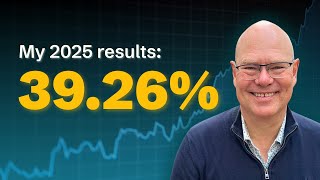

I Made +39.26% in 2025 Trading Options
54sImmediately reveals impressive results, sparking curiosity and engagement.
▶ Play Clip"Delivers exactly what the title promises: a detailed breakdown of 2025 results and the four core strategies, with no fluff."
In this video, John from Theta Profits shares his 2025 options trading results, revealing a 39.26% account growth driven by four core strategies. He emphasizes that Theta Profits is not about promoting his own style but about exposing viewers to diverse trading approaches through interviews. He breaks down each strategy's performance, lessons learned, and plans for 2026.
John is based in Vietnam, which he calls the 'Miami Beach of Southeast Asia', and mentions he interviews retail options traders every Sunday on Theta Profits.
John's trading account grew by 39.26% in 2025, a result he is happy with given his risk-averse nature.
Theta Profits is not about promoting one trader's way; it's built around interviews with other retail options traders to expose different strategies. John does not endorse any specific strategy.
John started trading options in 2018. Early years were flat, but in 2020 he lost more than half his account in the COVID crash due to overconfidence and poor risk management, finishing the year at -23.77%.
2021: +6.08%, 2022: +48.07%, 2023: +35.49%, 2024: +26.3%, 2025: +39.26%.
John placed trades with 22 different strategies in 2025, partly to test strategies from guest interviews, but only four contributed significantly to profits.
Discovered from Simon Black (NZ) in May. Weekly combination trade: call broken wing butterfly on upside, put diagonal on downside. 33 trades, 81.8% win rate, avg duration 6.1 days, avg net profit 3.48% per trade. Contributed <10% of profits.
12 trades, 11 winners, avg duration 20 days, avg profit 3.1%. Some on volatile stocks like Coreweave. Contributed ~12-13% of total profits.
Core strategy: buy 100 shares, sell ITM covered call ~2 weeks out, aiming for 1.5-2% extrinsic value. 40 trades, 39 winners, avg duration 40 days, avg profit 3.4%. Contributed ~25% of profits. Works well with Norwegian tax rules.
Bread and butter for ~5 years. SPX zero DTE, sell multiple iron condors daily, collect $100-150 per side, tight stop loss. 2000+ trades in 2025, avg daily net profit 0.33% of capital risked, avg premium capture 5.4%. Contributed over half of profits. Only 7 negative months since April 2021.
Based in Vietnam, market hours are 9:30pm-4am, so manual day trading is unsustainable. Plans to learn Option Omega for automation, continue ITM covered calls, wheel, ramp up time flies, and add 1-2 new strategies.
John's 2025 results show that a risk-averse approach with a few core strategies can yield solid returns. He emphasizes the importance of risk management and adapting strategies to one's style, and he plans to automate and refine his trading in 2026.
What was John's 2025 trading return?
+39.26%
00:42
What was John's result in 2020, and what caused it?
-23.77% due to overconfidence and poor risk management in the COVID crash.
03:45
How many strategies did John trade in 2025, and how many contributed to profits?
22 strategies tested, but only 4 contributed significantly.
04:48
What is the 'Time Flies' strategy?
A weekly combination trade with a call broken wing butterfly on the upside and a put diagonal on the downside.
05:47
What was the win rate for Time Flies in 2025?
81.8% (27 wins out of 33 trades).
06:19
What is the 'Wheel' strategy?
A strategy involving selling cash-secured puts and covered calls to generate income.
07:02
How does John trade in-the-money covered calls?
He buys 100 shares, sells an ITM covered call ~2 weeks out, aiming for 1.5-2% extrinsic value.
07:59
What is the 'Zero DTE Break Even Iron Condor' strategy?
A SPX zero DTE strategy where multiple iron condors are sold throughout the day with tight stop losses.
10:48
How many trades did John execute with the zero DTE strategy in 2025?
Over 2,000 trades.
11:47
What is John's plan for 2026 regarding manual day trading?
He plans to automate with Option Omega because manual day trading is unsustainable in Vietnam's time zone.
12:46
2020 Crash Lesson
A candid account of losing half his account due to overconfidence, leading to a major improvement in risk management.
03:4522 Strategies Tested
Highlights the importance of testing strategies but focusing on what fits your style.
04:48Zero DTE as Bread and Butter
Demonstrates the power of a consistent, well-managed strategy contributing over half of profits.
10:352026 Automation Plan
Shows adaptation to lifestyle changes by moving to automated trading.
12:46[00:03] base this year. It is often called the Miami Beach of Southeast Asia and is a fantastic place to spend a couple of months in my opinion. If you follow
[00:15] Theta Profits, you know that I interview retail options traders every Sunday asking about their strategies and ways of trading and even their results.
[00:28] And naturally, people also ask me, "What about you, John? What do you trade and about you, John? What do you trade and how did you do in 2025?" how did you do in 2025?" And I guess it's fair. If I keep asking
[00:42] other traders about their results, I should also share mine, or not? So, should also share mine, or not? So, let's do it. In 2025, let's do it. In 2025, my trading account grew with 39.26%.
[00:57] I'm happy with that because I'm in general a risk-averse trader. I will break this down for you later in the video exactly which strategies that contributed to my profits. But, first, let me be clear. Theta
[01:14] Profits is not about me. It is not about promoting my way of trading or telling you what to do. Most options trading channels out there are built around one trader showing how they trade. Usually with a
[01:32] course or an alert service that they sell on top of it. That's fine. But, it is not what I wanted to create with Theta Profits because we all trade differently. Some love risk, others avoid it. Some have large accounts, some
[01:50] start small. Some enjoy screen time and studying the graphs all day, others prefer more set and forget trades. And that's why Theta Profits is built
[02:02] around interviews with other retail options traders rather than just showing the result of one trader. For me, it is a way to combine my professional a way to combine my professional background as a journalist with a, let's
[02:17] say, nerdy hobby as an options trader. Each week, I want to expose both you and myself to different ways of thinking about options trading. My goal is to ask
[02:30] the right questions so you can decide what fits your style. Therefore, I do not recommend any particular strategy. The fact that I interview a strategy. The fact that I interview a trader does not mean that I endorse his
[02:45] trader does not mean that I endorse his or her strategy or way of trading. Okay. Time to reveal my trading results. But, first, a quick walk-through of my options trading history. I started trading options in 2018.
[03:00] The first couple of years, up and down, I would say. In total, pretty flat. I tried and lost a lot of money on an alert service. I money on an alert service. I experimented with lots of strategy and
[03:14] stayed mostly flat overall. Then came 2020. I had been doing well for a while. I was overconfident, overexposed, and got hit hard in the COVID crash. I
[03:29] was sitting on multiple weekly iron condors, too many, and didn't cut them when the market was falling. I kept believing it would turn around, and as we know, it did not, and I lost more than half my account in a couple of
[03:45] more than half my account in a couple of weeks. That was a painful but necessary wake-up call for me. It forced me to dramatically improve my risk management. That year, 2020, I finished with a loss of minus 23.77%.
[04:06] year for year. In 2021, In 2021, my account grew with 6.08%. my account grew with 6.08%. 2022 was a fantastic year. My account
[04:19] grew with 48.07%. In 2023, In 2023, I made 35.49%. 2024, plus 26.3%,
[04:33] and then last year, 2025, plus 39.26%. a bit. I experimented
[04:48] a bit as I usually do. I actually placed trades with 22 different strategies. Why so many? One reason is that I like to test at least a couple of trades with the strategies that my guests introduce
[05:04] in the interviews, just to get a feel of them. But, here's the truth. Practically them. But, here's the truth. Practically speaking, all of my profits last year speaking, all of my profits last year came from just four strategies. The rest
[05:17] were mostly small, infrequent, and sometimes also ended in losses. Not because the strategies were bad, but because they didn't fit me and my style.
[05:30] Let's break down the four that worked for me last year. Number four is time flies. I discovered this strategy when interviewing Simon Black from New Zealand in May. It is a weekly combination trade with a call broken
[05:47] wing butterfly on the upside and a put diagonal on the downside. diagonal on the downside. It is similar to Steve Gann's fly agonal strategy. You You find link to both of those interviews in the description if
[06:02] you want to dig into these strategies. So, my statistics for time flies last year, I did 33 trades in total. 27 were wins, eight were losses. That gives a win rate of 81.8%.
[06:19] of 81.8%. The average trade lasted 6.1 days, and I had an average net profit per trade 3.48%.
[06:33] strategy that lasts less than 1 week. I traded very small with time flies. I was experimenting with it. So, it contributed to a less than 10% of my contributed to a less than 10% of my total profits. But, I love this strategy
[06:48] and I do plan to allocate more money to it in 2026. Number three is the wheel. I didn't do a lot of wheel trades last year, just 12 in 2025.
[07:02] just 12 in 2025. 11 were winners with an average duration of 20 days and an average profits of 3.1%. 3.1%. Some were on more volatile stocks like
[07:15] Coreweave, outside the usual wheel playbook. playbook. But, it worked, although I had to keep rolling for a long time. The wheel contributed around 12 to 13% of my total
[07:30] If you want to learn more about the wheel, I recommend my interview with Paul Gunderson. You find also that link in the description. Number two is in the
[07:43] money covered calls. This is one of my core strategies, and here's how I trade it. I start with buying 100 shares of a stock. I like to find an underlying with high implied volatility. I then sell an
[07:59] in-the-money covered call typically 2 weeks out. I aim to get about 1.5 to 2% extrinsic value for this to be a good trade for me. Usually, my strikes will
[08:13] be at the expected move or just a little bit above. This is a strategy with a lot of downside protection. If the stock stays about the strike, the shares get
[08:25] called away. I take a loss on the stock, but the premium for the call is bigger than the loss, and that makes the whole trade profitable. the whole trade profitable. That's what happens in most cases.
[08:38] If it drops near the strike price, I might decide to roll the call one more might decide to roll the call one more week if I can get at least 1% extra profit out of doing that. Sometimes, of course, it falls below the
[08:53] strike price. Then the call expires, and I am free to sell a new call now as a covered call primarily using the same strike price as before. And then keep rolling until the it is back above the strike price and my
[09:09] back above the strike price and my shares are taken away. My statistics for 2025 for this strategy, I closed 40 trades. 39 were winners. In fact, the 2 years I've traded this,
[09:25] In fact, the 2 years I've traded this, I've done 80 trades and still only one have been at the loss. But, last year, 40 40 trades, and the average duration 40 40 trades, and the average duration was 40 days. It would have been a lot
[09:39] shorter had it not been for the one losing trade that had been open for more than 2 years when I finally closed it for a small loss. for a small loss. My average profit last year on this
[09:52] My average profit last year on this trade was 3.4%. In-the-money covered call contributed around contributed around of my total profits last year. I love
[10:05] this strategy for its downside protection and I've had an extreme high winning percent. trade it and that is that it plays very well with
[10:19] the tax rules of my home country, Norway. In the money covered call was presented by Brian Terry in the first interview I did on You find also that link in the description if you are curious about the
[10:35] this strategy. And then strategy number one, zero DTE break even iron condor. This has been my bread and butter strategy for almost five years. It is
[10:48] strategy for almost five years. It is similar to the well-known MEIC, multiple entries iron condors. But I'm a bit less mechanical than many other traders. It's a strategy on SPX zero DTE strategy.
[11:03] I sell multiple iron condors throughout the day. the day. Typically, I collect about $100 to $150 on each side of the iron condor. So, in total two to $300 per iron condor. And
[11:19] total two to $300 per iron condor. And the stop loss is very tight. You set the stop loss on each side separately equal to the total credit received for the iron condor. And this means that if one stop loss is
[11:34] And this means that if one stop loss is hit, basically, the trade is at break hit, basically, the trade is at break even. I did more than 2,000 trades with even. I did more than 2,000 trades with zero DTE break even iron condor in 2025.
[11:47] zero DTE break even iron condor in 2025. The average daily net profit was 0.33% of the capital risked. My average premium capture rate was 5.4%. This contributed well over half of my
[12:03] This contributed well over half of my profits. I've traded this strategy since April end 2021. So, it's a pretty long period. I've so far only had seven negative months.
[12:17] me, I would say. If you're curious about this way of description. One is Tammy Chambless presentation of her MEIC strategy and the other is an interview I did with the Icelandic
[12:34] options trader, David Bentson. Let's look a little bit ahead to 2026. The year will start differently for me. As I said, I'm based in Vietnam until
[12:46] Um that's a different time zone. In fact, market opens at 9:30 p.m. and fact, market opens at 9:30 p.m. and closes at 4:00 a.m. And it's not sustainable or healthy, I would say, to do manual day trading on SPX as I've
[13:02] been doing before. So, I'm planning to experiment with Option Omega and try to learn that finally. Option Omega is a great platform for
[13:15] backtesting, modeling and trades and also trade automation. Just to remind also trade automation. Just to remind you, you do get 50% off the first year if you use the link that we have in the description. Otherwise, I will for sure
[13:30] continue in the money covered calls. I will still do wheel trades now and then and I will ramp up the time flies. I think that strategy has a lot of potential for me and I will allocate more capital to it and try to also
[13:47] improve how I adjust the trades when they do go against me. I will also probably add one to two trade strategies that I will try to trade consistently throughout the year. But I'm spending time on that these days to try to figure
[14:01] out what will be my trading plan for the year. So, that was my 2025 year. So, that was my 2025 profit of 39.26%. Four key strategies, lots of lessons. Now, I want to hear
[14:15] from you. How did your trading go in 2025? Which strategies worked for you? And which did not work? Let's learn from each other. Please share in the comments.


⚡ Saved you 0h 14m reading this? Transcribe any YouTube video for free — no signup needed.