
Why I Ditched Blazor for React
60sDevelopers love a good framework debate, and this controversial take is ripe for comments.
▶ Play Clip"Delivers a solid, honest tech stack walkthrough with practical trade-offs, though it's more of a personal preference list than a universal guide."
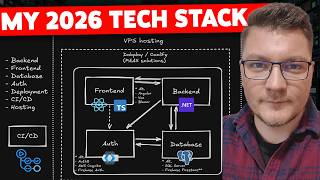
The video presents a comprehensive tech stack recommendation for side projects in 2026, covering backend, frontend, database, authentication, deployment, CI/CD, and hosting. The creator, a .NET developer, shares personal preferences and trade-offs, emphasizing flexibility and practicality for SaaS-like web applications.
The video outlines top picks for backend, frontend, database, CI/CD, and hosting, with a focus on trade-offs and alternatives.
.NET is chosen for its rich ecosystem, performance, and versatility, supporting console apps, web APIs, and AI applications. It's the creator's primary stack.
React with TypeScript is preferred over Blazor due to development experience and speed. Alternatives include Angular, Vue, and Blazor.
Postgres is the default choice for 90% of projects, offering SQL power, JSON, vector search, and full-text search. It's open-source and Docker-friendly.
SQL Server is heavier to host; Firebase Firestore is used for simple, responsive NoSQL needs, e.g., chat functionality on the creator's blog.
Keycloak is the top choice as an open-source identity provider supporting OAuth 2 and OpenID. Managed alternatives include Auth0, AWS Cognito, and Firebase Auth.
Backend communicates with database (Postgres, with auth data in a separate schema), auth service, and client app. Client app also talks to auth system for authentication.
Dokkuploy and Coolify are platform-as-a-service solutions that simplify deployment on a VPS.
Hetzner is preferred for affordability and reliability, especially in Europe. Alternatives include DigitalOcean and Hostinger.
GitHub Actions is used because GitHub is already the source control solution, making it a natural extension.
The stack is adaptable: simple frontends may use raw JS/CSS, and managed auth solutions can replace Keycloak for faster prototyping.
The tech stack is a proven, flexible foundation for side projects, prioritizing performance and developer experience. The creator invites feedback and suggests a reusable template for faster project starts.
What is the recommended backend framework for side projects in 2026?
.NET
00:41
Why does the creator prefer React with TypeScript over Blazor?
Because they feel more powerful and faster with React and TypeScript, and they don't like the Blazor development experience.
01:32
What database is chosen for 90% of projects and why?
Postgres, because it has SQL power, JSON support, vector search, full-text search, is open-source, and easy to run in Docker.
02:36
What is the top choice for authentication and what protocols does it support?
Keycloak, which supports OAuth 2 and OpenID.
03:54
What are two platform-as-a-service solutions mentioned for deployment?
Dokkuploy and Coolify.
05:15
Which hosting provider is preferred and why?
Hetzner, because it's affordable, reliable, and the best choice for the creator in Europe.
05:46
What CI/CD tool is used and why?
GitHub Actions, because GitHub is already used for source control, making it a natural extension.
06:10
.NET as Backend
Highlights the versatility and performance of .NET for various application types.
00:41React over Blazor
Shows a practical preference based on developer experience, not just technical superiority.
01:32Postgres as Default Database
Emphasizes Postgres's all-in-one capabilities for modern applications.
02:36Keycloak for Auth
Demonstrates a cost-effective, open-source alternative to managed auth services.
03:54PaaS for Deployment
Shows a trend toward simplifying deployment with platform-as-a-service tools.
05:15[00:02] 2026, this is the tech stack that I would choose. In this video, I'll show you my top picks for the back end, front end, off database, CI/CD, and hosting.
[00:14] And I'm also going to discuss what are the trade-offs and some alternatives we're going to do a comparison in a couple of categories. I'm going to choose from back end, front end,
[00:26] database, deployment options, CI/CD providers, and lastly, hosting. Let's make this a bit bigger, and then let's discuss how all of these components fit together. So, let's draw a big box here. This is going to represent our system,
[00:41] and I'm going to start from our back end component. And here, I think the choice is pretty straightforward. My pick is going to be .NET because it has a very rich ecosystem. You can build pretty much anything you want with this, from
[00:54] console applications to web APIs to AI applications. You can really do so many things in .NET, and it's very performant and becoming even faster with every new version. Another reason is that this is my primary tech stack. There's really no
[01:07] point to choosing anything else here. And again, the technologies that you choose here are going to depend on the type of application that you're building. Most of my side projects are going to be some form of SaaS-like web
[01:19] application. So, this tech stack mostly applies to that. If you are building something else, then you can consider adding or subtracting some things from here. Then, when it comes to the front end, and this one might be a bit
[01:32] controversial, at least for the .NET folks here, my choice is going to be React with TypeScript. I already know I'm going to get a lot of questions on why not just use Blazer and keep everything in the .NET ecosystem. And
[01:45] the answer is I simply don't like the Blazer development experience. I don't feel as powerful or as fast as I do with React and TypeScript. And part of the reason is probably what I know to work with, and Blazer simply isn't something
[01:58] that I've used a lot in the past, and I really don't see no reason to switch away from React. Now, when it comes to which framework, I will probably be running this with Vite, but when it comes to the front end, we also have to
[02:10] discuss some alternatives. So, a couple of things you could consider are Angular, which is really similar to React, and there's also Vue, and let's also add Blazer in there, why not? I'm just going to make this a bit smaller so
[02:23] it can fit on the screen. So, let's say that these are the alternatives, and I'll place them here. Our next component is going to be the database. I also have an obvious winner that I won't change in probably 90% of my projects, and this is
[02:36] going to be Postgres. It's an object-relational database, it has all the power of SQL, it's great with JSON, it's great with vector search, it's great with full-text search. It has pretty much anything for any type of
[02:49] application that I would want to build. It's also easy to run inside of a Docker container, it's also open source, and I've never really had problems when using Postgres as my database, so I always keep it as a backbone inside of
[03:01] my system. Now, I will give you a couple of alternatives, ranging from things that are popular, like SQL Server, but this one is going to be a bit more heavy to host than Postgres is, and then there are some niche databases that I use from
[03:15] time to time. For example, Firebase Firestore. This is when I'm building something really simple, I need the responsiveness that Firestore offers. If you're not aware, it's a NoSQL database available in the Firebase ecosystem,
[03:28] which is built and maintained by Google. Just to make sure that this isn't a general-purpose solution, I'm going to add two stars here next to Firestore. And to give you an example, I've actually used Firestore to implement the
[03:40] chat functionality on my blog, and so far it's working pretty well, and it's basically free for my use case. Now, let's move on to our next component, which is off or authentication. In here, we can discuss a couple of good options
[03:54] with my top choice being Keycloak. It's an open-source identity provider. I talked about it a lot on this channel already. It supports OAuth 2 and OpenID everything I might need for my authentication purposes. Now, of course,
[04:08] we have to discuss a couple of alternatives here. And if you're looking for a managed solution, you should definitely explore things like Auth0. Then there's AWS Cognito. And another one that you could explore, which is
[04:21] also pretty good, is actually Firebase Auth. As these also cover most of the use cases that you might need for authentication on a side project and even in a real production system. Now, as far as how these connect together,
[04:34] we're going to have our back end and our database communicating with each other. Since I'm using Postgres and Keycloak also supports Postgres, I usually host my auth data in a separate schema. Then we're also going to need our back end to
[04:47] talk to our auth service. And of course, our back end and client application need to be able to talk to each other. And lastly, our client app needs to talk to our auth system to facilitate authentication and being able to send
[05:01] authenticated requests back to our back end. Now, when it comes to how all of this gets deployed, recently I've been exploring some popular platform as a service solutions, and I briefly talked about one of these in a video, which is
[05:15] called Dokku ploy. And there's also very popular alternative called Coolify. So, these are both platform as a service solutions, which give you an easy way to manage your applications infrastructure. So, these are going to sit on top of my
[05:29] stack and let me easily deploy this to some sort of VPS. So, we're going to have another level above all of this, representing our hosting infrastructure. So, let me also add that. So, we're going to have our VPS facilitating the
[05:46] much any provider that you want. The one I'm using is Hetzner because it's very affordable. It's also very reliable. And since I'm in Europe, it's probably the best choice. You can also consider some
[05:58] alternatives like DigitalOcean or Hostinger. I'm not affiliated with any of them, so you have to decide which one works best for you. And then, the last piece of the puzzle is going to be my CI/CD component. And for this, I usually
[06:10] use just GitHub Actions because in 99.99% of the time, I'm already using GitHub as my source control solution. So, just using GitHub Actions is a natural extension to this. So, there you go.
[06:22] extension to this. So, there you go. This is my 2026 side project tech stack. And it's also been my tech stack in the previous years. Not much has really changed. What does change is I will switch out these components depending on
[06:34] what I'm working on. I already gave you an example where I use Firebase deploying a database like Postgres. Sometimes, if my front-end application is simple, I will use just raw JavaScript and CSS to build the UI as
[06:48] simple applications don't really require a framework like React or Angular. Also, for authentication, if Keycloak is heavy for what I'm building, I can always fall back to a managed solution to give me that speed in building my proof of
[07:00] concept and getting the product over the finish line faster. And lastly, I'd like you to let me know if there is interest in creating some sort of template that uses this tech stack and I could possibly build it and try to make it as
[07:12] reusable as possible. So, people can get started working on their projects faster. If you want to see what I think is required for a .NET developer in 2026, check out my roadmap video which you can find here. If you liked this
[07:26] video about my tech stack, then go ahead and smash the like button. Thanks a lot for watching and until next time, stay awesome.

⚡ Saved you 0h 07m reading this? Transcribe any YouTube video for free — no signup needed.