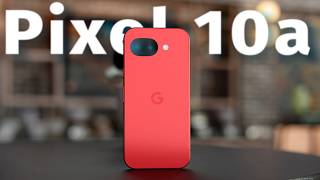

Why a $500 phone beats a $1200 flagship
45sChallenges the flagship phone norm with a provocative take that resonates with budget-conscious consumers.
▶ Play Clip"Title promises a hot take, and the video delivers a clear opinion with supporting details, though it's more of a standard review."
The video presents a detailed review of the Google Pixel 10a, a mid-range smartphone. The reviewer argues that while it may not outperform flagship devices like the S25 Ultra, it could be a better purchase for many users due to its balanced features and lower price. Key highlights include a flush camera design, satellite SOS, and iterative improvements over the previous model.
The Pixel 10a could be the best phone to buy in 2026 for many people, even if it's not the best phone overall. It offers a $500 price point with features that check the right boxes for most users.
Many people don't need to spend $1,200 on a flagship; a $500 phone that meets their needs can be a better purchase. The Pixel 10a has advantages like a flush camera bump and pocketability.
The camera bump is completely non-existent, making the phone minimal and pocketable. It doesn't wobble on flat surfaces and won't get hung up on pockets.
The Pixel 10a now includes satellite SOS, a flagship feature that can save lives when off-grid. It works by aiming the phone at the sky to connect with satellites for emergency messaging.
It uses the same Tensor G4 chip as the Pixel 9 and 9 Pro. While not as powerful as Snapdragon, it's solid for mid-range and handles AI tasks well.
The Pixel 10a uses the same Tensor G4 as the 9a, while the flagship Pixel 10 uses the newer Tensor G5. The difference in real-world performance is likely minimal.
Tensor chips are good at AI tasks that Google focuses on, even if they lag behind Snapdragon in raw performance.
Four color options: two neutral (white, blackish) and two vibrant (berry, lavender). Aluminum rails and a composite back made of 80% recycled polymer, with recycled cobalt and tungsten.
6.3-inch 1080p display with 60-120Hz refresh rate. Bezels are chunky but users stop noticing after about a week. Corning Gorilla Glass 7i on the front for durability.
Fingerprint sensor, PIN, and Face ID. Battery is 5,100 mAh, rated for 30 hours of regular use and 120 hours in extreme power saving. Wired and wireless charging each increased by about 3 watts.
48MP primary and 13MP ultrawide sensors, same as last year. Limited zoom (5-8x) but respectable quality. No telephoto lens, which is expected at this price.
4K video on both front and rear. Video is not as strong as photos but improving, with solid stabilization though panning can be slightly weird.
Includes Camera Coach, which guides users to take better photos. The reviewer is skeptical but notes it could help beginners.
8GB RAM with 128GB or 256GB storage, no expandable storage. Includes Google call suite features like Hold for Me, Call Screening, and Direct My Call.
Includes Gemini and other Google AI features, like photo editing with natural language prompts. Ultrawide lens has autofocus for macro shots, better than dedicated macro lenses.
Key differences from 9a: satellite SOS, no camera bump, new colors, improved display with smaller bezels, faster charging. Overall iterative improvements, not a major overhaul.
If you have a 9a, no need to upgrade. If buying new, consider the 9a which is $100 off and offers similar specs. Both have 7 years of software updates.
The Pixel 10a is a minimal, reliable phone with good software, cameras, battery, and wireless charging. It's not better than flagships but is a better purchase for most people.
The Pixel 10a is a solid mid-range phone that delivers essential features without the flagship price tag. For most users, it offers a better value than high-end flagships, though those with the 9a may not need to upgrade.
What is the price of the Pixel 10a?
$500
00:14
What processor does the Pixel 10a use?
Tensor G4
01:53
What is the battery capacity of the Pixel 10a?
5,100 mAh
04:15
What is the main camera resolution?
48 megapixels
04:56
How many years of software updates does the Pixel 10a get?
7 years
08:47
What is the refresh rate of the display?
60-120 Hz
03:31
What is the ultrawide camera resolution?
13 megapixels
04:56
What is the maximum zoom capability?
5-8x
04:56
What is the battery life rating for regular use?
30 hours
04:15
What is the battery life in extreme power saving mode?
120 hours
04:15
What is the difference between the Pixel 10a and 9a in terms of camera bump?
The 10a has no camera bump at all, it's completely flush.
00:43
What is the storage capacity options?
128GB or 256GB
06:41
What is the RAM capacity?
8GB
06:41
What is the name of the feature that guides users to take better photos?
Camera Coach
06:02
What is the name of the feature that shows call menus on screen?
Direct My Call
07:24
Flush Camera Design
A unique design choice that improves pocketability and aesthetics, rarely seen in modern smartphones.
00:43Satellite SOS on a Mid-Range Phone
Brings a life-saving flagship feature to a $500 phone, making it a standout value.
01:10Same Chip as Last Year
The Pixel 10a uses the same Tensor G4 as the 9a, highlighting a lack of major performance upgrade.
02:21Recommendation to Buy the 9a Instead
The reviewer suggests the previous model is a better value due to a $100 discount and similar specs.
08:34Better Purchase for Most People
The core argument that a mid-range phone can be a better buy than a flagship for the average user.
09:26[00:02] could it be one of the best mid-range phones of 2026, but it could very well phones of 2026, but it could very well be the best phone to buy in 2026. Allow me to explain. So, this phone has a lot that I really like about it. And I'm not
[00:14] saying it's better than the S25 Ultra. I'm saying this could potentially be a better buy for a lot of people. There's many people who don't need to spend $1,200 on a phone to get the best experience that they would personally
[00:27] use. And a $500 phone that checks all the right boxes could easily be an even be a better purchase because this has some other advantages that a lot of flagships don't have. For example, last year we had the very slim Pixel 9A where
[00:43] the camera bump was almost non-existent. This year, it is literally non-existent. There is no camera bump, it's completely flush, and it makes it a very pleasant and minimal experience when using this phone. It's way more pocketable, and you
[00:55] phone wobbling when you set it down. It's not going to get hung up on your pocket. And I know a lot of people use a case anyway, but I don't know. I think is not extruding from the back of your phone. That's a big benefit on the Pixel
[01:10] 10A. Another update this year is that you now have satellite SOS. In the past, pushed me towards originally iPhones when they had it. And then, you know, pushed me towards the flagship phones because I'm somebody who goes off-grid
[01:26] fairly often, whether you're hiking, you know, backpacking, doing stuff like that. And if you get hurt, satellite SOS could very well save your life. So, maybe it's like a little bit of like a fear in the back of my mind, and that's
[01:38] why I do that. But I think it's really nice to see that really big flagship feature rolling down to a $500 phone like the Pixel 10A. And to use this, you of aim it at the sky, and it lines up with some satellites, and you're able to
[01:53] send messages and get help like that. As far as what's under the hood of the Pixel 10a, we have the same Tensor G4 processor as the flagship Pixel 9 and Pixel 9 Pro. And although the Tensor is
[02:06] category, it can stutter, it's far from the Snapdragon series, but in the midrange category, it's a solid chip. It definitely gets the job done. And still one little complaint is that you should notice this is not a new chip from the
[02:21] Pixel 9a. The Pixel 9a and 10a both have the same Tensor G4, while the flagship Pixel 10 and 10 Pro are both using the Tensor G5. So, how much of a difference is it really going to be? Honestly, probably not that much different. The
[02:35] Tensor chips are always just one notch away from the Snapdragon flagships, but they're pretty good at a lot of the AI tasks that Google really focuses on with like plural, there's four different colors. So, you've got two that are
[02:50] pretty subtle, pretty neutral, and two that are much more vibrant. You've got kind of like a white and and kind of a blackish colorway. And then you've got berry and lavender, much more vibrant. Honestly, kind of fun colors. And you of
[03:02] change it entirely. You have aluminum rails on the outside, much like the Pixel 9a, and you have a composite back on the well, the back of the phone. The aluminum, which is pretty cool. Aluminum's super easy to recycle, so
[03:18] it's nice they do that. And the plastic back is about 80% recycled polymer. And recycled materials. Cobalt in the battery, tungsten in the haptics. It's kind of nice to see that. Now, this phone, talking about the display in the
[03:31] very familiar again, much like the Pixel 9a. You've got a 1080p display, 60 to 120 hertz, so very smooth refresh rate, 6.3 inch display. Now you have thinner fairly chunky bezels compared to flagships. I have to say it's one of
[03:47] those things that last year I used the Pixel 9a for like, you know, several phones for a living. So, I have access to some pretty incredible phones. And yet, when you're using this, you kind of stop seeing the bezels after just about
[04:00] a week. Nonetheless, they're chunky and I'll give you that. Now, this is also a because now we have Corning Gorilla Glass 7i on the front. So, a little bit more tough. Also, you can unlock this, again, much like before, fingerprint
[04:15] sensor, PIN, Face ID, the same usual stuff. And again, the battery is also the same as last year, 5,100 milliamp hours. Now, they're rating that for 30 hours of regular use and 120 hours in extreme power saving. So, again, if
[04:29] just not going to be plugged in for a couple days, you could do that. And uh faster. I think the wired and the wireless charging each got an increase of about 3 watts each. So, I mean, I promise there's some more differences,
[04:44] familiar phone. I'm naming a lot of things that are just like the 9A, which is not necessarily a bad thing. Google doesn't tell me exactly what the sensor is in the phone, but they said the specs are the same as last year, 48 megapixel
[04:56] primary rear sensor and 13 megapixel ultrawide. You do have a very limited zoom capability on this. You can zoom in till, depending on video or photo, about like 5 to 8X. But, the zoom is respectable in quality. It's kind of
[05:10] in to 100X, I mean, if you were trying think you'd really be usable anyway. So, the lack of a telephoto lens is kind of expected in this price range. Although, there are phones from Nothing, for
[05:23] example, that do have a telephoto lens. And if you want, I can make comparisons phones. Just leave comments below. Whichever phones get the most comments, I will be making comparisons with this one. Also, video quality on this, 4K on
[05:37] both the front and the rear lenses. It's a Pixel. So, the video is not going to be as strong as the photos, but it's definitely getting a lot better. And uh video, because I think it looks pretty solid is going to be the stabilization.
[05:50] Sometimes it's a little bit weird when you pan, but again, that's just kind of a pixel thing. We also have the usual Pixel camera experience. So, a big AI focus here. Google's trying to push everyone towards camera coach is their
[06:02] new feature that they had on the Pixel 10. And basically it's like it'll guide you to take photos and tell you what to do. I mean, I I somebody who kind of uses a camera for a living, I don't know if I see that much use in it, but I I at
[06:15] are are not really that good at taking photos and they probably could use this, but I'm curious. Like, have you ever used camera coach? And if so, have you found it helpful? I've seen some pretty poorly framed photos out there and maybe
[06:27] quite sure if it's it's a gimmick or cameras, again, getting back to the internals of this phone, same specs as last year, 8 gigs of RAM and either 128 gigs of storage or 256 GB
[06:41] one. You don't have expandable storage, once again, like I said. And you still and experience as the flagship phone. So, you're getting the whole Google call suite including hold for me, which I use all the time. Like, you call the IRS or
[06:55] just say hold for me, you don't have to listen to that music, and it'll notify You also have call screening, filters out a ton of spam and uh just unknown numbers. It can use the Google Assistant basically and say, "Hey, like, what's
[07:10] up? Who is this?" And once they tell you Google Assistant who it is, it'll then Pretty cool feature. And the one that I personally use the most is direct my call. Again, if you're calling the IRS or if you're calling anyone that has
[07:24] Google shows you all of that on the screen and you can navigate so much faster without having to wait for it to read every single item in the list. You also get all of the Google AI features on here. And I'm not a huge AI user on
[07:37] my phone. Like, I use Gemini and I I ChatGPT, but a lot of times these phone much stuff out there. However, some of them are pretty neat. Google's photo language, so you could just ask it like, "Hey, change the bricks to more of a
[07:52] outfit to blue, and it can do all of that very easily. The ultrawide lens, mid-range category. A lot of times they add it as a third useless lens, but the shots. So, if you get really close, you've got autofocus on there, and it'll
[08:07] focus and essentially give you a much better macro shot than you would if you had like a 2-megapixel macro lens. I find those incredibly useless, and this so summary of the Pixel 10a. What's actually different about it? Satellite
[08:21] SOS is probably the biggest one in my opinion. You also have that lack a got new colors on here. We've got some improvements to the display, smaller bezels, faster charging, just kind of across-the-board iterative improvements.
[08:34] That it's not going to be a a big overhaul. Like, if you have the 9a, you 10a. In fact, if you're in the market to buy one of these phones, you might want to buy the 9a. It's $100 off right now, and you're getting kind of the same
[08:47] cameras, you're getting the same processor, and things like that. By the way, this phone and the 9a were both rated for 7 years of software and OS updates, so it's pretty great that that's a future-proof design and phone
[09:00] here. But, yeah, it's going to be a fairly boring phone. This is a phone that is minimal. It works. It gives you good software, very clean minimal experience, solid cameras, solid battery life, wireless charging, really
[09:13] everything like I said that most people would want. Is it going to be better than the top-tier flagship phones? No, not at all, because this doesn't even have a telephoto lens. But, is it going to be a better purchase for most people?
[09:26] I would say probably, actually. I think a lot of people could spend $500 and they would get if they bought a flagship, because a lot lot people just wouldn't use all of the flagship features like reverse wireless charging
[09:39] video helpful. Like I said, leave a comment and let me know what I should most comments will be getting a comparison video. Thanks for watching. I'm Michael Brian and I'll see you in those comparisons.


⚡ Saved you 0h 09m reading this? Transcribe any YouTube video for free — no signup needed.