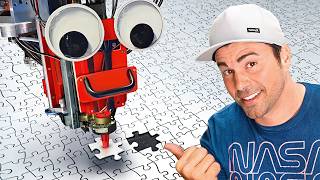

Robot 200x Faster Than Humans?
45sThe bold claim of a robot being 200x faster than humans sparks curiosity and debate, perfect for hooking viewers.
▶ Play Clip"The title is accurate: the robot is indeed much faster than humans, though the 200x claim is based on initial tests."
This video documents the creation of 'Jigsaw,' a robot designed to solve jigsaw puzzles at speeds up to 200 times faster than the fastest human competitor. The host explains the complex tasks humans perform while puzzling, the engineering challenges of replicating those abilities with robotics, and the final face-off between Jigsaw and a champion human puzzler.
Jigsaw is a robot designed to solve jigsaw puzzles, potentially 200x faster than the fastest human.
Humans perform four complex tasks: picking up pieces, orienting them, moving them, and using visual perception for pattern recognition.
Human hands have 27 bones and 34 muscles, providing flexibility, strength, precision, and sensory feedback.
The brain subconsciously combines pattern recognition, spatial reasoning, visual memory, and executive function to solve puzzles.
Humans have the highest brain-to-body weight ratio of any living thing, enabling tool use, planning, and cooperation.
Replicating human hand dexterity with a robot requires a suction cup gripper, precise rotation, and industrial motors.
Teaching a computer to recognize piece placement is hard because human brains do it subconsciously.
Shane, an expert engineer, had already built a puzzle-solving machine but wasn't satisfied, leading to collaboration.
Instead of competing with human brains, the robot uses edge analysis to match puzzle pieces by comparing edge splines.
A camera on a gimbal takes pictures of each piece, isolates them, and extracts edge splines for matching.
The algorithm filters edges by length, overlays splines to measure overlap area, and ranks matches.
When a wrong piece is chosen, the robot backtracks to the last fork and tries the next best option until all pieces fit.
The team scaled the prototype to a 1000-piece all-white puzzle, which took weeks of late nights.
Jigsaw successfully solved the 1000-piece puzzle, though the code didn't work on the first try.
Jigsaw uses a wiggle routine to adjust pieces into place, mimicking human tactile feedback.
After 48 attempts, Jigsaw solved a puzzle in 55 seconds, setting the stage for a world record.
Tammy, a national sudoku champion and fast puzzler, is introduced as the human opponent.
Kristen solved a 30-piece puzzle in 1 minute 5 seconds, but Tammy was the real challenger.
Tammy shares tips: flip all pieces, sort by edge/corner, group by color/texture, and sort by shape.
Jigsaw and Tammy compete on a 1000-piece puzzle. Jigsaw takes an early lead and wins.
Tammy concedes, and Jigsaw is declared the winner. The host promotes CrunchLabs Hack Pack.
Jigsaw successfully defeated a human champion in a 1000-piece puzzle, demonstrating that robots can surpass human speed in specific tasks. The video highlights the engineering ingenuity behind the robot and the unique capabilities of the human brain.
How many bones and muscles are in the human hand?
27 bones and 34 muscles.
00:44
What percentage of body weight does the human brain make up?
2%.
02:34
What is the precision of Jigsaw's rotation?
0.005 degrees.
03:34
What algorithm does Jigsaw use when it hits a dead end?
Backtracking algorithm: it goes back to the closest fork and tries the next best option.
07:53
How does Jigsaw correct placement errors?
It uses a wiggle routine that translates the piece in various directions until it snaps into place.
10:50
What are Tammy's four tips for solving puzzles faster?
1. Flip all pieces to see them. 2. Sort edge pieces and corners. 3. Group by color/texture/pattern. 4. Sort by shape (ins/outs).
15:23
How long did it take Jigsaw to solve a puzzle in the world record attempt?
55 seconds.
11:42
Human Hand Complexity
Highlights the biological marvel of human hands with 27 bones and 34 muscles.
00:44Brain-to-Body Ratio
Humans have the highest brain-to-body weight ratio, enabling advanced cognition.
02:34Edge Analysis Solution
A clever workaround to avoid replicating human vision by focusing on edge matching.
05:35Backtracking Algorithm
Demonstrates how robots can use trial and error systematically to solve problems.
07:53Tammy's Puzzling Tips
Practical advice from a champion that can help anyone improve at puzzles.
15:23[00:00] He's a friendly little robot that's really, really good at only one thing: Really, really fast. but according to our initial tests, we have hopes he might be 200 times
[00:14] faster than the fastest competitive jigsaw puzzler in the world. to get ready for the ultimate robot versus human face off. you might find helpful as a mere human jigsaw puzzler yourself.
[00:28] I first want to give us humans some well-deserved credit to be able to pick up and arrange these 12 pieces of a puzzle, I'm actually doing four very complicated tasks.
[00:44] Have you ever stopped to think just how amazing our hands are? Hiding beneath that skin are 27 bones and 34 muscles, which makes them flexible and strong, but they're also incredibly precise and dexterous
[00:59] for sensing pressure textures, and temperature. which makes it way easier to hold tools than if it was just five fingers all side by side.
[01:12] to the correct orientation, which again is pretty straightforward we need to move the piece into position, and that requires our whole arm.
[01:24] most vertebrae have the same basic arm bone configuration from a human to a bat, to a chicken to a turtle to a dolphin. is the most technically capable arm
[01:37] If you imagine a large cube in front of me, it's wild that us humans can move this puzzle piece to any position and orientation within that cube. or pretty much any other species to do for that matter.
[01:52] it’s hard to explain how this piece should go here. visual perception to our brains, which then subconsciously synthesize
[02:08] a complicated combination of pattern recognition, spatial reasoning, visual memory, and executive function, and as a result, in fractions of a second? But this is once again where us humans are the undisputed champions.
[02:22] Physically, we're kind of unremarkable in the animal kingdom. We can't swim as well as dolphins or fly like an eagle.
[02:34] It's our brains that make up 2% of our body weight, And that ratio is higher than any other living thing ever. because it allows for the huge survival advantages that come from tool use planning,
[02:51] problem solving, language, and large scale cooperation with other humans. in history, made us the best... or better than us at puzzles, our daunting challenge
[03:06] and figure out how to translate it into things in lieu of an opposable thumb and 27 hand bones that's often used to manipulate small objects on assembly lines.
[03:21] This solenoid here can cut off and then connect to this vacuum pump, and then turn it off we attached the suction cup grabber of jigsaw
[03:34] That's precise to an incredible 0.005 degrees. it could slice your circular birthday cake into over 65,000 pieces.
[03:47] For number three to move a piece around, we modified our avid CNC router by upgrading the motors to ClearPath industrial servo motors. Our autonomous Domino robot.
[04:01] accurately place a puzzle piece down to .0005 inches jigsaw can take the lead out of a mechanical pencil
[04:13] and move all around the table, and then come back and put the lead right back in. rotate, and move any piece with terrifying precision. The only thing he lacked was step four, knowing exactly where to place the pieces.
[04:26] because all the subconscious work performed by neural pathways in our brain that makes finding the right piece feel so obvious to us
[04:38] using just computer logic and code just as we were really struggling to come up with a good solution to this problem, the most devastating thing that can happen as a YouTuber actually happened.
[04:51] released a video about, you guessed it, a machine that solves jigsaw puzzles. the most technically capable engineer I know. my knowledge goes pretty deep in maybe four, and I'm a generalist in the rest
[05:09] Shane, however, is somehow an expert in all 15 When I told him he beat me to the finish line, he told me he personally wasn't satisfied with where he landed the project
[05:23] And that's when our fortunes improved, because while filming a video in Rwanda using autonomous drones, I got to spend some time with Ryan,
[05:35] And after hearing all of our challenges by the time the plane landed on the way back home, he'd coded up a solution Basically, instead of trying to compete with our brains
[05:49] we took a much more simple approach and just looked at the edges makes it more impressive and way harder to solve for us humans.
[06:01] So to do this edge analysis, we first need a set of eyes. I love a good pair of googly eyes. Because the googly is controlled by two servo motors
[06:16] The idea was to run a serpentine pattern over all the pieces and take a picture of each one, and then isolate them against the background So if we wanted to find a match, say for this edge,
[06:31] that had a corresponding edge spline that matched up perfectly. Now, even for a small, simple puzzle like this, that's over 200
[06:44] So the first step is just to look at the overall length of each spline and disregard any edges that were significantly longer or shorter, Then for the remaining candidates, we would overlay the splines
[06:58] between the two edge splines. So two pieces that were obviously not a fit would have a lot of overlapping area, the overlap area would essentially be zero.
[07:11] From there, we looked at all the possible spline matchups and ranked the pieces Then jigsaw would start with one of the four corner pieces and map out the potential solution space,
[07:24] is the only one that finds a good fit for all 12 pieces of the puzzle. And that's because sometimes it was really obvious what the matching piece was.
[07:37] because the edges are so similar, and our pictures weren't always perfect, what seemed like the best match for a set of two pieces. and there would be no more good candidates to match the edges
[07:53] he chose the wrong piece somewhere previously up the chain, back to the closest fork and then choose the next best option, until he found a path that finally connected all 12 pieces
[08:08] And then at that point, he knows exactly where each of them is starting from over here. he demonstrated back in steps one through three.
[08:22] Could we scale that up to a 1000 piece, all-white puzzle? We figured maxing out the number of pieces would give the advantage
[08:35] So after a couple more long weeks filled with plenty of late nights scaling up a simple prototype 100 times over... We're at this moment about to fully solve it for the first time.
[08:51] The code always works on the first try jigsaw got to work starting first with taking all the pictures. And after we had the pictures, and we did the prep work on them I mentioned earlier
[09:08] it was time for jigsaw to actually try and solve the 1000 piece puzzle. the actual time to figure out the correct placement And I love how you can actually see him
[09:22] solving, and then going back each time he hits a dead end the only combination that makes them all fit perfectly.
[09:34] jigsaw to do was get to work placing the pieces, since he now knew And just as we made the mistake of having some kind of glimmer of hope,
[09:47] And then a bunch more followed right behind. there were a few very small sources of error So, for example, there's always a little slop
[10:01] between any two puzzle pieces, which adds up over a lot of pieces. when certain pieces were laid down. one final important feature us impressive humans possess
[10:16] we first just approximately place the piece where it needs to go to form a feedback loop with the brain to make really tiny adjustments until we feel the piece fall into place
[10:31] But since jigsaw doesn't have nerves in his gripper, we approximated and that encoder is so accurate jigsaw could feel that tiny hair slice if it was resting on top of the table.
[10:50] and he could feel it hadn't quite snapped into place he would employ a wiggle routine where it would just barely translate the piece into various directions until he got the feedback from his finger
[11:02] at which point he would give it the customary final tap And so, with Jigsaw's new hardware and software upgrades And I should mention, by the way, from a combined
[11:14] hardware software perspective, this is by far the most challenging the auto Bullseye dartboard and the automatic Domino Robot Dominator. all the juicy details, including all of the source code,
[11:27] You boys ready to try this again officially for the 48th time? Have you learned nothing Ian?! So jigsaw got to work and after taking pictures
[11:42] in a mere 55 seconds you got this jigsaw. Okay, I guess we could sit back down
[11:57] I just get to kick back and relax in a state of Zen Because unlike the CrunchLabs build box, which is made for kids, we just launched HackPack, which is kind of similar
[12:11] It's just more advanced and created specifically for teenagers and adults. delivered right to your door, where we build it together and learn, that go into making the builds on my channel.
[12:25] They're all super fun and even useful, and they'll work right out of the box. but since my goal is to get you to always level up your skills you can level up the functionality of your robot, or get totally creative
[12:43] of unlocking the really fun and rewarding hobby of making stuff, where we're giving away one free box as an early subscriber special.
[12:56] Things were looking very promising for the world record attempt with no human intervention. Some required a little bit of wiggle.
[13:13] And some required a lot of wiggle C’mon last piece Now feeling more confident in Jigsaw’s abilities
[13:29] It was time for him to meet the greatest jigsaw puzzler the human race had to offer also happens to be a national sudoku champion I first wanted her to face off
[13:42] my dear friend Kristen Bell aka Anna, or Veronica mars, or Eleanor, or a bunch more ever since I told you I was making a puzzle robot, you've been talking so much trash.
[13:55] So instead, I have a friend I want you to... challenge. the fastest puzzle We kick things off with a simple 30 piece puzzle.
[14:09] Kristen started off pretty strong. I mean, I could trash talk, but- Wow, that was one minute and five seconds for a 30 piece puzzle.
[14:26] But I wanted to see one more face off, and a huge advantage in Kristen's favor. And with Kristen's renewed confidence, the clock started
[14:41] Tammy was so confident in this 2-v-1 matchup. She saw no problem in helping our cause. SHE’S RIGHT
[14:54] Is this the robot? and that was espionage. Tammy, get real.
[15:08] I have good color acuity. So if you say had to go against an all white puzzle... But she didn't stop there.
[15:23] she tells amateur jigsaw puzzlers to help them solve puzzles faster. and turn them over so you can see them all at the same time. and that's not a bad move, but it's not always the best.
[15:37] like a gold frame around the outside and then leave them till the end, where there's a lot look for groupings that catch your eye and organize them into piles.
[15:51] So for example, you could organize by colors, textures, or patterns. But either way, you're trying to reduce the search space into smaller chunks And this way you don't have to do them at the same time, which makes it easier.
[16:05] sort by shape based on how many ins and outs they have This will leave you with six total piles And I needed to look no further than our current match up-
[16:20] Don't look at Tammy's, Kristen -to understand there must be some validity to these four steps. I'm not trying to-
[16:32] 34 minutes and 2 seconds. Your next puzzle match will not be against mere humans. Tammy, I'd like to officially introduce you to jigsaw.
[16:49] And Jigsaw was in no mood for conversation as he got straight to work. of all humanity resting on her capable shoulders. The only shape I can make use of is the edge.
[17:04] not really sure what I'm supposed to do now... I might need to take measurements on your neck later. Wow, Tammy
[17:19] No, that's not it. There's a corner piece! and began cutting.
[17:33] Tammy, ignore me... It ain’t over till it's over. And while I was tempted to count all 1000
[17:46] I decided to take up woodworking instead. Jigsaw. My love is very conditional.
[17:58] Jigsaw has now officially taken the lead. Jigsaw continued to make steady progress while Tammy... faced the limits inherent in biology
[18:11] Without the precise search capabilities... Click. I love that sound. Jigsaw. Do you need a water break?
[18:26] I was the ideas guy and jigsaw was the muscle. The only thing is So I opted to help Tammy instead.
[18:40] Do you need this piece? Do you need thi– I made myself useful by woodworking. Nah I’ll look later
[18:54] as the annoying youngest sibling. And after all that, Tammy had made a lot of progress- There's only eight pieces left
[19:09] The good news is I made you a scarf! to try all the remaining combination of pieces she had left It would take her one and a half months to finish
[19:24] Unless you're about to finish 1000 pieces in four hours. Okay, Tammy, you represented us humans well,
[19:38] But alas, it’s time we welcome our benevolent robot overlords. It's an honor to lose to him Good work, jigsaw.
[19:50] I put the final touches You are the best the human race has to offer. Just, you know, not that great
[20:02] and you've always wanted to make and build cool stuff It's called the CrunchLabs Hack Pack of really fun programable robots that get delivered right to your door.
[20:15] Where we build it together and learn, step by step, the kinds of engineering skills and they all work with no programing required. and level you up, you can easily hack the microcontroller brains
[20:29] of any of these robots in a bunch of ways to completely level up the functionality. as well as an AI chat bot named Mark Robot that will check your code for you and help you implement your most creative ideas.
[20:44] If you're box has it, congratulations because college is now plus you get to come out here and brainstorm So if you want to enhance or even just take the first step
[21:00] of unlocking the really fun and rewarding hobby of making stuff, We're giving away that free box as an early subscriber special Thanks for watching.



⚡ Saved you 0h 21m reading this? Transcribe any YouTube video for free — no signup needed.