
The Secret to Kicking a 64-Yard Field Goal
38sEducational breakdown of the exact technique used by an NFL record holder, appealing to sports fans and aspiring kickers.
▶ Play Clip"Delivers exactly on the promise of a robot vs NFL kicker competition with impressive engineering and actual record-breaking."
Mark Rober builds a robot to challenge NFL kicker Matt Prater in a competition to see who can kick the longest field goal. Through iterative prototyping, the robot achieves a 105-yard field goal, surpassing Prater's NFL record of 64 yards. The video compares human technique with engineering, highlighting key factors like leg speed and contact point.
Mark introduces his robot and the competition with NFL kicker Matt Prater to settle man versus machine.
Tom Dempsey held the record with 63 yards, then Matt Prater broke it with 64 yards nearly a decade ago.
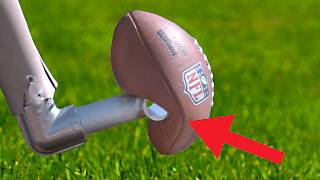
Leg speed and making contact 2.2 inches from the bottom of the ball are critical for distance.
Both successfully make 25-yard field goals; Mark's kick is similar to Prater's.
Both make 45-yard field goals; Mark is pleased to still be competitive.
Mark tries a barefoot style popular in the 80s, but the kick fails.
Mark reveals the true reason: a robot built over a year to kick long field goals.
The robot uses a freely rotating leg, winch, springs, and a quick-release hook system.
Version 3 improved foot attachment and diameter; version 4 increased spring force to 2 tons and changed sprocket ratio for more power.
At one-third power, then half power, the robot kicks impressively, with Prater watching.
Prater successfully kicks a 60-yard field goal; discussion of optimal launch angle (45 degrees) and drag.
Prater makes a 64-yard field goal, one yard past the NFL record.
Prater attempts 70 yards but falls short.
At 80% power, the robot kicks an 84-yard field goal, beating Prater's record.
Mark uses a custom grid blanket to measure foot speed: robot foot at 82 mph, Prater at 80 mph, and later robot at 120 mph full power.
The robot kicks with inflated footballs; first kick has poor trajectory, second is short due to knuckleball effect.
At full power, the robot kicks 83 yards, breaking the NFL record with ease.
The robot kicks a 105-yard field goal into a slight headwind, showcasing its potential.
On the last attempt, a key breaks, but the robot already proved its capability.
The robot, Ray Finkle, successfully beat the NFL record by kicking a 105-yard field goal, demonstrating engineering prowess. Matt Prater's human skill is impressive, but the machine ultimately achieved greater distance.
What is the NFL record for longest field goal?
64 yards held by Matt Prater.
01:24
What are the two key factors for a long field goal according to Matt Prater?
Leg speed and hitting the ball 2.2 inches from the bottom.
02:08
What was the robot's foot speed at 80% power?
82 mph.
13:22
What was Matt Prater's foot speed?
80 mph.
13:37
What was the maximum spring force used in the robot?
Two tons.
08:19
What was the longest field goal the robot kicked?
105 yards.
17:27
At what percentage of full power did the robot break the NFL record?
80% power.
19:11
What trick did Mark use to measure the speed of the robot's foot?
A grid blanket with known square sizes to convert grid boxes per second to mph.
13:09
Two Key Factors for Long Field Goals
Core insight from an NFL kicker on what matters for distance.
02:08Quick Release Mechanism
Critical engineering component for releasing stored energy.
07:25Weakest Link Principle
Demonstrates how iterative testing reveals failure points in engineering.
08:32Optimal Launch Angle of 45 Degrees
Physics principle applied to field goal kicking for maximum distance.
10:50Robot Foot Speed 120 mph vs Prater 80 mph
Quantitative comparison showing machine superiority in speed.
13:37Robot Beats NFL Record at 80% Power
Demonstrates the robot's potential exceeded the record comfortably.
19:23[00:00] He holds the NFL record for the longest field goal ever And this is a robot I made, which not to brag,
[00:13] So, to settle who's better between the two of us, man versus machine. (upbeat pop music)
[00:32] (upbeat pop music continues) that I had an entire stadium just to myself (upbeat pop music continues)
[00:56] He thinks he's coming here just to teach me which is partially true, I am curious. that can kick really far field goals.
[01:11] But if I'm really good test that hypothesis, that can kick field goals the farthest. Originally, a guy named Tom Dempsey,
[01:24] held the record with a 63-yard field goal, But then Prater came along and beat his record by 1 yard - [Commentator] Good! (crowd cheers)
[01:39] - And he still holds the record nearly a decade later. And not only did Matt show up, but to my absolute delight, - This is Pax. - What up, Pax?
[01:52] for his standard warmup and stretch routine, - I definitely don't practice as much - Everyone on your team is watching is like, "Oh, you punk."
[02:08] - [Mark] Then I asked him how to kick and he said it all comes down to just two things. And leg speed makes intuitive sense,
[02:20] is making contact 2.2 inches up from the bottom of the ball. as the most critical for maximizing distance.
[02:32] to achieve those two factors. as close and straight as you can, So, right when you're making contact with the ball,
[02:46] And where do you hit the ball? - Yeah, like right here? I've legitimately attempted to kick a field goal.
[03:00] to playing soccer, and I like to play soccer. So, I say we have a competition. That Gatorade thing, it's got ice water in it.
[03:17] - Yep. Yeah, that works. - You seem pretty confident. - Look at this guy, sandbagging. And this was his first kick, which he lined up left footed
[03:30] - 'cause he's not left footed. And then it was my turn. Laces Out, Dan!
[03:43] - I like that. - Nailed it! - Nice. This is a 25-yarder.
[03:56] And that's true, but the end zone itself is 10 yards. So, you always include that with the kick distance. Let's see what you got, pal. - All right.
[04:10] - We can have a full conversation. Ohh, goodness. That was right in the middle. - Ooh, that was a bad kick, but I'll take it.
[04:24] Okay. Crushed it. So far, I don't know, our kicks look pretty similar.
[04:42] (Mark laughs) - Easy, with room to spare. Oh no. Now, that we are back to a 45-yard field goal,
[04:56] I was just stoked to still be in this. - What? Official review, I want an official review. I'm actually a barefoot kicker.
[05:10] It's honestly the last thing I expected you to do. this was a super popular kicking style in the early 80s, except for me.
[05:23] (Mark exclaims) (Matt laughs) (ball thuds) - That's the worst sound you can hear is a kicker too,
[05:37] - Oh, that was heart-wrenching. (ambient music) Oh. (laughing)
[05:53] (ambient music continues) I thought the barefoot was gonna be my trump card, But while I might not be good at kicking footballs,
[06:07] which technically means I'm really good (train horn blares) - [Matt] (laughing) What is this?
[06:20] This, now you come around back, - [Matt] Oh, no way. - Oh my God. (Mark laughs)
[06:33] - [Mark] So, now Prater knew the real reason I was here, we have to go back just about one year we tested our first prototype.
[06:45] 'cause he is worked in the industry we could make a 60-yard field goal. We needed more power and accuracy
[06:59] first you need to know how it works. it can freely rotate. Then if you put a winch on this side,
[07:13] and then springs on this side also attach to a wire the springs stretch out as the leg is cocked back
[07:25] A quick release is a hook system So, if we put one of those here and then pull the cord, For version two of the robot,
[07:38] because we doubled the force from the springs to over a ton, And our 60-yarders were looking much more promising.
[07:50] it still wasn't as accurate as we wanted. So, for version three, we changed how the foot attached We also tried to determine the best foot diameter
[08:04] But I still wanted even more power that we busted our industrial strength quick release which is just never something you wanna see.
[08:19] we upgraded to a much beefier quick release and then increased our spring force to two tons. by making the diameter of the leg sprocket twice as small
[08:32] So, it rotated twice as far but in the same amount of time, you are only as strong as your weakest link. helps flesh out all the weak links as quickly as possible
[08:48] this fourth version finally had the kind of power even if we were definitely pushing the physical limits For now though, it was time to give Mr. Prater
[09:02] So, Ray Finkle is my surrogate. We'll see if ol' Ray here can do better. Uh huh.
[09:15] Okay, two steps over. 3, 2, 1. That's my boy! That's my boy! (laughing)
[09:30] - That looked pretty easy? - Yeah, that went really easy. In fact, that was only one-third power. where for reference here is Prater, the mere human,
[09:45] and then Finkle at half power (Mark laughs) Matt suspiciously asked me to hold his next kick.
[10:00] And secondly, - [Mark] he continued working his way down the field, (train horn blares)
[10:12] - And it's good! to arrange with my buddy Paul Nurkalla because he's the Drone Racing World Champion,
[10:25] This footage here is from a test session we arranged and it turns out the answer is really freaking cool. a staff member requested we didn't fly drone inside.
[10:37] as Prater bombs this 60-yarder. Which meant the next kick attempt And one of the things Matt does so well is that,
[10:50] technically, you want to launch the ball at 45 degrees More than that, and you waste your energy in height. where the ball experiences drag from wind resistance.
[11:04] which you could see Prater has down to a science. This is one yard past the NFL record, which this man holds.
[11:18] - [Mark] It's good! - Oh, is it in? - You're crazy, dude. as much as I don't wanna get doused with Gatorade.
[11:35] let me just say that it's really special Don't rule out barefoot here. - No, that's way short.
[11:50] from anywhere on the field. - No. So, now that Prater was unsuccessful from 70 yards,
[12:03] and save me from an ice bath. A little bit of train horn for good luck and good measure. of Finkle's true range of motion.
[12:18] - This was about 80% full power form. That's all you gotta do. - Okay. Hit it!
[12:30] Go baby, go! - [Mark] we'd settled the question of man versus machine. Finkle!
[12:44] The hang time though, right? - Dude, it was so high. But since Finkle had made the trip all the way out here, at an 84-yard field goal
[12:56] But first we wanted to try and figure out So, we recorded a few kicks in slow-mo This is a trick I learned while at NASA
[13:09] because if you know the size of each of those squares, and tell the speed of any moving object in the footage by converting grid boxes per second two miles per hour.
[13:22] at an insane 48 miles per hour, The robot's foot, however, at a blazing 82 miles per hour.
[13:37] And while Prater is at 80 miles per hour, the robot clocks in at 120 miles per hour. that I invented this.
[13:51] because it's a real soft functional blanket on one side, that are sized just right the math works out perfectly
[14:06] in exactly one slow-mo second. So for example, if I film this Nerf Dart in slow-mo, in one second, in this case, it's 28 squares,
[14:22] And just to prove this approach works and it came up at the exact same speed. at 15 miles per hour,
[14:35] There are 40 total squares But if you get two blankets, to measure things up to 80 miles per hour.
[14:48] you can can measure the speed of light. and a cozy blanket you can put on your bed, which works great as a green screen for filming
[15:01] And a very limited quantity are available where every single dollar of anything I sell And even if you're like,
[15:14] I put all the critical square spacing info on the website And so, now that we knew Finkle could blast these balls although still not quite at full power.
[15:30] (train horn blares) 3, 2, 1. These were the most inflated footballs I'd ever handled.
[15:44] It's just the pressure from the robot foot was that high. The first kick had the worst possible trajectory. And so, the hang time was hilarious.
[16:02] I think we need to optimize this a bit, So, for the next one, we arranged the foot so it wouldn't pop it up so much,
[16:14] Go! Please! But this one was just short because it knuckleballed to split the difference between those two,
[16:29] which makes now a great time On our last trip to the practice field, I mean, that thing is suborbital.
[16:44] This is only four yards shy of the NFL record. as we pass through the uprights. of spring force through the machine and into the ball,
[16:59] We're just going absolutely full. All of the power. (laughing) Oh my gosh.
[17:13] As you watch that clip back, the ball landed here, And you'll notice, that's right above this unique pattern that unique pattern is right here.
[17:27] So, the question is, what is that distance? then that kick would've gone through the uprights, with no tee, and a slight headwind from 105 yards away.
[17:41] because on one hand, the ability to max out the robot and kick 105-yard field goals is amazing. (machine clatters)
[17:57] We might be done for today. (laughing) because of the whole two tons of spring force thing. It's just a chunk of metal that gets wedged in here
[18:11] So, the final improvement would've been because those distribute the load evenly among many services Unfortunately, those spline shafts had a two week lead time
[18:25] Right, Finkle from 83 yards, full power plus a little more. 3, 2, 1. Oh!
[18:41] Watch Finkle's head here. I'm sorry, buddy. And sure enough, it was the key that was the culprit.
[18:57] Keys aren't supposed to do this. Like, that's bonkers. Not only did robot Ray Finkle beat the NFL record but he did it at 80% power
[19:11] even though he lost a couple of fricking legs he showed he is capable of bombing 105-yard field goal into a slight headwind right off the turf with no tee.
[19:23] because an argument could be made But his son Pax was already way too excited until it turned out he got off easy by comparison.



⚡ Saved you 0h 19m reading this? Transcribe any YouTube video for free — no signup needed.