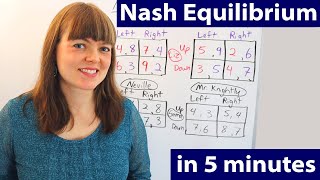

What is Nash Equilibrium? No Regrets!
43sExplains the core concept of Nash equilibrium in a simple, relatable way with a clear 'no regrets' hook that viewers find intuitive and shareable.
▶ Play Clip"The video delivers exactly what the title promises: a clear, step-by-step explanation of Nash equilibrium in about 5 minutes."
This video explains how to solve for Nash equilibrium in game theory using a step-by-step method. The presenter demonstrates the process with several examples, showing how to identify best responses for each player and find equilibrium points where both players have no regrets about their choices.
A Nash equilibrium is a 'no regrets' equilibrium where every player, given the choices of others, is happy with their own choice. It is a best response to a best response, meaning each player's strategy is optimal given the other player's strategy.
To solve a game, first consider player one's payoffs (e.g., Harry's red payoffs). Check each of player two's strategies (Hermione's left/right) and determine which option gives player one a higher payoff. For Harry, down is always better (6 > 4, 9 > 7), so down is a dominant strategy.
Then flip to player two's perspective (Hermione), looking at her payoffs. Check each of player one's strategies (up/down). If Harry goes up, Hermione prefers 8 over 4; if down, she prefers 3 over 2. The box where both players' best responses meet is the Nash equilibrium.
In the Elizabeth and Mr. Darcy example, Elizabeth's best responses are always down (5 > 3, 4 > 2), and Mr. Darcy's best responses are always right (9 > 6, 7 > 5). This yields two Nash equilibria: (Down, Right) and (Up, Left) if both players coordinate.
When payoffs are not color-coded, underline player one's payoffs to keep track. For Ron (player one) vs. Neville, Ron's best responses: if Neville goes left, Ron prefers 9 over 5; if right, prefers 7 over 2. Neville's best responses: if Ron goes up, prefers 8 over 4; if down, prefers 6 over 3. No box has both best responses, so no Nash equilibrium exists.
Emma (player one) vs. Mr. Knightley: Emma's best responses are always down (7 > 4, 8 > 5). Mr. Knightley's best responses: if Emma goes up, prefers 4 over 3; if down, prefers 7 over 6. The box (Down, Right) has both best responses, so it is a Nash equilibrium.
The video demonstrates a systematic method for finding Nash equilibria by identifying best responses for each player and checking for boxes where both players' best responses coincide. This technique works for any two-player game with finite strategies.
What is a Nash equilibrium?
A no-regrets equilibrium where each player's strategy is a best response to the other player's strategy.
00:02
In the Harry and Hermione example, what is Harry's dominant strategy?
Down, because it gives higher payoffs (6 > 4, 9 > 7) regardless of Hermione's choice.
01:05
How do you find a Nash equilibrium in a payoff matrix?
Circle the best response for each player given the other's strategies. The box where both payoffs are circled is a Nash equilibrium.
02:19
In the Elizabeth and Mr. Darcy example, how many Nash equilibria are there?
Two: (Up, Left) and (Down, Right).
03:01
What does it mean if no box has both payoffs circled?
There is no Nash equilibrium in pure strategies.
04:12
In the Ron and Neville example, is there a Nash equilibrium?
No, because no box has both players' best responses.
04:12
Definition of Nash Equilibrium
Provides a clear, intuitive definition of the core concept.
00:02Step-by-Step Solution Method
Demonstrates a practical technique for solving games.
00:36Multiple Equilibria Example
Shows that games can have more than one Nash equilibrium.
02:33No Equilibrium Case
Illustrates that not all games have a Nash equilibrium in pure strategies.
03:28[00:02] basically a no regrets equilibrium where every single player after all of the Dust is settled all is said and done every player can say given what the other player or players did I'm happy with my choice
[00:22] best response to a best response meaning both players can say given what they did my best response is the choice I made and the other player can say the same thing now that doesn't necessarily mean Best Choice or best outcome but let's
[00:36] actually solve these problems so you can see how it's done so we've got a game with Harry and Hermione and Harry's payoffs in this case are red he's player one so his payoffs are always the first payoffs listed his strategies are up and
[00:50] payoffs listed his strategies are up and down so to solve these we first start by thinking from Harry's perspective meaning we only care about the red outcomes and yet and here's the trick we check Hermione's strategies that's the
[01:05] weird part so with Harry we say okay I care about the red payoffs but I'm going to go one by one over each of Hermione's strategies and I'm going to say if Hermione goes left will I prefer the four or the six and I prefer the six as
[01:21] four or the six and I prefer the six as Harry and if Hermione goes right each well I as Harry prefer the seven or the nine and I prefer the nine so he actually has a dominant strategy meaning his best response is always down no
[01:35] matter what she does and then once we've done Harry's perspective we're going to flip perspectives and look at the whole thing from Hermione's perspective looking only at the second payoffs listed since she's player two and yet
[01:49] Hermione is going to check Harry's strategies to say what's my best response so Hermione comes here and Hermione says checking Harry's strategies if Harry went up I as Hermione would prefer the eight rather
[02:04] than the four and then Hermione says if Harry goes down then I as Hermione would prefer the three over the two and then anytime you have two circles in the same box that means it's a best
[02:19] equilibrium now we notice here that we have an interesting situation because both players would prefer this box up here but yet this is the Nash equilibrium and that this is actually a prisoner's
[02:33] dilemma I won't get into that here but let's do this next box starting from Elizabeth's perspective we look at all Elizabeth's payoffs and yet we check Mr Elizabeth's payoffs and yet we check Mr Darcy's strategies so Elizabeth says if
[02:47] Mr Darcy went left then I as Elizabeth would prefer the five rather than the would prefer the five rather than the three if Mr Darcy went right then I as Elizabeth would prefer the four rather than the two and then we flip
[03:01] perspectives and think from Mr Darcy's perspective as player two yet he is going to check Elizabeth's strategies he says if Elizabeth goes up he would
[03:13] prefer the nine over the six and if Elizabeth goes down he would prefer the seven rather than the five so in this box we actually have two different Nash equilibriums now what if your game is not nice and color-coded
[03:28] actually have a tip in that case sometimes I will underline the payoffs um to begin with just to help me organize my my thoughts so down here Ron is player one and so I'm going to underline all of the player one
[03:43] strategies and I'm going to say Ron is going to check Neville's strategies so Ron says if Neville goes left Ron would prefer the nine over the five prefer the nine over the five and then if Neville goes right Ron would
[03:58] prefer the seven over the two and then I flip perspectives now this time I'm going to be looking at the non-underlined payoffs and I'm Neville now so I'm going to say as Neville I'm going to check Ron's strategies so if
[04:12] Ron went up I as Neville would prefer the eight over the four the eight over the four and if Ron went down I would prefer the six over the three so in this game we have no Nash equilibrium and then let me
[04:26] do one without the colors so Emma is player one meaning she cares about the first payoff listed those are her payoffs she's going to check Mr nightly's strategies so she says if Mr Knightley went left she would prefer the
[04:40] seven over the four if Mr nightly went right she would prefer the eight over the five then we flip perspectives and think about from Mr nightly's perspective which is the second payoff and yet we check Emma's strategies so we
[04:54] Mr Knightley says if Emma went up he would prefer the four rather than the three if Emma went down he would prefer the seven rather than the rather than
[05:07] the six so in every single box up here where there are two circles in the same box that's a best response to a best response or a no regrets strategy
⚡ Saved you 0h 05m reading this? Transcribe any YouTube video for free — no signup needed.