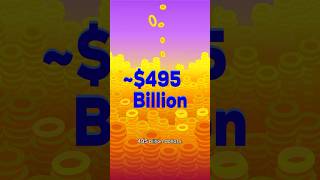

What $495 Billion Could Do
45sThe shocking scale of wealth juxtaposed with life-saving solutions creates a compelling 'what if' scenario that viewers love to share.
▶ Play Clip"Delivers on the promise of showing the power of 1%, but lacks depth and specifics on implementation."
This video explores the transformative potential of redirecting just 1% of the annual income of five wealthy countries. It illustrates how this relatively small sum could fund global health initiatives, provide clean water, and build renewable energy infrastructure, while also highlighting the consequences of recent aid cuts.
1% of the annual income of five rich countries amounts to approximately $495 billion, a sum large enough to wrap around the world in banknotes.
A small fraction of this money could vaccinate every child in sub-Saharan Africa against malaria, saving hundreds of thousands of lives annually.
About half the money could provide clean water to the world twice over, and the remainder could build around 240 solar farms, each capable of powering a city.
In 2025, many rich countries cut aid budgets, sometimes by over half, stopping life-saving treatments and emergency supplies for the world's poorest.
Underfunded health systems and increased conflict could breed antibiotic-resistant pathogens, projected to kill millions by 2050.
The video concludes that with a tiny fraction of their income, rich countries can still help build a better world, implying the future is not inevitable.
The video argues that a relatively small financial commitment from wealthy nations could yield massive global benefits, from saving lives to building sustainable infrastructure, and that recent aid cuts threaten this potential.
How much is 1% of the annual income of five rich countries?
Approximately $495 billion.
00:02
What could a small fraction of this money achieve?
Vaccinate every child in sub-Saharan Africa against malaria, saving hundreds of thousands of lives a year.
00:15
What could be built with the remaining money after providing clean water?
Around 240 solar farms, each large enough to power a city.
00:30
What happened to aid budgets in 2025?
Many rich countries cut them, sometimes by over half.
00:45
What is a projected consequence of underfunded health systems?
Breeding antibiotic-resistant pathogens projected to kill millions by 2050.
01:00
The Scale of 1%
Provides a concrete, relatable number ($495 billion) that makes the abstract concept of '1%' tangible.
00:02Vaccinating Children
Demonstrates a direct, life-saving application of the funds, making the argument emotionally compelling.
00:15Impact of Aid Cuts
Highlights a real-world policy shift (2025 aid cuts) and its immediate negative consequences.
00:45Consequences of Underfunding
Connects underfunding to a long-term global health threat (antibiotic resistance), broadening the stakes.
01:00[00:02] countries money and see what we can do with it. 1% of what these five countries make in a year [music] is around $495 billion. Stacked up in banknotes, it would wrap around the whole world. With less than
[00:15] vaccinate every child in sub-Saharan Africa against malaria, saving hundreds of thousands of lives a year. With another tiny slice, we could cut global >> [music] >> With around half of the money, we could
[00:30] provide clean water to the world twice. And with the rest, we could build around 240 solar farms, each large enough to power a city. Even when countries give a fraction of this in aid, they invest in amazing things, from access to clean
[00:45] water to saving lives when disaster strikes. But in 2025, the aid budgets of many rich countries were cut, sometimes by over half. For the world's poorest, this stopped life-saving treatments and emergency supplies. And it will mean a
[01:00] less stable world for all of us with more conflict and underfunded health systems breeding antibiotic-resistant pathogens projected to kill millions by 2050. But this future isn't inevitable. With a tiny fraction of their income,
[01:14] rich countries can still help to build a better world.
⚡ Saved you 0h 01m reading this? Transcribe any YouTube video for free — no signup needed.