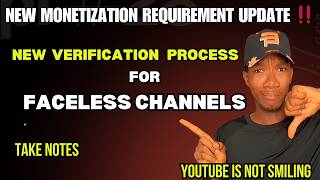

PIN Verification Now Mandatory for YouTube Monetization
49sThis reveals a major policy change that affects all new creators, creating urgency and fear of missing out.
▶ Play Clip"Title accurately highlights new monetization rules for faceless channels, though it slightly overemphasizes faceless channels specifically."
YouTube has introduced two major monetization changes for 2026: mandatory PIN verification for all new AdSense accounts and a dual account suspension policy. PIN verification is now compulsory even after completing online verification, and if you have multiple YouTube channels on one device, issues with one channel can lead to suspension of all linked channels.
As of late January 2026, PIN verification is compulsory for anyone applying for YouTube monetization for the first time. Previously, online verification was sufficient, but now both are required.
Google AdSense requires verification to ensure the user is a real person, not a robot or AI-generated video. PIN verification sends a physical mail to the user's address, which is harder for AI to fake.
If you have two YouTube channels on the same device and one gets suspended for policy violations (e.g., reused content), the other channel is also at risk of suspension. It's advised to use separate devices for different accounts.
Giving your YouTube login to someone else can lead to your account being suspended if their account gets flagged, due to the device link.
You have only five attempts for online facial verification. If all fail, the verification option closes permanently for that account.
YouTube is tightening monetization requirements in 2026 to combat AI fraud and policy abuse. Creators must complete both online and PIN verification, avoid sharing accounts across devices, and ensure original content to avoid suspension.
What is the new mandatory verification for YouTube monetization in 2026?
PIN verification is now compulsory for all new AdSense accounts.
Why did Google bring back PIN verification?
To ensure the user is a real person, as AI can now fake online facial verification.
1:56
What is the dual account suspension policy?
If you have two YouTube channels on the same device and one gets suspended, the other is also at risk of suspension.
3:56
How many attempts do you have for online facial verification?
Five attempts. If all fail, the option closes permanently.
8:47
What should you do to avoid dual account suspension?
Use separate devices for different YouTube accounts and never share your login credentials.
6:59
Mandatory PIN verification
This is a major policy change affecting all new monetization applicants.
Reason for PIN verification
Explains Google's rationale to combat AI-generated fake identities.
1:56Dual account suspension
Highlights a new risk for creators with multiple channels.
3:56Online verification limits
Creators must be careful not to waste attempts.
8:47[00:00] YouTube has been rolling out new
[00:01] monetization requirements for 2026. And
[00:03] one of the recent monetization
[00:05] requirements that have been rolled back
[00:07] in into YouTube monetization is now the
[00:09] pin verification. Pin verification is
[00:12] now compulsory for anyone who is going
[00:14] to be applying for YouTube monetization
[00:16] in 2026. As of early last year, 2025,
[00:20] pin verification was an option when it
[00:22] comes to Google AdSense. When I was
[00:24] applying for my YouTube monetization
[00:26] back in 2025, I did not do any form of
[00:30] in verification and that was because I
[00:32] choose the online verification which is
[00:35] a 10-minute verification you do just to
[00:37] avoid the pin verification. I did that
[00:40] and my application was successful. As of
[00:43] late January 2026, pin verification is
[00:46] now compulsory for anyone who is
[00:49] applying for YouTube monetization. I
[00:51] noticed this because of all my student I
[00:53] have been guiding in applying for
[00:55] YouTube monetization. All of my students
[00:57] I guide in applying for YouTube
[00:59] monetization starting from the late
[01:01] January 2026 up until this date I've
[01:05] been asked to do pin verification. Pin
[01:08] verification is now compulsory for
[01:10] anyone who is applying for YouTube
[01:12] monetization for the first time. So,
[01:14] starting from February 2026, as long as
[01:17] you're applying for YouTube monetization
[01:19] or as long as you're opening a Google
[01:21] AdSense account for the first time,
[01:24] you'll be asked to do pin verification
[01:27] is not a compulsory um policy that you
[01:30] have to do for you to move forward.
[01:32] Right now, in as much as you do the
[01:35] online verification, maybe some of you
[01:37] still will still go and choose 10 minute
[01:38] verification. In as much you still
[01:40] choose 10 minutes online verification.
[01:42] After your 10 minutes online
[01:44] verification, you will still be asked to
[01:47] do pin verification starting from
[01:49] February 2026 is now mandatory for
[01:52] anyone that will be applying for YouTube
[01:55] monetization. Now, some of you guys
[01:56] might not know this. Why Google AdSense
[01:58] always request for verification be the
[02:01] online verification or the pin
[02:02] verification which has now been brought
[02:05] back into Google AdSense. why they
[02:07] always request for verification is so
[02:09] that they make sure that the person they
[02:11] are interacting with is actually not a
[02:13] robot. That is why when you're doing
[02:15] that your online verification they
[02:17] usually tell you turn towards the left
[02:19] slowly and turn towards the right slowly
[02:21] so that they know that they actually not
[02:24] um relating to a robot. they actually
[02:26] relating to a physical person right now
[02:29] with the whole AI thing going on on the
[02:32] internet right AI can now do videos of
[02:35] people turning towards the camera slowly
[02:38] turning towards the left right hand
[02:39] slowly so that pin verification has been
[02:43] brought back into verification for
[02:46] Google AdSense so that that way they
[02:48] know they are going to be sending a pin
[02:49] to a postal office to your address and
[02:53] that way you are going to pick up that
[02:54] pin and then fill in that being on your
[02:56] computer. That way they know they
[02:58] actually interacting with a physical
[03:01] human being because trust me AI can do
[03:03] the same thing under online
[03:05] verification. I've seen a video of AI
[03:08] doing turn towards the left slowly and
[03:10] turn towards the right slowly. So the
[03:12] only way they can cut off that bridge in
[03:14] terms of knowing if these are physical
[03:16] people or if this is just an AI
[03:19] generated people is by sending pin to
[03:22] your mailing address. That's why pin
[03:24] verification is now brought back into
[03:27] Google AdSense verification. So now
[03:29] after doing your online verification
[03:31] which is a 10-minute verification you do
[03:33] in Google AdSense you do the facial
[03:35] verification after doing that facial
[03:37] verification you'll still be requested
[03:40] to do a pin verification so that that
[03:43] way Google AdSense actually know that
[03:46] they are relating to a real woman being
[03:49] that's just why they brought back pin
[03:51] verification into monetization again. So
[03:54] now moving on to the second requirement
[03:56] that was rolled out for YouTube
[03:57] monetization for 2026 is now the dual
[04:00] account suspension. Now let me repeat
[04:03] this again is now the dual account
[04:06] suspension. What does this mean? This
[04:08] actually means that if for example you
[04:11] have two YouTube channel on a mobile
[04:25] mobile phone, right? And channel A
[04:29] actually have a an issue with their
[04:32] monetization or with reuse content or
[04:35] something relating to that. For example,
[04:37] channel A in the same phone, right? You
[04:40] are still the owner of the account have
[04:42] issue with reuse content. If that issue
[04:45] was not treated or if that issue was not
[04:48] treat is going to affect your channel B
[04:52] right let's say for example I have two
[04:54] YouTube accounts on my phone right I run
[04:57] two YouTube channels right maybe I run
[04:59] this YouTube channel and I run a
[05:01] faceless YouTube channel for example if
[05:04] my faceless YouTube channel had an issue
[05:07] and I was not able to resolve that issue
[05:09] there's 100% chances that my main
[05:12] YouTube channel is going to get
[05:14] suspended ended because of my first
[05:16] YouTube account. That is what is going
[05:18] on on YouTube now. So any of you that
[05:21] have two YouTube accounts on your mobile
[05:23] phone, it's advisable you use one device
[05:27] for a different YouTube account and use
[05:29] another device for a different YouTube
[05:31] account. This is something that is going
[05:32] on currently on YouTube. I've seen this
[05:35] happen to a student of mine, right?
[05:37] That's why I'm actually sharing this
[05:39] right now. So never you in any
[05:42] circumstances give your email address
[05:45] that is linked to your YouTube account
[05:47] to another person right because if that
[05:50] person's account has an issue your
[05:54] account because your account has been lo
[05:57] there's 100% chances that your account
[05:59] is also going to get issues right that's
[06:02] why where YouTube always tell people
[06:05] like people who have reused content
[06:07] YouTube always give a statement that if
[06:09] the issue on this account is not
[06:11] resolved, there's 100% chances and
[06:13] there's 100% likely that the other
[06:15] accounts relating to this device is
[06:18] going to be getting affected. So never
[06:20] in any situation give your YouTube
[06:22] account to anybody, right? They should
[06:26] log it on their they should log in in on
[06:28] their mobile phone because if that
[06:30] person YouTube account has an issue is
[06:32] 100% chances that your account is also
[06:34] going to have an issue. Right? So most
[06:37] of my students I've been working through
[06:39] I've been working with we have not I've
[06:41] not been doing anything relating to
[06:43] that. So all I do is that we do on a
[06:45] video call and I guide you on what to
[06:47] do. So I don't do any form of um give me
[06:50] your email, your password and I log into
[06:52] my computer. I don't do that. I do it by
[06:56] either any dex or WhatsApp. Right? So
[06:59] never in any circumstances share your
[07:01] YouTube email address or give it to
[07:03] someone to login into their device
[07:06] because if that person's account have
[07:08] issue for example your account because
[07:12] your account has been logged into that
[07:14] phone is 100% likely if that person's
[07:17] account was not resolved with the issue
[07:19] the person is having and the account was
[07:21] terminated there's 100% chances that
[07:23] your account will also be terminated.
[07:26] That's the new policy going on on
[07:28] YouTube, right? I'm going to be leaving
[07:30] a statement in terms of reuse content.
[07:32] One of my students account, right? So
[07:34] that's why they always if you see people
[07:35] that have reused content or inauthentic
[07:38] content, they always state there that if
[07:40] this channel was app was not successful
[07:42] or something, it's 100% likely that
[07:44] other channel related to this device is
[07:47] always going to have issue or suspension
[07:49] issue. So that's something you should
[07:51] take note in 2025. Never you in any
[07:54] circumstances give anybody your YouTube
[07:57] account to log into the different device
[08:00] because that person's account might have
[08:02] issue in the future and because your
[08:04] account has been logged in into that
[08:06] device is going to affect your account
[08:08] in the future. So these are just the two
[08:11] new updates that have been rolled out on
[08:13] YouTube recently. Now I always advise
[08:15] students if you know you cannot apply
[08:17] for your YouTube monetization by
[08:18] yourself and you do not want to make any
[08:21] mistake in your application now that pin
[08:24] verification is now compulsory is always
[08:27] advisable you reach out to someone who
[08:29] you know that can actually guide you to
[08:32] apply for your YouTube monetization now
[08:34] because once your pin has been sent to
[08:37] your address three times and you could
[08:40] not get that pin or get the postal
[08:42] office or something that your account
[08:44] will stop showing ad.
[08:47] Right? And some of you might not know
[08:49] doing your online verification where you
[08:51] do where you turn your face towards the
[08:53] left where you turn your face towards
[08:54] the right. If your online verification
[08:56] was not successful up to five times that
[09:00] verification will closed from your
[09:02] AdSense account. I've seen it happen in
[09:04] a student account. Right? So you always
[09:06] have five times to try your online
[09:09] verification. If you try your online
[09:11] verification five times and it was not
[09:13] successful, your online verification
[09:15] will automatically closed.
[09:19] Right? I've seen this happen for a
[09:21] YouTube a YouTube student, right? So
[09:24] that is something you guys should take
[09:25] note of. So you guys should be careful
[09:27] for YouTube 2026. YouTube is not smiling
[09:30] in 2026. I feel like in 2026, YouTube
[09:33] might actually roll out new monetization
[09:36] um updates concerning maybe um their
[09:38] monetization requirements being 2,000
[09:41] subscribers or 5,000 um watch hour. I'm
[09:44] I'm very certain that that might happen
[09:46] in the future because a lot of people
[09:49] are getting into YouTube monetization.
[09:51] That's why pin verification is back into
[09:53] YouTube monetization because that pin
[09:55] verification they always want to make
[09:57] sure that they actually relating to a
[09:59] real woman being pin verification is now
[10:03] brought back into monetization. So a lot
[10:05] of you has to be careful concerning the
[10:07] kind of content you post containing the
[10:10] kind of things you say in your videos
[10:11] concerning the kind of um videos you
[10:13] create
[10:15] AI related video. If you create AI
[10:18] related video, the setting that that
[10:21] video is authentic is not that you go
[10:23] and copy um a a a story from somewhere
[10:27] and then create a video about it. They
[10:29] are still going to find out that that is
[10:31] not your original work. So you need to
[10:33] be careful for YouTube 2026. YouTube is
[10:37] not smiling. Trust me, a lot of accounts
[10:40] have been deleted. A lot of account has
[10:42] been suspended. A lot is still getting
[10:45] suspended. A lot of students have been
[10:47] reaching out to me for suspension
[10:48] accounts, for reuse content, all those
[10:51] kind of things. So, you need to be
[10:52] careful in the things you do on your
[10:54] channel in 2026. A lot of people are
[10:57] getting accepted into the platform. A
[10:59] lot of people are also getting kicked
[11:01] out into the platform. So, you need to
[11:03] be very careful on the things you do on
[11:06] your channel. Like I said, for any of
[11:08] you that want to um get your PIN faster
[11:11] in your postal office, there's actually
[11:13] a way you can put in your phone number
[11:15] so that it appears when your PIN arrive
[11:18] in the postal office. So that once they
[11:20] see your phone number there, the postal
[11:22] um officers can actually call you to
[11:24] come and picking your PIN. So you can
[11:25] actually reach out to me on Instagram
[11:27] for me to guide you on how to do that.
[11:29] So that your PIN once you get to postal
[11:31] office, they can call you to come and
[11:33] pick up your pin. So yeah, that's it
[11:35] about this video. I just wanted to share
[11:37] new YouTube monetization requirement for
[11:40] 2026. This is what is going on in 2026.
[11:43] YouTube is not smiling. If one of your
[11:45] accounts have issue is likely that other
[11:48] accounts that you operate on are 100% to
[11:51] have issues. So this is what is going on
[11:53] on YouTube. So, if this video was
[11:55] helpful to you, don't forget to give me
[11:56] a thumbs up and don't forget that you
[11:58] can always reach out to me on Instagram
[12:00] for a one-on-one guide on applying for
[12:02] your YouTube monetization so that you
[12:04] don't make any single mistake in your
[12:07] application. I'm going to see you guys
[12:09] in my next one. Don't forget that my
[12:10] online class is going to be coming up by
[12:13] the first week of April. A lot of
[12:14] students have been paying for this
[12:16] online class, so you want to make sure
[12:18] you grab your own seat for the online
[12:20] class. I'm going to catch you guys in
[12:22] the next one. And I have a welldetailed
[12:24] video concerning applying for YouTube
[12:25] monetization here on my channel. If this
[12:28] video was helpful to you, don't forget
[12:29] to like as well as subscribe to the
[12:31] channel. And I'll catch you guys in my
[12:34] next one. Bye-bye.
⚡ Saved you 0h 12m reading this? Transcribe any YouTube video for free — no signup needed.