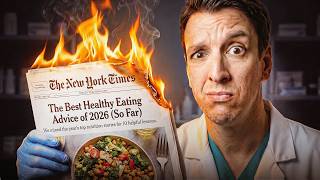

NYT's Worst Nutrition Tips Exposed
44sExpert calls out a major publication, sparking controversy and debate among health enthusiasts.
▶ Play Clip"Title accurately reflects the video: a doctor explains why NYT botched their nutrition advice."
A doctor critiques the New York Times' selection of the best nutrition tips of the year, arguing that the advice is misleading and fails to focus on diet quality over labels like low-carb or high-protein.
The speaker finds the NYT's top nutrition tips disappointing, citing examples like 'be wary of low-carb diets' and 'intermittent fasting science is not sound'.
Tips like frozen yogurt not being health food, diet influencing cancer risk, need for more fiber, and alcohol dangers starting at one drink a day are correct but obvious.
The NYT warns against low-carb diets, but the speaker agrees that carb quality matters more than quantity. However, the article later forgets this point.
Diet A (bacon, butter, deli meats) is bad; Diet B (salmon, avocado, chia seeds, walnuts, greens, berries) is good. Both are low-carb, showing the issue is diet quality, not carb quantity.
The speaker disagrees with the NYT's framing that IF science is weak. IF works for weight loss and blood work, but it's not magic; benefits can be achieved by eating less overall.
The NYT says 'you can eat too much protein' but conflates quantity with source. High protein from healthy sources (salmon, beans) is fine; the problem is poor diet design.
The biggest missed opportunity is focusing on labels like low-carb instead of what people actually eat, which determines health.
The speaker agrees with the NYT that oats are nutritious, citing positive science. Social media claims that oats are poison are unfounded.
The NYT says warm water is not a cure-all; the speaker agrees, noting cold water might be more satiating. It's a minor fad.
Stop obsessing over diet labels. Focus on eating mostly healthy foods: fruits, vegetables, whole grains, legumes, fatty fish, nuts, seeds, fermented dairy, lean meats.
The speaker concludes that the NYT's advice misses the mark by focusing on diet labels rather than food quality, and offers a simple principle: eat mostly healthy foods and ignore the hype.
What is the speaker's main criticism of the NYT's nutrition tips?
They focus on diet labels (low-carb, high-protein) instead of food quality.
06:03
According to the speaker, what is the problem with the NYT's warning about low-carb diets?
They ignore that carb quality matters more than quantity; a low-carb diet can be healthy or unhealthy depending on food choices.
01:08
What does the speaker say about intermittent fasting?
It works for weight loss and blood work, but it's not magic; benefits can be achieved by eating less overall.
02:49
What example does the speaker give of a good low-carb diet?
Salmon, avocado, chia seeds, walnuts, greens, and berries.
02:19
What is the speaker's view on oats?
Oats are healthy; science shows lower risk of diabetes and better blood work. Social media claims they are poison are unfounded.
06:15
What does the speaker say about warm water before breakfast?
It's not a cure-all; cold water might be more satiating. It's a minor fad.
08:04
What is the speaker's top nutrition advice for 2026?
Stop obsessing over diet labels; focus on eating mostly healthy foods like fruits, vegetables, whole grains, legumes, fatty fish, nuts, seeds, fermented dairy, lean meats.
08:30
What does the speaker say about the NYT's tip on protein?
They conflate quantity with source; high protein from healthy sources is fine, the problem is poor diet design.
04:24
Carb quality over quantity
Highlights a key principle often overlooked in nutrition debates.
01:08Good vs bad low-carb diets
Illustrates that diet quality matters more than carb count.
02:19Intermittent fasting not magic
Clarifies that IF benefits are not unique; caloric restriction works similarly.
02:49Oats are healthy despite social media
Contrasts scientific evidence with internet fads.
06:15Stop obsessing over diet labels
Summarizes the core message: focus on actual food, not labels.
08:30[00:02] their selection of the best nutrition tips this year so far. I thought it was really disappointing. I think they screwed the pooch on a number of points. Some of their selected tips that they say are the top tips of the year include
[00:16] "Be wary of low-carb diets, the science of intermittent fasting is not as sound as you think, and you can eat too much protein, so be careful with that." So, I went over all of it, and I think there's a recurring mistake that explains why
[00:30] nutrition advice seems so confusing to all of us. So, let's start with the easy ones, the ones they got right, and that most people already know. One of their tips is frozen yogurt is not exactly a health food. I'm not sure who that
[00:43] surprises. Another is your diet influences your cancer risk. Another is most Americans need more fiber. Okay, I guess it's good to emphasize. Another one is the dangers of alcohol start at one drink a day. I think most
[00:56] people who watch this channel are well aware of these facts. So, let's move on to some of their more controversial points. Their number three controversial points. Their number three tip was "Be wary of low-carb diets." I
[01:08] was surprised that they singled out this one diet that a minority of people eat. Is it so dangerous that it justifies singling out above all others? Now, they make one point that I agree with 100%. They say it's more about the quality
[01:23] than the quantity, the amount of the carbohydrates. I couldn't agree more. I've said that many times here on the channel in previous videos. Obviously, soda, candy, lentils, and apples all contain carbs, and yet some of those
[01:37] great for you. So, lumping all carbs together is misinformation. It's not nutrition. It doesn't help you. Now, what I found a little frustrating is they make this great point, and then they completely forget about it just a
[01:50] couple minutes later, as you'll see. They also say, "If you eat a low-carb diet long-term, you miss out on some important nutrients like fiber. But, that's not a low-carb problem. That's a bad diet problem. The typical American
[02:04] lot of carbs. And by the same token, you can be on a low-carb diet with a lot of fiber in it. So, the problem is not low-carb or high-carb, it's poorly designed diets. Consider these two diets. Diet A: bacon, butter, and deli
[02:19] meats. Diet B: salmon, avocado, chia seeds, walnuts, greens, and berries. Both are low-carb, and yet one is terrible for you, and one is great for you. So, I think we inform people not by saying, "Careful with low-carb," but by
[02:34] explaining what a healthy diet is, and then they can adapt those principles carb or higher carb. Their number four tip is the science of intermittent fasting is not as solid as you think. I really disagree with this framing, and I
[02:49] The problem is not the science of randomized trials showing that intermittent fasting can help you lose weight and improve all kinds of blood work parameters. The problem is the hype
[03:03] around intermittent fasting and telling people fairy tales that intermittent fasting is this magical thing that gives you benefits that nothing else can match because autophagy or mitochondrial renewal or any other mechanistic
[03:16] speculation, the science shows the opposite of that. You can get the same benefits as you get with intermittent fasting with other approaches that don't involve fasting. For example, just by eating less overall, several trials have
[03:29] you get the same benefits with or without fasting. So, it's whatever you prefer. It's whatever fits into your lifestyle. So, I would completely change how they wrote that. I would say, "Fasting is powerful, but if you don't
[03:43] like it, there are other ways to get the same benefits." There. You don't take strategy, and you don't lie to people, either. So, if you like fasting, absolutely use it. We have enough science to back that up. I use it,
[03:57] but I don't think it's magic. It's just a way to moderate overall caloric intake. That's it. If you don't like it, if it makes you feel miserable, if then you overeat, or it doesn't fit into
[04:10] your lifestyle, don't do it. Find other ways to moderate ancestral trigger. That's all salesmanship. Now, their number six tip is going to upset a lot of people. You can eat too much
[04:24] don't blame you, because look at the justification they give. Getting most of your protein from red or processed meat raises risk of heart disease, type 2 diabetes, and certain cancers. What does that have to do with eating more or less
[04:38] protein? They just explained to us that it's about the quality of the carbs, the quality of the nutrient, not the quantity so much. And here they fall for the exact same trap. They're conflating quantity and source. And they continue,
[04:53] "If you leave out fiber, like vegetables and whole grains, you may suffer digestive consequences." What does that have to do with eating high protein? Again, this is just a bad diet with high or low protein. You can eat a very high
[05:08] protein diet and have lots of fiber and vegetables and whole grains and zero red and processed meat if you want. In fact, some sources of protein include fiber, beans, lentils, tempeh, on and on and on. So, the problem is not
[05:22] high protein. The health effect of sardines, of salmon, of kefir, of unsweetened yogurt look great. So, I don't have a problem with diets that are higher in protein. I have a problem with poorly designed diets, whether they're
[05:36] high or low in protein. Let's just explain to people what a healthy diet looks like, what it's composed of, and then they can adapt that to their need, if they are very active or if they're a little older,
[05:50] fits their needs. So, I think the biggest missed opportunity in the whole biggest missed opportunity in the whole article is we focus too much on these diet labels, the low carb and the high carb and the low fat and the high
[06:03] protein, and we don't focus enough on what people are actually eating and that's what's going to determine your health, not the label that we apply on the diet. Now, I've been pretty critical, but I also want to give credit
[06:15] where credit is due. Their number five tip, I completely agree with. They say oats are powerhouses of nutrition. They're good for your heart, they're good for your gut, your blood sugar control, etc. I find this pretty funny
[06:27] because oats have become a great litmus test of whether someone forms beliefs based on scientific evidence or stories from the internet. If you look at the science on oats and the health effects in humans, it's overwhelmingly positive.
[06:43] Lower risk of developing diabetes, lower risk of dying, better blood work. You cannot find, and I've tried, studies in human beings showing any harm at any level of oats in their unprocessed form, right? We're talking about
[06:58] steel-cut oats or rolled oats without a bunch of sugar added. But on social media, there's this fad, it's almost a fashionable to say that oats are they're poison. >> I think that oats are probably the worst
[07:11] breakfast you could possibly eat. >> Oatmeal is one of the worst foods that you can put in your body. >> Oatmeal is the biggest scam on Earth. It is peasant food. >> Oatmeal is a terrible food for human
[07:23] >> Oats are not healthy at all. >> Oats are not good for you. >> This is just based on lack of scientific understanding and just repeating stories that people hear on social media. It's It's nothing else. I have oats all the
[07:35] my diet. We give it to the kids in our family because we have so much science on it and I couldn't care less about internet fear-mongering. Just try this experiment sometime. Google oats studies or oats human
[07:51] trials. Go on Google Scholar if you want more detail or just regular Google and see what pops up. Their top 10 tip I found pretty funny. Warm water before found pretty funny. Warm water before breakfast is not a cure-all. Is this a
[08:04] thing now? I had no idea. This is actually the type of fad I don't mind meal. It's not going to hurt. If anything, it's going to suppress appetite a little. Warm water is completely random.
[08:16] In fact, if anything from the studies we have, cold water might be a little better, more satiating. But you want to drink some water before a meal? Knock yourself out. Cold water, warm water, whatever floats your boat. My top
[08:30] nutrition advice for 2026 is actually what the article hints at and then immediately forgets. Stop obsessing over diet labels. Low carb, high carb, high
[08:42] This is usually a distraction. It doesn't teach you much. Focus on eating doesn't teach you much. Focus on eating mostly healthy foods as staples. Fruits, vegetables, whole grains, legumes, fatty fish, nuts and seeds, fermented dairy,
[08:55] lean white meats, and the rest takes care of itself. If you want to see me debate someone who thinks oats are terrible for you, respectfully, we had a cordial back and forth. Here it is with Dr. Ken Berry.
[09:08] Here it is with Dr. Ken Berry. Check it out. And I'll see you in there.


⚡ Saved you 0h 09m reading this? Transcribe any YouTube video for free — no signup needed.