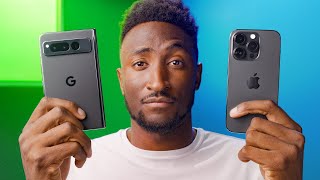

iPhone vs Android: The Impossible Debate
45sOpens a classic, highly polarized debate that immediately grabs attention and invites engagement.
▶ Play Clip"Title promises a definitive winner, but video delivers a balanced rubric for personal choice—mostly honest."
This video breaks down the iPhone vs. Android debate into seven categories: customization, features, ease of use, support, apps, excitement, and ecosystem. The host provides a rubric for viewers to determine their personal winner based on weighted preferences.
Android offers more customization options like icon packs, custom widget sizes, and free app placement, while iOS restricts users to Apple's way, resulting in similar-looking setups.
Both platforms are mature, but Android still has more tweaky features like battery management, file management, game modes, and reverse wireless charging.
iPhone excels in ease of use with consistent design, no bloatware, and better customer service, making it ideal for non-enthusiasts.
Apple provides longer software support (e.g., iOS 17 supports iPhones back to 2018), while Android updates vary by manufacturer.
iOS apps often get prioritized updates and better optimization due to fewer device variations, giving iPhone a slight edge.
Android offers more variety and innovation (foldables, gaming phones, fast charging), while iPhone excitement often revolves around catching up to Android features.
Apple's ecosystem is seamless and popular in the US, but Samsung offers a comparable ecosystem with USB-C and more device variety.
There is no objective winner; the best phone depends on personal priorities. Use the rubric to weigh categories and choose accordingly.
Which platform offers more customization options according to the video?
Android
00:48
What is a key feature Android has that iPhone lacks in terms of battery management?
Customizable charging speeds and manual charge limits
04:42
Why does the video say iOS apps often get better optimization?
Because there are fewer device variations to support, making updates easier for developers.
10:28
How many major software version updates does Apple typically provide for iPhones?
Five major software version updates (e.g., iPhone XR from 2018 gets iOS 17).
09:08
What is the main advantage of Apple's ecosystem mentioned in the video?
Seamlessness and continuity features like Continuity Camera.
15:09
Apple moves call end button
Highlights how even small changes by Apple cause user freakouts, showing their focus on consistency.
06:54iPhone catching up to Android
Summizes the excitement around iPhone launches often being about finally getting Android features.
12:46The real winner is us
Ends the debate on a positive note, emphasizing competition benefits consumers.
18:12[00:00] All right, welcome to the definitive iPhone versus angry video. The impossible debate, right? In a lot of ways, people just get so entrenched on one side that they never want to flip to the other side.
[00:15] To each their own, you hear that all the time. But I have a solution. Here's how we're going to do this. So I'm going to break this down into seven actually meaningful categories. So it's an odd number, so there has to be a winner, no tie. But since we're not psychos and we know that one winner doesn't automatically apply to every human on Earth,
[00:32] I'm actually going to give you a system, a rubric, to help figure out the real winner for yourself. You'll see what I mean. Let's get into it. So, all right, category number one, customization. Basically, if you see this icon and you get excited, then you probably love customization too.
[00:48] So digging into the settings and messing around with the home screen and the lock screen and tweaking things and behaviors to make the device absolutely perfect for you, it's a hobby all on its own.
[01:00] Now, at first, in 2023, it might actually seem like iOS 17 and Android 14 are pretty close, right? I mean, let's get real. iOS just added a bunch of really good features that are very well done.
[01:13] The new lock screen update gives you the ability to change all these clock fonts and colors and put various super useful widgets on your lock screen and then save a bunch of different lock screen setups for different situations and different focus modes.
[01:26] And then widgets were also added to the home screen less than two years ago as well. So that unlocked a ton of customization of home screen setups, displaying visible information. But the more you look into it, the more you realize it's not actually that close.
[01:39] And a lot of this really just comes down to the fact that Apple, they do keep adding all these abilities, but you're always restricted to doing it the Apple way, the correct way. And so that's why a lot of iPhone setups still just kind of look the same.
[01:52] Like, even if you just take stock Android 14 from the Google Pixel, which isn't even the most customizable version of Android, there's still way more that you can change, from the colors of the theme of the OS, matching the color of your wallpaper,
[02:06] thanks to Material U, to icon packs, custom widget sizes. I mean, Android will just kind of let you do whatever you want. On the iPhone, you can't expand a widget to any size you want. You can't put an app just on the right side of your home screen for reachability.
[02:21] You literally can't even place an app wherever you want on the home screen. It must be the next up in the grid of Apple's choosing. You can't change the grid size. You can't change the icon sizes. I mean, it just takes a whole bunch of extra work and a Siri shortcut tack just to use a custom icon.
[02:36] Just basic stuff. Now, I think the other side of that coin is you can make a truly ugly, horrible Android setup where you can't really mess up an iPhone home screen that much. So while you can definitely argue that iOS does it prettier,
[02:50] the winner for most customization, that would be Android. Well, then category number two, features. All right, just straight up, which one can do more stuff? This has been one of the hottest debates at the forefront of iOS versus Android conversations you always hear,
[03:06] mostly because both platforms at some level launched missing features, but especially the iPhone. Like, you always hear, wow, can you believe the iPhone can't even set wallpapers? And then it was, can you believe the iPhone is just now getting copy and paste seriously?
[03:22] And then it's, wow, it's crazy that iOS is just getting widgets now, a decade later. But hey, now it's 2023, and they're both very complete. And even in the ways that they're not, they're copying each other all the time. You always see a new keynote with new stuff on Android, and you're like, that came from iOS.
[03:36] And you'll see stuff from the iPhone keynote, and you're like, that came from Android. But there's even some new stuff now that the iPhone has that Android doesn't. A pretty good one recently is Focus Modes, which gives you super high control over notifications
[03:48] in various different situations with your apps and your contacts. There are also a lot of privacy features, things like Hide My Email with iCloud Plus and iCloud Private Relay. You could even argue that Dynamic Island on the Pro iPhone is a feature if you want to,
[04:04] but I mean, I just couldn't because only a small handful of apps support it. But it's something pretty cool and unique, which is more and more rare than ever in the smartphone world. At this point, though, neither OS is really missing any gigantic features anymore.
[04:17] They both matured up to this level where they're their own character. They both do a lot of stuff. But I still am going to have to give the edge to Android in this one just because there are so many little like tweaky like little OS features There little things that you can tweak and change on Android that still just are not on the iPhone So I talking like battery management features to customize charging speeds or set
[04:42] manual charge limits to preserve battery life. There is also an actual file management system, so you can drag and drop things onto your phone into certain folders if you want to. There is gaming specific features like game modes, the ability to dial up and down your
[04:57] screen's refresh rate whenever you want to, independent volume controls for phone calls and ringtones and alarms. Also, reverse wireless charging comes up a lot for charging wireless earbuds without breaking out a separate cable.
[05:09] Really, it comes down to the benefit of Android is having so much feature choice. That's kind of the point. And this also bleeds into hardware, too. So even if the feature you want is a huge camera with no notch, then you have to get
[05:24] Android phone, right? So if the feature is super fast charging, or a 10x camera, or USB Type-C, as of right now, it's got to be an Android phone.
[05:36] So even though they both offer all the basic features and they appear to copy each other all the time on little added stuff, the winner here, again, is definitely Android. Now, number three is ease of use.
[05:49] Now, ease of use is very valuable to a lot of people, like a lot of people. And the thing about ease of use is it often basically has an inverse relationship with customization and a ton of features,
[06:02] because there's this delicate balancing act you have to do of having flexibility, giving flexibility to the user, but not overwhelming them with a ton of buttons and settings. And this is really where the iPhone excels and has excelled for years,
[06:15] as a high priority, for sure, even in the most fundamental ways. The home tree on the iPhone has had up to four icons in the dock on every iPhone, since the beginning. And the phone icon has always been green
[06:28] and always been on the left every single time for 17 years. The iPhone's camera app, we've all seen that stay fundamentally the same with the viewfinder and the sliding modes. It's been like that for years. And that kind of tucks away a lot of the settings into a separate settings app,
[06:42] and it can feel like it's missing features. But honestly, it's still the easiest and most straightforward for most people to use. It's like they hate changing things for no good reason. The calculator has basically been unchanged for years.
[06:54] Now, there's also downsides to that. Like, Siri has basically been ignored since it was introduced. But still, like, Apple moves the call end button by, like, 200 pixels to the middle of the screen, and people freak out about it.
[07:06] Sometimes it feels like Android versions will just move stuff around just kind of to try it, and for the sake of changing things, and sometimes it works, sometimes it doesn't, they'll move it back. And that's interesting and exciting sometimes, but that does hurt just user continuity and ease of use.
[07:22] Maybe not for you watching this video, but just think for the average person, like for your five closest friends, think about how they use their phone. Yeah, then throw on top of that, there's basically never any bloatware loaded onto the iPhone, ever.
[07:36] And then customer service is basically always better for an iPhone because Apple stores are everywhere and Apple controls that entire experience for better or for worse, so they get to do great work with customers. So it's just for people who are not enthusiasts, who just want to get the thing and not think about it anymore,
[07:53] they pretty much always go with the iPhone. So ease of use is a checkbox for the iPhone. By the way, if you're enjoying this video, get subscribed. Why not? It's free. All right, so we've got to talk about updates. So number four is support.
[08:06] So this is something that I would classify as kind of underrated just because I don't think enough people buy their new phone that they plan on having for years with this in mind. I think having the latest and greatest updates, software, and security patches as quick as possible and as long as possible should be a priority, but it usually isn't for people.
[08:26] Either way, it's kind of a mixed bag across the board. In Android world, some companies make no promises or they kind of break their promises. Some have short promises, and some will actually extend out to promising three to four years of software updates.
[08:41] Weirdly, Samsung right now is the undisputed king of Android software updates, with some rumors of maybe Google catching back up. But Samsung announced in 2019 that all devices in 2019 or later will get four years of security updates,
[08:54] and some flagships will even get five. But none of them really come close to the iPhone. When iOS 17 comes out this fall, every iPhone back to the iPhone XR from 2018 is officially supported
[09:08] and going to get the latest version That five major software version updates I don think there are any Android phones from 2018 that are going to get the latest version of Android 14 when it comes out
[09:20] So this one easily goes to the vertically integrated Apple phone with the Apple software all day. So now my number five category is apps. This one is actually kind of fascinating.
[09:33] So obviously we have our standard, like our apps that we all use every single day on our phones that we're used to, but then sometimes it's fun just sort of popping around in their respective app stores, discovering new things, finding fun apps.
[09:46] And at this point, they are both flourishing. There's millions of apps now. There's over three and a half million apps in the Google Play Store and over a million and a half in Apple's App Store, which, if you just stop there,
[09:59] looks like a win for Android, but quality over quantity, my friends. Quality over quantity. Basically, every major app is available for both platforms, which means there are many more niche apps or relatively unknown possible diamonds in the rough on the Google Play Store, sure.
[10:16] But the difference is, when you actually talk to these developers and observe the cycle of how they get made and how these apps get updated, the truth is, so many of them are prioritizing iOS.
[10:28] And really, it's purely for efficiency. Think about it. If you just have to update one version of your app, and it works with all the newest iPhones instantly and works perfectly for millions of people who all have basically the same aspect ratio,
[10:41] of course you'd do it. Flip that switch. But with Android, there are naturally many more complexities. There are a bunch of different devices that all have different aspect ratios and different pixel densities and different feature support and even foldables.
[10:53] And it's like, it's a lot more work to get all of those users up to date with the same level of optimization. It's a lot of different switches to flip. So a lot of them just don't go through all of that, or they take way longer to. So the number of titles is one thing,
[11:07] but is it the same Instagram app on both iPhone and Android? Is it the same Threads app on each one? As someone who's been carrying and using both phones and often using the same app on both phones, I have a firsthand experience of knowing that often,
[11:23] even with some of Google's own apps, the updates are prioritized on the iPhone. They come first to the iPhone before they come to Android. I wish that wasn't true. I wish they were just as easy to do one or the other, but that's just the truth of it.
[11:36] So the slight app advantage is going to go to the iPhone here. And interestingly enough, this also applies generally to accessories. Again, same reason, same efficiency, but that's the one for the iPhone. So then category number six.
[11:49] I'm going to go a little more subjective with this one, but I still think it matters, which is excitement. Which one is more interesting or exciting in the moment to you? Now, honestly, I get pretty excited for a lot of different new tech these days.
[12:04] And actually, because there's only like one or two new iPhone drops every year, it's actually very easy to get hype built up for the new iPhone. But it's definitely a different type of excitement with the massive variety of new innovations and things that come to Android phones all the time.
[12:19] Like, if you just are interested in folding phones, well, there's more Android releases than ever for that. Want a gaming phone? There's going to be an Android for that. Do you want a headphone jack? Do you want a compact phone? Do you want the world's fastest charging?
[12:32] Do you want some interesting new unique designs or materials or textures or experimental features? Like, that is the world of Android. And if you think about it, seriously think about this, most of the interesting excitement around every new iPhone launch,
[12:46] the question really is, is this new iPhone going to get a new feature that's been in Android phones for years? Like, are we finally going to get USB-C on an iPhone? Are we finally going to get fast charging on an iPhone?
[13:00] Are we finally going to get a 5X camera? And so just for that novelty reason alone, the excitement category, that's definitely got to go to Android. So that brings us to my last category, number seven, ecosystem.
[13:15] We've heard this word before, ecosystem. So, okay, say what you want, but there are a lot of people who will not buy a phone. if it doesn't have iMessage or FaceTime, wherever it is.
[13:27] And Apple has, like, weaponized this and built walls around this and closed it off as much as possible. Technically, you can join a FaceTime from an Android phone, but you can't start one. So I made an entire video just about Apple's ecosystem.
[13:40] Hate it or love it, it is important to some people. Now the thing is Apple is not the only one with an ecosystem Like look at Samsung for example Apple happens to build bigger walls around keeping people into their ecosystem but Samsung has a lot of equivalents to all the same pieces
[13:57] Like you could get a Samsung Galaxy S flagship, and you could quickly and easily connect your Galaxy Buds, just like AirPods. You put on your Galaxy Watch with a lot of the same features as the Apple Watch. You tether to a Samsung Tab
[14:09] just for entertainment purposes, like an iPad, but then you get a Galaxy Book Pro with cellular internet sharing and wireless QuickShare, just like a MacBook Pro with AirDrop. You see where I'm going. It just keeps going and going. I'm sure Samsung is eventually going to come out with their smart speaker
[14:23] to match the HomePod. It's totally, totally funny. But on paper, the idea is they are surprisingly congruent. So the way I see it, at the time of this recording, because this could change very soon in the next couple of weeks, but the main advantages of Samsung's ecosystem would be things like,
[14:39] one, USB-C across literally everything, so you can use one charging cable for all of your stuff, Two, they make more different versions of devices that fit into the ecosystem. Like, there are a ton of different phones and a bunch of different watches
[14:53] and different headphones and laptops, etc. So there's more flexibility and hardware choice. Classic Android. Plus, Samsung also makes other stuff that connects, like dishwashers and refrigerators. But then, the advantages of Apple's ecosystem, not just in the U.S., but especially here,
[15:09] are, first of all, ease of use and seamlessness. It is genuinely crazy how good some of the continuity stuff is in Apple's ecosystem. Something like continuity camera is so sick every time.
[15:21] You just push one button to use a super high-quality iPhone camera as your webcam. It works very, very well. But then the popularity factor, especially in the U.S., makes things like FaceTime and iMessage and the Find My Network super strong.
[15:37] So I can make a whole video on this. I could put up the strengths and weaknesses and put up just these two ecosystems up against each other. But as of right now, they're both very strong. And I'm going to give the slight edge to Apple's just because, one, I'm in the U.S. and that advantage is strong.
[15:54] But two, just because of the seamlessness and how well things are integrated and the continuity features are unreal. So if we tally these all up here, you can see that the objective winner in four out of the seven categories that I made up is the iPhone.
[16:07] But, but, put your pitchforks down, guess what? There is no, as you've probably picked up from the beginning of this video, there is no objective winner to a decision as personal as this one and when the options are this close.
[16:20] You probably already know. If you've been watching my videos, you know I name an Android phone most of the time alongside an iPhone, but my main phone and my main customized setups are on the Android phone, so what gives? Like, picking one de facto winner kind of suggests that the one winner is best for everyone,
[16:37] but we already know that people, there's some people who literally don't care about some features that some others would say they can't live without. So I'll devise a very basic system to help you pick your winner for yourself.
[16:52] And it's really quite simple. All you have to do is put these seven categories in order of importance to you and then rate each one of them, let's say on a scale from one to five. So give them a one to five point rating
[17:05] based on how much you care about it. So here, for me, I care the most about customization and features. Then I care a lot about apps, and excitement and updates are decently important,
[17:17] but then my daily driver, ease of use, and ecosystem aren't that big of a deal. I've got a mixed bag. So then I just give the amount of points earned to each winner of that category. So the winner, for me, is clearly Android.
[17:30] But hey, for you, maybe you care a lot about ecosystem, and maybe nothing else. I'm sure you know someone like this. Then the iPhone will clearly be calling your name. Or if you're the type who wants all the features and excitement in the world,
[17:44] well, then Android probably is what's in your pocket. You might even have your own category you could add in that's heavily weighted. I kind of see it like buying a car, like maybe cool factors in there. Have at it. It turns out buying a phone is one of the most personal decisions you make.
[17:58] I've said this before, but it's the thing you spent your money on and you carry everywhere you go. I thought a lot of people get so worked up about this side versus that side, but at the end of the day, the winner, not to be cheesy, is us.
[18:12] Because they're competing against each other to get better and hopefully win you over. And that's the way it should be. Thanks for watching. Catch you in the next one. Peace.

⚡ Saved you 0h 18m reading this? Transcribe any YouTube video for free — no signup needed.