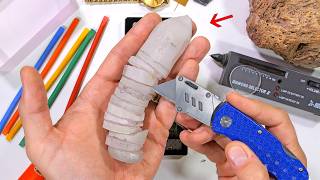

2,432-Karat Sapphire Block!
45sExtreme rarity and jaw-dropping size of the sapphire block grabs attention immediately.
▶ Play Clip"The title accurately reflects the video's content: the phone indeed uses sapphire and gold, and no other gaming phone offers such materials."
This video explores the manufacturing process of synthetic sapphire and its use in premium gaming devices, specifically the Red Magic 11 Pro Golden Saga smartphone and Astra gaming tablet. The host demonstrates cutting and polishing a sapphire boule, then performs a durability test and teardown of the phone to verify its sapphire and gold components.
The host shows a 2,432-karat white sapphire crystal and mentions Arc Energy produces a 65,000-karat boule weighing 660 lbs, enough for 4,000 smartphone covers.
The Red Magic Astra gaming tablet and Red Magic 11 Pro Golden Saga phone use level-eight scratch-proof sapphire and real gold in their construction.
Only diamond (level 10) can cut sapphire (level 9). A diamond-embedded saw blade is used; the blade is self-sharpening as new diamonds are exposed.
Sapphire boules are created at ~2,000°C and cooled slowly over a week to reduce internal stress and fracturing. A seed crystal acts as a blueprint for crystal growth.
Diamond-laminated grinding wheels from 80 to 3,000 grit are used to polish sapphire into an optical lens. Industrial setups use up to 20,000 grit for clarity.
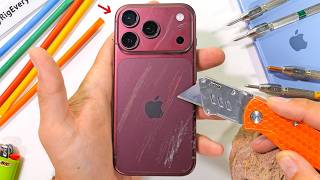
The phone includes an external cooling unit, 80W charger, gold-plated SIM tool, and collector's card. The sapphire back scratches only at Mohs 8, confirming real sapphire.
Sapphire's thermal conductivity is 40 times higher than glass, making it hard to soften glue. The host uses an iFixit Clampy tool to remove the back without breaking it.
The phone features a liquid cooling loop with gold-colored liquid, a gold-and-silver air duct, and a gold-plated vapor chamber. Gold prevents oxidation, maintaining thermal performance.
The 7,500 mAh battery has pull tabs. The gold-plated vapor chamber is revealed; gold is chosen for oxidation resistance rather than superior thermal conductivity.
The host praises Red Magic for innovation. He announces a giveaway of the Astra gaming tablet and notes the limited edition pricing is reasonable.
The Red Magic 11 Pro Golden Saga uses genuine sapphire and gold plating, verified through scratch testing and teardown. The video highlights the engineering behind synthetic sapphire and the benefits of gold for longevity in electronics.
What is the Mohs hardness of sapphire?
8 or 9
06:00
What is the only material that can cut sapphire?
Diamond (level 10)
01:25
How much does the largest sapphire boule from Arc Energy weigh?
660 lbs
00:33
Why is sapphire difficult to remove during phone teardown?
It has 40 times higher thermal conductivity than glass, dissipating heat and preventing glue softening.
06:31
What is the purpose of gold plating in the vapor chamber?
To prevent oxidation, which can act as a thermal barrier.
09:14
How long does it take to cool a sapphire boule to ambient temperature?
About a week
03:45
What is the battery capacity of the Red Magic 11 Pro Golden Saga?
7,500 mAh
08:48
Sapphire Boule Size
Demonstrates the scale of synthetic sapphire production, a key material in premium devices.
Diamond Cutting Principle
Explains the self-sharpening mechanism of diamond blades, relevant to material science.
01:25Sapphire Growth Process
Details the high-temperature crystallization and slow cooling to prevent fractures.
03:01Thermal Conductivity Challenge
Highlights a practical engineering challenge due to sapphire's high thermal conductivity.
06:31Gold Plating Rationale
Explains why gold is used for oxidation resistance rather than thermal performance.
09:14[00:00] This, my friends, is a solid 2,432-karat white sapphire crystal. And you might be like, "Hey, Jerry, how did you get your hands on six inches of rock-hard, scratch-proof sapphire?" That's a
[00:17] great question, and I'm going to need you not to ask so many questions. While six inches is far above average, it actually is nowhere near the largest man-made sapphire block in existence. There's a company called Arc Energy that makes a 65,000-karat boule of
[00:33] sapphire that weighs 660 lbs. The boule is nearly two feet wide and one foot tall, and it has enough white sapphire inside to make 4,000 smartphone covers.
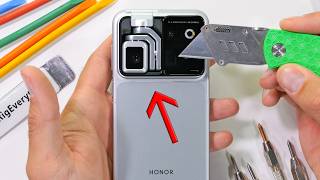
[00:45] Which brings us to today's victim: the new Red Magic Astra gaming tablet Golden Saga, which uses this level-eight scratch-proof sapphire crystal and real gold as some of its ultra-premium, top-of-the-line materials inside the most luxurious gaming tablet on
[01:00] the planet. I'll give this tablet away to one of you at the end of this video. Today, we're going to take my sacrificial sapphire and show how it might be cut up and transformed
[01:13] into something useful. Since most level-eight or level-nine scratch-proof screens are exceptionally superior, we can find examples of sapphire crystal on watch faces, the backs of phones, and sometimes
[01:25] even on phone screens. The problem is , though, is that the only thing on the planet that will cut scratch-proof level-nine sapphire is a level-10 diamond. We'll get to that part in a second. The other rock here on my desk is actually fossilized dinosaur poop called coprolite.
[01:41] It doesn't have anything to do with sapphire; I just wanted some dinosaur poop on my desk just for fun. Thumbs up for that. Anyway, aside from having real sapphire on their Astra gaming tablet, Red Magic also sent me a new limited edition Red Magic 11 Pro Golden Saga gaming phone,
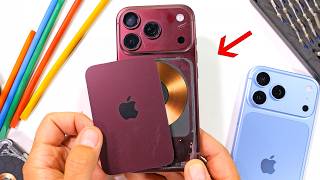
[01:58] which supposedly also has real sapphire on the back. The sapphire covers the new golden liquid cooling loop, and it has a literal gold-plated internal vapor chamber, which means we've got to do what we always do and verify those claims.
[02:14] Let's start with how the sapphire is cut. Diamond saws are actually pretty common on construction sites. You can get diamond blades like this one for about 20 bucks at Home Depot; they handle cutting tile or granite countertops. This saw, however, is specific to lapidary work.
[02:30] As you can see, the diamond dust, or grit, is fine enough to be embedded into the edge of the blade. As the metal holding the diamond dust wears away, new diamonds are exposed, making it a self-sharpening system. Since the diamond dust is microscopic, the saw blade itself has no teeth
[02:47] to damage my fingers with. I can touch the blade while it's still spinning and still count to ten. As you can see, the level-10 diamond dust in the blade is making short work of our level-nine sapphire boule. The main thing we have to watch out for is the boule cracking.
[03:01] Since sapphire boules are created at around 2,000°C, there's a lot of brittle stress built up on the inside. You might have noticed that the tip of my boule has been broken off. This is where the seed crystal originally was. The seed crystal is kind of like the blueprint
[03:16] from which the rest of the crystal grows. Aluminum oxide dust is melted down over the seed crystal, and as the new liquid cools, it orients itself into a crystalline form based on how the original seed crystal was placed—kind of like cloning or an icicle.
[03:32] What takes millions of years to happen naturally below ground can happen in just a few hours here high above ground with, of course, the right equipment and scientific know-how. It does take about a week to slowly cool the boule back to ambient temperature,
[03:45] though. The slow cooldown process helps reduce internal stress and subsequent fracturing, since a fractured boule wouldn't be very useful when cutting out screens, back panels, or watch faces.
[03:57] With our sapphire cut, you can see it's not totally clear. This is where polishing comes in. We have a range of diamond-laminated grinding wheels ranging from 80-grit to 3,000-grit. The higher the number, the finer the polishing diamond grit. As the grit gets finer, the scratches are
[04:14] reduced, turning our sapphire into an optical lens. A more industrial setup, like the one Red Magic uses on their Golden Saga sapphire devices, could get the crystal even more optically clear than we have here. Ultra-fine aluminum oxide dust can get up to 20,000-grit or higher, but you get
[04:31] the point. Industrial sapphire cutters also use high-end lasers to get their exact dimensions. Sapphire is pretty cool. Keep in mind, though, never to call it "sapphire glass," since they have very different elemental structures, hardnesses, and values. Sapphire glass
[04:46] would just be blue-tinted glass, and sapphire crystal might look like glass, but it's actually a gloriously premium, jewel-grade gemstone, and we should put some respect on its name. but here we are. I wouldn't have it any other way.
[05:04] Hopefully, the sapphire crystal on the back of the Red Magic 11 Pro Golden Saga holds up to the hype that I just generated. Inside the box, we get our external cooling unit, which can drop the temperature of your cooling loop by 18 degrees. Everything about this phone
[05:19] is overkill, including the 80W charging brick. We also have two USB-C charging cables—because why not—a carbon fiber case, also literal gold-plated SIM card removal tool, and an
[05:31] individualized gold-plated collector's card. My number is 297, so it's a pretty rare device. The cooling loop on the back is the same liquid-filled pump that we found on the normal non-gold-plated version of the 11 Pro that we durability tested earlier this year,
[05:46] except now the liquid is gold instead of blue. We'll get a closer look at all the gold on the inside, but first: the sapphire scratch test. A plastic- or fiberglass-backed smartphone would scratch at a level two or three on
[06:00] the Mohs scale of hardness. Regular glass would scratch at a five or six, and real sapphire crystal would scratch at a level eight or nine. Diamonds, of course, are level 10. Just like we expected, we don't see any scratches until a Mohs 8. Red Magic
[06:15] is indeed using real sapphire crystal on the back of their Golden Saga smartphone. Very impressive. Now, one thing that makes this teardown much more difficult is that sapphire has a thermal conductivity 40 times higher than regular glass. So, as I try to soften the
[06:31] glue holding this watertight phone together, the crystal is so good at getting rid of heat that it cools itself down before I have a chance to lift the crystal off. This is extremely good for gaming but bad for taking phones apart. I'm using a new tool from iFixit called the
[06:46] "Clampy" anti-clamp, which should help me get the back sapphire off in one piece. Sapphire is impervious to scratches, but it can still shatter like glass if it's ever dropped. The marks you see on the underside of the sapphire is just the
[06:59] aesthetic tinting getting rubbed away by my tool. And look at that—Clampy got the sapphire off in one piece. I'll put this sapphire down with the rest of my sapphires. You know your desk is cool when it's covered in sapphires and dinosaur poop.
[07:13] Where was I? Ah, yes. The coolest part of the Red Magic 11 Pro Golden Saga, aside from the golden sapphire, is the cooling loop. Under the carbon fiber sheet, we can see the full loop in all of its glory. We see the liquid flowing around inside the loop,
[07:27] dissipating heat from the gold-and-silver air duct up top. I can feel the piezoelectric pump at the bottom vibrating through my fingertips. I'll pop the microphone cover off of my microphone so you can hear the vibrations for yourself. She's humming along rather nicely.
[07:49] To get to the golden vapor chamber, though, we need to remove the nineteen T4 Torx screws holding down the back hardware. Then we can lift up the gold-and-silver alloy air duct and cooling loop. Red Magic has had cooling fans inside their gaming smartphones since the early days,
[08:04] but only with this 11 Pro have they managed to make the whole thing IPX8 watertight, meaning the fan itself is waterproof. Air is allowed to flow through the air duct, so water, of course, would be able to enter as well; however, the duct itself is sealed off
[08:18] from the rest of the phone. For some reason, it definitely has gold plating on the inside. There's probably not a single other person on the planet who would actually check for gold inside of the air duct except for me, but Red Magic actually did it, just like they said they would.
[08:33] Here is also where we can see the mesh that lets the air and water flow through the vent, while the red gasket keeps the liquid from entering the rest of the electronics inside of the phone. Speaking of which, I'll unplug the massive 7,500 mAh battery. It's got more than
[08:48] twice the capacity of an iPhone 17—but who's counting? It also has pull tabs, but the glue does need a bit of extra persuasion from my pry tool to let loose.
[09:00] With the battery gone, we can start to get a glimpse of our golden vapor chamber. I'll remove one more screw holding the motherboard and pop that out so we can get a better look at Red Magic's gold. Now, gold-plating the vapor chamber probably doesn't help all that much with
[09:14] actual thermal conductivity, since gold moves basically the same amount of heat as copper. But where gold excels is being literally immune to atmospheric oxidation. If you remember Lady
[09:26] Liberty here in the USA—may she rest in peace—she was originally made out of shiny copper but has since turned green due to atmospheric oxidation. Which, once copper is oxidized or tarnished, that layer acts as a thermal barrier. So, the reason electronics get gold-plated is to keep
[09:42] them clean and useful for longer. Still pretty wild that France would just gift us a whole statue. To be fair, though, her torch is gold-plated, which is kind of cool. And look at that—everything still works, including the liquid cooling. I'm a big
[09:58] fan of Red Magic. They're pushing boundaries and trying new things where everyone else appears to have given up. Instead of taking the new Red Magic Astra gaming tablet Golden Saga apart, I've decided to give it away. It has the same sapphire and gold-plated internals as
[10:12] the smartphone. Let me know your favorite TV show or YouTube channel down in the comments (besides mine, obviously), and I'll pick a random winner from anywhere in the world. Current pricing for the limited editions is down in the description. It's actually pretty reasonable,
[10:26] all things considered. Thanks a ton for watching. I'll see you around.

⚡ Saved you 0h 10m reading this? Transcribe any YouTube video for free — no signup needed.