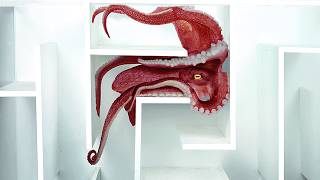

Octopus vs Underwater Maze: The Challenge Begins
45sThe setup of a nine-part underwater obstacle course for an octopus is instantly intriguing and promises a unique, high-stakes challenge.
▶ Play Clip"Title accurately describes the content: an octopus navigating an underwater maze."
This video documents the journey of Sashimi, a pet octopus, as she navigates a nine-part underwater obstacle course designed by her owner. The creator aims to test her intelligence and problem-solving skills before returning her to the wild, while also exploring the unique biology and cognitive abilities of octopuses.
Sashimi, a pet octopus, must complete a nine-part underwater obstacle course to earn her favorite food, shrimp. The creator admits underestimating her capabilities.
The creator decided to get a pet octopus to test their intelligence. Sashimi quickly adapted to her tank and showed curiosity and playfulness.
The creator realized that most pet octopuses are wild-caught, leading to a plan to return Sashimi to the ocean after testing her abilities.
Octopuses can color-shift, mimic shapes, and recognize individuals. They have problem-solving skills, like turning off lights or raiding other tanks.
The course includes nine obstacles: over-under, barrier, revolving door, block push, ball drop, red gate, water crawl, maze, and vault door unscrewing.
Sashimi quickly solved early obstacles using her arms to gather information. She showed persistence and adaptability.
Octopuses have a beak, blue copper-based blood, and can regrow arms. Their neurons are distributed in their arms, allowing independent thinking.
Octopuses evolved intelligence independently from vertebrates, making them akin to alien intelligence. Their arm neurons can sense light and act independently.
After training, Sashimi solved the final vault door quickly. She was released back to her native beach, where she would eventually lay eggs and die, completing her life cycle.
Sashimi successfully completed the obstacle course, demonstrating remarkable intelligence and adaptability. The video highlights the unique biology of octopuses and the importance of returning wild animals to their natural habitat.
What is the lifespan of an octopus?
About one and a half years.
15:24
What color is octopus blood and why?
Blue because it is copper-based.
08:49
How many obstacles were in the underwater course?
Nine.
00:12
What happens to a female octopus after laying eggs?
She stops eating and dies while protecting them.
15:24
How do octopuses change color?
They have sacs of black, red, or yellow pigment that they stretch, plus layers that reflect light and papillae for texture.
13:33
What is convergent evolution in the context of octopuses?
Octopuses developed intelligence independently from vertebrates, resulting in a different neural structure.
11:28
Where are most of an octopus's neurons located?
In their arms, not the brain.
11:43
What is the 'over-under' obstacle?
An obstacle where the octopus must go over a barrier and then under another.
04:01
Octopus as Alien Intelligence
Explains convergent evolution and why octopus intelligence is uniquely different from vertebrates.
10:02Neurons in Arms
Reveals that octopus arms can think and act independently, a key biological fact.
11:43Color Change Mechanism
Detailed explanation of the three layers of color change, showcasing advanced biology.
13:33Octopus Life Cycle
Highlights the short lifespan and maternal sacrifice, adding emotional depth.
15:24[00:00] And this is a vault filled with all her favorite food. she'll have to rely on her incredible intelligence and dexterity
[00:12] to make it all the way through this nine part underwater obstacle course. out of the gate, I will admit in hindsight, I completely underestimated the capabilities of this remarkable creature.
[00:25] But to understand how we even ended up at this spot, we need to go back in time when I decided to get a pet octopus to see for myself if they were really as smart And after bringing her home to CrunchLabs
[00:37] and appropriately decorated tank, she made herself right at home. For example, when you put anything into the tank,
[00:49] including your arm, they immediately swim towards it and just want to interact. But beyond just being able to really securely latch on to things It’s so strong!
[01:01] information about me, like my smell, taste and color. given how playful she is, it's hard not to form a quick bond. which I assume is the octopus equivalent
[01:17] she had a propensity for selfies any time she saw a camera. she would go full 20,000 leagues under the sea.
[01:30] every year us humans put on a dinner plate or in a pet store, basically, all are born and originally raised in the ocean, which is when I was hit with the startling realization
[01:45] And since no one wants to be the bad guy in Finding Nemo, as much as we'd already and found out from the pet store we got her from
[01:57] The only problem with my plan of returning her, So the idea was that if she could figure out and remember how to solve an and remember her early days hunting in the ocean
[02:11] Phase one of the plan was to give her some challenges she actually had. For starters, their ability to color and shapeshift is unmatched
[02:26] For example, can you spot the octopus hiding in plain sight right here? Play it in reverse and see just how quickly and convincingly these changes occur.
[02:42] They can also mimic the shape of larger, more predatory animals like eels. they’ve even come up with some pretty creative ways
[02:54] There’s stories from octopus researchers where they will recognize and shoot water at only one specific person any time they walk by the tank. even if they switch clothes with other people
[03:07] to turn off the lights in the room. to better map out the room they're being stored in or to raid the other takes for food only to return to their tank in the morning
[03:22] once we had really come to understand each other So after a lot of brainstorming, We eventually landed here
[03:35] with the Golden Vault. well then she’s earned the 3 pounds of her favorite food: shrimp and the reason we know it's her favorite food is because over the course of a week,
[03:49] And all four times we repeated the experiment But in order to earn that succulent reward, she's got her work cut out for her,
[04:01] the over-under. well then she's got to find a way to get over this barrier, And if she manages that, then is through the green circular portal,
[04:15] where she'll find herself face to face with this four panel revolving door. well then Sashimi will basically be met by a wall that by pushing this block out
[04:30] and continue her journey upwards to the ball drop. becomes much more critical and rotate it in this slot, which will allow it to fall down
[04:43] with the balls trailing behind, clearing up the pathway upwards through the tube. because the porthole out is blocked by this red gate. which will push this glass counterweight ball
[04:58] and allowing entry into perhaps my favorite obstacle, Because here the only way for Sashimi to continue her progress for up to an hour by crawling out of the water up over
[05:14] where after passing through the portal is a shrimp. where a strategically placed snack led to a timely photo op.
[05:29] because the hope is that as she eats the shrimp with her beak it will look like Phat Gus has eight braids of beautiful, flowing hair. Sashimi can hopefully finish strong with the penultimate challenge,
[05:44] ranging from small to really small. And if she takes the easy route by squeezing through the least small hole. That puts her right at the finish.
[05:57] And if she solves the final puzzle by unscrewing the vault door, but she’s proven she's quick enough on her tentacles to the very tide pools she was raised in.
[06:12] So with everything in place, all that was left to do was open this ball valve. she made her way down the tube So while we wait for her to make that 40-second trek
[06:26] that if you want a Christmas morning reaction like this Then a CrunchLabs Build Box subscription is the answer. not only do you get a super fun toy that you get to put together every month
[06:41] all the incredible physics behind how it works. building, learning, and succeeding together and you're looking for something to put at the top of your Christmas list,
[06:55] to be the household hero by giving it to someone else, where were giving away two free boxes as a holiday special. then sort of exploring the borders of the maze for a bit,
[07:10] she made her way inside fairly quickly, but then sort of just chilled, But since you can only ignore the ambrosial smell of raw, fresh shrimp for so long
[07:22] And one of the first things we observed is that any time by walking around gathering data with her arms And soon enough she had things figured out.
[07:36] because having observed Sashimi in her home tank I knew she was good at digging and burrowing herself in the sand, The floating balls were even less of a challenge for her,
[07:50] of how much she sends out her arms as scouts to gather critical information, They can reach their arms around and inside crevices, not only to smell but, as we'll cover in a minute, even see and independently think.
[08:05] but figuring out how to operate a revolving door Wow. And this was my first real indicator that we were headed for a real battle of wits.
[08:22] It was a similar feeling to when the squirrels eventually outsmarted And I really should have seen this coming as long as an opening is bigger than their beak,
[08:36] then they can eventually squeeze through it. You can see Sashimi’s beak or mouth right here. And while this part looks like a big nose, that's actually their main body where
[08:49] gills, kidneys, ink sack, siphon. Two other cool facts about octopi is their blood is blue because it's copper based,
[09:01] And if they lose an arm, they can regrow it completely Next up was the block push. But this is where their natural curiosity pays off
[09:17] but also constantly pulling and pushing to see what she can interact with. And so sort of by default, she figured out this red part of the wall which cleared the way up to the ball drop.
[09:31] there's not enough room for her to just squeeze by. And number two, pushing and pulling on walls wasn't going to solve it either. for quite some time, eventually she got frustrated and just stopped and sat there,
[09:46] almost like she was processing all the data she just gathered because while basically maintaining eye contact with me as a flex, she reaches up with one arm and then twists the bar, which dislodges the ball
[10:02] And this feels like the perfect moment to tell you that my absolute favorite fact we have to intelligent alien life on this planet.
[10:14] This is a very simplified version of a tree of Life. and what evolved from what. Well, by being true scientific detectives and looking for clues.
[10:27] For example, a few hundred years ago, scientists noticed that us humans But wait a sec. So do whales, mice, elephants, lions, horses, and bats.
[10:39] they all share a common ancestor and belong to this group called Mammals. Watch what happens if you compare the arm bone configurations of a human to a bat, to a chicken, to a turtle, to a dolphin.
[10:53] It's wild what tiny beneficial mutations and millions of generations can produce it's allowed us to compare the DNA of different species and sort of if you want to see where
[11:08] you have to go back over half a billion years ago to a simple flatworm. But if you look closely, all of what we think of as the smart animals including dolphins, dogs, pigs, horses, humans, but even birds, dinosaurs and fish
[11:28] Sort of like those arm bones I showed. But octopi developed their intelligence completely independently And that's why they're built just so differently from us.
[11:43] But unlike all the animals over here, where all the neurons are focused are in the brain and the rest are in their arms, which means they not only smell and taste, but they can even think and act
[11:58] the arm can still camouflage itself to the surroundings by sensing light. walking into a room, touching a wall and having your hand match the color.
[12:11] Having eight independent mini brains, along with a larger central brain is as incomprehensible as alien intelligence to us. putting her at the halfway mark, and as usual, she starts by having her
[12:26] And it's almost like once she feels the red door, she figures out my trick and then immediately pushes the button to drop the ball and open the gate And I was relieved to see that I'd thrown her another curveball
[12:41] because after quite a bit of exploratory arm expeditions, she realizes that the only way forward is up and out. And so after psyching herself up,
[12:55] over And this demonstrates another octopus superpower And as you can see here
[13:07] It's one of the reasons they're such successful hunters in I figured she deserved a bit of a snack break
[13:19] And just like I'd hoped, once she saw the shrimp attached to the back, And since that's right at the center of all her legs starting first with a more free-flowing sandy blonde option
[13:33] Now, the reason she's able to change her appearance so drastically is because all octopi have four tricks up their sleeve. black, red or yellow pigment, and then they use their muscles to stretch
[13:47] those sacs like a balloon to achieve any combination of those three colors. that bounce back specific wavelengths of light, Then there's even one more layer that reflects back
[14:02] On top of all that, they can also use a muscular structure called papillae And because they could change which is literally less than the blink of an eye,
[14:15] Now, she was on to the maze and you can see she opted for the largest hole, And I love this because it's sort of classic Sashimi at this point,
[14:28] and make just about every possible wrong turn along the way. And while that's technically an automatic DQ I took the high road
[14:40] After a month or so of training on all the obstacles, she went straight for the door, ripped it off the foundation, and then immediately basked in the sweet, delicious taste of a hard earned victory
[14:56] And after letting her gorge for a bit, and give her the Finding Nemo happy ending she deserved by driving her 8 hours down the coast back to the exact beach where she was raised.
[15:11] I was convinced to hunt for her own food in the open ocean. because there's one octopus fact I haven't mentioned,
[15:24] which is their entire lifespan is only about one and a half years. And as a final act after laying her eggs, a female will continually watch over and protect them to the point that she stops eating and dies.
[15:36] Which meant that in the exact same coves in tide pools that her mother did for her, soon Sashimi would be extending that ever changing tree of life creating a new branch
[15:49] With everything you know about Sashimi at this point but what should also hopefully not surprise you is that learning science and engineering doesn't have to be sucky and boring.
[16:06] with the expressed goal of helping kids think like an engineer where you put it together with me. The data is in;
[16:20] on a fun scale, out of ten. said their child gained a new passion around STEM and engineering from the boxes.
[16:32] so everyone leaves feeling stoked about the outcome. to contain the platinum ticket, and if you get it
[16:45] So if you want to embark on this monthly journey with me Yes Just go to CrunchLabs.com
[16:58] where we're giving away those two boxes free as a holiday special. Thanks for watching.



⚡ Saved you 0h 17m reading this? Transcribe any YouTube video for free — no signup needed.