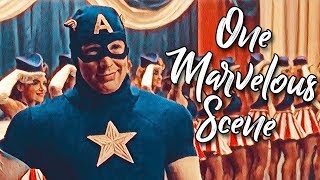

Captain America's Propaganda Origins
45sReveals the surprising real-world history of Captain America as a WWII propaganda tool, sparking curiosity and debate.
▶ Play Clip"The title promises a deep dive into Captain America's propaganda, and the video delivers, but it spends significant time on other MCU films, diluting the focus."
This video essay analyzes the Marvel Cinematic Universe's (MCU) relationship with the American military, using the propaganda montage in Captain America: The First Avenger as a lens. It argues that while the MCU often critiques military propaganda, it simultaneously serves as a de facto marketing arm for the Pentagon through subtle and overt military influence.
The montage in Captain America: The First Avenger is a self-aware parody of military propaganda, making it funny for modern audiences while highlighting the character's origins as a WWII propaganda tool.
The video defines propaganda neutrally as 'information presented in a biased manner,' focusing on one-sided, uncritical portrayals of military life.
The first MCU scene glorifies the military, but the film omits morally compromising actions. Marvel partnered with the Pentagon, which had final script approval, shaping the film's portrayal.
Director Jon Favreau wanted a line about military suicide, but the Pentagon's Hollywood liaison objected, and the line was cut entirely, illustrating military influence on content.
The first Captain America film uses propaganda effectively, shaping Steve Rogers into a hero who embodies the values promoted in the reels, suggesting propaganda can be 'effective and useful.'
Captain America: The Winter Soldier is the most critical of American policy, but it pins surveillance issues on a fictional Nazi-run S.H.I.E.L.D., sidestepping real-world criticism.
Black Panther features a heroic CIA agent, and the CIA promoted the film, reaching new demographics while the political conversation focused on progressive themes.
Captain Marvel glorifies military hardware and was used by the Air Force as an enlistment ad targeting women, blending feminist themes with military promotion.
Unlike Captain America's parody, Captain Marvel treats military propaganda unironically, making military advertising more palatable to audiences who might otherwise critique it.
The MCU's relationship with the military is complex, evolving from self-aware parody to unironic promotion. While films like Captain Marvel deliver progressive messages, they also serve as a de facto marketing arm for the Pentagon, a trend worth scrutinizing.
Neutral Definition of Propaganda
Provides a clear, unbiased framework for analyzing media influence.
02:33Censorship of Military Suicide Line
Concrete example of Pentagon influence altering creative content.
05:15Military's Withdrawal from Avengers
Shows the military's strategic decision-making in media partnerships.
08:30Captain Marvel as Enlistment Tool
Highlights how progressive themes can be co-opted for military recruitment.
11:04MCU as Marketing Arm
Summarizes the video's core argument about the MCU's role in military propaganda.
13:24[00:00] In the first Captain America film, there is a spectacular montage where our hero becomes the frontman for a military propaganda campaign.
[00:30] The scene works on multiple levels. First, it's a clear inversion of the origins of the character who was created to spread a message in favor of joining World War II.
[00:44] The cover of his first issue depicts him punching Adolf Hitler in the face, a moment which is recreated here on stage as well as reproduced in comic books. It's because of that history and the character's reputation as a figure of military propaganda
[00:59] that makes this a difficult adaptation. I mean, how do you take a character like this, a character who literally has America in his name, and turn him into the headliner of a multimedia mega-franchise
[01:11] embraced around the globe at a time when the real American military is, well, not embraced around the globe? In other words, how do you depoliticize Captain America?
[01:24] Well, Marvel's answer is to turn that original context on its head. So, yes, he had an overtly political purpose in real life, so in this movie we'll be completely self-aware about that fact
[01:36] and have him participate in self-parody in the most over-the-top way possible. Which is the second reason the sequence works. In its very over-the-topness, we, the audience, recognize it as obvious military propaganda.
[01:50] That's what makes it so darn funny. Within the context of the story, a presentation like this is propaganda. But in the context of a modern audience watching it, it isn't. It's a joke. We're laughing at how obvious military propaganda used to be.
[02:05] The joke's on us, though, because while we all see this scene for what it is, we're not nearly as sensitive to the less subtle forms of military influence in our media that's more common today and indeed in this very franchise.
[02:19] A couple of caveats here. First, before we get too deep into things though, let me just address my use of the word propaganda. The word has an extremely negative connotation. It's basically an insult and the quickest way to dismiss your opponents.
[02:33] But in this video, I want to use the term a little more neutrally. Propaganda is information presented in a biased manner. And the moments that I'll be calling military propaganda are the ones that present a one-sided and uncritical look at what it's like to be in the military.
[02:50] Caveat number two. Some of this should be taken as an attack against the work and sacrifice of people in the military. It's a critique of the fact that their real experiences are rarely portrayed in their totality in American media.
[03:03] All clear? Okay. Oh, and one last thing. A bunch of other video essayists are also dropping videos today with the title, So make sure to check them all out in the playlist in the description.
[03:15] I'll be talking about quite a bit more than one scene in this video, but I felt that the best way to contextualize the propaganda montage in Captain America was to use it as a lens to look at the rest of the MCU.
[03:28] Alright, so let's talk about the, let's call it, interesting relationship these movies have had with the American military.
[03:41] The very first scene of the Marvel Cinematic Universe has Tony Stark driving with the American military through Afghanistan while listening to ACDC Back in Black The music is awesome the vehicles are awesome Tony is awesome the military is awesome Contextually
[03:58] through everything that the camera and the music is telling us that's what we're supposed to feel. Now, obviously, this is a superhero action movie. I don't expect it to be the Hurt Locker. But let's ask what's not being shown in this scene or throughout the film. We don't see the American
[04:13] the military doing anything morally compromising. We don't see the use of drones, civilian casualties, or the use of torture. It's the enemy who attacks them in the first scene, not the other way around. And even more than that, we don't see any character question military decisions or allude to any topic
[04:30] that is uncomfortable for the military. And that's because Marvel partnered with the Pentagon in the production of Iron Man, which is nothing new in Hollywood. Another YouTube channel, Pop Culture Detective has a great video about all of this that I highly recommend you check out. The basic idea
[04:46] is that movie studios will work with the Pentagon in order to get access to military equipment, but in exchange the Pentagon gets final script approval, giving them enormous power to make sure that the military isn't presented in an overtly negative way. The result is a decades-long
[05:03] stream of hyper-masculine blockbuster films that are uncritical of the American military, of which Iron Man is merely one. The director of this movie, John Favreau, actually got into an argument with Phil Strub,
[05:15] the Department of Defense's Chief Hollywood Liaison, during the filming of Iron Man. Favreau wanted to have a military character-stable line, people would kill themselves for the opportunities I have. But Strub objected.
[05:27] They didn't want any mention of military suicide, which is an enormous issue that the military is currently dealing with. Eventually, they agreed to change the line to people would walk over hot coals for the opportunities I have.
[05:39] But the line was eventually entirely cut from the finished film. Now, this is just one small example of the military exerting its influence on Hollywood. But that influence is wide-reaching, shaping scenes for movies as disparate as the Transformers films to meet the parents.
[05:54] Marvel has partnered with the Pentagon on a bunch of its films in the last decade, including all three Iron Man movies and all three Captain America movies.
[06:06] Military propaganda is extremely effective in the first Captain America movie. It's basically prophetic. Steve spots an Uncle Sam poster, then he becomes an Uncle Sam poster.
[06:22] He stars in a commercial with a cast of diverse soldiers, then he leads an actual group of diverse soldiers into battle, which is then itself recycled into propaganda. Early in the film, Steve watches an enlistment ad,
[06:34] which promotes the values of self-sacrifice and of everyone doing their part to win the war. Every able-bodied young man is lining up to serve his country.
[06:47] Even little Timmy is doing his part. And later he'll echo those same sentiments. Come on, there are men laying down their lives. I got no right to do any less than them. In fact, we could even say that these values are the cornerstones of his character.
[07:02] He embodies the messages that these propaganda reels are trying to sell. We want to believe that these enlistment ads are at least partially based on reality, but more often than not in this film, they are completely fictitious.
[07:16] Until they're not. They create the reality they promote. It helps to shape Steve into the person he is, and he is a good person. Propaganda may be fake, this film seems to say, but it is effective and useful.
[07:28] Okay, but what about the sequels? Why, what are you going to do? The conflicts in the Captain America sequels are much more morally ambiguous than those in the original Here Steve Rogers navigates the politics of the 21st century dealing with issues like government surveillance in Winter Soldier and the role of unilateral
[07:47] action in Civil War. The Civil War largely takes place outside of America and reduces the importance of the American military in the plot. But in Winter Soldier, Cat fights against the fictional military organization S.H.I.E.L.D. to prevent them from spying on civilians instead
[08:02] of fighting against, say, the NSA. Of all the films in the MCU, Winter Soldier is the most pointedly critical of American policy, even though it's sort of by accident. The movie feels
[08:14] extremely topical, given that it came out a year after the Edward Snowden leak, but then again, it was well into production by that point. So, it's interesting that the film still received Pentagon support, and the reasons for that are nuanced. The military actually pulled their
[08:30] support from the first Avengers film because they felt that S.H.I.E.L.D.'s place in the national security apparatus was a little too vague. It's a transnational organization, so who answers to who exactly? It makes military organizations look shady, and the ambiguity
[08:45] in that messaging made the film into something the military did not want to be involved in. But they were back for Winter Soldier, and part of the reason is because S.H.I.E.L.D. is revealed to be secretly run by an evil Nazi conspiracy. Thus, it could be an ideological
[08:58] enemy that the film could defeat. It pins the angst of government surveillance not on a real American military organization, but on some crazy Nazis for Steve DePunch. It's quite different from
[09:10] the rah-rah America type of military propaganda Cap dealt with in the original film. Here, what is propagandistic about the film is its attempts to sidestep away from difficult topics, pinning
[09:22] the responsibility for them elsewhere. Constructing the film this way also helps minimize the risk of Captain America being seen as a tool of military propaganda. He is consistently positioned against his own country as a way to challenge our ethics,
[09:37] and so that it doesn't feel like he solely belongs to America. So throughout the Captain America films, there is an attempt to mitigate the risk of the character being read as a champion of imperialism, as an obvious propagandistic symbol.
[09:51] But as Marvel's newer films appeal to different demographics, the way they've integrated military messages has also evolved.
[10:04] Black Panther is a movie about a competent, courageous CIA agent named Everett K. Ross. In the movie, Ross gets swept up in an adventure in the faraway land of Wakanda, where he helps restore the legitimate ruler of the country, and in the climax of the film, he single-handedly
[10:20] takes down several enemy aircraft, preventing the spread of weapons of mass destruction. Okay, so obviously that's not the main thing the movie is about, but you can understand why the CIA would be so happy with partnering on Black Panther.
[10:33] They promoted the movie regularly and live-tweeted about it during the Oscars. They got to be part of one of the biggest movies of the year, they were portrayed heroically, and the film reached new demographics that other military-sponsored blockbusters did not.
[10:48] All of this happened while the political conversation around the film centered entirely around the movie's progressive themes. There's a similar story with Captain Marvel, although the partnership here was much, much closer. The camera glorifies military hardware in a way not seen since the Iron Man movies.
[11:04] The main character and her closest ally are both Air Force pilots. The colors of her costume are taken from a U.S. Air Force t-shirt. The film shot in military bases with military advisors. And the Air Force used the opportunity to make an enlistment ad targeted to women.
[11:19] Every superhero has an origin story. We all gotta start somewhere. As a piece of media intended to reach a female audience, Captain Marvel has plenty of fine feminist themes.
[11:34] It's about overcoming gaslighting, becoming who you want to be, and that you don't have to prove your worth to others. All good things, right? On their own, they are. But the issue is that these themes also end up being in service of promoting military enlistment.
[11:48] It says be a fighter pilot, specifically, because it's really fun to be a fighter pilot. There's just one moment in the film that I feel registers partly as a critique of the military. It's in an early flashback where Carol is sexually objectified by another pilot.
[12:04] It is a tiny acknowledgement of the problem of sexual harassment in the military. But it's not woven into the story in any way. It's not an obstacle for Carol and it's glossed over as quickly as possible.
[12:17] There's a similar moment in the original Captain America. I got a few moves I know you'll like. In both cases, sexism is an isolated incident that is dealt with immediately by the person it is directed against, rather than a larger ongoing issue.
[12:34] And given that this very year the Air Force reported that nearly half of female cadets experienced sexual harassment, it's weird that a Marvel movie would be so eager to tell young women to join the institution.
[12:47] While there isn't a dancing chorus line or a catchy song, Captain Marvel still feels like the propaganda montage in Captain America. Except, instead of being played for a laugh, it's treated unironically here.
[12:59] Where Marvel was careful to prevent Captain America from being seen as a symbol of the military, Captain Marvel's feminist messages of empowerment are melded in with the empowerment fantasy of warfare. And in doing so, the film projects that message to a demographic that it might not otherwise reach, while making military advertising more palatable to those who would otherwise critique it in a movie that didn't have progressive themes.
[13:24] And I think that's something to be aware of. Because while many of the messages in these movies are important, and while I'm sure they are sincerely believed in by their creators, I also think that maybe these children's movies shouldn't also serve as a de facto marketing arm of the Pentagon
[13:41] as part of a broad decade's old propaganda campaign to maintain the military's domestic reputation. Maybe? No?
[13:54] Thank you.
[14:24] So, since we were talking about World War II and the Air Force today,
[14:36] I'd like to recommend this documentary on CuriosityStream. It's called Bombing War, from Guernica to Hiroshima, and it details how the evolution of aerial bombardment completely changed how wars were fought.
[14:49] It's an angle on covering World War II history that I haven't encountered before, so give it a look. I want to thank CuriosityStream for sponsoring this episode. If you don't know, CuriosityStream is an excellent documentary streaming service,
[15:03] and it's got more than 2,400 documentaries to choose from. Plus, it's only $2.99 a month, and you can get your first month for free if you go to CuriosityStream.com slash Just Write, and use the promo code Just Write when you sign up.
[15:16] Thanks for watching, everyone, and thank you to my patrons for supporting this channel. Keep writing, everyone.
⚡ Saved you 0h 15m reading this? Transcribe any YouTube video for free — no signup needed.