
Onimusha Returns: Stunning Facial Capture
48sCapcom's facial capture tech makes characters incredibly lifelike, a visual treat that grabs attention.
▶ Play Clip"Title accurately describes the content: a technical analysis of the demo's performance and RT/PSSR upgrades."
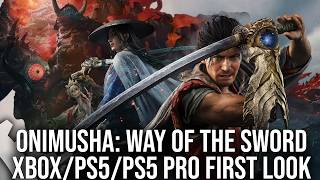
Digital Foundry analyzes the Onimusha: Way of the Sword demo, focusing on its performance and visual features across PS5, PS5 Pro, Xbox Series X|S, and PC. The video highlights the game's use of Capcom's RE Engine, ray-traced reflections, and PS5 Pro's PSSR upscaler, while noting limitations like missing RT global illumination and shadows.
Capcom revives Onimusha with Way of the Sword, featuring hero Miyamoto Musashi hacking through demons in a 30-minute demo. The RE Engine is used, with excellent facial capture and physics.
PC and PS5 Pro support ray-traced reflections, but RT global illumination, RT shadows, and path tracing are missing. The demo uses limited rasterized shadows, which can be noticeable indoors.
All consoles offer two modes: 60 FPS performance and 30 FPS quality, both upscaled to 4K. PS5 and Series X run at dynamic 1440p-4K in performance mode, while Series S is fixed at 1080p.
PS5 Pro uses PSSR upscaler and offers ray-traced reflections at 60 FPS without performance penalty. It provides sharper image and fewer artifacts compared to base PS5.
Series S runs at 1080p with lower quality textures and hair detail, but holds up well with SSR reflections and volumetric effects, maintaining 60 FPS.
All consoles achieve locked 60 FPS in gameplay, but cutscenes see drops to 50s (and high 40s on base PS5). PS5 Pro minimizes cutscene drops. VRR displays can smooth out fluctuations.
With VRR, consoles can run unlocked from 60-90 FPS. PS5 Pro leads by 4-8 FPS over base PS5. Surprisingly, enabling RT is slightly more performant than SSR in most scenes.
A fixed 40 FPS mode is available but has a bug with one frame dropping every 960 frames on PS5 and Xbox. The 30 FPS mode is flawless.
Capcom lists 900p handheld and 1080p docked at 30 FPS for Switch 2, but it's unclear if these are DLSS targets or native resolutions. Performance remains to be tested.
Onimusha: Way of the Sword is a well-optimized RE Engine title with solid performance across consoles, though ray tracing is limited. PS5 Pro offers the best experience with RT reflections and PSSR upscaling, while Series S holds up well at 1080p.
What engine does Onimusha: Way of the Sword use?
Capcom's RE Engine.
0:19
What ray tracing features are missing in the demo?
RT global illumination, RT shadows, and path tracing.
1:18
What are the two graphics modes on consoles?
60 FPS performance and 30 FPS quality, both upscaled to 4K.
1:56
What is the native resolution of Series S in both modes?
1080p.
2:28
What upscaler does PS5 Pro use?
Sony's PSSR (PlayStation Spectral Super Resolution).
2:48
What is the fixed frame rate option for performance mode?
60 FPS or 40 FPS (requires 120 Hz display).
3:00
Does PS5 Pro support ray tracing at 60 FPS?
Yes, with no performance penalty.
3:53
What is the performance of all consoles in gameplay?
Locked 60 FPS with barely any drops.
6:55
What happens to frame rates during cutscenes on base PS5?
Drops into the 50s and high 40s.
7:29
What is the bug with the 40 FPS mode?
One frame drops every 960 frames on PS5 and Xbox.
9:52
What are the expected resolutions for Switch 2?
900p handheld and 1080p docked at 30 FPS.
10:23
Stellar Facial Capture
Capcom's facial capture technology is highlighted as a standout feature, selling Musashi's character without words.
0:42PS5 Pro RT at 60 FPS
PS5 Pro can run ray-traced reflections at 60 FPS with no performance penalty, a significant advantage.
3:53RT More Performant Than SSR
Surprisingly, enabling ray tracing is slightly more performant than SSR in most scenes, contrary to expectations.
8:36[00:05] [music]
[00:08] >> Developer Capcom revives its long
[00:10] dormant Onimusha series with Way of the
[00:12] Sword, where a new demo offers up a
[00:15] slice of the adventure ahead of its
[00:17] September 25th release. The team's RE
[00:19] Engine is deployed once again, of
[00:21] course, hot off the heels of its uses in
[00:23] Resident Evil Requiem and Pragmata just
[00:25] this year. Today, then, as legendary
[00:28] hero Miyamoto Musashi, you hack through
[00:30] demon-infested temples in this 30-ish
[00:33] minute segment, dispatching each foe to
[00:35] great bloody effect, and mopping up
[00:37] their souls with your gauntlet as you
[00:39] go. The highlight, so far, is once again
[00:42] Capcom's stellar use of facial capture
[00:44] technology. Musashi's every grin and
[00:46] grimace is put in these tight close-ups,
[00:49] selling his role as the reluctant hero
[00:51] before a single word's even been spoken.
[00:53] Paired with object destruction, cloth
[00:56] physics, plus decapitations, if you're
[00:58] so inclined, there's a convincingly
[01:00] hefty feel to his every move. Now, it is
[01:03] obviously early days, but there are some
[01:05] limitations to the demo worth touching
[01:07] on. The upside is that PC and PS5 Pro
[01:10] support ray-traced reflections, which is
[01:12] great to see. On PC, the ray-tracing
[01:14] setting affects the quality of those
[01:16] reflections alone. However, beyond RT
[01:18] reflections, we're missing support for
[01:20] RT global illumination, RT shadows, and
[01:24] even path tracing, features that are
[01:26] included in Requiem and Pragmata. As a
[01:29] result, and regardless of your chosen
[01:31] Onimusha's demo reverts to a limited
[01:34] rasterized approach to shadowing in
[01:36] particular. It holds up well enough
[01:38] outdoors, but you might notice lacking
[01:40] shadow reactions from interior light
[01:42] points, like lanterns and candles.
[01:47] Limited ray-tracing features aside, as
[01:49] an early snapshot of its progress on
[01:51] PlayStation 5 and Xbox, Onimusha's in a
[01:54] promising state overall. To start, every
[01:56] console release gets two graphics modes
[01:58] here, 460 FPS performance and 30 FPS
[02:01] quality. Visual settings are identical
[02:04] either way and both upscale to a 4K
[02:06] target as noted in Capcom's handy
[02:09] graphic here. However, the most notable
[02:11] difference is the underlying native
[02:13] resolution of each mode, which affects
[02:15] clarity. So, PS5 and Series X run at a
[02:18] dynamic 1440p to 4K in the performance
[02:21] mode and settle more typically at a
[02:24] fixed 4K value in the graphics mode.
[02:26] Meanwhile, Series S drops to 1080p in
[02:28] both modes and based on early testing,
[02:31] it's rare to see much in the way of
[02:32] dynamic adjustments under that figure so
[02:34] far. In practice then, it's 1080p either
[02:37] way, though this may change for later
[02:39] chapters in the final game. Lastly, PS5
[02:42] Pro operates at a more flexible 1296p to
[02:45] 4K range on its performance mode using
[02:48] Sony's new improved PSSR upscaler while
[02:51] the graphics mode runs at 4K.
[02:55] Rounding out, the settings menu offers a
[02:58] few other extras. The big one is the
[03:00] fixed frame rate option allowing for a
[03:01] cap at either 60 FPS or 40 FPS if you
[03:05] have the performance mode selected. To
[03:07] access that fixed 40 FPS cap, you'll
[03:09] need a 120 Hz display attached of
[03:11] course, while as an alternative, it's
[03:14] possible to run entirely unlocked, which
[03:16] is ideal for VRR displays. There's
[03:19] plenty of useful options here then, but
[03:20] in practice, the fixed 60 FPS
[03:22] performance mode is all you'll likely
[03:24] need. It enough on PS5, Series X and S
[03:28] and controllable play is a locked 60
[03:31] based on the demo content at least. On
[03:33] the quality mode meanwhile, it's only
[03:35] possible to fix the frame rate at 30 FPS
[03:38] or again, run with uncapped frame rates.
[03:40] Finally, the PS5 Pro version gets one
[03:43] extra toggle allowing ray trace
[03:45] reflections. This works independently of
[03:47] the graphics mode toggle at the top of
[03:48] the menus and in fact, it combines
[03:51] beautifully with Pro's 60 FPS
[03:53] performance mode. Effectively, you can
[03:55] run at 60 FPS with ray tracing engaged,
[03:57] and there's no performance penalty in
[03:59] doing so. There's no downsides. Engaging
[04:01] RT reflections replaces the screen space
[04:04] reflection method seen on all other
[04:05] consoles, and for Pro owners, it's
[04:08] really the biggest plus point. Alas,
[04:10] it's not used as extensively as say
[04:13] Pragmata's glossy spaceship corridors,
[04:15] and the Onimusha demo limits the effect
[04:17] to puddles and ponds scattered around
[04:20] the temple. It's expected given the
[04:22] setting. Still, as you can see, ray
[04:24] traced reflections allows more thorough
[04:26] coverage of the scene than SSR, and
[04:28] avoids that method's classic occlusion
[04:31] artifacts from the player.
[04:40] The second PS5 Pro advantage is its use
[04:42] of Sony's PSSR upscaler. In this case,
[04:45] on its newest iteration. Combined with
[04:47] the typically high pixel counts on PS5
[04:49] Pro, PSSR resolves a sharper image
[04:52] compared to base PS5. A cleaner, more
[04:55] stable frame in still moments
[04:56] especially. It really stands out when
[04:58] using the 60 FPS performance mode, where
[05:01] a native 4K isn't a given. Though, to
[05:03] truly demonstrate, I've had to go for a
[05:05] two times or even three times zoom here.
[05:08] The resolution on base PS5 generally
[05:10] holds up, but Pro offers a decent
[05:13] refinement in clarity across the dark
[05:14] pathways ahead. On top of that, the
[05:16] additional benefits of PSSR is its
[05:19] treatment of the moving image. Some form
[05:21] of reconstruction artifact is expected
[05:23] within the upscaling tech, but at least
[05:25] PSSR avoids the banding trails, the
[05:27] ghosting, present on the standard PS5
[05:30] version here. Note the arc of the sword
[05:32] as we approach this demon, and likewise,
[05:35] the trail left behind by Musashi's
[05:37] cloak. PS5 Pro benefits from fewer
[05:39] artifacts, and again, a slightly sharper
[05:42] image if you know where to look. Great
[05:44] stuff.
[05:50] >> Looking past the image quality
[05:51] differences and the ray tracing option,
[05:53] PS5, PS5 Pro, and indeed Series X are
[05:57] identical. The biggest variation in
[05:59] settings is on Series S, as you'd
[06:00] expect, which drops to 1080p with an
[06:03] expected loss in clarity. The most
[06:05] glaring impact of its lower native
[06:07] resolution is the presentation of hair,
[06:09] which tends to break up more obviously
[06:12] on the four teraflop console. In classic
[06:14] Capcom fashion, Series S also reverts to
[06:17] lower quality texture maps. To be fair,
[06:19] this is subtler than, say, the glaring
[06:21] cutbacks in Street Fighter 6, and the
[06:24] third-person view in Onimusha tends to
[06:26] prevent putting them in frame too often.
[06:29] Elsewhere, minor level of detail
[06:30] differences are also in place for
[06:32] foliage, favoring Series X, but
[06:34] otherwise, Series S holds up well based
[06:36] on the demo. You get SSR into the
[06:38] bargain for reflections, volumetric
[06:40] effects hold up well, and it runs at a
[06:43] tight 60 frames per second on its
[06:46] performance mode, too.
[06:51] >> [music]
[06:53] >> On which note, let's talk performance.
[06:55] Base PS5, PS5 Pro, Series X, and S are
[06:58] all faultless in their push for 60
[07:00] frames per second, at least while in
[07:02] gameplay. There's barely a drop on
[07:04] record here, and again, PS5 Pro does it
[07:06] all with ray tracing engaged, too. Even
[07:09] with a high on-screen enemy count,
[07:11] multiple effects, and the destruction
[07:13] physics, each is locked at 60. The fact
[07:16] that Series S is also hitting the mark
[07:18] perfectly is encouraging. The only
[07:20] downside is the cutscenes, which engage
[07:23] more post effects, notably depth of
[07:25] field, with less flattering readings
[07:27] overall. On base PS5, for example, we're
[07:29] dropping into the 50s while first
[07:31] collecting the gauntlet, and then later,
[07:33] even going into the high 40s during a
[07:35] final boss showdown. It applies to all
[07:37] machines, sadly. The silver lining being
[07:40] that it's still within range for VR to
[07:42] smooth out. That said, PS5 Pro does at
[07:44] least minimize these cutscene lurches in
[07:46] the demo, and so switching to a similar
[07:49] boss cutscene on Pro, it's only dropping
[07:52] to the 50s here. Again, it's only for
[07:54] cutscenes, and once you take control
[07:55] again, all consoles are back to a
[07:57] rock-solid 60.
[08:04] Those lucky enough to have a VR display
[08:07] have an extra benefit in the form of an
[08:09] unlocked FPS option. It works fine with
[08:12] the graphics mode, but it's more
[08:13] sensibly combined with the performance
[08:15] mode to give VR the most frame data
[08:17] possible. This way, both PS5 consoles
[08:19] run from 60 to 90 FPS depending on the
[08:23] complexity of the frame, and PS5 Pro is
[08:26] the clear performance leader on average
[08:28] as you'd expect. In fact, the Pro lead
[08:30] ranges from 4 FPS to 8 FPS in matching
[08:33] runs, and surprisingly, you'll spot the
[08:36] ray tracing mode is the more performant
[08:38] of the two. In almost every scene,
[08:40] keeping ray tracing disabled, therefore
[08:43] engaging SSR, is actually more expensive
[08:45] for the system across a bulk of the demo
[08:47] content. Perhaps it's down to the
[08:49] minimal use of ray tracing in most
[08:51] scenes, being limited to a small
[08:53] scattering of puddles. Either way, ray
[08:55] tracing or not, the divide is very
[08:57] slight, by around 2 to 3 FPS in favor of
[09:00] keeping RT engaged. Meanwhile, jumping
[09:02] over to Xbox Series X and S running
[09:05] unlocked, you're getting a likewise 60
[09:07] to 90 FPS range. Despite running at
[09:10] matching settings here, Series X is
[09:12] averaging at 2 to 3 FPS lower than base
[09:14] PS5, which thankfully doesn't affect
[09:17] play with a 60 FPS cap engaged. And
[09:19] then, Series S trails behind X by a
[09:22] further 1 to 2 frames per second on
[09:23] average here.
[09:30] All of this points to Onimusha: Warlords
[09:32] of the Sword being a well-optimized RE
[09:34] Engine release on console as it is, but
[09:36] there's surely more to do and see in the
[09:38] full version. There's a fixed 40 FPS
[09:41] option, too, of course, which could
[09:42] potentially be a good backup if you
[09:45] prefer to mask those sub-60 drops during
[09:47] cutscenes on the performance mode. That
[09:49] said, I did notice an unusual bug at 40
[09:52] FPS with one frame seemingly dropping
[09:55] every 960 frames. PS5 and Xbox consoles
[09:58] have the same issue, a minor blip that's
[10:00] evenly spaced out over the course of the
[10:03] 120 Hz output. Thankfully, there's no
[10:06] such issue with the fixed 30 FPS option
[10:08] via the graphics mode. This gets you to
[10:10] a perfect 30 FPS line with the most
[10:12] crisp, high-resolution output each
[10:14] console can afford.
[10:17] The only remaining question then is how
[10:19] this series return will play out on
[10:21] Nintendo Switch 2. Looking at Capcom's
[10:23] spec sheet, we're expecting a 900p image
[10:25] in handheld and 1080p in docked, both at
[10:29] 30 FPS. It's not yet certain if those
[10:31] stated resolutions are the target image
[10:34] for, say, DLSS or the actual native
[10:36] pixel count we can expect on Switch 2.
[10:39] Without a demo in hand for this one,
[10:40] we'll also have to wait till September
[10:43] to see if Nintendo's machine can hit a
[10:45] tight 30 FPS lock. But for now, that's
[10:48] all for this quick look. If you did
[10:49] enjoy this video, feel free to like or
[10:51] subscribe, and don't forget to hit that
[10:53] bell for instant notifications as any
[10:56] new video lands. Check out our website
[10:58] at Digital Foundry to support what we do
[11:00] and to get in touch directly. You know
[11:02] where to find us. But for now, thanks
[11:04] for watching.


⚡ Saved you 0h 11m reading this? Transcribe any YouTube video for free — no signup needed.