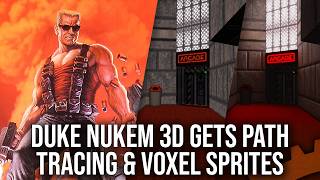

Duke Nukem 3D Gets Path Tracing!
53sShowcases a beloved classic game with cutting-edge graphics, sparking nostalgia and curiosity among gamers.
▶ Play Clip"Title accurately describes the mod and its visual impact; video delivers on the promise."
This video explores Duke RT, a mod that adds path tracing and optional voxel sprites to Duke Nukem 3D. The creator discusses the visual enhancements, performance considerations, and overall impression of this modern take on a classic game.
The video introduces Duke RT, a mod that adds path tracing to Duke Nukem 3D, based on the source port Raze.
Duke RT is a fork of Raze with a path tracing render backend using Nvidia NRI, supporting DirectX 12 and Vulkan.
New materials with normal maps were created to support the lighting, preserving pixel art while adding realistic lighting, shadows, and reflections.
The mod generates real-time light and shadow, with pixel art fences casting shadows and explosions emitting dynamic light.
Light panels emit diffuse lighting, creating soft shadows and dramatic effects, enhancing the atmosphere.
Voxel sprites convert 2D sprites into 3D pixel art, but performance is poor; disabling voxels significantly improves frame rates.
Best used with DX12 and Nvidia ray reconstruction for optimal denoising; tone mapping may need adjustment.
City-based levels work best with the mod; other maps may not have updated assets and look less appealing.
Duke RT offers a fresh way to experience Duke Nukem 3D with impressive path tracing, though voxel performance needs improvement. It's a worthwhile mod for fans with capable hardware.
What is Duke RT based on?
Duke RT is a fork of the source port Raze.
01:41
What rendering backend does Duke RT use?
It uses a path tracing render backend based on Nvidia NRI.
01:41
What APIs does Nvidia NRI support?
DirectX 12 and Vulkan.
01:53
Why were new materials needed for Duke RT?
Original textures lack directionality information needed for lighting.
02:19
What is the performance issue with voxel rendering?
Performance is poor, unable to get above 50 FPS even on a powerful rig.
06:12
What feature is recommended for optimal denoising?
Nvidia ray reconstruction.
07:34
Which API mode works best for Duke RT?
DX12 mode, not Vulkan.
07:34
Surreal Lighting
Demonstrates the dramatic visual transformation of the classic game.
02:47Subtle Lighting in Theaters
Shows how path tracing creates realistic ambient lighting.
04:35Voxel Integration
Highlights the potential and current limitations of voxel sprites.
05:56Ray Reconstruction Importance
Critical for visual quality; without it, visuals become grainy.
07:34[00:21] years old, which of course gave me a hankering to play some Duke. So, as you do, you check out the latest info on source ports and ways to play classic game. This time in my searching, however, something new popped up, Duke
[00:34] [music] RT. So, I gave it a shot and thought I'd talk about it here today. Yeah, it's Duke Nukem 3D, but with path tracing. But, here's the thing, and I largely agree, these types of RT mods, [music]
[00:49] they're interesting, but they rarely look better than the original games, right? That's the nature of grafting modern tech onto classic artwork. From a technical standpoint, I find them fascinating. It's cool to see what's
[01:02] possible. But again, these games were never designed to look this way, right? But in this case, I got to admit, I kind of like it. It has this nice middle ground [music] between retaining the original visual
[01:16] design from 1996 while offering some neat enhancements. The thing is though, when you've played a game enough times, as I definitely have with Duke 3D, it can be a lot of fun to revisit these classics in a new
[01:29] way. And that's what Duke RT provides. So, what is it? Well, at its core, Duke RT is a fork of the source port Raze, which is my favorite source port for
[01:41] Duke Nukem 3D. But this version brings a new path tracing render back end based on Nvidia NRI, which according to the documentation is a modular, extensible,
[01:53] low-level abstract rendering interface designed to support all low-level designed to support all low-level features of DirectX 12 and Vulcan. So, yeah, I guess you could call this new version ray tracing if you wanted.
[02:07] Anyone? Okay. Of course, you can't just drop this stuff into an old game and have it automatically look good, right? To make it work, things like new materials need to be created, adding normal maps and
[02:19] the like. The original textures alone just wouldn't cut it. They don't have any directionality information to help showcase the lighting at work. So, that's basically what's been done here. The result is a curious
[02:32] amalgamation of technology. The original pixel art design of the graphics remain fully intact, but it now boasts actual lighting that produces some pretty dramatic results. It's actually kind of surreal seeing
[02:47] lighting. It's similar to Doom RT, [music] [music] though perhaps a bit more conservative. So, to make this work, all the maps in the main campaign have been updated with
[02:59] new features. So, the real-time lighting, shadows, reflections, and more all appear throughout. So, let's start things off with a look at the very first level, Hollywood Holocaust. Right away, you can see how light and shadow are now
[03:12] generated in real time. Even things like the pixel art fence here project actual shadows in the environment that align with the object. And when explosions occur, light is generated in real time around you. In
[03:26] fact, if you use debug commands, you can spawn a light source at any point, [music] and using a different command, you can draw just the lights with direct illumination. It's kind of neat to see it because it shows that these sorts of
[03:38] demonstrates how they affect the environment. that you can use like this one which shows the game's diffuse lighting, you know, the soft light scattered across surfaces. We can actually visualize it
[03:52] interfering. There's also one for specular lighting. would be useful if you were actually building a new map specifically to use Back into the normal view though, here on the street, you'll notice that the
[04:07] buildings now properly reflect the surroundings in a dramatic fashion. While things like the marquee here project real light. Now, let's go inside the theater then, and things are a bit dim, but kind of
[04:21] eerily realistic. It recreates that feeling of soft ambient lighting in a large theater space. But what I really love are scenes like this. The light panel here actually emits real diffuse lighting across the
[04:35] entire scene, creating soft dramatic shadows and light. Look at the subtle lighting in this scene. It's really nice, I think. where that light panel above the sink performs similar duty. And there's a ton
[04:49] You'll see it here as well, on the second level. These lengthy light panels that were placed all over now suddenly become proper light-emitting sources.
[05:01] Resulting in some very subtle, but rather slick lighting. Now, you can jump into other areas of the game like to here with a lot of this metal, and that material has been updated to show proper reflections of
[05:13] There's a ton of stuff like this throughout the game, actually. And it all really transforms the presentation to something that does feel fresh. The thing is though, it's not always a good thing that it transforms the
[05:26] presentation. And as I alluded to earlier, a lot of these RT mods can be somewhat overbearing. But I do genuinely think it works pretty well here in Duke RTX. It preserves and enhances the original art design just enough to
[05:39] create something attractive without going too far. It's not that super implementation we've seen in some other games. It just works well. now all of the footage I've shown of Duke RT has been running exclusively
[05:56] with the game's normal sprites. They do integrate surprisingly well, but Duke RT also has an option for voxel rendering. There's just one problem. Performance is currently very poor when voxels are enabled. This actually left me
[06:12] scratching my head as I was trying to adjust settings, lower resolutions, and basically do anything to claw back frames, but I really couldn't get above 50 FPS even on a very powerful rig. Once I disabled voxels, however, the frame
[06:25] rate skyrocketed, instantly suggesting that it was bottlenecked by this Now, you can improve things a bit by using frame generation, but it's only limited to FSR 3 frame gen, which isn't great, and windowed mode.
[06:39] Which is why in its current form I recommend playing without voxels a decent frame rate. That said, the look of these voxels is pretty neat, and it's very promising for the future. Now, this pack already
[06:53] exists, and it was used for other ports, right? But the idea here is that you transform 2D pixel art into actual 3D pixel art, where the individual pixels now occupy space within the scene, and all of that integrates really well into
[07:07] Duke RT. Still, thankfully, the game looks great with or without the voxel objects, so it's not a huge loss if you have to disable them at the moment. The main benefits of the path tracer are obvious
[07:19] regardless. Now, in its current form though, there are a couple little things that you might want to keep in mind in regards to First of all, this is designed to work best in DX12 mode, not Vulcan. And it
[07:34] really shines with Nvidia ray reconstruction. Without this feature, the denoising becomes significantly worse, producing grainy, noisy visuals in its place. So, keep that in mind when you set it up. Secondly, things like
[07:48] tone mapping can require some tweaking as by default, I felt like the colors garish. Thankfully, that and tons of other options are available to mess with. So, it's extremely tweakable. You can make
[08:03] it look exactly as you'd like. It's also currently still in active development with a lot of new features being tested and added over time. Things instance, are planned along with improved water effects.
[08:16] It looks fine enough as is, but I look forward to seeing some of these additional features show up in later versions. Having played a big chunk of Duke Nukem 3D using this mod, though, I kind of
[08:28] feel like the city-based levels all tend to work the best with materials that best tuned to accept the new lighting. It's atmospheric and just feels correct without straying too far from that
[08:40] missions, which were never as visually striking, aren't bad here, but the results are a bit more garish and less visually attractive overall. Still, you can basically play through the game without an issue.
[08:54] That said, the other maps and such that go outside of that main campaign don't seem like assets have been made to support them. Like here, you can see things just don't look right, do they? Still, overall, this is a really neat
[09:10] experimental little project and one that I do think is worth messing with. I've played through Duke Nukem 3D so many times at this point that seeing it presented with this new coat of paint is really, honestly, pretty exciting. So,
[09:23] all in all, I'm pretty happy with this mod. It was a blast playing through the game once again, celebrating its 30th anniversary. I still can't believe it's been that long, but man, what a game. So, if you have the hardware and are
[09:36] looking for a new way to play Duke Nukem 3D, look no further than Duke RT. Be sure to give it a look. It's over there on GitHub and precompiled for your That's all for this rather brief video, but hopefully you enjoyed it and we'll
[09:51] but hopefully you enjoyed it and we'll see you next time.


⚡ Saved you 0h 09m reading this? Transcribe any YouTube video for free — no signup needed.