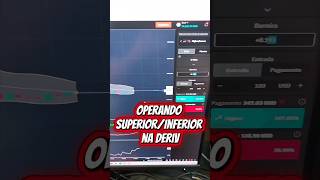

How I Turn $20 into $100 on Deriv
45sShows a quick, relatable profit-making strategy with a 20-30% return, enticing viewers with potential earnings.
▶ Play Clip"Delivers exactly what the title promises — a live Higher/Lower trading session on Deriv — though the content is repetitive and light on deep strategy explanation."
This video is a live trading session on Deriv, where the trader demonstrates a Higher/Lower strategy on synthetic indices using a compensation barrier to target 20-30% returns. The session shows real-time entries on both appreciation and depreciation, with martingale management and loss-splitting techniques used to recover from a $100 loss and close with a profit of $118.6.
The trader introduces the Higher/Lower strategy on Deriv with a compensation barrier, targeting a 20-30% return. Focus is on synthetic indices, switching between markets as opportunities arise.
The trader configures the barrier and places a first entry on depreciation (asset going down), using five contract ticks for faster execution.
First entry wins $19.87. The trader emphasizes maintaining the same volatility setting to avoid resetting the barrier between trades.
The trader places the barrier down and enters on appreciation (asset going up), showing flexibility in switching between rise and fall trades.
Another win at $19.87. The trader anticipates the asset seeking the upper Bollinger Band, using this technical indicator to time entries.
The trader explains using martingale management to recover losses, or alternatively paying in installments to reduce exposure.
The trader takes a $100 loss. The recommended strategy is to split the loss into smaller entries rather than exposing a high stake.
The $100 loss is split into two smaller entries. The trader uses devaluation again with the safety barrier in place above the initial entry.
The first recovery entry brings back $59.65, with the balance at $59.01. The safety barrier continues working above the initial entry.
The session closes with $118.6 in profit, demonstrating the effectiveness of the compensation barrier and loss-splitting strategy.
With a 20% safety net, the trader notes you can pay the Gale (martingale) in three installments to further reduce exposure during recovery.
The session demonstrates that combining a compensation barrier with disciplined loss-splitting and martingale management can turn a $100 loss into a $118.6 profit. The key principle is that with a high level of security in your favor, you don't need to expose yourself with a very high stake on your next entry.
What return does the trader target with the compensation barrier strategy on Deriv?
A 20-30% return.
00:02
What strategy is used to recover losses in this trading approach?
Martingale management, or paying in installments.
01:09
What technical indicator does the trader use to anticipate price movement?
Bollinger Bands.
00:54
What is the recommended approach when taking a loss with a high security level?
Split the loss into smaller entries rather than exposing yourself with a very high stake on the next entry.
01:38
With a 20% safety net, how can you further reduce exposure during recovery?
Pay the Gale (martingale) in three installments.
02:43
What was the final profit amount in this trading session?
$118.6.
02:30
Compensation Barrier Strategy
Using a compensation barrier allows targeting consistent 20-30% returns while maintaining a safety net — a core principle for risk-controlled trading.
00:02Martingale for Loss Recovery
Martingale management helps recover losses, but splitting into installments reduces exposure — a practical risk management technique.
01:09Smart Loss Splitting
Instead of risking a large stake after a loss, splitting it into smaller entries reduces risk while still recovering the loss.
01:38Exposure Reduction Principle
A 20% safety net allows paying martingale in three installments, further reducing exposure during recovery — a key principle for sustainable trading.
02:43[00:00] Pessoal vou fazer algumas entradinhas no mercado de higher and lower aqui na Deriv com barreira de compensação que me traga de 20 a 30 por cento de retorno tá tô aqui nos índices sintéticos vou alternando os mercados de acordo com a oportunidade 5 tiques de contrato para ficar mais rápido aqui
[00:16] eu configuro a minha barreira então eu vou colocar diversos clipes dessas minhas entradas primeira entradinha aqui desvalorização vamos lá esperando a minha barriga de compensação ali em cima vamos
[00:28] com 100 dólares aí, opa, beleza, primeira entrada, aí ó, 19.87, estou achando interessante manter a mesma volatilidade para que eu não fique toda vez configurando barreira, tá? Agora eu vou colocar a barreira
[00:40] para baixo, beleza, vamos colocar agora uma entrada em rise, na direção da valorização do ativo, aqui ó, minha barreira de compensação próxima da entrada inicial, mais uma entradinha aí ó, 19.87,
[00:54] Aí está subindo o ativo, mais uma entrada, mais uma win, 19,87. Eu estou realmente achando que o ativo vai buscar a banda de Bollinger superior. Vou fazer mais uma entradinha, vamos ver.
[01:06] Lembrando que aqui se eu perco uma entrada e eu estiver trabalhando com gerenciamento de Gale, minha entrada tem que ser bem alta para recuperar o prejuízo. Ou você pode também parcelar. Mais uma entrada, 19,87. Já estou com 79,48 e vou já fazer uma entradinha na desvalorização.
[01:21] Vamos ver se esse mercado vai desvalorizar. o correto era voc esperar mais confirma t esperar pelo menos um pouquinho mais de tempo mas como eu tenho uma barreira a meu favor a mais uma entrada mais uma win R dessa vez Estou com quase R
[01:34] Acabei já fazendo uma entrada. Aqui, um, ó, subiu bastante. Vamos ver se ele consegue retomar abaixo da barreira de compensação. Está trabalhando bem próximo dela. Tomei um loss. Agora eu perdi R$100. Nesses casos de perda, quando
[01:46] você trabalha com uma segurança alta, o que é interessante fazer? Você parcela o seu gain. Você faz duas vezes de um valor mais baixo. Eu estou com 100 aqui. Eu vou fazer duas entradas de 300 dólares. Estou agora mais uma vez na
[01:58] desvalorização. Está trabalhando ali na minha banda de Bollinger superior. Vamos ver. Ali está próximo da minha barreira de compensação. Eu perdi 100. Na primeira entrada já recuperei 59,65.
[02:11] Com todos os gains e aquele loss nesse momento estou com 59,01. Ele deixou um pavio ali. Tenho minha barreira de segurança acima ali da minha entrada inicial. Trabalhando ali, próximo, beleza
[02:23] Desceu, aí ó, mais 59,65 Colocando isso daqui 59, opa 59,65, fechei com 118,66 Funciona dessa forma galera, se você está trabalhando
[02:35] Com uma segurança muito alta a seu favor Você não precisa se expor com uma Stake muito alta na próxima entrada Você pode parcelar em duas ou três Vezes de acordo com a segurança que você está Usando, como eu tinha ali uma segurança em torno
[02:47] De 20%, você pode até fazer o Gale em três parcelas e diminuir ainda mais essa exposição na recuperação. Mas é isso, 118 dólares aí, trabalhando com o Heirenloer na Deriv.




⚡ Saved you 0h 02m reading this? Transcribe any YouTube video for free — no signup needed.