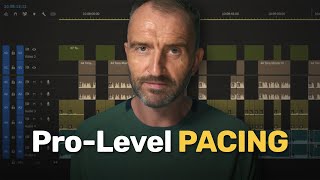

Why Your Brain Needs Variation in Editing
43sExplains the neuroscience behind why pacing variation keeps audiences hooked, making it a must-watch for editors.
▶ Play Clip"The title accurately reflects the content: the video delivers techniques for high-end pacing, exactly as promised."
The video explores the critical role of pacing variation in film editing, explaining how it keeps audiences engaged by leveraging our brain's reward for novelty. It outlines a first-principles approach to designing pacing, starting with the emotional destination of a scene, and details four key factors that drive pacing: cut speed, in-frame action, subject distance, and camera movement. The host, Paddy Bird, provides practical exercises to help editors master tempo design and avoid amateur mistakes.
Lack of variation in pacing makes films dull because our brains are wired for novel stimuli and reward us with dopamine for new experiences.
Pacing is like designing an emotional roller coaster: editors control the slow climbs and fast drops to shape audience experience.
Start with the emotional destination of a scene, then choose a tempo (slow, medium, fast) that reinforces that emotion.
Ask five questions: Does the scene have one overall tempo? What is it? Does it change? When? Why? This ensures intentionality.
Four factors drive pacing: speed of cuts, action/movement in frame, distance from camera, and camera movement. They are accumulative.
Practice by taking a scene, defining its emotional destination, choosing a tempo, and editing B-roll using the four factors. Then try the opposite tempo.
Why does lack of variation in pacing make a film dull?
Lack of variation in pacing leads to dullness because our brains are wired for novel stimuli and reward us with dopamine for new experiences.
What are the four factors that drive pacing in a sequence?
The four factors are: speed of cuts, action/movement in the frame, distance of subject from camera, and camera movement.
09:11
What is the first principle for designing pacing in a scene?
Start with the emotional destination of the scene, then choose a tempo (slow, medium, fast) that reinforces that emotion.
04:05
What five questions should an editor ask to ensure intentional pace changes?
The five questions are: 1) Does the scene have one overall tempo? 2) What is that tempo? 3) Does the tempo change? 4) When does it change? 5) Why does it change?
06:41
How does the distance of the subject from the camera affect perceived pacing?
Someone moving fast in an extreme wide shot appears slower than small head movements in an extreme close-up.
10:23
Why are the four pacing factors considered accumulative?
The four factors are accumulative: combining lots of cuts with fast whip pans on close-ups creates faster sequences than cuts alone.
11:21
What is the difference between short-form and long-form editing in terms of pacing?
Short-form social media editing is simplistic and fast, while long-form narrative editing is complex and varied.
03:20
Variation is key to engagement
Explains the psychological basis for why pacing variation keeps audiences engaged, rooted in dopamine response.
Pacing as a roller coaster design
Provides a powerful metaphor for editors to think of pacing as designing an emotional journey with intentional ups and downs.
02:36Start with emotional destination
Introduces a first-principles approach: define the desired emotion first, then choose pacing to reinforce it.
04:05Five questions for intentional pace changes
Offers a practical framework to avoid random pace changes, a hallmark of amateur editing.
06:41Four factors that drive pacing
Breaks down pacing into measurable, actionable components beyond just cut speed.
09:11[00:00] Imagine if every scene in every drama, documentary, and reality show was at the same pace for the whole film. If it were fast all the time, it would be relentless and overwhelming.
[00:13] If it was too slow, it would be too relaxed and the audience would fall asleep. Either way, it would be dull, but it would be dull for a very interesting reason.
[00:25] Lack of variation. As human beings, we love variation in all its forms, our brains are wired for the novel stimuli. Not only does it give us pleasure, but we're also rewarded with a shot of dopamine every time we
[00:43] experience it. Lack of variation and lack of new experiences, however, does the opposite. No shot of dopamine. And it's this knowledge that we, the editors, the designers of intrigue,
[00:57] drama and entertainment must keep constantly in our mind when we look across our timelines. Variation in editing comes in many forms from changing cutting styles to changing music
[01:12] tonality to unexpected events happening in the narrative. These create unpredictability within our storytelling and audiences are addicted to it. And one of the most powerful skills we can have
[01:28] as editors is to design variation in pacing across our whole film. Our ability to control this tempo is the skill set that tells producers, directors and high-end clients that we have truly mastered
[01:46] editing. So in this episode, I'm going to outline the concepts and techniques that you can use to create high-end pacing like a pro. If you want sequences to have that amazing tempo design
[02:00] of a Netflix documentary, then you're in the right place. I'm Paddy Bird, and this is Inside the Edit. Everything in editing means something. Every decision we make has an effect on the audience.
[02:20] From the shots we include to the dialogue or facial expressions we leave out. There are no random decisions in editing. Every frame is there for a reason. And pacing is at the very top of that list.
[02:36] A great way to think about this pacing variation is like the ability to design an excitement roller coaster for our audience. We are the entertainment engineers that will bend and shape the angle,
[02:51] the gradient and the duration of every curve on that roller coaster. We'll decide how long that slow crawl up to the peak will be and how fast and deep that drop will go down when they
[03:05] get to the top. Our timeline may look like a flat two-dimensional block of interconnected Lego, but inside it is a wild and adventurous ride full of ups and downs and peaks and troughs.
[03:20] This is the difference between short-formed social media editing and long-form narrative editing. One is simplistic and fast, the other is complex and varied. So, how do we go about building this?
[03:37] Well, like everything in high-end editing, it starts with first principles thinking and asking ourselves the right questions. Let's look at two big ones. Number one, why do we change pace? And importantly,
[03:53] number two, how are pace changes created? Let's break these down.
[04:05] Now, a key part of becoming a successful filmmaker is learning how to convey the emotions within your narrative to the audience. This comes in a huge range of forms in any one film.
[04:18] The action that plays out in front of the camera, the behavior our characters exhibit, the music we choose to accompany the scene. Pacing is designed and manipulated to reinforce the exact emotions
[04:34] we want to convey to the audience and at every single moment. It is one of many layers of storytelling that is here to help us. If we want to create a specific emotional atmosphere in a scene,
[04:49] the tempo that we design will be extremely important. Okay, maybe I'm building a reflective scene where my documentary character is thinking back on a,
[05:05] I don't know, maybe a difficult or innocent time in their life. I may decide that I want the scene to be cut slower so that the emotional impact of what's being said to the audience hits harder.
[05:19] The emotional atmosphere is created by slowing down the pacing. Or maybe I'm editing a very tense and nervous scene where a character is late for a very
[05:34] important event and is rushing. I may decide that I want the scene to be cut faster to increase the tension that's inherent in the raw footage. The emotional atmosphere is created by speeding up the
[05:49] pacing. Now, in both of these examples, I'm starting off with the emotional destination of the scene first and then asking myself what pacing best reflects these emotions. These thought processes
[06:07] are invaluable as a higher end editor, but it doesn't stop there. While a huge percentage of scenes have one overall pace, slow, medium or fast, a great many scenes have multiple tempos within
[06:23] them. A scene may start off a slower or medium pace, then something happens and it moves to a much faster pace. Or the opposite, a scene may start fast and then abruptly or gradually slow down.
[06:41] It doesn't really matter what the pace change is. Like anything in editing, what matters is the questions we ask ourselves. Number one, does the scene have one overall tempo? Number two,
[06:56] what is that tempo? Number three, does the tempo change? Number four, when does it change within the scene? And five, why does it change? Now, it's incredibly important that we take all of these
[07:10] factors into consideration because nothing screams amateur editor more than seeing random pace changes throughout a sequence. Don't forget, everything in editing has a narrative meaning. A fantastic exercise
[07:28] when you're cutting your next scene is to ask yourself these questions and then plot the different pacing points and changes throughout your timeline. Now, there may be numb, there may be a few,
[07:44] or there may be many. Again, that doesn't matter. What matters is the intention.
[07:56] One of the things I struggled with when trying to break into high-end editing was learning the language used in a professional edit suite. Learning all of the terminology really does help
[08:09] when shaping your mind for every stage of the creative process. And that is why I created this for you. It's a beautifully designed film poster that I call the periodic table of editing terminology.
[08:25] 50 of the most used creative turns you'll hear in a pro suite. You can print it out and put it up on the wall of your cutting room or keep it as a screensaver. Just click on the link in the description
[08:38] below, head on over to inside the edit.com and download it right now. Memorize every single one and you'll start sounding like a high-end editor very quickly.
[08:56] So how are these pace changes actually built? What do we need to do to speed things up or slow things down? Well, it's not one thing. In order to change pace, we need to know what drives
[09:11] pacing in a sequence. So let's go through the four top factors. Firstly, the speed of the cuts. This is the obvious one. This is the one that short-form editors rely on.
[09:23] The amount of cuts that we allow onto a timeline and therefore the amount of compressed action or space that is pulled out of the sequence plays a big role. But this is only the beginning. Secondly,
[09:39] the action and movement that plays out in front of the camera. Is it fast action? Is it slow action? Is it a mid-shot of someone sitting down and calmly peeling an orange, for example? Or a shot of
[09:53] someone running through a supermarket throwing tons of food in their trolley at lightning speed? Of course, there may be no movement in a shot at all. You know, something like a beautiful
[10:06] b-roll shot of a sunrise, a wide shot of a building at the start of a scene. All of this affects pace. Thirdly, the distance of the subject or object from the camera. Whatever that thing or person is,
[10:23] how near or far is it to the lens? Are they a small percentage of a very wide shot, or is it a detailed extreme close-up of someone's face? Someone moving fast in an extreme wide shot
[10:38] is going to appear slower than small but continuous head movements in an extreme close-up. And fourthly, the camera movement. Is this a static shot? Is it moving? Is it panning or tilting?
[10:53] If so, how fast is that panel tilt? And of course, are there any zooms in the shot? If yes, then are they crash zooms like really, really fast? The amount of camera movement we allow in any
[11:06] sequence plays an enormous role in the pacing. Now, there are other factors like music and how much space we allow around the cut, which we'll go into in future episodes. But understanding and
[11:21] analysing these four factors is key in any pacing design. The most important point to remember, however, is that these factors are accumulative. Lots of cuts plus lots of whip hands are all on middle close-up
[11:39] shots is going to create faster sequences than just lots of cuts alone. So, start on this right away. Take the raw footage of a scene you've already cut.
[11:57] Write down the emotional destination you want the audience to feel. Choose a tempo. Slow, medium, fast. Take the four pacing factors and practice cutting the B-roll while
[12:12] taking them all into consideration. Once you finish the cut, duplicate your sequence and then try the opposite tempo. Here's a bonus for extra points. Try changing tempo mid-scene for a specific
[12:30] narrative reason. I want you manipulating pacing like a Jedi master and I want you doing it as quickly as possible so that you can start getting better and better work. Practice an hour a day, half an
[12:45] hour a day, whatever. And in a couple of weeks, it'll start to become a reflex. Thank you for your kind attention dear friend. I'm Patti Bird and this is Inside The Edit.
⚡ Saved you 0h 13m reading this? Transcribe any YouTube video for free — no signup needed.