
The Match Cut: Seamless Storytelling
40sMatch cuts are visually stunning and often go unnoticed, making viewers appreciate film editing skills.
▶ Play Clip"The title perfectly matches the content — the video delivers exactly what it promises: 10 editing cuts every filmmaker should know."
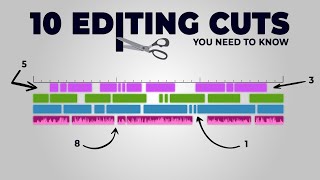
The video explores ten essential editing cuts that every filmmaker should know, explaining how each one contributes to storytelling and audience engagement. It covers the basics from simple cuts to more complex techniques like J-cuts and L-cuts, emphasizing that editing is 'invisible storytelling'.
The most basic and common cut: an instant switch between shots and audio. Example: from a spire scene to an office scene.
Removes a segment of a shot and splices the ends together, creating a jump in time. Often used in talking head videos to remove pauses or in films to show the passage of time.
Matches action, shape, color, framing, or audio between two shots for seamless transitions. Three types: graphic, movement, and audio.
Audio from the next scene starts before the video cuts, preparing the viewer. Example: Wolf of Wall Street where chest-beating sound leads into a lunch scene.
Audio from the current scene continues after the visual cuts to the next. Example: Ant-Man where dialogue continues over a reenactment scene.
A shot dissolves to or from a solid color, typically black (start/end of story) or white (death/dream). Symbolizes beginning or end.
Fades from one shot directly to another, commonly used to show passing of time within or between scenes.
Cutting during a character or object's movement so that the out point of shot A matches the in point of shot B, creating a seamless transition.
Cutting back and forth between multiple scenes happening simultaneously, often used in thrillers or phone conversations.
An abrupt, harsh cut from one scene to another with contrasting visuals and audio, e.g., from a loud chaotic scene to a quiet one.
The video wraps up by encouraging viewers to storyboard their edits before shooting to maximize impact.
What is a jump cut?
A cut where a segment of a shot is removed and the ends spliced together, making the shot feel like it has jumped in time.
00:43
Name the three types of match cuts.
Graphic (visual elements match), movement (camera/character/object movement matches), and audio (sound matches between scenes).
01:25
How does a J-cut differ from an L-cut?
In a J-cut, the audio from the next scene starts before the video cuts. In an L-cut, the audio from the current scene continues after the visual cuts to the next.
01:52
What does a fade to white typically symbolize in film?
A character dying or being in a dream.
03:23
What is a smash cut?
An abrupt, harsh cut from one scene to another with contrasting visuals and audio.
05:06
Editing as invisible storytelling
Establishes the core philosophy that editing is about telling a story seamlessly.
00:15J and L cuts create immersive flow
Explains how these cuts guide attention and build emotional impact by bridging audio and video.
01:52Fades symbolize beginnings/endings
Highlights how a simple technique carries symbolic meaning in storytelling.
03:11Cutting on action smoothens transitions
A practical tip to make cuts feel natural by matching movement between shots.
04:02[00:00] Editing is where the magic happens, it's where all that hard work production and shoot days gets laid out and put together to tell a story. In many ways, Editing is invisible storytelling and understanding the different types of cuts
[00:15] is key to mastering it. So in this video, we're going to dive into 10 important editing cuts every filmmaker should know. So I don't think we can start this list without the most obvious cut of the mall at number one, and it is called, well, the cut.
[00:30] The cut is an instant switch between one shot to another, including audio. You would have seen thousands of these as it's the most popular cut style of the mall. Here you see we cut cleanly from the spire scene to this office scene, and we're ready
[00:43] to take on new information. Number two, the jump cut. This cut is when a segment of a shot has been removed, and the separate ends have been spliced back together, making the shot feel like it has jumped in time.
[00:56] You may also see a lot of jump cuts in talking head videos like these on YouTube to help remove pauses and mistakes. In this Tarantino movie, the effect these jump cuts are having is showing the passing of time, and that the characters have actually been speaking longer than the screen time being
[01:11] shot. I just got my part, part for sheer luck. Number three is the match cut. The match cut is a cut that matches action, shape, color, framing, or even audio of two shots
[01:25] seamlessly bringing the viewer into the next scene. The three types of match cuts are graphic, with visual elements matching, movement, with
[01:37] camera, character, or object movement matching, and audio, with the sound matches between the two scenes. Mama said they'd take me anywhere. She said they was my magic shoes.
[01:52] Number four and five is the J-cuts and the L-cuts. J-cuts is when the audio from the next scene starts before the video cuts, so the viewer hears what's coming before they see it.
[02:04] Here is a popular J-cuts from the Wolf of Wall Street, where we begin to hear Matthew McConaughey beating on his chest, leading us into the lunch scene before we've been listening to it. So!
[02:18] And now I realize a lot of my examples all contain Leonardo Capri, that was not intended at all. An L-cut is the opposite. The audio from the current scene continues even after the visual cuts to the next.
[02:30] You're still hearing a line of dialogue or ambient sound as you're already seeing the new shot. This L-cut from Ant-Man continues the character's dialogue while we're visually seeing a reenactment scene, bridging the two together.
[02:42] You know, but there was a rosé that saved the day, it was delightful. And then he tells me about this girl Emily that would use to kick it with, it was actually the first pair of boobs that I ever touch. It's a round details. It's a round. It has nothing to do with the story. These cuts are incredibly useful because they create a smoother, more natural flow between
[02:58] shots, a speci in conversations. They let Editors guide the audience's attention, build emotional impact, and instead of just feeling like a hard stop, the J and L-cut make the film feel more immersive.
[03:11] Alright, number six, the fade. The fade is a classic, and it's when a shot dissolves or fades to or from a solid colour.
[03:23] And that colour is most commonly black, whereas a fade to white might be used to show the character dying or in a dream. Fades are commonly at the start or the end of the film and they symbolise the beginning
[03:35] or the end of a story. Now similar to the fade is the next transition we have, and this is the dissolve. This instead of fading from a colour, we just fade to a new shot.
[03:48] The dissolve is commonly used to show a passing of time either within a scene or from one scene to the next. Number eight is cutting on action.
[04:02] Cutting on action means just that. You cut during the character or objects movement. Basically when the out point of shot A matches the in point of shot B, it creates a seamless transition.
[04:14] Cutting on action is another very common technique used by Editors, and it helps make the cuts feel smoother and more natural to the viewer. Number nine is cross-cutting.
[04:38] Cross-cutting is when the editor is cutting back and forth between multiple scenes, usually at the same time. This is a common technique used in thriller-style movies, can be used when maybe two characters
[04:50] are on the phone to each other and you're cutting two from each character. What cross-cutting allows you to do is to easily tell your two stories that are happening at the same time. And luckily last we have the smash cut, and this is exactly as it sounds.
[05:06] It's a harsh abrupt cut from one scene to the next with contrasting visuals and audio. An example of a smash cut could be a loud chaotic scene that suddenly cuts to a quiet simple one.
[05:18] There we go, that's ten common edit and cuts you can use to help with your storytelling.
[05:31] To really maximize the impact of your edits and cuts, take the time to plan and storyboard them before you go out shooting. If this video helped you at all, subscribe below, and I'll see you in the next one.
⚡ Saved you 0h 05m reading this? Transcribe any YouTube video for free — no signup needed.