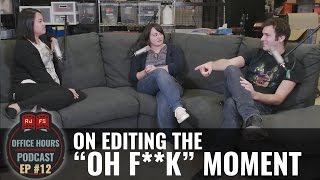

The Editing 'Oh F***' Moment Explained
60sThe hosts explain the concept of the 'Oh F***' moment in editing, a high-engagement topic for film enthusiasts.
▶ Play Clip"The title promises a discussion on editing, and the podcast delivers, but it's a casual conversation with tangents and inside jokes, not a structured tutorial."
In this podcast episode, the RocketJump Film School team discusses their video essay 'Editing: Creating the Oh F*** Moment,' exploring the philosophy behind purposeful editing. They answer viewer questions about the creative process, the importance of motivated cuts, and how editing controls information to guide audience attention. The conversation also covers the challenges of teaching editing, the role of rhythm and audience expectations, and the value of collaboration between directors and editors.
Lauren, Joey, and Cherish introduce the podcast, discussing their video essay on editing and the 'Oh F*** Moment.' They mention that November is podcast month, with tutorials coming later.
Joey explains that the original idea for the essay was broad ('the purpose of a cut'), but it crystallized when they focused on cuts that build to a reveal or 'oh f***' moment, emphasizing information orchestration.
Cherish notes that the examples in the video (e.g., Reservoir Dogs, Doctor Strangelove) effectively demonstrate the specific editing technique, showing it's not the only way to edit but a distinct approach.
The team discusses how editing is like working in negative space—removing pieces to create meaning. This conceptual nature makes it hard to teach, as it's about what's not seen.
Joey emphasizes that editors should have a reason to cut, not just because time has passed. He criticizes cutting line-by-line due to lack of rehearsal, which can be avoided with proper preparation.
The conversation highlights one-take scenes (e.g., Working Girl, Birdcage) that rely on actor skill and direction, showing that cutting isn't always necessary when performances are strong.
A cut segment discussed how knowing your audience's viewing platform (phone vs. big screen) affects editing choices, with more close-ups and mediums for smaller screens to direct attention.
Joey recommends 'Murder on the Orient Express' (Sidney Lumet) for its purposeful editing, and discusses Memento and Nightmare on Elm Street as examples of building stories through close-ups and audience expectations.
The team analyzes the Butch Cassidy and the Sundance Kid scene, showing how holding on close-ups and then cutting to a wide creates tension and reveals character, demonstrating motivated cuts.
Joey discusses the rhythmic structure in The Fugitive's train scene, noting how alternating extreme wides and close-ups creates a subconscious, poetic momentum that can break if overdone.
The team notes that some scenes (e.g., action sequences with stunts) are shot so specifically that editing choices are predetermined, limiting creative freedom but ensuring a planned outcome.
Joey shares that standard coverage (master, over-shoulders) isn't a one-size-fits-all solution; it can miss story nuances. He suggests learning by making mistakes and hiring outside editors for fresh perspectives.
Editors should consider audience expectations and maintain interest; unmotivated holds or cuts can make scenes uninteresting. Hiring an outside editor can provide an audience perspective.
The team discusses that strong directors know when to accept better ideas from editors, and that collaboration brings out the best in a story. Editors bring a distinct point of view that shapes the final product.
The podcast underscores that editing is a purposeful, information-driven craft that requires understanding audience psychology and rhythm. It encourages filmmakers to embrace collaboration and iterative learning, as there's no single rulebook for editing.
RocketJump Film School YouTube Channel
link
LA Public Library Workshops
link
Reservoir Dogs
movie
Doctor Strangelove
movie
Working Girl
movie
The Birdcage
movie
Lawrence of Arabia
movie
Murder on the Orient Express (1974)
movie
Memento
movie
A Nightmare on Elm Street
movie
Butch Cassidy and the Sundance Kid
movie
The Fugitive
movie
Jaws
movie
Spy
movie
OSS 117
movie
Alien
movie
Top Gun
movie
Unstoppable
movie
Emmanuel Lubezki
person
Wes Craven
person
Sidney Lumet
person
Editing as Negative Space
Provides a conceptual framework for understanding editing's intangible nature.
05:41Audience Screen Dictates Editing
Highlights a modern consideration for editors in the age of mobile viewing.
10:48Rhythm in Editing
Explains how visual rhythm creates subconscious audience engagement.
20:45Hire an Outside Editor
Practical advice for directors to gain fresh perspective and improve storytelling.
32:12Strong Directors Trust Others
Challenges the ego-driven notion of directorial control, emphasizing collaboration.
37:15[00:00] Hey guys, it's Lauren, and welcome back to the Rocketton Film School Podcast Office Hours. And me, Joey, and Cherish are going to talk about one of our previous videos,
[00:14] the Editing the OF moment, made by Joey himself. It's one of our favorite video essays, and we're going to answer some of your questions about the video, about editing, and kind of get into our thought process behind it. So if you're interested in editing, it's a good podcast to check out.
[00:29] So hope you guys enjoy. Hey guys, welcome back to the Rocket Jump Film School podcast office hours.
[00:53] And November, we are taking off from releasing our normal tutorials. We're doing another podcast month. and that is because we are going to be crazy busy on Hulu-related content. That means we're going to have tutorials based on the cool shorts that we've been working on all year
[01:09] and that we are dying to tell you about, but we can't because we're going to form a secrecy under pain of death and then will kill us. I've seen his crazy eyes. I've seen his crazy hair. It's still flowing. It's beautiful. Oh, yeah.
[01:21] He lures you in with his beautiful mane, and then when you get too close, He was like, I know what you said on Twitter. And I was like, shit. I could take them. Well, yeah. So Charis will avenge our deaths as soon as we spoil and spill all the beans on the Hulu show.
[01:36] Yes. But today we are going to kick off podcast month again. We're talking a little bit about the editing essay that Shirley put together. I love it. Woo-hoo. DTW.
[01:48] It's called, and be warned, this podcast is going to have a lot of language in it because Because the actual video is called Editing Creating the Oh Fuck Moment. So we are going to have a lot of F-bombs. It's going to be a lot of swearing. But it's educational.
[02:00] It's educational swearing. Yeah. Fuck, fuck, fuck, fuck, fuck. But it's a super fun video. Sorry, Mom. And I was just, we wanted to, there's a lot of questions that came up about it. And there's a lot of dialogue and it's really interesting.
[02:12] So we just wanted to delve into it. So, Joey. Hello. What was, what was first? How long did, how much, how many clips did we pull for that? Gosh. So many for just like a second of actual time.
[02:26] You know, we downloaded full films just to pull that one moment from stuff. And that takes up a lot of render space. So my computer kept like having a heart attack every time just because of the amount of full features within the project file.
[02:42] It was quite a bit. I actually don't know the actual number of clips. Well, some stuff you hang on for quite a bit too, which is cool. Right, right. No. So, yeah, I don't even know where the original idea for the whole fuck moment came from.
[02:56] Originally, it was, like, the idea was all over the place. It just took finding, like, one cohesive thought to teach a lesson on, like. Yeah, because I remember it started with, like, the purpose of a cut or, like, the meaning behind a cut.
[03:11] Yeah, why do we cut and all this other stuff. That's such a huge idea, but I think it really clicked when we realized the type of cut that you wanted to focus on. Yeah, I noticed that things were building to a cut a lot of times or a reveal.
[03:26] And so then it just became about information and how you orchestrate that within a story. And I was learning as I was going, too, because I would find things in films that now that I'm looking for that,
[03:39] and you start picking that out, like Reservoir Dogs and stuff like that, to tie it back in with, say, Doctor Strangelove. It's like, this isn't the only time we've done this, so I was looking for another one that sort of does a similar thing.
[03:51] Yeah, I think your examples are actually what really demonstrate the cohesive technique you're talking about. Because, I mean, cutting for the oh fuck moment is not necessarily,
[04:04] obviously, the only way to edit, but it is a very specific way that we're illustrating. and all your examples just sell it so well. Right. I mean, sell is maybe the wrong word. Demonstrate it so well. That was the whole thing is, like, people, yeah,
[04:17] maybe might have issues, like, with the fact that it doesn't teach every nuance of editing or something like that, but let's put this in perspective. Like, we want, at film school here, we want to teach something that is almost universal
[04:29] that anyone could apply to any project that they're doing. And we have to do it step by step. we can't do a video that's like the secrets of all secrets and nuances of editing the video in
[04:43] five minutes because you guys don't want to watch a 16 hour tutorial on the intro to editing exactly so it's like it's real like it's not easy to talk about editing because and man it was a real
[04:56] struggle because you want to have something that is relevant but also something that doesn't that people might not have thought of or something that just almost goes without saying but saying it just to have it out there so that your subconscious mind might pick up on these things
[05:11] as you're watching a film as an audience. However, to have it then pointed out to you and say, like, that's what they're doing here. Yeah. Take note of that and see how you could apply that to whatever film you're doing.
[05:24] I like dissecting filmmaking through editing. You have to sort of work your way backwards to how it was shot and how it was directed and staged. So it's sort of like my way to look at all aspects of filmmaking through how it's assembled.
[05:41] Again, it's really hard to just talk about because it's so vast. Yeah. I think editing is especially, like, we would say directing and editing are our two hardest kind of disciplines to teach. And I always think of editing as, like, basically working in negative space.
[05:56] Yeah. It's like, you know, you're removing things in order to piece them back together. And that is a hard thing to define because it's not something you're seeing.
[06:08] You know what I mean? You're using the pieces of what everyone else has constructed in order to tie something together. So how do you teach someone to operate with a negative space? You know, it's a really conceptual kind of way of thinking.
[06:23] And so, you know, just all you can teach are concepts of that discipline. And a lot of people, like, and this is one of the things I've run into learning how to teach, because that's a whole different skill, is that there's so many times where I was like, this just feels right.
[06:40] And a lot of people who have been working a long time have those skills down as a feeling or a gut thing or, like, even just a reflex. and so you can't work, you have to work way back into your own mind
[06:54] to figure out your own reasoning. Yeah. Because you've already figured it out and now it's just like a thing. So it's like, oh, that edit feels right. It's like, oh, wait, how do you actually explain why? Right. It's really hard. It's really hard.
[07:07] Well, yeah, I guess working it backwards again from problems that I've seen in editing is cutting for just no reason or not understanding why. So I guess that became the thrust to try and formulate some sort of thesis on or idea or lesson out of having a reason to do it.
[07:26] Because people often cut just because they felt like too much time has gone by or something like that. It's like, oh, we need to cut just because we haven't cut in, you know, 10 seconds. Right. And that's not always, like, the best solution, you know.
[07:39] And knowing that and then really trying to – unfortunately, a lot of comments, I'm all over the place just because this is the way my brain is rambling off stuff. In comments, some person said, and this happens with a lot of student films also, is that they're cutting because they have to.
[07:55] They're cutting because they haven't rehearsed the scene. They're cutting line by line. No one remembers their lines or their blocking or their this and that, their cues. And that's another thing that you can appreciate more about when they hold on it or when it's very well rehearsed and tight and people and you can let your actors perform for you.
[08:16] Oh, the one takes. Yeah. Yeah. That's really impressive. So if you do have a film where that's how the scene is shot and you could do that, I suggest it. See what feels right, basically.
[08:29] See what feels right, yeah. Like, it's funny, because I might have mentioned this before, but, like, movies right now that have the one take is a very popular thing. They're very elaborate and blah, blah, blah. It's very impressive. But the thing with Emmanuel Lebesgue, this cinematographer, he's been doing one long take since the beginning of his career, but they're very subtle.
[08:48] And they really depended on the skill of the actors and the director to really pull the strong image. So, like, Working Girl, there's this amazing long scene in the women's bathroom where she's, like, redoing her makeup and Harrison Ford's reflected in the mirror.
[09:05] And it's one shot and they just talk and the scene is so tense and interesting. And then you have the birdcage, which is just Nathan Lane and Robin Williams being themselves. Yeah. And they just held on this kitchen shelf for like two minutes.
[09:18] Oh, I love it. Yeah, we were talking about... But you don't notice it because you're so, you're picking out where you want to focus. Yeah. And the actors are so interesting. that you don't need to cut, you don't have a reason to cut. It's the shot dynamic. People are coming in, they're coming out, they're doing all this stuff.
[09:31] There are no rules for when you have to cut. Yeah, exactly. Unless you're working with crappy footage. Sometimes that's the part you're doing. When you start over-cutting in feature films,
[09:43] or basically you have a scene that is just dialogue that is cut from all different angles and stuff, you have a whole feature film like that. By the time you get to the end, even if it's 90 minutes, it's just exhausting because you're not realizing it
[09:55] but it's nice when you're just getting bombarded with and sometimes that's what you're going for too yeah Tony Scott films like you're on the ride you know Unstoppable and Top Gun even like I think Top Gun started
[10:07] just wrapping up that tension or that energy with Insane Just the open
[10:22] There always a time and place and reason to do it If it a couple people sitting down and having a conversation maybe not so much
[10:36] Maybe not. Maybe yes, again. Birdcage is an example. There's so many examples that I would have loved to include in the thing. That's another great example. Well, there's a lot of stuff that was cut out, too, that we can talk about, I think.
[10:48] You had a whole thing about Lawrence of Arabia and, you know, knowing your audience about the film. You can't watch Lawrence of Arabia on a phone, so how do you edit for a piece of content that you know is going to be mostly viewed on a phone?
[11:01] Yeah. That was a huge chunk that we cut out. Which I think is, like, a separate thing from what your essay became, but it's still, that's an interesting idea.
[11:13] The idea behind that, which I still think is very important, is to know, like, how your audience will be seeing the film. so nowadays we're watching films on our laptops and phones and you take a movie like Lawrence
[11:26] Arabia which has these vast wide shots and landscapes and things like that and the and the actor could be this big on the big screen now you shrink that down to a phone and you're losing
[11:39] all that detail you know that it doesn't look it doesn't have the same emotional impact yeah that it read on a large screen just because of how the shots framed. Right, exactly. And all that detail and stuff gets lost,
[11:54] so then I feel like you start seeing more films that just use mediums and close-ups throughout because of how the audience will be seeing it, and it will be on a phone. That seems to be a pretty recent trend that a lot more stuff,
[12:07] especially online, is close-ups and mediums and stuff, so people's heads fill up most of the frame or their expressions fill up most of the frame or whatever is important to see fill up most of the frame
[12:19] because it needs to, you need to direct the attention in a different way than you could have on a big screen, which is, again, going back to your essay, it's about controlling information, it's about presenting information.
[12:31] When you have only this, a screen this big, you have to choose, like, you know. Yeah. Do they think of a movie that was, like, last did, like, huge, huge, huge, huge extreme
[12:43] wise like that? I mean, Coen Brothers still don't give a shit. They know that their movies will be seen in theaters and stuff. So, I think all... 310 Yuma. 310 Yuma. All these Coen Brothers films, they use the full spectrum of cinematography here.
[12:59] Yeah, yeah. And they commit to it with Anderson. He still does wise, you're right. Yeah, yeah. Not as much as the Cullens, but he does, he has such a big idea of Nathan's son that he does still.
[13:13] Spielberg. Totally. Spielberg nails it. You know, they just know how to tell a story. And I say. Bridget Spies had a lot of, he, now that I'm thinking about it, you guys should see Bridget Spies because it's this classic Spielberg,
[13:25] but his close-ups were very intentional. He didn't use a lot of close-ups. There was a lot of mediums and lines in that film. Yeah. Yeah. Which makes sense. It was really good. Considering the Jaws example. Yeah, exactly. I feel like you're gearing your stuff just for film,
[13:41] or basically you're just accepting that people will see it here. My point at the end of that essay, which we cut out, was to not be discouraged by how people see it. Just know that this, because basically the juxtaposition between these things works,
[13:57] and it's proven to work. It's guiding the eye constantly. because you want it, it's good to have all the world and then what's important for the story, like specifically like a close-up in that case.
[14:11] That was a comment on the editing to eyes. How do I draw readers or the audience's attention? I'll like use a close-up. And then it's like, oh, yeah. It's like, bam, of course. Yeah.
[14:23] And then that also tied into creating this essay anyway. but yeah it's not being discouraged by the fact that no one might see that thing but just know that on a big screen
[14:35] that stuff looks bomb or a room or a wide with seven people is going to be more interesting than cutting to each person you know what's an interesting movie for editing I don't know
[14:48] actually if it is but I now that I'm thinking about it I just saw Murder on the Iron Express the Sidney Lumet version ooh I haven't seen it yet. I don't want to see it. It is incredible.
[15:00] I mean, it's like one of my favorite books ever. It's got a bomb, just ensemble cast. It is out of freaking control. And Kenneth Brown is possibly doing a remake of it now, which is dead on. That would be interesting. I know. Can you imagine the ensemble you could get for that movie nowadays?
[15:13] Oh, my God. But I felt like the editing, like, I mean, you're doing a mystery, which is a very different thing from what, you know, like that genre specifically. Yeah. Editing is chaos. But it was interesting.
[15:26] It was very purposeful editing throughout, I felt like. When you move from, you know, inside Provo's car into the hallway, you know, it's just something to think about, I guess. A movie to watch for purposeful editing.
[15:39] Definitely check it out, for sure. Yeah. Lumet's always on it with staging and working with his actors. Like, a lot of his stuff feel like plays as he films.
[15:51] Two examples that I, I guess, yeah, The main two that I was thinking that I didn't explain as we were showing them in the video, but I'm showing clips of as I'm talking, are Memento and Nightmare on Elm Street.
[16:04] You weren't talking about Whiplash either. Oh, I didn't talk about Whiplash. Yes. It's a three. Those two in particular, though, I feel like Memento shows how you build a story through close-ups
[16:16] because that's the intro to the film. And using close-ups, I'm like, you know, it's all pieces of a puzzle, right? You're not seeing the whole puzzle. You're seeing, like, that bullet, the blood here and this and that.
[16:29] It's different from that. I have no short term memory. I know who I am. I know all about myself. I just, since my injury, I can't make any memories. Everything fades. And as an audience, you're starting to really use your brain.
[16:43] You know, what does that mean? How do these pieces fit together? and that's the so basically that was my example of uh drawing you in through just showing you pieces of information like a director pointing at something to you this is important look at that
[16:57] and as you're just getting shown these little glimpses of things your your brain is just firing on all cylinders so i think that's really important perfect for that story because that's literally what the character's doing he's taking these tiny bits of information and putting them
[17:10] together in order to see a whole yeah so that style works phenomenally and as a theme and as a style but also like but that wouldn't work for other movies yeah like if you wanted to do that in like
[17:22] a comedy you'd be like i don't know what's going on why am i looking at this why is that close up of this pigeon yeah is that a tooth like i don't know yeah unless it's a parody yeah but like um
[17:34] it just kind of goes to show what editing can do for a particular story. Yeah, oh yeah. One thing that I think came up in the comments and I thought was interesting is,
[17:47] and you touched on this in the video, it's like, well, what's the line between directing cinematography and editing, and what determines what? What if you didn't have that close-up to choose not to cut to it and that kind of stuff?
[18:02] So there is that kind of overlap where a director should have editing in mind. But what I really did like about your essay was showing editorial choices within, like, a larger scene.
[18:19] So, like, cutting the scene differently could create other outcomes. Yeah. Yeah, entirely. Yeah. I feel like the Butch Tassie one is a good example of that because you're on that wide for so long.
[18:34] And it's closer. Right, sorry. Well, eventually, then the wide. But, yeah, you're on that close-up for so long, and you know that eventually they shoot a wide, too. So it's like, that scene is covered. There's choices being made there very specifically.
[18:48] And so I think that's when you can see, like, the other shots and all the dailies going on, and then the specific choices being made at specific points which you call out. and I think that was an incredible example of purposeful editing.
[19:03] And we especially don't see the man losing to him. This guy assumes Sundance is cheating and challenges him to a duel. Cut. We see a close-up of the gun. Cut. Now I'm going to jump ahead a little bit here.
[19:15] We hold on this close-up until Butch Cassie comes in and takes it over. These are our two main characters, and we learn everything we need to know about them right here. And when the next cut comes, it's again motivated by story.
[19:27] Butch says, I can't help you. Cut. Huh? Cut. That's right. Cut. Oh, f***. Cut wide. See how that works? Bang, bang, bang, bang.
[19:40] I just know you're the Sundance kid when I send you a cheat. Those cuts come in rapid succession at work because the tensions have already been drawn out. Now the rest of the scene plays out mainly in a wide, contrasting the amount of time we spent in the close-up. and yet the tension remains the same.
[19:54] It's a fantastic scene. It's very well balanced and we'll come back to that. Yeah, purposeful. It's letting the audience get in on what's happening as everyone's learning who Sundance is in that character.
[20:07] The guy doesn't know, you know. We don't know who he is until we don't see him until he knows who he is. We realize when he realizes and then it's like, oh, fuck. If he realized earlier on
[20:20] it wouldn't be as interesting. Yeah. Yeah. And I like... You don't need it either. Yeah. And the fugitive, it's the fugitive, right? Yeah. It's a really good example because they had so many different shots. They had all the wives
[20:32] and all these close-ups and they could have used the close-up earlier. They could have done all the close-ups at once and all the wives. Like, that back and forth was an interesting choice because you know they had a ton of coverage. Oh, yeah. They had to crack a train.
[20:45] Yeah. But the way they put it together was super intense and four reasons that you described. As I was breaking it down, even looking at it, I realized like the music within it And it was like there a chunk of If we go through shot by shot it it so musical it starts out as a extreme wide to extreme close and then you got back and forth
[21:08] back and forth extreme close extreme wide and there's like there's a rhythm there that's like subconsciously just poetic you know it's like that's got a structure to it and so if you create subconscious expectations too that's interesting and it's it's got this it's momentum to it and
[21:25] it's bouncing back and forth and i it's really interesting when you actually just take a chunk of a film and dissect it like that because of how effective it is if you had one more back and forth in there it starts to break down you know it's like it starts to feel too much you know
[21:40] when you're editing too because you're you're you are so specific i'm sure a ton of editors are like about the rhythm of what's happening. Oh, yeah. And not necessarily, again, to someone who's just viewing it,
[21:52] like if you and I are watching something for the first time, we don't pick up on that rhythm in the details that you do, obviously, because we are not editing it. But it's subconscious, right? And so this idea of rhythm as an editor
[22:04] is maybe something interesting we can explore. Yeah, it's like rhythm in shot choice and structure. You know, like the way it's built is like visually. um it's not even just like a temporal rhythm it's a visual rhythm yeah it's a weird like
[22:21] again you get you get to you know everything you see and then you see that you focus on the story and you pull it's like goes wide macro back it's just it's just an accordion you know it's doing
[22:34] this constantly and uh um yeah so i thought the fugitive and i don't even know how that even came into my head to pick that scene. Were you? You just like, yeah. But I just think it's a great movie. It's a good movie.
[22:46] Yeah, and I was like, and I didn't want to show, like, an action scene, like, fighting, like, an action fighting scene. Like, action could be train derailing, you know? I was like, well, why not? Let's take a look at how this thing, let's break this down.
[22:59] Yeah. And, yeah, that, I think that was a great example. I know a lot of, like, fist fight and stunts and stuff, you start having to, and this is something you kind of as well were thinking about is like sometimes your hands are tied with editing
[23:13] like maybe you're dealing with a stunt double maybe you're dealing with um the effects plates that you have to match like you can't like these things are locked in yeah and the when they are revealed is determined by how they were shot yeah um so like i think the fugitive was such a
[23:29] they had so much coverage and that kind of stuff that was such a good like choice to use an example But if you're doing a scene, and this is the reason why I think Freddie was kind of disappointed.
[23:42] They did an editing exercise with speech justice. Okay. And they released the footage online. That was the iPhone video? I think, no. You got the Superman? No, it's when that guy was running along the rooftop with the huge bag of cocaine,
[23:57] and then Freddie does the bullet, like the hand to the gun thing, which is really funny. Everything made it funny. but they shoot their action scenes so specifically that they're already edited in their head
[24:09] because you have to the way they move on set and so they're like oh maybe that wasn't the best editing exercise so there are certain scenes where it's like your hands are tied yeah it's hard to teach because sometimes it's just it's sometimes it's directing it can only
[24:24] go a certain way which is good like most of the time you want to be thinking that have an idea of how your story will turn out instead of just like i will figure it out later it's nice to have that planned out and choreographed directing is just
[24:38] that's a huge part of it too because I feel like anytime we work with a director that it's a great experience with a director when the director sees the edit in their head when they have that plan in place
[24:52] and obviously that plan can move in a period of direction for whatever reason but having that edit in their head gives you, I think, like, a lot of times leads to things like the Jaws example.
[25:04] Yeah. You know, that's like a directorial choice. And if he knew he was going to stand that wide the whole time while Roy Scheider is in the office and then punch in on Jaws or the shark attack, like, that saves you time because you know that edit.
[25:18] Yeah. You know, it's hard because for every awesome example, there's an exception. Yeah. And Seberg had the skill and the know-how to know that that would sell and that would work.
[25:31] If he was like, oh, this might be a fun thing to try, he got really lucky. Yeah. And sometimes those experiments don't work and you have to do pickups, which you find out later in the edit. So a lot of it comes down to experience.
[25:43] I talk about that, too. All right, that we cut out. I was talking about how a lot of times you don't know. Sometimes you don't know all the stuff that you have until you're in the editing room. Right. And that's when you need pickups for a second unit or something like that.
[25:57] It's like, look, we need this. We need to get this angle of that, that typewriter or something. Or you could have, like, you could have shot all the coverage in the world of that whole scene and then just in the edit room discovered, oh, I just need to stay in this wide.
[26:09] Yeah. And then punch in. Yeah. It's just brilliant. Exactly. I remember when I first started teaching, that was the big question. It's like, how do I know what I need? How do I know what coverage I need? Right. And it's just like, you've got to do it.
[26:24] you've got to fail at it. And the fastest way to know what coverage you need and don't need is to make short, shoot a film and not have the coverage you need and then you will never make that mistake again. Oh, yeah, there's that. There's definitely that. I hate that. I learned that in school.
[26:37] You just, like, delete your footage and junk, so then you're like, you have half a movie and you're like, crap. Yeah. Because the amount is, it's like, yeah, you have your standard master-wide
[26:49] over-shoulders, over-the-shoulders. Yeah. But, so you can be a director covers everything, but you all, you know what I mean? It's like, that's inefficient sometimes. You just can't do that. Yeah. You can't make choices. I, um, that's a really good point.
[27:03] My first feature film I did, it's, I did it in high school. Uh, John shot one too, actually, John Carman with Jake. Um, so we shot, and Freddie, I think. We all shot features in high school. Um, and I, that's like where I learned to hate standard coverage. You know,
[27:19] I just, it doesn't necessarily work. It doesn't translate over to every nuance of the story. And if it's just generic, you get your overs because you just assume that's the way to shoot and put, edit and assemble a film, you're going to miss out.
[27:34] Like, that is not, that's not like a go-to reliable formula. It won't, it doesn't, it's not one size fits all. Yeah, it's just. Some movies can really work with it. Yeah. Some movies really need something else.
[27:46] You really need to think about how to visually tell your story and how to assemble it. And then, you know, like if you just shoot it all. Again, it could be because you're constructing it line by line because no one, you know,
[27:58] we didn't have the time to rehearse or do something like that, which you should take the time to do. It'll save you time. Right. But, yeah, I just, standard coverage isn't like the be all, end all answer.
[28:10] I think Spy is a good example of it, which I thought Spy was fun. The movie was great. But, I mean, again, you're dealing with improv performances there, but the coverage is over the shoulders almost the entire time.
[28:23] It wasn't thought like a spy movie. Exactly. And it's like, yeah, you're doing it, you're accomplishing it over the shoulders for the comedy element of it, but you're also doing a riff on a genre, you know, like on the spy movie. And so you want to visually feel like an exciting, glossy spy action movie, and it didn't represent that element at all.
[28:41] The rhythm felt not like a spy movie. The cuts didn't feel like a spy movie. The cinematography did at some point, but, like, it wasn't shot and cut and directed like a spy movie, which is, like, I think it would have been even...
[28:56] I loved Spy. Yeah. It's so funny, but I think it would have sold even harder if they had really gone full 100% Spy, Melissa McCarthy being super awesome. Yeah, like, you compare it to, like, OSS 117,
[29:09] totally hits the spy, like, kind of zesty, like, overtones really well while still being funny. And I love spy, too. I thought it was very, very funny. Yeah, I think I like spy.
[29:21] It's fun. Yeah. And my cousin Chad was like, man, that looks so bad. And I was like, dude, they didn't market that movie. Like, it's, because it isn't, like, how do you market a movie as a spy movie when it's obviously not,
[29:33] you can't cut that into. I didn't mean it. I was doing it that way. Exactly. So it's hard to sell it as a good spy movie or a spy movie when all you have to go on is, like, your comedy look. Yeah. That was tough.
[29:45] Tough sell, but it's really funny. That would be interesting to go into, like, looking at genres and how editing differs and how there might be tropes, but there are also genres that flip those editing tropes and do something totally different that actually sells the genre more.
[30:02] with horror and that genre and Nightmare on Elm Street as that example earlier um I just showed that just because Wes Craven had passed and it's and so that was like kind of like a hello thank
[30:14] you for your service in your in your work yeah um Nightmare on Elm Street is just like a phenomenal film oh yeah the filmmaker because of all the art department and the effects that they have to
[30:27] This is a feast of, like, really good filmmaking. But with the editing, and just in the head of the audience, you really need to be in the head of the audience in a horror film because they're just constantly waiting for that jump, you know, that scare.
[30:41] So when you have an audience who's constantly scanning every frame, like, that was my point, is, like, with horror, you're always looking at every corner of that from your full frame of where is that scare going to come from.
[30:54] because you don't want to, like, that's, like, why you have to be so careful when you craft a horror film because the audience is doing this every time. And that was the whole point that I just wanted to make. I didn't tell you that,
[31:06] but I didn't jump into that with Alien to sort of get you in that mindset of, you're looking, you're looking, and they're not going to show you. You're looking. Audience expectations. Audience expectations.
[31:18] And being aware and sensitive to it. And sensitive and to be, yeah, to be aware of just the full frame Yeah Well I think that important Another mistake I think a lot of editors make is not putting themselves
[31:34] in the heads of the audience and then things get uninteresting. You know what I mean? Like, I think if you keep looking at your edit as a way of maintaining interest or moving the story forward, then, I mean, that gives you another reason to cut, right?
[31:46] Exactly. So that's motivated as well because I feel like a lot of times I'm like, man, we could really use, we're just holding on this for no reason now. Like, this is not a motivated, like, the lack of the cut is unmotivated.
[32:00] Right. Yeah. That's why I always suggest to learning directors is to hire an outside editor because they will do a first pass
[32:12] that you wouldn't necessarily think of because you're very close to the material and you want to hold on that beautiful shot that took you four hours to get. And they are coming into this movie as an audience. They're the first to see it, and they're going to show you what they want to see
[32:27] and what they got out of the story. And they might bring something to the story that you didn't think of and would get rid of information that you thought was necessary but actually isn't necessary. And they're like, I don't need that to understand it. I think we should just skip it.
[32:39] Yeah. And having that collaboration just makes your story that much stronger because you have a first audience in there helping you craft it. Totally. That's a really good point. Yeah.
[32:51] I feel like what's also interesting about editors, too. Yeah, they're just so interesting, editors. They're so great. Editors have to have such a distinct point of view, you know? Like, I feel like when we shoot stuff, we have all this footage, and then we just give it to you, Joey,
[33:07] and then it comes out a video that's entertaining and distinct for you, you know? Like, thank God we have the Joey machine. Yeah. You can see stuff, and he can bring in the funny stuff out. Yeah. Like, yes!
[33:19] Yeah, I mean, like, when we do that. It's like sometimes really straight, straight laces. You know, we're just getting the information out. We're just teaching the lesson. Yeah. And then you put your spin on it through your edit brain, and it comes, and you find the
[33:33] funny spots or the areas that breathe. It's fascinating. And you know what we'll need for an edit. Like, I still don't think that way that much, because I'm focused on getting the shot and lighting it and that kind of thing. And it's like, oh, this will cut together.
[33:46] And it's like, actually, no. Like, I can see where this is going. and we need you to do this funny face thing. And I'm like, why? And you're like, just trust me. And I'm like, okay. And then usually it just works.
[33:58] It works. Because you already have the edit in your head. The edit code, do you call it? We're obviously just doing this and we crack each other up every day and we don't take ourselves too seriously,
[34:10] even though what we teach about we're very passionate about. You know what I mean? And there's a good line of we keep it fun because you don't want it to ever feel like work. You know, we're making movies here. We're telling stories. And you want your stories to be good.
[34:23] You want the lessons about how to tell a story to be good. You know, everything just wants to. So we encourage, like, going with the goofy take. You know, like, when we were cutting the trailer, the whole, like, Lauren,
[34:38] And you just practicing saying, Rocket Jump! Rocket Jump! Rocket Jump! Was, like, hilarious and just what we needed. You know, it's just, like, the personality of, you know, who we are. We are Rocket Jump!
[34:53] Right. I can't believe you kept that in. I can't believe you lived with that take. But I was like, Lauren, that's the best take. Right. Yeah. But, like, a lot of, you know, if someone else edited any of those things, you and I did a pass at editing any of those things,
[35:06] it would have come out totally different. Sure. And not a sign of better or worse, although I think you're probably a better writer, Joey. You're a good writer. You're a good writer. Burr-er.
[35:18] Burr-er. I'm burr-er. Okay. But that's what's really interesting is that as an editor you have to have this point of view. And I think that applies to bringing an outside person in because you're hiring someone for their perspective,
[35:33] which is really interesting. you know, like, this kind of vague thing, and how do you, how do you get a sense of what someone's point of view is as an editor? Yeah. I like the audition video. That was, like, a fun way to, like, sort of have an idea of, like, how do you show something
[35:47] and make it interesting? Like, you need a call sheet, and then we have, like, bloop, we just do simple jump cuts, like, to having a call sheet there now, and it, it just works, you know, and it was, like, it was something different that we hadn't done, and how we were teaching and doing,
[36:01] like, these sort of reenactments, and it was really, it was really goofy. learning experience right there and Kate obviously killed it yeah yeah she's a beast she's so good yeah uh just point a camera at Kate and then just like go yeah and it's fine yeah great that's one
[36:17] that I think it was fun to just sort of figure out as you're going like have here's this idea let's just have having these things just appear as we're talking about it and I remember one of the we'll probably have to wrap this up here in a second but I remember one of the questions
[36:29] at one of our workshops at LA Public Library that we did last year, which are all online in our earlier videos on our channel. But one of the questions was like, well, how much control should I have in edit?
[36:44] Like if I'm the director, what vision and blah, blah, blah. And a lot of young directors, I think, are scared to have an editor or cinematographer come in and take control of more stuff than they'd like
[36:58] or have more input from them because you feel like, oh, well, I'm not a strong director or I don't have as much control, but it's just like I think the sign of a strong director is knowing when to go with the better idea or with somebody else's gut feeling.
[37:15] It's your direct choice to choose someone who's going to bring that specific thing into your film. It's like if you can trust other people to do their job well, you're the person who's bringing all these people in together.
[37:27] and so if you have an editor that does better cuts than you, you don't have to be like, oh, but I'm still the director, so I have to make decisions and make a cut just for the sake of being the director.
[37:40] It's like if someone's doing something good, encourage that. Yeah. Or sometimes it's also sticking up for your vision, too. I think it's just ultimately being able to make a choice
[37:54] and then making her bed and sleeping. Yeah. And a good editor will respond well to a strong director who's like, actually, I see what you're doing, but the vision for the scene is this,
[38:06] and I really want that. And then that back and forth can bring something really good. That's the struggle that I face just cutting this thing together. It's like, because you have all these things that you want to talk about, but the editor in me is saying like, well, this video isn't about that stuff,
[38:20] so then you get rid of that. And then you just start whittling it down. it's not about this we don't need that and then yeah I really like that thought yeah but it's just like it doesn't fit anymore so you have to and as a director you need to acknowledge that you have
[38:36] to listen to both sides like of your head you know it's like you're trying to do both just be honest with yourself you know don't cling on like nothing's precious you shouldn't like sure it is
[38:48] but it isn't. Yeah. You know? Is there anything else about Theodosia we should cover before? Oof. I think the major questions that popped out to me
[39:01] I think I addressed a little bit of. Some of. I don't know. We can follow up. If you have a question about any of the movies turn on your closed captions. Yeah, yeah. I see a couple of them. Whenever we have
[39:14] clips we put Cherish spends a long time typing in all of the movies. I'm very proud of the CC. She really likes doing it, apparently. Oh, I do. You like? No, but then I literally go in frame by frame and adjust it.
[39:29] It's like I'm very, very particular. Yes. So these are the best closed captioning titles you will ever see on YouTube. I'm serious, though. There might be titles. There might be titles. But all of the movies are listed.
[39:42] You just hit the CC button on the bottom right, and you'll see all the movies that we use because we want you to watch them. You should go and rent them or buy them or just whatever you want to do. Yeah, legally acquire them.
[39:55] Yeah. Yeah. True. Did I wink? No, I didn't. Wink. Wink. No, watch these movies. Did you just close your eyes? No, I really didn't. Wink. Wink. Double wink. Double wink.
[40:08] It's not a blink if you do them separately. If you have any questions or any other, like, I don't know. We're in the flums. Yeah, we're in the forums. Anything else about editing, just ask. I'll try and answer it.
[40:21] But, again, there's really no rule book for this thing. We're going to be doing just so much more because this is not our one editing video. I think a lot of people get worried. It's like, oh, but you didn't cover it.
[40:33] Next year is going to be super fun and interesting. We're going to do more of a structured curriculum. We're going to have, like, step-by-step-by-step stuff, more introductory stuff, more film school-type structured stuff.
[40:46] And we're going to cover it. And if you guys, feel free to keep suggesting stuff. Or, like, I would really love to see this. If we don't respond to you, don't worry. We've heard it. We've added it to the list of requests.
[40:59] We read all the comments. We read all the comments. We always add stuff that's like, oh, that would be an interesting thing. Like, a lot of our follow-up videos are always stuff that you guys asked us. So more is coming, especially for editing, like for everything.
[41:14] Yeah. Rocket comes home school. More stuff. More stuff. Not making it worse. With more stuff. With more stuff. We've expanded our motto. Yeah. Our logline. That's it. Our tagline. Tagline. So, Cherish, do you remember your little...
[41:27] I don't know. I don't know. Okay. All right. So, okay. I don't think that she does. We're going to sign off now. I'm going to do it. Ready? Okay. Ready? Okay. Okay. So, thanks for listening, guys. This is Rocket Jumps Home School.
[41:39] Not making it worse. With more stuff. We'll see you next week. Podcast. Yep. Bad day, bad to do. I don't think that was the right jingle. Thanks.
[41:51] Goodbye. Stay up.
⚡ Saved you 0h 41m reading this? Transcribe any YouTube video for free — no signup needed.