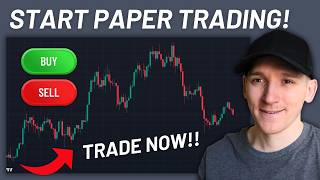

Practice Trading Without Risk
44sHigh educational value for beginners, showing how to practice trading with fake money, a common pain point.
▶ Play Clip"Delivers a solid beginner guide to paper trading, though the 'FAST & EASY' promise is slightly overstated."
This video is a beginner-friendly guide to paper trading, demonstrating how to practice trading without risking real money. The presenter walks through setting up demo accounts on platforms like TradingView and OKX, explains the difference between market and limit orders, and shows how to execute and close trades.
Paper trading allows practice in real environments without risking real money. Recommended platforms include TradingView (free) and major crypto exchanges offering demo trading.
TradingView provides $5,000 in paper money. OKX also offers demo trading with $5,000. Signing up may include deposit and trading bonuses.
Search for tickers like NVDA or TSLA. Ensure you trade on an exchange (e.g., Binance) rather than an index created by TradingView to simulate real trading.
Go to 'Trade' panel, select 'Paper Trading', and press 'Connect'. If the order box is missing, right-click the chart and 'Add order'. Dock the order panel to the right.
On each platform, choose a trading pair (e.g., BTC/USDT). The order screen is similar across platforms, requiring you to specify buy/sell, order type, amount, and price.
Market orders execute immediately at the best available price. Limit orders let you set a specific price; the order fills only if the market reaches that price.
The presenter demonstrates a market buy of 1 unit on TradingView and a buy on Binance using USDT. After execution, the trade appears in the trade history.
Positions show the asset owned, entry price, and unrealized P&L. You can close positions partially or fully via the 'Close position' button.
Closing a position means selling the asset back to the base currency of the trading pair (e.g., selling BTC for USDT). You can also trade into other pairs if you hold the asset.
Paper trading is an essential first step for beginners to learn trading mechanics without financial risk. By using demo accounts on platforms like TradingView and OKX, you can practice order types and position management safely.
What is paper trading?
Practicing trading in a simulated environment without risking real money.
00:01
Which platforms are recommended for paper trading?
TradingView, OKX, and Binance offer demo trading.
00:16
What is the difference between a market order and a limit order?
Market orders execute immediately at the best available price; limit orders execute only at a specified price or better.
03:01
How do you close a position in paper trading?
Click 'Close position' to sell the asset back to the base currency of the trading pair.
06:33
What is the purpose of choosing an exchange-based pair on TradingView?
To simulate real trading conditions, as opposed to using an index created by TradingView.
01:38
Risk-free practice
Emphasizes the core value of paper trading: learning without financial risk.
00:01Market vs. limit orders
Clearly explains the fundamental difference between order types, essential for beginners.
03:01Closing positions
Demonstrates the practical step of exiting a trade, a key skill for any trader.
06:33[00:01] can practice trading in real environments without putting any real money at risk. The platforms I recommend doing this on, the first one is recommend it. You can get great charting software. You can track the prices of
[00:16] I'll link all of the platforms I use below as well, so you can go and sign up. TradingView is free. Now, if you want to go into real brokerages or then all the major crypto platforms are going to give you paper or demo trading
[00:30] as well. You can sign up for these exchanges. You can get all of the prices that you need, and you can just use demo trading for free. So, for example, on trading, we'll click that. It gives you what
[00:43] looks to be a live environment, and you can see just uh with assets right here about $5,000 of paper money to trade with, as you can see right here. Something like OKX is exactly the same. You can go to demo trading, and again,
[00:58] you can just practice everything $5,000 of paper money to trade with. I'll leave You can get some deposit and trading bonuses on those as well if you sign up trading on them as well. Whichever platform that you're using, go ahead and
[01:11] on TradingView, that would be in the top left, and you can search for stocks or FX or anything else, right? You just search for the ticker. Nvidia, Tesla is TSLA, or you can search for the name, and it's going to bring up the asset
[01:25] Now, what you want to do on TradingView is make sure that when you're choosing an asset to trade, you trade it on an exchange. So, this is going to simulate exactly live trading, but without any real money. And so, if you're choosing
[01:38] where you're getting an index or like that's actually something TradingView create. That's not an exchange. So, you paper trading order orders because they're simulating real trading. And so,
[01:52] that's not an exchange. What you want to do is find an exchange to trade on, and exchange. So, something like Binance I can pick here. This is Bitcoin against up the trade panel. So, in the top right, it's TradingView here. So, trade
[02:06] and then you want to go to paper trading and press connect. It's going to bring some equity to trade with. Now, if you don't see this order box, just right-click on the chart and go to add order like this and it's going to bring
[02:19] window, so you can go to the drop down here and just press unlock or dock. then you can dock it to the right and that's docked as well. So, now we can every other platform as well. What you want to do is go to the top left of each
[02:35] of the screens and then you can choose a trading pair. So, for me I can trade anything USDT against all of these different assets and it's going to be So, choose the asset that you want to trade and then on the right-hand side
[02:48] the same, right? So, you'll have the area where you can input orders. I'll also show you entering your first order. So, the order screen on every platform is going to be exactly the same. It's the same information, right? You have to
[03:01] tell the trading system what you want to do. Do you want to buy or sell? And that's pretty much it. So, we're going to be a buyer cuz we haven't got to buy the asset. We can choose between market and limit
[03:14] order. Market order is where you choose the amount that you trade but not the price. And then limit order is where you choose the amount and the price that you trade at. Now, with a market order, you trade immediately because other people
[03:26] and what they're willing to trade at. So, we're if we're a buyer, we just take the best seller, whatever their price is and we trade immediately. If we're a seller, we'll just sell to the best buyer, right? Whoever's buying at the
[03:39] highest price, we sell to them immediately. With limit orders, price. Notice the price I can choose now. Whereas a market order, I can't do that. A limit order, we can then input the price that we're willing to trade
[03:52] at. So, let's say right here it says that the current buy price is 73,000 ish. I can say, "Well, I'm willing to trade at 68,000 per unit." And that's my order, and I can show that to the market. Well, if
[04:08] other people are paying 73,000, no one's going to trade with us at 68, just an instruction to the system where you put in a limit order and it says, "I'm willing to trade at 68,000." I show my order to everyone else. If there is
[04:22] price, then we'll go ahead and trade. If not, the order will be there, the trade. So, it's up to you what you want to use, you need to know exactly how to trade, you see me trading everything and
[04:35] detail. I'll leave some videos down below in the description that go through so you can watch those. I'll just open a sample order for you. So, we're going to done immediately. I'm going to trade one unit, so that's
[04:49] well, so if you want to do it by how many dollars you spend, but units is fine on TradingView. On other systems, it's just going to give you the dollar amount that you can trade. So, if we go to Binance, it's very easy, right? We
[05:02] have limit and market orders here. And we can choose an amount, so this is done in USDT, right? So, like a dollar stable coin, so you can say, you know, I want to spend this amount. You can just press buy like this. And it goes into the
[05:14] And you should see you have a trade history here of what you bought. If I go over to TradingView, it's exactly the same, right? So, order buy market order, trade, press buy. That goes through, and again, you have your order here. And
[05:27] information of the order, the price that you traded at, the amount that you traded at, and then your unrealized P&L, right? So, when you bought and the price now, are you making a profit or a loss based on what you traded. Now that we
[05:39] course hold them and wait for the prices to change and hopefully make a profit in well, either at a profit or a loss. So, you can come down to the positions that systems. It's going to show you what you own. It's going to show your P&L. And
[05:54] amount of it or sell the whole thing. So, in TradingView on the right-hand side, if you press the X button, that's basically closing the position, right? What this will do is close the total amount that you own. So, I bought one
[06:06] Bitcoin, I think it was, or an amount of whole position, which basically says, "You own X amount of this thing. Do you return to cash?" You can press that. Or
[06:19] choose the amount of the position that you have. If you have one unit, maybe something like that. So, you can do that. So, let's close the whole entire thing. Close position. It's just going to get out and return the cash to you.
[06:33] when it says close position, what it means is close out that that position in the way that you opened it. So, I'm trading Bitcoin US dollar here. So, when I'm saying close, what I'm saying is I bought Bitcoin with dollars. Closing
[06:47] because that's the trading pair that you're trading. It's the same on any amount. You can see on the right-hand side, I have less dollars, I have more BTC. So, I can sell any amount of the BTC that I own. Let's say we're going to
[07:02] we're selling. Selling BTC, but remember the trading pair that we're trading on Binance is Bitcoin USDT. So, I bought Bitcoin with USDT. I can sell Bitcoin back to USDT, and that's the trading pair that we're
[07:16] different trading pair, so let's say that I have Bitcoin, but I want to trade different stable coin or anything else, you can go ahead and find that trading pair. And because you've got the BTC, you can now sell that into all of the
[07:29] different trading pairs that supported like USDC, Brazilian reals, euros, etc. pair. Like I said, if you want a much more in-depth trading guide, I'll leave trading bonuses to the exchanges I use will be down in the description as well.
[07:43] watching and I'll see you in the next one.
⚡ Saved you 0h 07m reading this? Transcribe any YouTube video for free — no signup needed.