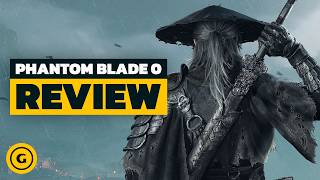

This combat feels like a martial arts movie!
44sHigh-energy opening with stunning combat description that hooks action game fans.
▶ Play Clip"Title delivers on its promise—combat dominates the review and is praised, but the story's issues are a real focus, making it a balanced take."
This review of Phantom Blade Zero focuses on its standout combat system, which draws inspiration from martial arts films and delivers a fluid, non-committal experience. The reviewer notes that while combat is exceptional in its best moments, the game faces criticism for its confusing narrative and uneven difficulty. Overall, it is still a fantastic game for action enthusiasts.
Soul, a stoic assassin, dies and is given a choice between two artificial hearts: one that strips emotions but lets him live, or one that preserves emotions but leaves him with 66 days. He chooses the latter, setting up a quest to find a cure and clear his name.
The narrative unfolds through background miniations, clandestine conversations, hidden notes, and secondhand H information. The game does a poor job of filling in the player, making it difficult to track who's who and what's what, even toward the end.
Combat is inspired by films like Hero and Crouching Tiger, Hidden Dragon, translating choreographed action into a playable medium. It's fluid, dynamic, and feels like a cinematic dance, with attacks requiring no commitment and allowing instant blocks or parries.
The Shi stamina system drains on blocks and heavy attacks, but successful parries deplete the opponent's Shi, breaking their guard. Blue and red flash attacks telegraph special moves requiring parries or dodges.
Weapon switching is key: it replenishes Shi and provides more combat options. Each weapon is unique, and the upgrade system allows refunding materials, encouraging experimentation.
Power Surges are weapon-specific techniques that cannot be canceled once initiated, adding strategic depth. Phantom Edges are secondary weapons with limited uses, ranging from axes to ranged weapons and a magic bell that summons puppets.
Boss battles are the game's highlight, where spectacle and cinematic action are at their peak. They are challenging and reflect From Software's influence, but they aren't overly punishing due to lenient checkpoints.
The game's style is described as 'kung fu punk,' mixing kung fu aesthetics with steampunk machinery and body modification. Levels are Soulslike with branching paths and shortcuts, though enemy respawning is absent.
Non-committal Combat Design
This design philosophy is antithetical to most action games and is central to the game's unique fluidity.
03:33Kung Fu Punk Style
Official term for the game's unique melding of kung fu with steampunk machinery.
08:35Shi Stamina System
Successful parries deplete the opponent's Shi, breaking their guard—a core risk-reward mechanic.
05:10Player-Lenient Checkpoints
Checkpoints don't respawn enemies, and boss phases don't retry after death—a notable departure from Soulslike norms.
10:07[00:04] Blade Zero, clearly understands that if your melee combat isn't tight, responsive, and oozing cool, then what's the point? Some games might have better combat, but few can match Phantom Blade Zero style. Every moment feels like
[00:19] you're in the middle of a Chinese martial arts movie, pulling off moves that go against what we expect from thirdp person action games, yet are baked into the mechanics. The game is not without issues, and they do hold it
[00:33] back from reaching the genre's upper echelons, but the highs are echelons, but the highs are stratospheric.
[00:45] known for telling riveting stories, and Phantom Blade Zero is no different. You play as Soul, a stoic assassin who dies in the game's opening moments. Soon after, a mysterious figure gives him a chance to come back from the dead,
[01:00] forcing him to choose between two artificial hearts. One will allow him to live, but strip away all of his emotions, while the other will let him retain those emotions, but only give him 66 days left on this mortal coil. Soul
[01:15] chooses the latter, setting up a 66-day quest to find a cure, unravel a conspiracy, and prove that he was framed for his master's murder.
[01:29] >> It's a fairly ridiculous opening, but one that doesn't reflect the rest of the game. Much of Phantom Blade Zero's narrative unfolds through background minations in clandestine conversations, hidden notes, and secondhand
[01:43] information. Multiple organizations, people, and malicious schemes are in play, but it doesn't do a particularly good job of filling you in. So, I found it tough to keep track of who's who and what's what. some aspects eventually
[01:57] come into sharper focus toward the end of the game. But this feels like too little too late. You're essentially dropped into an established world and together an understanding through the notes and loading screen tool tips. But
[02:11] even then, you'll still be in the dark for a good chunk of the game's dialogue. Repeating or explaining plot points during loading screens feels like a concession to its failures elsewhere, though, and ultimately I found it
[02:24] difficult to latch on to anything that would make me care about the story. Unsurprisingly, combat is Phantom Blade Zero's bread and butter. [snorts]
[02:37] played. Essentially translating the choreographed action films like Hero and Crouching Tiger Hidden Dragon to a playable medium. Fight scenes are known playable medium. Fight scenes are known to be incredibly fluid and dynamic. Half
[02:50] combat, half choreographed dance with both sides attacking and defending at the same time, creating a calculated but frenetic spectacle of clashing steel.
[03:06] replicate in video games without resorting to quicktime events, but Phantom Blade Zero still makes it look and feel like you're engaged in a cinematic, free flowing dance to the death. You have two light and heavy
[03:19] attacks at your disposal with combos alternating between the two. The key is that these attacks require no commitment. There's never a point where an attack begins and locks you into an animation until it ends. Switching to
[03:33] defense, either to block or parry, is instantaneous, even if you're mid combo. Some attacks will even deflect incoming strikes automatically, recreating [music] the back and forth simultaneous attack and defend action Woo is known
[03:46] for. The whole thing is antithetical [music] to the call and response philosophy of so many other action games, but it works when enemies test your abilities. Maybe because you've created an opening to counterattack or
[03:59] need to lock in and parry multiple strikes in quick succession, it is elsewhere. Most combat encounters achieve this satisfying flow through
[04:13] speed, aggression, and how combos and parries gracefully intersect. [music] Sure, you could sit back and wait for your opponent to attack, or you could rush in and deal damage while still watching for [music] their attack cues.
[04:25] Every action you take is fast and responsive, and even the biggest, heaviest weapons are swung at a rapid pace. Most of this fluidity comes from the game's excellent motion capture, which showcases each movement with the
[04:40] smoothness and intent you'd expect from seasoned martial artists. It's also complemented by an eclectic soundtrack that infuses the action with everything from Chinese rap, metal, and pop to somber piano pieces and electronic
[04:55] somber piano pieces and electronic beats. surface. Panache 2. These mechanics are more par for the course, but familiarity
[05:10] is important when trying something new. Shi, for instance, is Phantom Blade Zero's stamina system. The meter drains when you hold down the block button or perform heavy attacks, but successful parries will severely deplete your
[05:24] opponent's shi instead, gradually breaking their guard and leaving them vulnerable to a flurry of offense. Blue and red flash attacks also denote special telegraphed moves you need to either parry or dodge, with both
[05:39] tightening up the window for you to react. Failing to do so will eat into your health bar, but depleting your Shaqi meter also takes you out of action for a few seconds. To counteract this, switching weapons quickly replenishes
[05:53] your Shaqi, letting you maintain the initiative with a different arament. You can equip two primary weapons to alternate between, which not only helps you manage your shi, but also gives you more combat options when you consider
[06:06] how varied Phantom Blade Zero's plethora of swords, axes, and spears are. Each one feels unique when executing your standard light and heavy attacks, and they all have various intricacies that unlock as you level them up. For a good
[06:21] chunk of the game, I used a sword called the Outlaw Warblade. With this two-handed weapon, heavy attacks deal increased damage by eating into your health, which switching to standard attacks then restores. It can be a risky
[06:35] but effective weapon to use, but one I wasn't afraid to equip knowing I could quickly switch to another weapon. The weapons on offer are incredibly fun to use. They're flexible, too, with an upgrade system that lets you refund and
[06:49] recover the materials you've spent. So, you never feel locked into using a particular weapon just because you've spent time upgrading it. You're free to experiment and jump from one to the next, which is a more than welcome
[07:01] choice. Each weapon also has a secondary attack that breaks the non-committal rule. Landing heavy attacks builds Shachi essence, which you can then spend on weapon specific techniques called power surges. While some of these might
[07:16] enhance your offense for a short time, others unleash devastating combos that you can't cancel out of, forcing you to consider when the opportune time to utilize them is. The same is true of phantom edges, secondary weapons you can
[07:31] use a limited number of times before needing to replenish [music] their stock. These range from heavy axes that can break through shields and armor to ranged weapons, change sickles, flying guillotines, and a magic bell that can
[07:46] summon puppets to fight by your side. Both power surges and phantom edges add another layer to Phantom Blade Zero's flashy combat, upping the ante in desperate situations or providing that extra oomph you need to finish off a
[08:01] boss. Boss battles are where the game's combat truly sings. Where spectacle and cinematic action are pushed to the forefront with free flowing and thrilling mechanics to back it all up.
[08:16] It's no surprise that these conflicts represent Phantom Blade Zero at its most challenging. It might not be a Soulslike, but From Software's influence Soulslike, but From Software's influence is felt here.
[08:35] kung fu aesthetic and steampunk machinery and body modification, is all same. The studio calls this style kung fu punk, and it's an accurate descriptor, melding pagodas with industrial iron and billowing smoke.
[08:51] There's variety within this conceit, too. At one point, you traverse a once verdant forest that's now crimson, stained red after a brutal battle, as though the forest itself were weeping blood. Another area sees you using a
[09:05] steamowered boat to navigate a vast lake dotted with islands, while you also venture into a town whose denisens have been transformed into wooden puppets and a winding valley with waterfalls and cliffs overlooking its crystalclear
[09:21] cliffs overlooking its crystalclear streams. It's a strongly realized world, but the level design is distinctly soulslike with securitous areas full of branching paths and looping shortcuts. It's one of the strongest examples of
[09:36] this type of level design, making each local a treat to explore, though it doesn't always feel entirely necessary. Soulslike checkpoints let you replenish health and upgrade weapons and items, but crucially they don't respawn enemies
[09:52] as you would expect. It's an odd choice, especially since enemies stay dead even after you die. This changes the dynamic of enemy encounters, essentially letting you whittle down a group of enemies even if they get the better of you. This
[10:07] speaks to Phantom Blade Zero's overall leniency, though. Many of its boss battles contain multiple phases, but if you reach the second phase and die, you don't have to repeat the first. I'm a fan of this decision because if I've
[10:21] already demonstrated I can beat the first phase, forcing me to do so again can be frustrating. There are also three difficulty levels to choose from. You time, which is something I took advantage of to make some of the regular
[10:35] enemy encounters more interesting. This is Phantom Blade Zero's biggest flaw, as even on the hardest difficulty, it's too easy to simply button mash your way to victory against [music] most enemy types. Groups still gave me trouble on
[10:51] occasion, especially since switching lock-on targets in those instances is cumbersome, but as I mentioned earlier, taking out a few enemies is beneficial taking out a few enemies is beneficial even if you die.
[11:08] a lot, this might not be the same experience for everyone. Yet, the bosses still posed enough of a challenge that I had to bump the difficulty back down to medium, so it feels more like a wildly unbalanced swing than anything else.
[11:22] Under the right circumstances, Phantom Blade Zero's combat is spectacular. It nails the free flowing back and forth nature of its kinetic influences with a plum. Being able to cleave through dozens of enemies who barely put up a
[11:37] dozens of enemies who barely put up a fight isn't a fatal flaw, but tedium. And the fact you know how thrilling combat can be makes it a more glaring issue. It's this misstep that holds Phantom Blade Zero back, but it's still
[11:51] a fantastic game that any action afficionado should lap up.



⚡ Saved you 0h 12m reading this? Transcribe any YouTube video for free — no signup needed.