

Why Support & Resistance Fails
40sReveals the frustrating reality that even classic strategies fail, sparking curiosity about the hidden factor of financial management.
▶ Play Clip"Title accurately reflects the content: it explains why traders lose money and offers actionable advice."
This video explains why many traders fail in day trading, focusing on the importance of risk management and long-term strategy validation over short-term results. The speaker emphasizes that no strategy is 100% effective and that success comes from consistent application and proper risk control.
The difference between successful and unsuccessful traders is not the strategy but financial management. No strategy is 100% effective, and all strategies have periods of failure.
No operational strategy guarantees 100% accuracy or instant wealth. Backtesting past success does not ensure future results.
Support and resistance levels fail when supply exceeds demand. Buying at support does not always work because sellers may dominate.
Never fully trust a newly learned strategy or anyone claiming 90% accuracy. Such claims are rarely sustainable long-term.
The speaker uses a single validated strategy daily, relying on risk management (stop loss) to handle losses. Long-term validation is key.
A strategy must be tested for at least 30 days to three months to determine its long-term profitability. Short-term results are unreliable.
Many traders abandon a strategy after a few losses, leading to a cycle of failure. Stick with a strategy and use risk management.
Choose a simple strategy, understand entry triggers, apply risk management, and avoid excessive leverage initially. Slow and steady progress leads to success.
Success in trading requires a long-term mindset, consistent application of a validated strategy, and robust risk management. Avoid the trap of seeking perfect strategies or quick riches.
What is the main reason traders fail according to the video?
Lack of proper financial management and over-reliance on strategies without risk control.
00:21
Why do support and resistance levels sometimes fail?
When supply exceeds demand at that level, sellers overwhelm buyers, causing the level to break.
01:47
How long should a strategy be tested before evaluating its effectiveness?
At least 30 days to three months.
04:11
What is the recommended approach to leverage for beginners?
Avoid excessive leverage initially; focus on strategy and risk management first.
06:37
What does the speaker say about strategies with 90% accuracy claims?
Such claims are likely unsustainable in the long term and should not be trusted blindly.
02:30
Financial Management Over Strategy
Key insight that risk management is more important than the trading strategy itself.
00:21Supply and Demand at Support
Explains a fundamental market mechanism that causes strategy failures.
01:47Consistency and Risk Management
Practical technique of using a single validated strategy with stop losses.
03:00Long-Term Testing
Principle of evaluating strategies over months, not days.
04:11[00:09] Dude, have you ever noticed that some people manage to make money in the financial market and others don't? You know why? Have you seen that some people, for example, some traders out there, make money using classic support and resistance levels (
[00:21] LTLB)? And you, doing the same thing, can't get the same results. You know why? There's something called financial management that people often disregard. There's no technique or operational strategy that's 100% effective, and there
[00:37] 's also no operational strategy that 's completely bad. It's that thing they say, right? In the financial market, everything works and nothing works. So, support and assistance will work and it won't work;
[00:49] technical analysis will work and it won't work; tape reading analysis will work and it won't work at certain times. You need to understand that you wo n't find a type of operational strategy
[01:02] n't find a type of operational strategy that will give you 100% accuracy and from there you'll become rich overnight or in a month. Because when we enter the financial market, we find some types
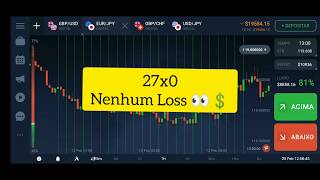
[01:15] of strategies, we even do some cataloging there, wow, it worked really well. I was cataloging the past of the chart and I had 30 x 0, so this strategy will work. And then... The other day you go
[01:30] to the market with that gigantic confidence. You put in that money you can't afford to lose because you made that previous extension on a put it into practice, it seems like nothing works.
[01:47] market will have buyers and sellers. Just as there are people interested in buying at support levels, there are people in Forex interested in selling at that situation. And if the market has more supply than
[02:01] demand, what will happen? The support level of that market will fall, and that's where I come in. But they told me to buy at support levels. Most people buy at support levels, and it works. When I enter, it seems like the market falls.
[02:16] Understand that the market will have its ups and downs, and when your strategy, which you think is a good strategy, starts to fail, you will start to test whether that strategy really works or not.
[02:30] Never put your trust in a strategy you just learned. strategy you just learned. Never believe 100% in someone who tells you, "Look, I have a strategy that is 90% of this activity." Okay, they said that
[02:45] at a certain point, but it's 90% of this activity in the long term, every month. They're going to guarantee it. This kind of assertiveness, man, I think it's very difficult. That's why there's assertiveness, man, I think it's very difficult. That's why there's
[03:00] That's why it exists. And that's the difference between people who make For example, I have a type of trading strategy that I apply every single day, even live, right? I don't change anything. We do
[03:15] day, even knowing that the market is dynamic. We try to use this strategy because it's validated in the long term, it has already shown me that it works in the long term, and we use this strategy no matter what. And if it fails, what do
[03:30] I do? I have risk management for that. I even put a risk management for that. I even put a I know that most of the time the market will respect my
[03:43] strategy. And since I have a slightly longer-term risk management strategy with a stop loss, I have the possibility of still being able to come out positive using that type of trading strategy. But eventually, it can happen that things are very bad, not
[03:56] trading strategy at all, and then I need to have risk management to protect myself in that type of from the moment you understand that you won't be able to dominate. In the market, you won't be able to dominate. In the market, you already have a step ahead.
[04:11] What you need is to work with the tools you have. Take a management strategy that you believe is very interesting for you, an operational strategy that you believe is good, and work with it no matter what, until the end of a month, for example, or the
[04:26] end of a year. You'll keep working because you can't measure whether this operational strategy, this management, is working in the long term. You can't measure that in a day or a week; you can't have data at your fingertips. You need to
[04:39] work with this same management strategy and this same operational strategy for a long time, at least 30 days, at least three months, to tell me if it's worthwhile or not. If it wasn't profitable for you, maybe you should consider implementing a new management strategy or a new
[04:55] operational strategy so that you can find your place in the market. What I see is that most people test something today, then start making money, and then it starts to fail, they lose everything, saying, "Damn, it's not working," and they stay in that cycle.
[05:10] Every time your operational strategy starts to fail, you already disbelieve in it, saying, "Damn, I'll test something else." Don't be faithful to what you believe. Put risk management on top of it. Test that strategy for at least
[05:24] three months to see if it's valid for you in the long term. If it proves to be effective for at least those first three months, very good strategy, a good management strategy you're using, that will make you money in the
[05:40] long run. Always think long-term; you don't have to be short-sighted. Even if you win today, you don't have to be short-sighted because that will cause you to fall off the horse and fall into the statistic that 90% of people
[05:54] good amount of money, but you don't know how to hold onto that profit precisely because you truly believe in something, some strategy, or some person, and you put all your chips on it without effective risk management.
[06:09] So, next time, this month, if you want to put it into practice now or next month, it's up to you, it's good that you think about what I'm Find a strategy, it can be the simplest one you find interesting, a
[06:24] strategy that will give you a good result, where you understand the entry points, the triggers, put a management strategy on top of that, and work with it. Don't try to leverage too much at this first moment because otherwise you'll fall.
[06:37] Leverage is very dangerous, especially for those who you need to meet with a trader, understand their operational strategy, and develop a good management plan. After that, you can think about using leverage.
[06:51] But let's not go too far, slowly but surely, so you can become a successful and profitable trader and survive in this very complicated market. Did you like this video?
[07:03] Leave a like and follow us on social media too! Every Monday I do a live stream trading my capital, where we exchange a lot of experiences. I hope you enjoyed this video.



⚡ Saved you 0h 07m reading this? Transcribe any YouTube video for free — no signup needed.