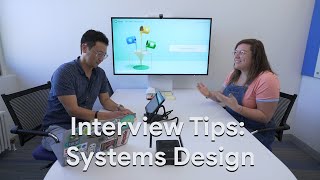

Google面试:沟通是关键
45s直接点出面试核心要求,吸引求职者关注沟通技巧的重要性。
▶ Play Clip"Title accurately reflects content: a direct guide to Google systems design interview preparation."
This video offers tips and advice for Google's systems design interview, emphasizing communication, scalability, trade-offs, and problem-solving. It outlines the interview structure, key areas of evaluation, and best practices for success.
No coding; strict time limit; first 20 minutes to gather requirements and propose a solution.
Explain your thought process, not just the final solution. Ask clarifying questions.
Design for global scale, high reliability, and efficient resource use. Problems are open-ended.
How to monitor system health? Identify bottlenecks? Define APIs? Serve global users?
Estimate latency, throughput, storage. Know costs of disk reads, memory reads, network round trips.
Know data sharding, redundancy types, write-ahead logs, data separation, metadata storage, load distribution.
Identify system flaws, discuss trade-offs (e.g., cost vs. latency), and justify decisions.
Explain your thinking, ask for clarifications, iterate on solutions, practice on whiteboard.
The video provides a comprehensive guide to Google's systems design interview, focusing on communication, scalability, quantitative analysis, and trade-offs. Preparation should include practicing on a whiteboard and thinking aloud.
What is the time limit for the Google systems design interview?
Strict time limit; first 20 minutes to gather requirements and propose a solution.
0:26
What should you do during the first 20 minutes of the interview?
Gather requirements and formulate an initial solution.
0:29
Why is communication important in the interview?
Because explaining your thought process is key; Google values collaboration and how you solve problems.
0:37
What kind of problems are given in the interview?
Open-ended, ambiguous problems that require asking clarifying questions.
1:22
Name three properties you should be prepared to estimate for system components.
Latency, throughput, and storage capacity.
2:33
What are some industry patterns you should know?
Data sharding, data redundancy types, write-ahead logs, data separation, metadata storage, and load distribution.
3:24
What is an example of a trade-off mentioned in the video?
Storing data on spinning disks to save cost at the expense of latency vs. using flash storage for faster retrieval at higher cost.
3:55
What should you do after coming up with an initial solution?
Think about how to improve it and discuss improvements with the interviewer.
4:47
Congratulations on the interview
Sets a positive and encouraging tone, making the viewer feel accomplished.
0:02Problems are intentionally ambiguous
Reveals a key insight: the interview mimics real-world ambiguity, testing problem-framing skills.
1:22Trade-off example: disk vs. flash storage
Concrete example of a common system design trade-off, making abstract advice tangible.
3:55[00:00] 你做到了
[00:02] 成功获得了谷歌现场面试的机会
[00:04] 祝贺你!
[00:05] 我和其他谷歌的同事
[00:07] 希望分享一些
[00:09] 在这个视频中,我们将讲到
[00:10] 沟通、设计大型数据应用
[00:13] 具体和定量的解决方案
[00:18] 以及整体最佳实践
[00:20] 在介绍面试的重点之前
[00:23] 有几点提示
[00:24] 这个面试中不会有编程环节
[00:26] 有严格的时间限制
[00:29] 我们希望你能在前20分钟内
[00:31] 归纳需求并制定初步的解决方案
[00:34] 请一定要合理利用时间
[00:37] 沟通在谷歌的日常工作中非常重要
[00:41] 因为这是我们开发和构建产品的关键流程
[00:45] 在面试时,你需要展现出这些品质
[00:48] 理解问题和设计解决方案
[00:51] 都是面试流程中的重要部分
[00:53] 我们希望你能说出自己的思考过程
[00:55] 而不是只看到最终的解决方案
[00:58] 我们希望知道你是如何
[01:00] 谷歌是个注重合作的地方
[01:01] 项目都是由不同的团队共同计划和执行
[01:04] 这些团队的使命就是协同合作
[01:06] 解决重要且往往不够明确的问题
[01:09] 那些问题通常有许多不同的解决方案
[01:12] 请告诉我们你计划如何解决这些问题
[01:14] 而且一定要问问题
[01:16] 记住,答案不是固定的
[01:19] 你在面试中需要解决的问题并不明确
[01:22] 我们是有意这样设计的
[01:23] 我们希望提出一些开放式的问题
[01:25] 因为现实中的问题往往
[01:28] 你需要通过提问理清问题
[01:31] 在谷歌,我们需要每天处理
[01:34] 并维护超大规模的计算系统
[01:35] 我们的应用服务于全球用户
[01:38] 确定解决方案仅仅是个开始
[01:41] 解决方案必须具有可扩展性
[01:44] 具有很高的可靠性
[01:47] 还应该能够高效利用我们的资源
[01:50] 在这个面试中,我们会评估
[01:51] 你设计大型数据应用的能力
[01:55] 你需要牢记于心的问题包括
[01:57] 如何判断系统是否在正常运行?
[01:59] 设计中是否存在瓶颈?
[02:01] 如果有多个组件,有哪些API?
[02:04] 它们如何协同运行?
[02:06] 如何为全球用户提供出色的服务?
[02:09] 一台机器就可以
[02:12] 早就一去不复返了
[02:14] 我们可能会给你一个大型数据集
[02:17] 要求你说明
[02:18] 如何在多个工作器之间
[02:21] 或者,我们可能会给出一个请求
[02:23] 你可以用众多机器中的任何一台来响应
[02:26] 但你需要确定速度最快的那台
[02:29] 放弃其他的
[02:30] 你还应该准备好
[02:33] 如延迟时间、吞吐量和存储容量
[02:37] 我们希望看到这些属性的估算数值
[02:39] 例如系统每秒能处理多少请求
[02:43] 你可能还需要清晰合理地说明
[02:44] 设计方案如何保证系统能实现这些属性
[02:49] 我们的系统影响着全球的用户
[02:52] 我们希望工程师能够以
[02:57] 所以在设计时,你一定要
[03:01] 你还要大致了解各种操作的
[03:06] 比如从磁盘读取数据、从内存读取数据
[03:10] 局域网往返和跨洲网络
[03:15] 在面试中,我们会提供白板
[03:18] 你可以使用白板
[03:22] 或绘制设计方案图
[03:24] 你应该知道行业解决方案的模式
[03:26] 例如数据分片、数据冗余的类型、预写式日志
[03:31] 数据分离和元数据存储
[03:33] 以及几种基本的负载分配方式
[03:38] 作为谷歌的系统设计师
[03:40] 你要学会权衡取舍
[03:43] 在面试中,我们会要求你
[03:47] 并阐明系统如何应对各种故障情况
[03:50] 我们希望你能列出
[03:54] 并解释你的理由
[03:55] 你是将数据存储在旋转磁盘上
[03:57] 以延迟时间增加为代价
[04:01] 还是把数据放在闪存盘上
[04:04] 用更高的成本换取更快的检索速度?
[04:07] 这些都是你面试时
[04:10] 我们希望系统设计师能够
[04:13] 选定一种,然后反复改进
[04:17] 了解了各项重点后
[04:20] 接下来介绍一些
[04:21] 适合面试当天的实用要点
[04:25] 我们希望了解你是如何思考的
[04:27] 因此在面试过程中
[04:30] 我们不仅会评估你的技术能力
[04:33] 还会评估你是如何解决问题的
[04:35] 很多问题都是故意设计成开放式的
[04:38] 就是想了解你解决技术问题的方式
[04:41] 我们欢迎应聘者要求我们做澄清解释
[04:43] 众所周知,第一个版本的
[04:47] 因此,你在想出一个问题答案后
[04:49] 要思考如何去改进它
[04:52] 并告诉面试官你的想法
[04:54] 最后,在草稿纸或白板上练习
[04:57] 在面试期间,你可能
[05:02] 以上就是我们针对谷歌
[05:07] 如果对即将参加的面试有任何疑问
[05:10] 欢迎随时联系招聘专员
[05:12] 我们非常乐于提供帮助
[05:13] 期待在不久的将来
[05:17] [为所有人而创造]
[05:18] [为所有人而设计]
[05:19] [为所有人而编程]
[05:21] [为所有人而打造]
⚡ Saved you 0h 05m reading this? Transcribe any YouTube video for free — no signup needed.