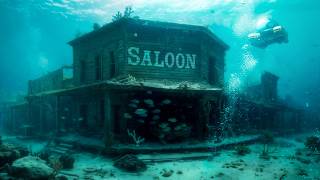

Underwater City of Gold?
45sThe opening hook of a lost underwater city and hidden treasure immediately grabs attention, promising adventure and mystery.
▶ Play Clip"Title promises an underwater city and treasure; video delivers a sunken boat, bridge, and plane, but the city remains elusive."
Mark Rober explores a 180-year-old underwater city submerged beneath a lake, using sonar and a submarine to find a sunken boat, a bridge, and a plane wreck, while embracing failure as part of the engineering process.
A 180-year-old city lies beneath 1.3 billion tons of water, built during the Gold Rush and submerged 70 years ago by a dam.
Mark aims to find the lost city using cutting-edge technology, including a sonar torpedo and a personal submarine.
A quarter-million-dollar wakeboard boat sank offshore; Mark uses it to calibrate equipment and successfully locates it.
The sonar torpedo works like echolocation, sending sound pulses and measuring return times to map underwater objects.
Mark uses a personal submarine to dive 63 feet and confirms the sunken boat, covered in silt after only a few days.
Two planes collided over the lake in 1965; one plane and its passengers vanished into the lake, never found.
Freshwater is less dense, requiring more air to float, limiting the sub to only four ascents and descents.
The boat's motor dies, but a replacement boat with a water slide arrives, turning the situation around.
Sonar reveals an underwater bridge, indicating the lost city is nearby.
The lake is an underwater forest; submerged trees pose a risk of snagging the sub and trapping it.
The sub contacts the bridge structure, but it's a safe landing on a guardrail.
The sonar mesh of the bridge aligns with a photo taken during a drought, confirming accuracy.
Sonar detects a man-made object that could be the missing 1965 plane at 220 feet deep.
Despite scanning the expected location, the city is not found; later research reveals a fire destroyed all buildings, leaving only foundations.
With only one dive left, Mark attempts to reach the plane but a hatch leak forces abort.
A remote-operated vehicle (ROV) is used as a backup to explore the plane wreck.
The ROV locates a propeller, confirming a plane wreck.
The wreck is identified as an LA-4-180 amphibious plane that sank in 1986, not the 1965 plane; all occupants survived.
Despite not finding the lost city, Mark discovers a sunken boat, a bridge, and a plane wreck, learning that failure is part of the engineering process and that the lake still holds one final secret.
What event caused the valley to be submerged?
A dam was built to stop floods, creating a lake that submerged the valley.
01:41
How does the sonar torpedo work?
It sends sound pulses (echolocation) and measures the time for echoes to return, generating a map of underwater objects.
03:13
Why does the submarine have fewer dives in freshwater than saltwater?
Freshwater is less dense, so the sub needs more air to float, limiting it to four ascents and descents.
07:02
What happened to the buildings of the lost city?
A massive fire destroyed all the buildings, leaving only foundations.
15:26
What plane was actually found at the bottom of the lake?
An LA-4-180 amphibious plane that sank in 1986.
19:58
How many people were on the plane that vanished in 1965?
Four people.
06:20
What was the name of the first millionaire in California mentioned?
Samuel Brannan.
01:28
First Submarine Dive Excitement
Mark's childlike joy and the iconic 'I'm the king of the world!' moment capture the thrill of exploration.
04:18Water Slide Rescue
After a boat motor failure, a replacement boat with a water slide turns a setback into a fun, unexpected twist.
08:50Accidental Plane Discovery
While searching for the city, the team stumbles upon a potential plane wreck, adding a new mystery.
13:12[00:00] Somewhere underneath the 1.3 billion tons of water behind me is the 180-year-old underwater city. This city built on the dreams of thousands of people looking to discover gold on hotels, churches, stagecoaches, and even their cemeteries.
[00:15] But all that vanished 70 years ago when rising water swallowed the entire valley. And today we came out here with some cutting-edge technology because I knew if we could locate the city, we might find some buried treasure. What I didn't know, in the process, we would absolutely stumble upon some discoveries.
[00:32] What is that? We're way more incredible. Oh my gosh, I'm the king of the world! I'm about to go hop on a boat to attempt something, to make a video I've been wanting to make for over six years.
[00:45] There's just something about exploring the unknown. Like, even at NASA when I worked there, we were exploring the unknown since it was a four-year-old. But I'm here on Earth. You've got this lake with thousands of boaters on the surface, totally oblivious,
[00:59] and hidden secrets lurking just hundreds of feet below them. And this lake in particular, I've got a feeling, has some really juicy secrets. And that's because on a cool March morning in 1848, a guy named William Sidney and his two buddies were hunting along the American River.
[01:13] But instead of bagging a deer, they discovered something a heck of a lot shinier, bringing back the largest pile of gold since the start of the California Gold Rush only a few weeks earlier. When we're spread about the discovery, nearly 7,000 people moved into the valley, hoping to strike it rich.
[01:28] And indeed, this did create California's first millionaire, Samuel Brannon. So rather than mining any gold himself, he just sold pickaxes to everyone looking for gold. Now all this hype created bustling towns, with seven saloons, a post office, even dance halls.
[01:41] But when the gold was mostly gone after decades of mining, and deadly floods kept sweeping through this valley out to Sacramento, a dam was built right here to stop all those floods, creating a new lake, stealing away this ghostly time capsule somewhere under all this water.
[01:55] And since I love nothing more than a good scooby-doo mystery and cutting-edge tech, I headed out to the lake to see what submerged secrets we could reveal. As we could have it, a few days before my planned trip, I saw this clip of a quarter-million-dollar wakeboard boat sinking just offshore.
[02:12] So I decided that would be as good a spot as any to kick things off and calibrate our other water stand defencers. We've got to make our way to the approximate location We dropped in our scanning torpedo Get some fog in the water
[02:25] Okay, we're in Let's go And nothing happened Let's hand transmit on But there's nothing the group of engineers want more than the problem it needs to do fixed
[02:37] Let's check those connections The antennas are hooked up to the box, right? What about this one? It's after another 30 minutes of intense troubleshooting What's the connection that's missing? We should have everything We just turned the dump thing off and on again.
[02:49] Oh. Oh wait, now I'm getting response. And then of course, got our first hit. We got a signal! Since we already knew the boat's approximate location, after just a few minutes of scanning, guys, we hit jackpot. We got something here. You got something?
[03:01] I see the boat. You think it could be that ski boat? Could be. Is it a big shadow? Oh! Oh, baby! This could be the boat! We might have found her! This is Todd, by the way. And he not only has a doctorate in geohydrology,
[03:13] but this is his scanning torpedo. And the trick now at worst, is sort of like when you're on a cliff and you yell and then wait to hear your echo. If it takes a short time to hear your echo bounce back, you know the other side of the canyon is closed. And if it takes a long time, you know it's hard.
[03:26] Well, the cabito is just traveling through the water, yelling echo a bunch of times every second. But since it has really sensitive ears, it can tell exactly how long it takes to hear the echo back, and from that, it can generate a map of everything that's below the water,
[03:40] even in pitch-black darkness. This, by the way, is also how our Crunch Lab's hashtag balance spot named Bobo If you can build yourself by the way Knows when it's too close to a wall This proximity sensor is the part Intrasonically yelling and listening to the echo
[03:53] How deep is the water here? 63 feet, that's gotta be it So you're saying there's a chance There's a chance It might be the boat It might be the boat I feel like such an adventure So now that we located the sunken boat I wanted to see it for myself
[04:05] That's good enough for me, let's fix this up And the coolest way possible to do that Is in your own personal submarine But not just any personal submarine Because this is the exact sub A few years back in the Bahamas when I first discovered my love of shock.
[04:18] Oh, my God! Oh, my God! Oh, my God! I only hope that this time, it gives you a shock. Let's go! Come on down. No sharks in this lake, huh? Not that I know of. Go find the boat.
[04:30] Oxygen is flowing. That's good. Ah, here we go. Hot as hell. Sorry for being so hot. You thought it was hot outside? And Julie, my son, I'm sure I see you. It's so hot. I'm sorry.
[04:42] My life's sports systems are on and running, and I am ready to dive. Let's go see what the heck's down there. So you're the co-pilot.
[04:54] If you see something you don't like, tell me if it looks weird. I need to know. See the vertical line on that thing? You should keep your eyes focused right on it if you could ask. Okay, and there's one. You on it? Yeah, yeah, I see it.
[05:06] There you are All right Show me anything down to see if I see the boat Sure enough just as the sonar torpedo predicted I see it You see it We found a ski boat Oh no way
[05:18] We're going to crash again. Boom. That just snuck up on us. Holy cow. That's a sunken ship. Top five, we're at the boat.
[05:30] And a quick check of the registration number confirmed this was the exact boat that sank a few days earlier. That is an expensive boat. And these were the exact oranges that sank a few days earlier. So this thing is chilling right on the bottom of the lake.
[05:44] Oh, a little fishy. We're swimming with the fish and the boat. Yeah. Oh, those are super sea boats, isn't it? Yeah. You wonder how it's such. This is like the Lake Titanic. Oh, hold on.
[05:56] I just felt something. We hit the ground. Yeah, we're bottom down. You can actually see the bottom. Oh, yeah. Without thrusting down the whole thing. We're just cheering on the bottom of the lake bed now, right next to this sunken boat.
[06:08] And as you can see, after doing underwater only a few days, the boat was absolutely covered in silk. And that's the main reason this lake is so good at keeping her secret. The low visibility means things are really hard to find.
[06:20] For example, on January 1st, 1965, two planes collided above the lake, killing four people. And while one plane somehow linked its way to an emergency landing at a nearby airport, The other plane and its passengers plummeted into the lake, never to be seen again.
[06:35] Well, we've already found one such involved. Now we just gotta find the lost city. Stop trying. No man's requesting permission to come up. No man, you're clear to surface. Copy, clear to surface. Here we go, what? I see the surface.
[06:50] This is what uses our air, is every time we go up once in place. How much air do we have to breathe? Breathing time's easy. Boasting time, we don't have a lot of. water, we technically have four assets and descents.
[07:02] Really? Now this was news to me, but it turns out you actually have to calibrate a sub differently for freshwater versus saltwater. Because saltwater is more dense, making the sub naturally more poignant. But in freshwater,
[07:14] that's to utilize more air to make you float to get you back to the surface. And that means fewer up and down dives before you're out of air. Unfortunately for us, that means we've only got a few dives left on our mission to find
[07:26] an underwater city. As troubling as this revelation was, the good news is found a boat. It's a modern day ship hunter. Now that we should find stuff with the torpedo sub-combination, we put the scanner back in the water to find our sunken city.
[07:39] I'm the king of the land! Now, it turns out there's a few differences between treasure hunting and treasure finding.
[07:58] Anything? Nothing yet. Because treasure finding is really exciting. But treasure hunting? Anything? Now, especially when you're hunting through 30,000 acres of mushy water. God! Nada. That's a really, really boring. The new hunting for underwater cities was so boring.
[08:12] And my intentions must have incurred the wrath of the Trigger Hunting Dogs, because something not boring finally happened. Where did you get your bad luck Q-J's, man? Why, what happened? Oh, we have a dead motor. Are you kidding me? No, not.
[08:24] Did you get the battery? No. Like locked in gear, which means I can't start it. Oh, oh, there you are. Alright, let's see what happens. Let's dive. Alright, let's hook up a tow line.
[08:38] It was time for reinforcements, because to the bad news, this boat was dead. But for the good news, the replacement boat was rocking a party deck and dual-action water slide. Let's go! Woo! Woo!
[08:50] Woo! The spectrature ending was suddenly... Woo-hoo! ...amorified. If anyone was wondering, now, I do my own stuff. Woo!
[09:02] Every shot! God! You got anything, Todd? And my decision paid off. Anything? Because we finally got some good news.
[09:14] Hey, Mark, I think we found something. We got something. All right, check it out. There it is. Boom. No way. We had discovered an underwater bridge. Yeah, you can see the bridge support structures where it would have turned into the old roadway.
[09:29] Now, the bridge looks warped in these pictures, But that's actually because the scanning torpedo only sends those echoes off to the side. So directly below, you'll always have a blind spot. If the blind spot was right in the center of the bridge, that could only mean one thing.
[09:43] That's right below us right now. Yep, that's it. I think it's time to hob in this sub. The meaning was, if you found the bridge, you would find the lost city. Room for one more? Welcome aboard. I got the hack. So I was all in on using our second dive to find it.
[09:56] Let's find the bridge. But the captain was having some worries. This is murky water. Yes it is. And the language we've really got across how dire the situation was. Ah, trees, yeah.
[10:09] Me not like these trees. But it turns out, trees were a pretty big worry here. Because again, this wasn't an ordinary lake. It's more of an underwater forest. Which means if for someone to get snagged in the branches of one of these underwater trees we could get trapped with no way to make it back to the surface while our air just runs out So with trees on the mind we cut off on our third to last stop
[10:30] Whoa. And it starts to get dry. We're trying to get clear water. You actually want steam to eat. Then I saw how working things got as we just went down. It was hard to stay nervous when the colors were changing so publicly around.
[10:44] Let's go. We're right on the edge of it, Mark. You got all lights on there, we can't even see anything. Wow, this is so surreal. Looks like we're on a green screen.
[10:57] I need all eyes. I'm looking straight now. Straight down? Looks everywhere. I was laser focused, even if I couldn't even tell if we were moving at all. Are you hovering or are you going down? Oh, no, we're still going down. And I'm pretty sure the coast was clear beneath us.
[11:10] Oh, until I wasn't. Because the sub hit something, and I just hoped it wasn't what I thought it was. We had contact. I got you. Stand by. And I don't want to give too much away, but a recurring theme of this video is failure and overcoming failure.
[11:26] And that's a skill study show that can be taught. And that's why I created Crunch Labs, because toys that are too simple are boring, and toys that are too hard are frustrating. But some toys, like all the ones we build here at Crunch Labs, are the perfect balance of challenging and super fun.
[11:44] The best part is they come every month right to your porch, and we build them together with an exclusive video where you get to learn the incredible real-world science that makes them work. With the holidays coming up, if you want the perfect gift to give or receive, go to crunchlabs.com or use the link in the video description where to say thank you, we're giving away two free boxes as a holiday special.
[12:06] Now back in the sub, we've hit rock bottom. Like, what do you do, go straight up? We appear to be on a bridge-beam flex. which was actually no way the best case scenario.
[12:19] We're literally on an underwater bridge right now that's sunk and lost to the world. Cards can no longer drive on this bridge, but in the submarines, we're like cruising along. We're literally on a guardrail right now.
[12:31] Visibility is really low, so it's kind of precarious, but we're getting closer to the city. Down in the sub, visibility was once again pretty low because of all the sediment in the water. But we were still able to perform some up-close scans of the structure,
[12:44] and when we combined that with the mesh from the scanning torpedo, we came up with a predicted bridge structure that looked something like this. And later on, after doing some further research, we discovered an actual picture of the bridge from when the lake water had receded from a bad drought a while back.
[12:58] And as you can see here, we were pretty much spot on. Since the bridge was slicing life to the underwater city, we knew we were closing in on the target. But after returning our orthostractor scanning, we stumbled across something completely unexpected.
[13:12] Oh, look at that. Wait, is that a plane? I think it could be. You can see the height, because look at the shadow cap. There's two shadows here that are sticking up high. One can be the tail, and one can be the motor. Look how different it looks than the rocks, right?
[13:26] These look really natural. That looks very man-made. Looks to me like this is perhaps part of a wing. No way. Yeah, that's what it looks like. What was really interesting about this discovery is if you recall from earlier, there was that plane that vanished into the lake 60 years ago with four people on board.
[13:42] And even though their family tried for years to find them, parts of the humidity stream were seen as the water, and were never to be seen again. You're telling me we might have just accidentally discovered a wrecked plane on the bottom of this lake?
[13:54] Yes. What? Does that happen? It happened today. We've got to go check it out. How deep is that? Uh, this is about 220 feet. Wow. That trap will be our deepest guide yet, and since we only had two guys left,
[14:06] We decided to continue on looking for the lost city, figuring that once we found it, if we had a dive to spare, we'd have ourselves a bonus airplane. And our positions paid off, because not long after, we got new scans back from the location and store records indicate the city would most likely be.
[14:20] So it was back to the subs to take our second to last dive straight into the city. Stop, side. We're going down. I feel like I want to put my seatbelt on. The first, I was just excited to get my eyes on the city.
[14:34] Are your lights on? That's it. But soon enough, as we ascended deeper and deeper, and the glass in front of me stayed just as empty, I started to get worried about whether or not I'd even find the city.
[14:47] Freaking terrible, isn't it? Yeah. We're running out of time. Yeah. Yeah. We were right where the town was supposed to be, but after searching as hard as we could...
[15:00] Fine, I'm done. We're coming up. We're finished down here. We came up empty-handed. Now what we were hoping to see would be something similar to this,
[15:14] based off first-hand descriptions of the town and some historical photos from the time, where you'd see one of the four saloons with a piano still inside, a general store with some pickaxes from Samuel Brannan, California's first millionaire,
[15:26] but instead what this can reveal which is the foundations of the building that looks like this because it turns out there was a massive fire that went through the entire town destroying all of the buildings which was a super critical mystery piece of information and in hindsight would have saved me a lot of time and money
[15:43] While our hopes of finding a super cool town were officially dashed, we still had that plane scan, giving us a glimmer of hope of not leaving the lake with just a bridge and a ski boat. Though the challenge was, it was in the deepest part of the lake, which made me pretty nervous,
[15:55] though we only had enough air for one more die. I'm sorry, my safety briefing is complete. My life support systems are on and running and I am ready to dive. Stay today. Catch, switch. Alright, here we go.
[16:07] Let's go see what the heck's down there. And so with the dive underway, I was really hopeful we were about to hold the book on a 60 year old mystery giving the families the closure they deserve. And while keeping a lookout for something cool, I saw something that definitely wasn't.
[16:23] It's okay that water is slipping down? Yeah, just water, don't worry about it. Just water, don't worry about it. Put it over here. I kept my eyes open and hoped the captain was right, and that this was completely normal.
[16:37] Can we just need some pressure on that hatch? Get that dynamic. Alright, I trust you, captain. Water... Literally. More water dripping down, but that's supposed to happen, right?
[16:49] Yeah, sure. And if we go deeper, it was clear something was very, very wrong. I'm not very good. This is the home stretch, but as long as we find the plane, the whole trip would be worth it.
[17:07] Alright, we're going up. Topside, we have a severe hatchery. Not certain why, though. That was not a little dribble.
[17:19] That was a freaking waterfall. This is a failed dive. Now the best part about being an engineer is you know failure is part of the process. In fact, you always embrace it because it forces you to repeat your approach and come back with something even better.
[17:36] You develop your willingness. It means you can always find a backup plan. And I'm happy to report that today was no exception. Because this was my secret weapon of last resort. It's actually an underwater remote controlled robot.
[17:48] The Diver can visit the plane for me, capturing cans and sending back a live video feed in the process. So while I wouldn't be seeing the plane with my own two eyes, a friendly robot was gonna lend me hers. So the sub out of commission and the robot in the water, our underwater expedition all came down to this.
[18:05] I know our chances of success were extremely slim in these super murky waters, in part because there were no backup plans for me. Oh, yeah, yeah. This would be our last chance.
[18:20] That's good. And how far away are we, you think? I would say maybe 20 feet. What is that? Are you kidding me? It's the propeller!
[18:32] The craft still is past. It's really no way. Yeah, look how lucky that's insane. As a reminder, the reason this lake holds so many secrets secrets because the visibility is so poor. But thankfully, we had a workaround. Just like with
[18:47] the bridge, our plan was to scan the plane section by section and then once we got back home, we'd piece those scans together to see what we'd actually found. So as far as today was concerned, we'd done everything we could and I felt really good about our efforts. Then at this point,
[19:00] after packing up and heading home, all we'd have to do was wait. And we didn't have to wait long. Okay, we've identified the plane. Just got word, there's an email in my inbox.
[19:14] It's a video that stitches together all the pieces of the plane we found, and I do not want to wait till tomorrow to view it, so I'm doing it now. The plane we're looking for that was locked 60 years ago is this HyperConanche 250.
[19:29] Here's my hand now. Let's go. Dang it.
[19:46] What? Doesn't look like this. It's close. What did we find then? And as it turns out, after doing some additional research, this is an LA-4-180,
[19:58] which matches perfectly with the reports of this exact model of water plane sinking here in 1986. And fortunately in that case, everyone made it out safely before it went down. And honestly, this felt like a win to me, because after powering through all the challenges the lake had thrown at us,
[20:14] I still got to make some pretty remarkable personal discoveries, and the lake got to keep her one final secret. At least for now. Working out to embrace failure as the quickest way of figuring something out is what it means to think like an engineer.
[20:28] If you want to strengthen that resilience muscle while having a ton of fun along the way, then CrankSubs.com and you can make a new description where we're currently giving away two free boxes and a new subscriber special.


⚡ Saved you 0h 20m reading this? Transcribe any YouTube video for free — no signup needed.