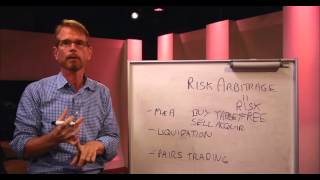

What is Risk Arbitrage? (No Risk? Think Again)
46sClarifies the difference between pure and risk arbitrage, appealing to viewers curious about hedge fund strategies.
▶ Play Clip"Title accurately describes the content; the video delivers a clear explanation of risk arbitrage strategies."
Risk arbitrage is a strategy that involves buying and selling correlated but not identical assets, unlike pure arbitrage which is riskless. This video from the NY Institute of Finance explains three common equity risk arbitrage strategies used by hedge funds and investors.
Risk arbitrage involves buying and selling two correlated but not identical assets, unlike risk-free pure arbitrage.
Risk arbitrage is used in equities, fixed income, swaps, options, and foreign exchange.
Buy the target company's stock and sell the acquirer's stock, profiting if the target rises or acquirer falls.
Buy stock to gain control and force liquidation of the company, either by selling assets or the whole company.
Buy and sell two stocks in the same industry, buying the undervalued and selling the overvalued.
Risk arbitrage strategies like M&A arbitrage, liquidation, and pairs trading allow investors to profit from market inefficiencies, but they carry risk if the expected event (e.g., acquisition) fails.
What is risk arbitrage?
A strategy involving buying and selling two correlated but not identical assets.
00:04
How does M&A arbitrage profit?
By buying the target stock (hoping it rises) and selling the acquirer stock (hoping it falls).
00:50
What is the liquidation strategy?
Buying stock to gain control and force liquidation of the company.
02:23
What is pairs trading?
Buying an undervalued stock and selling an overvalued stock in the same industry.
03:20
What risk does M&A arbitrage face?
The acquirer may back out, causing the target stock to fall and acquirer stock to return to previous levels.
02:08
Risk Arbitrage Definition
Clearly distinguishes risk arbitrage from pure arbitrage.
00:04M&A Arbitrage Mechanics
Explains dual profit potential from target and acquirer stocks.
00:50Pairs Trading Popularity
Identified as the most common type of risk arbitrage.
03:20[00:04] risk Arbitrage is related to Pure Arbitrage but unlike pure Arbitrage which is riskless or
[00:21] Arbitrage involves the buying and selling of two assets that have a correlation between each other but are not the same asset as you would have in a risk-free Arbitrage risk Arbitrage is a strategy
[00:36] Arbitrage risk Arbitrage is a strategy used by hedge funds and other investors in almost every Financial product category including equities fixed income category including equities fixed income swaps options and foreign exchange we're
[00:50] going to look at three strategies that are used in equity risk Arbitrage the first is mergers and Acquisitions Arbitrage which is where you
[01:03] Arbitrage which is where you buy the stock of the company that is the target the company that's going to be acquired so you buy the
[01:19] Target and then you sell the because two reasons you will make more money if the acquirer
[01:35] is forced to pay a higher price for the Target so in many cases where another bidder enters into a takeover the original acquir is forced to raise their bid so this is why you buy the Target stock the other way to
[01:52] profit is because generally when a company acquires another company it's paying too high a price and the value of it stock tends to go down so you're able to profit doubly from potentially the Target stock going up in price and the
[02:08] Target stock going up in price and the acquir stock going down in price this acquir stock going down in price this strategy Works fairly well unless the acquirer decides to back out and abandon the acquisition in which case the Target
[02:23] stock price would go down and the acquirer stock price would return to its previous level second strategy that we're going to look at is called a liquidation strategy this is not quite an Arbitrage
[02:39] in the sense of buying one security and selling another but it is just selling another but it is just buying stock once again and the thing that you're selling is potentially the entire qu company
[02:54] you're hoping that the company will be liquidated so you're buying the stock trying to get control of the company in the hopes that you can gain control
[03:06] Force out the existing management and then liquidate the company either by liquidating the individual assets of the company or by selling the whole company or by selling the whole company to another uh
[03:20] acquirer last strategy we're going to look at is pairs trading which is the most common type of risk Arbitrage and it involves just buying and selling two stocks that are in the same industry so they have a high correlation because
[03:36] they're in the same industry and you try to pick two stocks of more or less the same size company in the same industry and your objective here is [Music] buy the undervalued
[03:58] company and then sell the overvalued profitable if you are able to effectively be smarter than the market
[04:12] be able to say that the market is overpricing the company that you want to sell and it's underpricing the company that you want to
⚡ Saved you 0h 04m reading this? Transcribe any YouTube video for free — no signup needed.