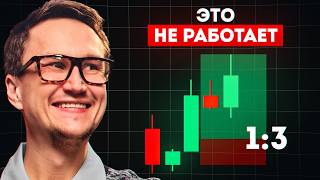

Risk Management: Everyone Knows It, Everyone Ignores It
45sThe brutal self-awareness moment about knowing risk management but not using it is immediately relatable to any trader or investor.
▶ Play Clip"Meme title aside, this actually delivers a genuinely useful risk management masterclass; a bit heavy on self-promotion and repetition."
This video is a beginner-focused risk management lesson from trader Artem Zvezdin. It explains why most traders ignore risk control, quantifies the true cost of losses with recovery math, and shows how professionals size positions using simple formulas and trading limits.
Risk management is universally acknowledged but rarely applied. The small 1-2% people think they are 'saving' by skipping it can ultimately lead to huge losses.
People are drawn to cinematic trading stories: office traders crying over charts or beach traders making millions with one click. But real professionals talk about boring risk management, not glory.
You can do every analysis correctly and still lose because new information constantly changes the market. Events like a falling rocket can drag prices down instantly, making risk control essential.
If you trade without stops, you must not use leverage. Build a diversified portfolio of stocks, bonds, and currencies, buy dozens of instruments, and rebalance every 3-4 months by selling winners and buying losers.
All genuinely rich people became rich slowly. The 'one-click millionaire' stories usually end with the person giving everything back and starting over. There is no shortcut.
A 10% loss requires an 11% gain to recover; a 25% loss requires 33%; a 50% loss requires 100%. This is why avoiding big drawdowns is more important than chasing returns.
Two traders using the same strategy had different outcomes: Trader A risking 5% per trade lost about 26% over a losing streak, while Trader B risking 2% lost about 11%.
Consistent losing streaks happen; the speaker has seen up to 40 consecutive stop losses. A 5% risk per trade is fatal in such conditions.
Long-term professional traders typically risk about 0.5% per trade. On a $100 account, that means a maximum loss of 50 cents per trade.
Position volume = allowed loss ÷ (step cost × stop distance). Example: with a 1-cent step cost, a 5-cent stop distance, and a 50-cent allowed loss, the position size is 10 units.
On a 100,000-ruble deposit, risking 0.5% (500 rubles), with share price at 10.25 rubles, stop at 8.26 rubles, and take profit at 16.25 rubles, a calculator gives a volume of 251 shares.
If the market is going against you and 'today is not your day', simply stop trading for the day. There are many other instruments to trade.
Close all positions before the session ends (18:45/00:00), take no more than 3-5 trades per day, and if you lose 10-20% of capital in a week or month, close everything and go to virtual trading.
After a profitable week, increase trading volume by 10%; after a losing week, reduce volume by 10%. This compounds gains in good phases and automatically trims losses in bad ones.
These principles are known, but traders lose because of emotional spirals and negative psychological states, not because the information is secret. Breaking the spiral is extremely difficult.
Focusing attention on breathing brings you back to the present moment and stabilizes your emotional state, helping traders avoid impulsive revenge trades.
The goal is a steady equity curve, not a 'wow' effect. Lasting wealth only comes from slow, disciplined compounding.
Wealth in trading is built slowly and preserved by boring, disciplined risk management; the key is to avoid big losses, follow strict limits, and keep your emotions in check.
If you lose 10% of your account, what gain is required to get back to breakeven?
11%
06:24
What gain is required to recover from a 50% account loss?
100% (you must double the account).
06:55
In the comparison, how much did Trader A (5% risk per trade) lose over the losing streak, including commissions?
About 26%, while Trader B (2% risk) lost about 11%.
08:05
What risk per trade do long-term professional traders typically use?
Around 0.5% per trade.
09:20
What is the formula for calculating position volume?
Position volume = allowed loss ÷ (step cost × stop distance).
10:45
What are Artem Zvezdin's intraday trading limits?
Close all trades before the session ends, take max 3-5 trades per day, and if you lose 10-20% in a week or month, stop and go to virtual trading.
14:48
How should you change your trading volume after a losing week?
Reduce it by 10%.
16:52
Why do traders keep losing even when they know risk management principles?
Because of emotional spirals and negative psychological states, not a lack of knowledge.
17:20
Loss recovery math
Quantifies why drawdowns are deadly: a 50% loss requires a 100% gain to break even.
06:24Professionals risk 0.5% per trade
Reveals the real-world risk per trade used by long-term professional traders, far below textbook advice.
09:20Hard trading limits
Gives concrete daily, weekly, and monthly rules that prevent a negative spiral from wiping out an account.
14:48Weekly volume adjustment rule
A simple adaptive position-sizing rule that compounds winning streaks and automatically trims losses.
16:10Breathing meditation for traders
Offers a practical psychological tool to break emotional trading states.
18:16[00:02] Risk management is something that everyone knows, but everyone finds boring, everyone ignores it, and then wonders why they keep losing, over and over again. Today I'll show you how this works using numbers and tell you that the 1-2%
[00:19] you seem to be saving on can ultimately lead to a huge loss of money. You are on Artem Zvezdin's channel. Here is my yield chart. Let's go. If you ask absolutely any trader what
[00:33] risk management is, whether he knows anything about risk management, he will say: "Yes." And if later you ask: "Do you use it?" He will be silent, look down a little and say that most likely not. Because knowing and applying are two completely
[00:47] different things. And that's why absolutely all of us, without exception, were taught to perceive trading in this way. That is, we judge a profession based on the pictures
[00:59] we can see somewhere on the Internet. This is either trading in the office, where, as you can see, it is quite complicated, there are a huge number of charts. serious business. By the way, many of them, as you can see, have napkins here, but apparently they
[01:13] cry during the trading session. The other side of the issue is these pictures, where a trader sits on the beach or somewhere in the mountains, looks at the charts, life is good, presses a button and makes
[01:27] millions. Yes, he gets a huge amount of money. And if you've watched podcasts with traders, then each one has a story about how, without having any money in their pocket, they came to the market, pressed a button and made a huge fortune
[01:41] . And not because people lie. No, that's how it was for many people, because we No, that's how it was for many people, because we all want to get cinematic stories. We all want to hear these stories. We are all drawn to those moments when a person, without any
[01:54] connection, no money, nothing, came to the market, pressed a button and made a million. So, if you ask any competent trader, including those guys who say they had nothing there before and then got a
[02:09] lot, they will all tell you boring things. They will all tell you about risk management, about absolutely boring things, and they will talk about it as if this is the right way to trade. The reason for this is
[02:24] that all of us, since we are involved in the markets, need to limit risks, control these very risks and monitor these very risks. The main problem is that the market is a very difficult thing
[02:39] to predict. Она зависит от случая. You can do absolutely everything right. You can do the analysis correctly, analyze correctly, set the entry point correctly, take everything into account, but still lose money, because the market is a
[02:52] living structure, and new information comes in every second. Market participants process this information every second. You could have done everything right, but at that very moment, for example,
[03:06] some rocket fell somewhere, and the security or crypto, or whatever you do, would quickly be dragged into the floor. You couldn't predict it, and it's impossible to predict it. These are factors that are beyond our control, unfortunately. Therefore, we
[03:20] all need to engage in risk management, whether we like it or not. In total, we have two methods of risk control in the market. Method number one is trading without stops. When we trade without stops, it means that
[03:35] we should not use leverage. Because if you trade without stops and leverage, it's only a matter of time before you're completely wiped out. I think that's clear. By trading without stops and leverage, you build your investment portfolio.
[03:49] Your investment portfolio includes a share of stocks, a share of bonds, and a share of currencies. Well, within the framework of this very share, in general, if we are talking about shares, you take not one share, but buy dozens. You don't buy just one bond, you
[04:04] buy dozens. You buy all this in equal shares, without leverage, without stops, and simply sit it out. Over time, you will notice that some securities will go up and some securities will go down. And
[04:19] your task is to rebalance in 3-4 months . That is, you sell the securities that have grown in value, or the coins if you are involved in crypto, and with the freed-up money you buy what has fallen. Of course
[04:33] , you do it wisely. That is, if you buy a company in a pre-bankruptcy state, no matter how much you buy it for, it won’t get any better. And here I would ask you this question: how does risk control occur here? Well, of course
[04:46] , it happens due to rebalancing and it happens due to the good old days. Buy low, sell high. For example, you bought a share of Sberbank in equal shares. Sberbank shares rose in price. You are selling some of your
[05:01] Sberbank shares. You will sell them at a high price because they have grown. And at the same time, you will use this portion to buy Gazprom, whose price has collapsed. You will buy Gazprom cheap. In this way the proportion is maintained. We buy
[05:14] way the proportion is maintained. We buy cheap, sell high. Sometimes, understand who I’m telling all this for. I always say the right things, but everyone wants to get some kind of [ __ ], literally doing nothing,
[05:27] just pressing keys like a macaque. Unfortunately, this won't work. And I understand you to some extent , because people want to get everything quickly and immediately. Nobody wants to get rich for a very long time. Everyone wants to get everything here quickly and immediately. But
[05:43] what's the trick? Богатеть придётся долго. There is no other way. All rich people, any, take any example, all became rich for a very long time. Over a short distance, well, maybe someone was lucky. But then this person
[05:56] reset himself again and started his journey again. You can go to any podcast and listen to these famous traders. They all have the same story, the same record. I was a nobody, I earned a lot, then
[06:09] I went down to zero, then I rose again, and so on. Life is not a movie. And if you want to be rich, really rich, you don't have to try to have that movie story. You need to come to terms with the fact that you will have to take
[06:24] slow steps and that it will take a very long time to get rich. Here is the most important table in trading that you can actually calculate in general. And in general, what you can touch. If you have a minus on your account, for example, 10%, in order to
[06:40] win back this minus, you need to earn 11%, that is, more. If you received -25% on your trading account, you would now need to earn 33%. Well, if, God forbid, you lose half of
[06:55] your account, in order to win back that same half, you will need to double up. That is, one step forward, two steps back. You take a step forward, but if you lose, you take two steps back. Therefore, our task, as
[07:09] trivial as it may sound, is firstly to understand that we will move very slowly. We will get rich slowly and thus become richer more likely. And the second point is that we must acknowledge the fact that we need to try not to lose,
[07:22] because if we lose half, for example, we will need to compensate for it with twice as much. We certainly would n't want that. Let's imagine this story. Here we have two traders. They make the same trades, but the
[07:36] risks are different. The first trader risks 5% of his capital on his account. So he made a deal and lost 5% of his account. It's mind boggling. I mean, for me it's just crazy. However, trader B still risks
[07:50] 2% per trade. And if you open any textbooks, they always advise putting 2% of your deposit into KON. I think this is an incredible amount. This is just a lot. Well, let's count together. Here the GPT chat did the calculations a little clumsily
[08:05] . Here, in fact, the result is not -23%, but -25%. But to be honest, it’s -26%. Because another 1% will go to our commission. So, our trader A
[08:19] lost 26%. Trader B had the same trades Trader B had the same trades and lost approximately 11%. For each transaction, 2% plus another 1% for commission, a total of 11%. Moreover,
[08:35] even if these traders used the same strategy, they get completely different results. And many of you will probably say: “Well, how is that possible? Is it really possible to get 10 stops in a row there, 15 stops in a row there?” Can.
[08:49] in a row there, 15 stops in a row there?” Can. Practice shows that it is possible. Now, this year there will be a competition for the Best Private Investor. And there are many examples of traders making stop after stop, step by
[09:03] step, the maximum number of stops that I have seen from colleagues is about 40 stops in a row. 40, just 40 stops in a row. No deposit can withstand this . And if you use 5% of your trade, that's just ridiculous. Now
[09:20] let me explain how much it really costs to risk your trade. As much as I personally make, my colleagues do, those who have been in the market for a very long time, that is, the guys who trade, specifically trading, who have been in the market
[09:34] for many years, who do not appear on all these podcasts, do not appear in interviews and, you know, do not talk about the fact that, guys, here I am, a trader, I had no money, then I came to the party and made money without all this. That is,
[09:50] earn money, who have been earning for more than one year, how much risk do they include ? We must always move from our stop-start. Okay, we've decided that we shouldn't lose more than, say, 0.5% in the deal. This
[10:05] means that if our account is, for example, $100, $100, we should not lose more than 50 money we can lose? In general, how do you calculate all this? We
[10:19] have some movement. For example, here you want to place your stop order. You need to know this distance from your entry point to your stop. For example, here the distance is 5 cents. From our entry point to our stop is 5
[10:33] cents. Now we need to calculate the trading volume. That is, how much specific trading volume should be taken in order to lose 50 cents at the stop point . I explained how to set a stop loss correctly in my free course,
[10:46] "Start Trading Without Deception." Scan this QR code and check it out . Everything is absolutely free. There I explained this topic very well. We have a slightly different task now. To do this, we multiply the cost of a step by the distance and
[11:01] divide the amount of loss by the resulting sum. What is the cost per step? If you there is a step cost. That is, you have a instrument makes, it costs some money. depending on what exactly this
[11:16] instrument is and what exactly it is in, what currency you have, and, accordingly, your account. If these are Moscow Exchange futures, then the cost of a price step is usually 1 ruble. Next, having learned this distance, well, in our case we looked at cents,
[11:31] the cost of a step from the price for us, let's assume, will be 1 cent. Our distance is 5 cents. Well, it's not hard to calculate that here we get 5 cents. 1 x 5 equals 5 cents. Now we divide the 50 cents we can lose
[11:45] by 5 cents. And thus we arrive at a trading volume that we can use in this transaction. Here it is easy to calculate that it will be 10, that is, 10 coins. I described a more complete calculation formula in my course The Grail of
[11:59] Real Trading. It is accessible via this QR code. Scan it and review it. Now I will tell you a more simplified version, but it will be enough to make the right trades. Let's assume
[12:12] you are trading shares of Moscow-based Pirsh. I have a stock trader calculator on my website . You can scan the QR code and go there. Let's take a deposit from you go there. Let's take a deposit from you , for example, 100,000 rubles.
[12:25] Next, we calculate the percentage for the transaction. We agreed that we can do 0.5. Let's say this is frequency trading. And in our case, the amount of loss in money will be 500 rubles. The current share price is, for example, 10 rubles. 25 kopecks
[12:39] The price of a stop-price, let's say we go into a purchase, is 8 rubles. 26 kopecks Well, the take profit price is, for example, 16 rubles. 25 kopecks The calculator gives us a transaction volume of 251. That is, I need to
[12:55] buy 251 securities. And if the market goes against me and reaches the market goes against me and reaches my stop, I will lose 500 rubles. Note that leverage is not taken into account in either case, as
[13:07] leverage only affects the size of the margin, meaning how much volume you can take and whether you can buy the security at all . Here you can set the leverage, for example, the second
[13:19] leverage, and then the amount of capital in the position will be indicated here. If you trade Moscow Exchange futures, there is an excellent futures calculator on the SmartLab website. You can go and play with it here too. There is nothing
[13:34] complicated about it either. But usually it is considered as follows . That is, if these are Moscow Exchange futures, the cost of a price step is usually 1 ruble. You will also need to determine the size of your stop loss and the amount of loss
[13:49] you can afford in this transaction, divided by the size of the movement, respectively. Well, for example, and then you will reach the position volume that you need to use in this transaction. As I said, you can
[14:04] lose money. This is the nature of financial markets, and unfortunately, it will be very difficult to do anything about it. Therefore, we should not change the market. We definitely won't be able to change it. We must change ourselves. If you understand that
[14:18] the market is going against you, that today is not your day, simply stop trading. And this should be done even if you do not day trade. If, for example, you trade in the medium term. If you understand that,
[14:33] well, it’s not working, yes, it’s not my card today, yes, it’s not working for you, but to trade specifically in this instrument, specifically on this trading day, don’t trade. There are a ton of other tools worth using. I understand
[14:48] rich and healthy than poor and sick. However, this is the basic truth that everyone forgets. For this reason, you must have limits. One of the reasons why I have survived in the long run is by
[15:02] the long run is by day trading, because if you look at my videos, you will notice that I am more of a day trader. That is, I sat inside for a very long time, a very long time. The reason I survived is because
[15:14] long time. The reason I survived is because I had limits. And I, you know, like in that parable, sit by the river and watch my enemies swim by one after another, merging, because they have no limits for intraday trading. Firstly,
[15:27] all trades are closed at 0:00, that is, before the end of the trading session. Either at 0:00, or, well, at 19, respectively, 18:45, to be more precise. This means we do not carry over transactions overnight. Second, no more than three to five transactions per day.
[15:41] Of course, at the moment I'm talking more about the downsides. If you are trading and you trading well enough, trade and make more trades. The main thing is not to get dizzy from success. And thirdly, you should have limits not only for
[15:55] intraday trading, that is, not only for the day, but also for the week and the month. In case you lose more than 10% of your capital, 10-20% of closed. That is, you close all your trades and go to a virtual
[16:10] going wrong, that is, why you’re losing. Now the moment you all have losing. Now the moment you all have experienced is the sudden loss of money where you have made money and lost it. Please like and
[16:23] encountered this while earning, earning, earning. Then one earning, earning. Then one deal, two deals and that’s it, goodbye to all the profit. If you have encountered this, please subscribe. I'll tell you now how to make sure
[16:36] this never happens in your trading. The formula is very simple. If over a period of time, well, let's take a week, a week. If you make money during the week, you increase your trading volume by 10%. If you
[16:52] lose in a week, you reduce your trading volume by 10%. What does this give us? This means that if we are in the right market phase and do everything correctly, we start to see interest on interest, meaning we get a pretty good profit.
[17:06] If the market changes, we accordingly reduce the trading volume and the trading volume becomes less and less, and we lose less. Why, if people know these principles, why do people still continue to lose? After all, I didn’t
[17:20] tell you anything secret just now, you know . These principles, well, even when . These principles, well, even when I started in 2008, they were already told to me back then, and even then people were complaining why no one was using them. Even then
[17:34] people said that this was a well-known truth. And you know, I have a background in psychology in addition to law, and I understand perfectly well why people don’t use it. Because when you get stuck in a state where you
[17:47] find yourself, well, let's not exactly on tilt, because tilt is a gaming term, after all, but when you find yourself in such a negative spiral, it's very difficult to get out of it. When you, for example, make a deal and, for example,
[18:01] buy here, yes, and the market goes against you, you understand: “Well, it can’t buy again,” but it makes a correction and continues to fall down. You bought again, you bought again. And only with time do you realize that at some point you
[18:16] got stuck, that is, you, uh, found yourself completely under the control of this situation, this state. It's very difficult to do something . Meditation helps me a lot . I think they will help you too. And by meditation I do
[18:31] transcendental meditations, when you spin your chakras and so on. Although, if it helps you to spin your chakras, then spin them. This is a meditation on the moment here and now. That is, when you, uh, bring your full attention
[18:45] back to the present moment. The easiest way to do this is while concentrating on your breathing. That is, you breathe and focus all your attention on your breathing, on this place where
[18:58] the air passes from the nose to this bridge of the nose or whatever this thing is called. And you feel how the air enters and leaves your lungs, and thus you begin to stabilize your emotional state. Try
[19:12] doing this right now. Try to concentrate on your breathing a little right now . And you will notice how that anxiety, those emotions that you experience, they will gradually go away. And many of us are anxious people
[19:26] and many people are subject to their emotions. Only in Hollywood movies are traders the ones who don't experience any emotions. That is, it’s like a person who sits like a crocodile, you know, like this, near the screens
[19:42] , watches and is not subject to any emotions at all. He always has a cold mind. In reality, this will never happen. I haven't seen this in myself or my colleagues. We are all living people. We all tend to make mistakes and
[19:59] errors. And I repeat, you can do everything right and still lose money. We are all living people, we all experience emotions, and it is completely normal to experience emotions. Another question is that when you experience emotions,
[20:13] whether to obey these emotions or not is already your choice. You can obey and lose a huge amount of money, or you can disobey and then not lose any money, close the trading terminals and go on with
[20:27] the end, because the work is quite stressful, and many, in general, relieve stress, including through this. Ultimately, we need to strive for this, uh, basically, profitability schedule. I don’t call
[20:42] myself some kind of genius or that I’m super-duper at everything , but pay attention, there’s no wow effect here. I would like to brag about something, but there is nothing to brag about, but there is long-term enrichment. And something
[20:55] tells me that it is only possible to get rich on this earth for a long time. Unfortunately, neither you nor I have any other options. So, gather your courage and try to trade on the report. Don't trade, just make money there,
[21:10] press a button and earn millions. No, try to do everything right. Right. The hen pecks grain by grain, and with time you will reach the goal you have set for yourself. Let's do it this way. Here. If I
[21:23] guess what you came up with in your head, then you will now subscribe to the channel and give me a like. Over time, you came to the conclusion that it is easier to lose money on the stock exchange than to make money. It's as if everything is against you. It's as if
[21:37] everything was done so that you would lose. This is precisely connected with this effect that one step forward, two steps back. You owe a subscription. Happy earning.
⚡ Saved you 0h 21m reading this? Transcribe any YouTube video for free — no signup needed.