
Roulette Computer Tracking Boxes
45sEducational content about the core tracking mechanism of a roulette device.
▶ Play Clip"Title promises 'automatic predictions' but the video is a brief, low-detail demo of an older system—more teaser than tutorial."
This video demonstrates a roulette prediction computer that uses computer vision to track the ball and wheel, calculate timings, and generate predictions. The presenter explains the system's components, including location tracking boxes and sensitivity settings, and highlights the latest version's improved accuracy.
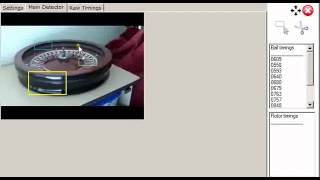
The system uses colored boxes to track the wheel (yellow), ball (blue), and green zero (green) as they pass by.
The version shown is older with limited functionality, but it can still track live spins.
The sensitivity of ball detection can be increased to improve tracking accuracy.
The detections are used to calculate timings, which are essential for predictions. Repeating the process yields more consistent results.
The latest version uses multiple timings and averages movement across a broader area, achieving about 1 millisecond accuracy—'basically as good as it gets.'
The system allows selecting the area and color for tracking, such as the green zero.
The video showcases a functional roulette prediction system with impressive timing accuracy, though the demonstration is brief and focuses on the older version's capabilities.
Millisecond Accuracy
The latest version achieves about 1 millisecond accuracy, a key technical benchmark for prediction systems.
01:22[00:03] it works is you've got the the yellow box here which tracks the location of the wheel uh the blue box tracks uh tracks the ball as it goes past and the green box uh tracks the green zero as it
[00:16] goes past uh this is an older version though it's um it's uh suddenly got limited functionality but it can still track Liv spins so basically how it track Liv spins so basically how it works you can see the tracking
[00:41] bottom part of it I can increase the sensitivity of the ball uh
[00:54] individual detections now this is set to give a per pass as we can see we're getting that
[01:09] these are used to calculate these timings here so if we repeat it we should get much the
[01:22] close uh in the latest version we we use uh we get multiple timings uh what happens is we can track a broader area uh we can average the uh the movement that goes across and we can get it down to about 1 millisecond accuracy which is
[01:36] uh which is basically As Good As It Gets uh same thing done for the
[01:54] green to be in the area select the color uh the rest of it yeah I'll start that uh the rest of it yeah I'll start that from the
[02:11] beginning okay so the road of timing has it goes

⚡ Saved you 0h 02m reading this? Transcribe any YouTube video for free — no signup needed.