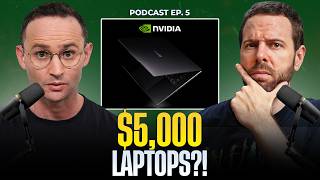

Nvidia Spark APU: 128GB RAM & AI Power!
45sReveals the shocking specs of Nvidia's new APU, including 128GB RAM, sparking curiosity and debate about its gaming vs AI potential.
▶ Play Clip"Title promises affordability discussion, and the video delivers on that, but it's a long podcast-style chat with some fluff."
In this video, Josh and Jared from Jared's Tech discuss Nvidia's new RTX Spark laptop chip, an ARM-based APU developed with MediaTek. They analyze its specs, performance expectations, and the broader implications for gaming laptops, Windows on ARM, and the laptop market's pricing trends.
Josh and Jared introduce the video, highlighting Nvidia's new gaming laptop chip, the N1X (Spark), which they claim changes everything.
The N1X is an APU based on ARM architecture, combining a CPU with a powerful integrated GPU. Nvidia partnered with MediaTek for the CPU part.
The chip supports up to 128GB of memory, aimed at AI workloads and LLMs. It has 6144 CUDA cores, about 4% more than the RTX 5070 Ti laptop GPU, but performance depends on power and memory speed.
The Spark chip draws 45-80W, compared to up to 125W for the 5070 and 140W for the 5070 Ti. This power difference significantly impacts performance.
Based on scaling, at 70W the chip might score around 13,000 in Time Spy, placing it between a 5060 and 5070. It could perform like a 5070 12GB at 115W.
The chip was rumored to launch about 12 months ago but was pulled back. It's now expected in the next few months.
The CPU is already in a mini PC (GB10) and performs around Intel's Ultra 9 275HX, but the desktop version has a 280W PSU, while laptops will have lower power.
The full-powered variant with 128GB RAM could cost $5,000-$6,000 or more. Josh doubts it's worth buying for gaming alone.
The chip shines for AI workloads and LLMs due to CUDA support, but for pure gaming or creative work, it may not be the best choice.
ARM-based CPUs depend on game developers porting games or using translation layers. Nvidia is working with publishers to get anti-cheat working, enabling games like Fortnite, League of Legends, and PUBG.
Jared and Josh tested Windows on ARM laptops and found many apps work, but there are still hiccups: some peripherals, DJ software, and professional apps don't work or install properly.
Windows on ARM has improved over time, and Nvidia's entry could accelerate that progress.
Josh warns that marketing often over-promises, and buyers should be realistic about what works and what doesn't.
The Spark is not the 'M1 moment' because Apple's M1 was in an affordable $1,000 device, whereas this is expensive and ARM efficiencies were already realized in 2020.
Jared notes that when he got his M1 laptop, most apps worked seamlessly, even with translation, unlike Windows on ARM.
Windows has many stakeholders (Nvidia, Microsoft, OEMs) that must cooperate, unlike Apple's single-company approach, making it harder to ensure compatibility.
Intel's Panther Lake, AMD's Zen 6, and Apple's M6 may be out by the time Spark laptops launch, so buyers should wait and compare.
For some users, CUDA support alone justifies the purchase, even if gaming performance isn't top-tier.
Windows laptops often get announced months before availability, leading to disappointment as competitors catch up.
Manufacturers often set high MSRPs and later drop prices by 40%, which is misleading. Josh criticizes this practice.
Jared and Josh emphasize using price history tools to avoid being misled by fluctuating 'original' prices on retailer sites.
Intel's B390 integrated GPU is the most power-efficient tested, rivaling MacBooks, while Nvidia's Blackwel is least efficient. This could be an opportunity for Intel.
The Spark chip is essentially discrete graphics, so battery life may not be amazing, despite Nvidia's hints of pleasant surprise.
Intel announced G3 and G3 Extreme handhelds with 10 and 12 XE3 cores, offering great performance but at a high price (~$1,500).
Jared suggests considering 2025 models, as 2026 refreshes often offer minimal improvements. Specific features like OLED might justify newer models.
The 2026 G14 is significantly better due to 10W more power and Intel Panther Lake, making it worth the upgrade over the 2025 model.
Some Lenovo laptops with Panther Lake and Nvidia GPUs have poor battery life when unplugged, as the GPU isn't properly shut down. This is a compatibility issue.
Laptops are becoming as expensive as cars, leading to concerns about debt and negative equity. This may boost the second-hand market.
Innovation is happening at the $4,000-$5,000 level and at the $600 level with Intel's Wildcat, leaving a gap in the middle.
On the gaming side, there's a lack of cheap options; lower-end GPUs like the 4050 and 3050 are still around.
Josh is making a video about cheap gaming laptops on Amazon that don't have dedicated GPUs, using old Ryzen processors, misleading buyers.
2025 has been a wild year for laptops with many launches and price increases, making it crucial for buyers to get clear advice.
Jared and Josh wrap up, noting that new laptop graphics might not come until 2027, and they caution against AI-generated advice.
The RTX Spark is an exciting but niche product, best suited for AI workloads due to CUDA and high memory, not for gaming. The laptop market is experiencing extreme price inflation and compatibility issues, making it essential for buyers to research thoroughly and consider last-gen models.
What is the Nvidia N1X Spark?
An ARM-based APU developed with MediaTek, combining CPU and integrated GPU.
01:09
How many CUDA cores does the N1X Spark have?
6144 CUDA cores.
02:22
What is the maximum memory capacity of the N1X Spark?
128GB.
02:08
What is the power draw range of the N1X Spark?
45W to 80W.
03:02
What performance level is the N1X Spark expected to achieve in Time Spy?
Around 13,000 points, between a 5060 and 5070.
04:01
Why is the N1X Spark particularly suited for AI workloads?
It has high memory capacity (128GB) and CUDA support, which is widely used in AI.
08:17
What is a major compatibility issue with Windows on ARM?
Some peripherals and professional apps don't work or install properly.
11:23
Why is the N1X Spark not considered the 'M1 moment'?
Because it's expensive, unlike the $1,000 M1 MacBook Air, and ARM efficiencies were already realized in 2020.
14:19
What is the power efficiency ranking of Intel's B390 GPU?
It is the most power-efficient integrated GPU tested, rivaling MacBooks.
21:19
What is a common misleading pricing practice by laptop manufacturers?
Setting high MSRPs and later dropping prices by 40%, making discounts seem bigger than they are.
19:32
N1X Spark APU Overview
Explains the core architecture and partnership with MediaTek, setting the stage for the discussion.
01:09Performance Estimate
Provides a concrete performance estimate based on power scaling, helping viewers gauge the chip's capabilities.
04:01AI Use Case Advantage
Highlights CUDA as a key differentiator for AI workloads, making the chip valuable despite gaming limitations.
08:17M1 Moment Comparison
Debunks the 'M1 moment' narrative by emphasizing price and historical context, offering a realistic perspective.
14:19Intel B390 Power Efficiency
Reveals a potential competitive advantage for Intel in power efficiency, which could shape future laptop designs.
21:19[00:00] video. So, we're here. [laughter] First actually, Jared, where have you been? All right, guys. So, uh we're here with Jared from Jared's Tech. Obviously, we got a
[00:12] really, really big announcement uh this week, which changes everything, right, Jared? There's no need to buy any other gaming laptop. Nvidia's launched the gaming laptop. Nvidia's launched the N1X, the Spark. It's all over. Uh
[00:25] actually, Jared, where [clears throat] have you been? What's been going on? boring. Figured I'd take a bit of a break. Um um but seriously, uh we just moved house. So, can't really tell cuz I've
[00:40] >> Yeah. >> Yeah. Uh it just worked out that it was a good time to move to a bigger place while the gaming laptop world was pretty quiet. So, yeah, we've just been busy working in the background. Yeah, now
[00:55] the last few weeks. >> Absolutely. Absolutely. So, Nvidia's Spark, right? We've got a lot to talk about here. It looks on the surface a pretty interesting announcement. Basically, as I understand, it's an APU.
[01:09] It's based on uh the ARM architecture, so similar to what Qualcomm's doing. You but in this case, obviously, you've got Nvidia behind it. So, hopefully, game developers going to really sit up
[01:22] and take note of it. And it combines the the CPU with a powerful integrated GPU. run through some of the core specs of what was announced and let's get into a >> Yeah, well, that's pretty much it. It's a APU, just like you said. So, um Nvidia
[01:38] partnered with MediaTek for this one. So, MediaTek are actually doing the the CPU part of it, and Nvidia obviously specialize in graphics. So, that MediaTek component, um as you mentioned, processor is ARM-based.
[01:53] Um so, we've got another uh I guess big ARM on Windows uh piece of hardware coming along here just after all the Qualcomm stuff. So, been laid at this point. The chip can use up to 128 gigs of
[02:08] memory. So, that's quite significant and I believe that's because this chip is more designed to be used for like AI workloads and LLMs, things like that which can actually take advantage of the higher memory capacity.
[02:22] Uh in terms of CUDA cores, I think it was 6144, which is about 4% more than Nvidia's RTX 5070 Ti laptop GPU. But, just because the 5070 Ti is, you know, slightly more CUDA cores, doesn't necessarily mean
[02:37] performing similarly cuz it comes down to other things as well like power and memory speed, all sorts of different variables. The 5070 Ti laptop GPU
[02:49] variables. The 5070 Ti laptop GPU uh has faster GDDR7 memory. So, although uh faster memory, it doesn't have as much capacity. So, you know, for gaming, probably better off having that faster memory, I'd say.
[03:02] things like power difference. >> Exactly, right? Because we're talking about a 45-W to 80-W uh power draw on this new chip versus I think up to what, 125 on the 5070 and then 140 on the 5070 Ti, right? So, that's going to make a
[03:18] pretty big difference. One thing that I thought was interesting is when I looked 2D's video where he did the power scaling of the 5070 Ti and what he noticed was once you drop the power to the 5070 Ti and I believe
[03:34] >> [snorts] >> um once you go down to about 80 W and just to be clear, I don't think we know if the 80 W is just to the GPU or to right? Where the 80 W is going to the whole thing. Do you know that or is it
[03:47] >> I don't I don't I don't know, but given the, you know, they're talking about it GPU [clears throat] combined. It wouldn't surprise me if it was just the one number for the whole thing. >> Exactly. So, if you then go to his graph
[04:01] of scaling and you scale it back to say 70 watts to the GPU, you end up getting I believe about 13,000 points in Time Spy which places it just in between a 5060 and a 5070. So, it sounds like given that this thing
[04:17] can have more memory, obviously, it sounds like I'm expecting it to be it sounds like I'm expecting it to be maybe like a 5070, the 12 gig version at maybe like a 5070, the 12 gig version at maybe 115 watts, so not quite 125.
[04:29] perform like. I don't know how you feel if you've got some expectations. >> Yeah, I mean, I think I've heard people saying 5070. I don't know if that was least it wasn't in the press [clears throat] release. Um but then at
[04:45] the same time when AMD Strix Halo came out, which I suppose is a competing that what were they I think they were saying like it was a 4070, but I found like a 4060 to end up beating it. So, you know, it depends on like the exact
[04:59] scenarios you're comparing against, of course. Like some certain games might companies like to cherry-pick the absolute best results when doing these sorts of announcements. Overall, it's um definitely an
[05:12] cooked up here. Although that said, I believe it was meant to come out about 12 months ago. So, I did hear rumblings about this at the last Computex that I last minute they kind of pulled the announcement back. But uh yeah, here we
[05:28] finally coming out in the next few months. >> Yeah. And so, I think just looking at this um exciting and obviously there's this Surface Ultra. There is the Dell XPS 16,
[05:43] really like the Surface uh Laptop 15 that already exists, but a bit thicker. Um and there's a bunch of others, right? The new product uh 14, 16, and um several others. And we'll we'll get into them. On the CPU side, funnily enough,
[05:57] this chip is not new. It's already been released in this kind of mini desktop form factor. I think it's called the GB10. Um it's in a mini PC. There's the well. There are actually Geekbench results of
[06:13] this CPU, and it is around the Ultra 9 275 HX, which is one of Intel's very powerful HX processors. So, apparently the CPU is quite capable. The one thing though that I think is very important to note is in that desktop one, it's
[06:29] actually got a 280 W I believe power supply, whereas obviously this is going to be much lower than that. I'd expect these things the full the full ones with if they're 80 W to the APU, say the laptop's 20 extra watts, come with a 100
[06:42] W power supply. So, it probably isn't going to be quite at those heights, but it does seem like it's a pretty decent performing CPU from can find. >> Yeah, I mean, even if it's somewhere
[06:57] between 5060 and 5070, those are still perfectly capable options for 1080p and upscaling. Um I guess it's it depends more on like what the cost of these things is going
[07:09] to end up, which I don't think has really been announced too much just yet. But obviously this is not going to be anywhere near as uh cost-effective gaming. >> Yeah. That and that I think is the big
[07:22] variant that I just mentioned, which comes with 128 gig of RAM, you're looking at between 5 to 6,000, a little bit even a bit over $6,000. And that monitor. Laptops tend to cost more because you've
[07:36] Laptops tend to cost more because you've got all the components included. So, this is if this comes in below $5,000, I'd be very surprised. At least the full the the full powered one, right? Maybe that 45 watt one, you know, maybe cut
[07:50] down with less memory will come in lower, but I think I mean, my two cents, I don't know about yours, Jared, but I I just think I I just can't see why you would get this as a gamer, personally.
[08:05] >> Yeah, definitely doesn't seem like it's worth buying specifically for gaming, but, you know, if you're someone who's getting it for the AI workloads or creative workloads or whatever else it has a good benefit for, you know, you
[08:17] side. But, yeah, I don't think it's going to make any sense at all for it to just be purchased entirely as a gaming laptop. me. >> Yeah, agreed, agreed. And same with like
[08:30] for creators as well. I know they're showing, you know, Premiere Pro running on it and all this kind of fun stuff, but let's let's be real. I don't think if that's your main workflow, if you're
[08:42] the laptop to get. But, I think to your point, Jared, right, if you can make use of that extra memory, if you're doing AI work for LLMs on your actual laptop, well, that's when this thing absolutely shines. There's nothing quite like it, I
[08:57] with or comparisons, should I say, with, you know, the MacBook with what's going on with the M3 Max chip or even, you know, Strix Halo, obviously both being APUs with powerful GPUs. But, let's call
[09:09] a spade a spade, you know, Nvidia has CUDA, which is what most AI is really using. So, there is a huge advantage to this, at least for, you know, local AI work, right? So, I think it's in that space it's going to truly shine, I would
[09:23] >> Yeah, definitely agree. And also just around gaming, um I don't think we've talked about the fact that because it's an ARM-based CPU, you know, we're going to be depending on game developers either porting their games from x86 to
[09:37] either porting their games from x86 to arm or uh relying on translation layers to handle that for us. During the Nvidia announcement, there was uh some mention of game publishers um getting their anti-cheats working, which I think is
[09:50] quite a big deal for like arm on Windows as a whole, not necessarily just this release. And you know, I guess Nvidia is big enough that they have uh that sort of influence where they can kind of push people along to make that
[10:02] happen. So, I think some games like Fortnite, uh League of Legends, and PUBG uh should be able to work on this new uh new chip. So, I thought that was pretty >> Yeah, I think and you also bring up I I totally agree and I think that's a a
[10:14] great thing because that's kind of held back some of the Qualcomm uh chips that are out there. But, I did want to touch on this a a lot because want to touch on this a a lot because we've tested um a bunch of these Windows
[10:26] on arm laptops. In fact, we just did a huge amount of compatibility testing for the latest Qualcomm X2 chips. And overall, I believe Windows on arm in a supercharged way was there before,
[10:40] their Snapdragon X chips. But, in the supercharged way since uh since Qualcomm launched back in 2024, mid-year, I think we're about 2 years into a 4-year journey. And that's me just estimating kind of where we are.
[10:55] What we found when we tested Windows on arm was in addition to what Jarrod just Legends didn't work because of the anti-cheat, but we found that a lot worked, but then there's still quite a few hiccups. So, for instance, Android
[11:09] Studio, I believe that ran in emulation and the actual Android emulator, if you didn't work. Um another good example, peripherals. We found that quite a few peripherals didn't work. So, for instance, our 1
[11:23] gigabit ethernet dongle, that worked perfectly. When we tried our 2.5 gigabit ethernet dongle and we tried we have a couple of them, they didn't work. I tried Recordbox, which is obviously the one that the Pioneer DJ controllers use.
[11:36] That software, it booted, it worked really, really well until you attach the actual DJ controller, and the DJ controller wasn't recognized. some software professional apps that we were installing. So, for instance, the
[11:49] well. But then, there were some other examples where we just couldn't even get examples where we just couldn't even get it to install. So, a lot is working, but we're still at a point where that you still do need to check, "Hey, what do I
[12:02] want to run? Is it going to work on Windows on ARM?" before just assuming that everything's going to work. That we're not at that place yet. Um so, that's kind of where I feel from the professional apps uh perspective,
[12:14] the thing that got me when I saw this release is they're showing, you know, all these creator apps and stuff like that. And I think they just need to be realistic that, "Hey, if your primary focus here is AI development on your
[12:28] computer, but you also want to run creative apps, great. These could be definitely wouldn't suggest looking at these as a pure creator. I mean, you'd realistically." >> Yeah, there's no way I would be buying
[12:43] something that's going to be as expensive as this and then have to deal that I need either aren't going to work or the experience just isn't going to be money, like that's just not something that you should be dealing with. But
[12:57] mentioned, things have gotten better on Windows on ARM over time. And I think with Nvidia bringing out RTX Spark, that's that's only going to accelerate things, really. >> Absolutely. Yeah. And I And I think,
[13:10] just speaking personally, I think that is a great thing, guys. I I really do. And I don't want anyone to think that I'm certainly not. I think competition is great. I think, as you said, Jared,
[13:24] Nvidia coming into play and pushing things along even further. Fantastic. The reason why I'm cautioning people is oftentimes these marketing spends of these companies, they promise the world and they're showcasing things for users
[13:37] that they probably shouldn't be focusing on. And there is a degree, I would say, of over-promising. And I'm just trying to be the voice of reason because there coming out and just, you know, so excited and pumping up these things.
[13:50] particular launch, but certainly that initial Qualcomm launch back in sponsorship. So, we had to come in there we had to be the voice of reason and just say, "Guys, let's be realistic here
[14:05] things and what's working and what's not." And I think that's where, you know, both your channel and mine, we are very focused on that buying to mention one thing and I've got it behind me, you know,
[14:19] know, the Windows is M1 moment and I don't releases. It certainly was back when Qualcomm launched 2 years ago. when we think about the M1 moment, we just got to be I'm holding the MacBook
[14:33] Air here, but we just got to be realistic that the M1 moment was the M1 moment not just because it moved from Intel hardware to to ARM-based hardware and all that, but it was in an
[14:48] affordable device. It was in a $1,000 device. So, everyone had access to it. Where this, I think, you can't quite call it the M1 moment because A, the move and the efficiencies of ARM have already been realized in in Apple
[15:00] laptops and they were realized back in 2020. And secondarily, it's only population here due to price. So, I don't I don't know if you have any >> Uh yeah, I think another thing is, I mean, you'd probably know more about
[15:13] this than me. Um but when I got my M1 laptop, um I found pretty much all the apps I wanted just worked. Like it was pretty much a seamless experience, at
[15:25] use it too much, but I was very impressed when I got it, even if it didn't run natively. Um just the the tran- translation to like was called. Um it just just worked flawlessly in the background and I I
[15:41] >> Yeah, that's right. And I think it speaks to about the Windows model itself. And I had a video about this just recently that you've got so many cooks in the kitchen. You've got Nvidia with their drivers. You've got obviously
[15:53] Microsoft. You've got the laptop manufacturers. All of these companies, and normally there's four of them, have to work together for things to work side, you really only got one company. So it's just a lot easier in their
[16:06] business model to make this happen. One thing I thought was interesting is this processor may not be competing with what you're seeing currently from AMD, Intel, I think it has some unique things that uh only Nvidia can deliver, which is
[16:22] like CUDA, right? Clearly. But if you're looking at this as a potential laptop to you know, gaming or creative tasks, things outside of the AI world, you've got to keep in mind that Intel might have an over a lake out by
[16:37] Intel might have an over a lake out by about then. Zen 6 Medusa also might be knows if it's if they're going to change that. You might have M6 from Apple. So paper launch, right? It's being announced on paper, but we have no
[16:52] is different to when Apple announces things and you can buy the laptop within normally 2 weeks. So I would also again just caution people, you know, not to say, "Hey, I'm going to
[17:04] buy this this new laptop. I'm going to wait and see what comes in in 6 months time and see what's available." I Again, Jared, I don't know how how you feel about that that either. >> No, that makes a lot of sense. Um
[17:18] but I guess at the same time even if I was interested in it, like that doesn't exist. Like I'm going to weigh my options up at the time when everything's available. And you know, if there is rumors of something else coming
[17:31] I'd probably wait a little bit. But especially when you're paying that much money. But otherwise, you know, I definitely could see some people who would only want this just for things like CUDA as you mentioned. Cuz that's
[17:43] definitely a pretty important feature for some people. Uh so yeah, I guess it needs. >> Yeah. Yeah. I don't know why that this keeps happening in the Windows space. Like we were seeing laptops at CES that
[17:57] still haven't hit the market. And that was back in January. And now Nvidia's, it a couple of times as well showing us little teasers and then the product's You're left kind of by the time the product arrives, other things have
[18:11] caught up and you're left a little bit disappointed. Where you would think they really, "Hey, we're announcing we're getting excited about this new product. It's here. Here it is." It's it's really weird. It's a weird business practice, I
[18:24] think. >> Yeah, it's a bit strange. I don't know if things are just delayed a bit more at the moment with like all the you know, Like cost of memory and that type of thing.
[18:36] that new the new budget budget Alienware laptop was announced at CES and I think that only just went on sale in like the 5-month gap. >> And isn't that a fantastic laptop? All
[18:50] they're starting it at. Have Have you tried it? I don't have it yet cuz it's taking a while to get stuff like that into month or two away until we get it. But uh yeah, that doesn't look too good from
[19:04] a value perspective. But at the same time, like I don't know how unique that like the prices of a lot of stuff is just going up in general. >> I think that's very fair. I cuz it came in at what $1,600
[19:18] and effectively has components and gives it power draw of laptops that we used to see at about $800. I think that's at least what I feel. It's a very budget >> Yeah. >> the thing that kind of gets me and why I
[19:32] want to hit hard at manufacturers that do this is oftentimes Windows manufacturers they release products at sky-high MSRPs just to then later say, "Oh, we've we've dropped the price by 40%. Isn't this a great deal?" And they
[19:47] have to stop doing this. It's very misleading and awareness of this kind of thing. It needs to stop. Like if you're going to be like kind of I mean, yes, there's price increases, but not like this is
[20:01] these kind of gaming laptops. And it just needs to if they're going to come discount, just give us the proper price to begin with. Like when you again looking at Apple laptops, their discounts tend to be like $200 off is a
[20:15] pretty standard Apple discount. They don't come in at 40% off or silliness >> I'm in the process of adding price history to our deals website and I know you guys already have price history, so you've probably already seen this, but
[20:27] man, just seeing how how much the like before sale price can like change. Like you might see a laptop that's say $3,000. Now it's on sale for 2,500 and
[20:39] then the next week they'll say that it it was like 4,500 or 5,000. It's just it's just complete crap. >> Yeah, it's ab- it it you need these getting a good price? Cuz you cannot trust what's listed on these retailer
[20:54] store pages. You can't trust it anymore. They're changing both the MSRP price, the original or the the compared to price as sometimes it's called. And the also the current price, both of them are moving. It's it's very very
[21:06] difficult. Um so, plug for both of our websites here, but you know, one thing I wanted to get back to on this announcement is Intel's B390. to on this announcement is Intel's B390. And the biggest finding that I had here
[21:19] we did this kind of analysis of power efficiency of GPUs, and we found that Intel's B390, which is their integrated GPU in their X-series uh Panther Lake laptops, was the most power efficient one that we tested. It was right there
[21:34] with MacBooks with their integrated GPUs. And Nvidia's GPUs, Blackwall, which this new one is using, was the pretty much the least power efficient. And I think this gives a huge opportunity
[21:46] for Intel. If I was at Intel, I'd be I don't know if it's possible, but I'd be really trying to come out with the maybe a a 24, rather than the 12 XE core uh XE3 core, uh which is the B390, coming out with a 24 core one. I'd be
[21:59] to what happened with um you know, Strix Halo. AMD just produced a bigger chip. Don't know if that's possible. I'm not an expert in engineering in any way in I think if their power efficiency beats
[22:13] believe it does, it's going to be very power efficiency changes with this one, right? Cuz you've got a lot of CUDA cores, less power being fed to them with this new Spark chip.
[22:25] I think if you're thinking about the laptop form factor, um Intel could do they do. I I don't know how you feel about that. >> Yeah, I mean, as you say, it comes down to how much power they're they're giving
[22:39] it. I suppose for like lighter workloads, you know, obviously less would help improve the battery life. But yeah, at the end of the day, still like a a fairly beefy Nvidia chip, which is
[22:52] essentially discrete graphics. Um so, probably not going to be amazing watch a video, I think might have been the Linus Tech Tips one, um and they mentioned that Nvidia said, you know, something along the lines of
[23:05] like, "Ooh, you'll be pleasantly surprised by its battery life." So, who >> Again, like are we talking video playback? Are we talking about gaming performance? Who knows? And I think that actually leads nicely along to the other
[23:17] announcement which we haven't really covered here was what Intel announced with their handhelds. There's the G3 and the G3 Extreme. Extreme, I believe, has the 12 XE3 cores, and then the other one has I believe it has 10. Let me check my
[23:30] notes. Yes, that's correct. And I think for gaming handhelds, it's going to provide amazing performance compared to what's in these today. So, that's very interesting, but I'm hearing that the pricing is well $1,500.
[23:43] So, that could be I mean, you used to be able to buy amazing gaming laptops at that price. So, that's a bit concerning, but laptop. >> I know. I know. Do you remember last
[23:58] year was it the HP Omen Max 16 with a 5080 that at Black Friday was going for what was it? $1,700? Was Was that the right one? less. Might have been like 1,600. I can't remember. But yeah, they ran some
[24:11] think the year before they had like no sales, and we told them we were like, "Hey, we don't really sell much of your too expensive." And then literally next year they just like had some crazy
[24:24] they do that again. >> And now we're talking about what's essentially an integrated GPU in a handheld that costs the same [laughter] amount as a 5080. I mean, obviously different devices, but I mean, do you
[24:36] have any thoughts for for people who are shopping right now or planning to shop particularly for back to school for How would you approach buying a gaming laptop today? What's your thoughts? >> Yeah, honestly, I think it makes a lot
[24:48] of sense to consider 2025 models from last year. Uh a lot of the 2026 [clears throat] model, but a lot of them aren't really that amazing. Like uh I've
[25:00] got the Legion Pro 7i here. So, I did a video on that just yesterday my time. And the conclusion was basically the uh refreshed 298HX Plus really not that different from a 275HX. So, you know, if this thing ends up costing more money,
[25:17] perform a little better, but like you know, I probably wouldn't want to spend more than like I don't know, 20 or 50 bucks more to get it. So, if it's hundreds of dollars more, it doesn't make sense. So, I think last year models
[25:29] there's like a specific feature you really want. So, for example, uh some laptops, like some of the Alienwares, they now have OLED. So, if you've been doesn't make sense to get the last gen model. So, it depends on your use case
[25:43] and what has actually changed in the 2026 model. Cuz in some cases, it can be quite a lot, like ASUS's Zephyrus G14 going from AMD to Panther Lake. Or it 7i. >> Yeah, I was going to make mention of
[25:59] that. The G14, I mean, we've we've already filmed our review of it. And I know you've got yours out, but man, you wouldn't think just 10 watts to the bottom, and switching to Intel Panther Lake was going to make that much
[26:13] of a difference, but boy, is it a better laptop. So, I I you know, I don't know part of your your video. Actually, I'll tell you a funny story. This is so I was watching part of your video just to make sure that, hey, there wasn't
[26:25] perhaps we'd missed. And I sent this feedback to my team going, "I think we've missed this." And they're like, "Josh, you watched Jared's 2025 G14 review, not his 2026
[26:39] one." Oops. Oh good gosh, that was ridiculous. But anyway, the G14, I agree. That one is worth spending a good amount to buy this year's model over last
[26:51] good example of that. I don't know if you've had that in, but that's a much better laptop, the 2026 one. It The old one, I believe it had that me if I'm wrong on that one, but there was a couple of other things where it
[27:04] just felt like a pretty It was It was a great budget laptop at a cheap price, clear things that you could look to and go, "There's what I think the colors of the screen and stuff like that." Where now they fixed pretty much every single
[27:17] to cost, but it's much better than the prior year's model. So, that's one that is. But, then I agree with you, Jared, a lot of them just haven't And as some of them are are finding We're finding have some issues. Like
[27:30] I don't know if you found this with your Legion Pro 7i, but then maybe they fixed it. But, in a lot of these Legions that we've tested recently and on the Yoga Yoga Pros, combining Panther Lake, Intel's CPU with
[27:44] obviously Nvidia GPUs, we found a lot of them when you just pull out the cable and try to run on battery, they're not properly shutting down the Nvidia GPU, and the battery life is very low. And then when we forcibly shut down the GPU,
[27:56] like say in the BIOS, we're getting much better battery life. We didn't see that better battery life. We didn't see that on ASUS's Zephyrus G14, but we feel like Lenovo, at least from the ones we've tested We've tested quite a few of these
[28:09] serious compatibility and tuning things that they kind of need to get on top of. I don't know if you saw that in your Legion Pro 7i. Did you see something >> Uh not with the Pro 7, but that's still Raptor Lake rather than Panther Lake, so
[28:22] there. >> Good point. Good point. Um it's interesting when we think about laptop buying now. In And this is Honestly, I say it's interesting, but in a bad way. I actually kind of feel that
[28:35] unfortunately, it's heading down the path almost of buying a car now. Where higher-end laptop space, that the laptops are becoming so expensive. I
[28:47] worry that most people can't afford to just outright buy them in cash anymore like they used to be able to. You know, you'd save up, you buy. And I absolutely do not advise this. I think you should be buying a second-hand
[28:59] around. But I think a lot of people might be caught in debt situations because, you know, whenever you borrow on a fast appreciating asset, which a piece of tech is, you could be caught in a negative equity situation where the
[29:13] amount you you owe on the loan is worth is is more than what the laptop's value is. And I'm worried that people might turn to kind of debt to try and get these new expensive laptops. So that's one thing that really worries me. Um on
[29:26] the flip side, I do think it's going to create a healthier second-hand market. Where right now having like imagine running a store that sells second-hand laptops, there's not a lot in it because like the margins are
[29:38] If you have to ship the laptops or warehouse the laptops, it's very expensive. It just doesn't make sense. But with the laptop the new laptop prices becoming so expensive, I think second-hand laptops are also um
[29:51] going to be much going to be their prices going to be on the rise and it buying and selling second-hand laptops more seriously. And it's it's weird. I I think we're seeing a lot of innovation at like the
[30:04] four $5,000 laptop level. And then we're seeing a lot of innovation with Intel's Wildcat and I at the $600 laptop level. to think when you talk about and I've got obviously the Neo in front of me.
[30:17] underperforming processor. But if you take one of these new Intel Wildcat the cost of jumping up from it to some of these high performing ones, you could be playing like four times the price and is it
[30:32] that? It's it's it's really weird. This price it used to be laptop prices were kind of compressed in this zone. But now we've seen them really >> Yeah, I think from the gaming laptop side it's mostly just everything's
[30:47] really have like a a cheap a cheap option cuz um on the lower end it's still just 50/50 and then in some places the 4050 and 3050 are still living on.
[30:59] >> Well, Alienware's brought it back, haven't they? For the Alienware 15. >> Yeah. >> I don't know what they're doing. I mean, misleading. And funnily enough actually, I've actually got this video I'm doing.
[31:13] I call it the Amazon gaming laptop scam. It's all those cheap gaming laptops that are being sold there for about $500 to $800 or $900, but don't even have a dedicated GPU. And they're using like these crazy old Ryzen processors. Like I
[31:28] found from the Ryzen 4000. I found one today for like 500 bucks with a Ryzen Ryzen 4000U processor. I mean, how well is that going to game? >> And funnily enough, one of some company rep from one of these companies wrote to
[31:41] us wanting us to do a sponsored video on them. And I'm like, oh, what a mistake >> [laughter] >> Um yeah, cuz obviously we've got some ethical levels that we want to hit with this company here and you know, doing a
[31:54] sponsored video on those is definitely not going to hit our ethics levels at But yeah, no, it's just I think just kind of to wrap here, it's been an interesting year because you wouldn't think on the outside that
[32:08] this would be a big year for laptops, but it's been just absolutely bonkers. Like it's been it seems like there's been so much focus on our space. Whether it's the Neo that's launched, Panther Lake, um this new uh N1X chip, the
[32:23] Spark. Uh the memory prices and the prices of laptops going through the roof. It's just craziness and I think people need channels like yours and and our one over here to that are really focused cuz
[32:36] similar in a way that we're very focused on I think on the buying decision, right? To really help provide clarity on what should people actually buy? Because it is it's just absolutely crazy right now.
[32:49] fall into huge traps like buying one of those crappy laptops off Amazon thinking you can game and you can't. >> Yeah, and it's only getting worse as you um with laptops laptop pricing, you know,
[33:03] [laughter] >> It is it's it's nuts. It is really nuts. time making videos for the business channel on trying to help people be more can afford the laptops that we're talking about on the laptop channel,
[33:18] which you know. It's crazy world. But anyway, Jared, I don't know, do you have anything else you want to end with? >> Uh no in particular. I mean definitely a lot of a lot more laptop
[33:30] stuff happening than I would have expected if you asked me at the start of the year during CES. Um I suppose on the gaming side it's probably a a bit quieter, which you know, worked out for me with my uh house move, so that wasn't
[33:42] Uh but yeah, hopefully we can get some new laptop graphics at some point, but I feel like that's probably we're probably like half halfway through the 50 series cycle, so that's probably like a 2027 dream. I guess we'll see how
[33:57] >> [snorts] >> Oh good lord, everyone's favorite word two-letter acronym right now. We've been testing it a lot, Jared. Just ask it like, you know, what what gaming laptop should I buy or this that the other and
[34:11] seeing its sources is just you know, random Reddit posts and things like this and I'm like, "Really?" Or or some of those pages that a lot of these companies these media companies have created just to get SEO traffic like,
[34:24] you know, "I've tested you you would have seen these ones. I test gaming laptops for a living and here are the top 20 you know, top five gaming and you just look at the page and it hasn't been updated in like three years
[34:37] what's going on here? And then AI sucking this stuff in and because it's from a big publication, they're giving it back to you guys. So, on that note It is. Yeah. On that note, get subscribed to to Jared's
[34:50] channel, Jared's Tech. Get subscribed here. I think we've droned on for a lot, but I hope you enjoyed this really random episode from us and I'll catch you later and >> See you guys next time.




⚡ Saved you 0h 35m reading this? Transcribe any YouTube video for free — no signup needed.