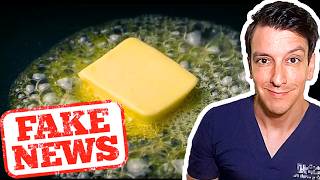

Saturated Fat Myth? FDA Commissioner's Flawed Claim
58sChallenges a popular narrative from a high-profile official, sparking debate on nutrition dogma.
▶ Play Clip"Title mentions 'MAHA' but the video primarily targets Makary's statements; still delivers substantive critique of saturated fat misinformation."
This video critiques FDA Commissioner Dr. Marty Makary's recent statements on saturated fat and heart disease, accusing him of spreading misinformation by selectively citing flawed studies while ignoring the broader body of evidence. The speaker dissects Makary's references, particularly the Minnesota Heart Study, and highlights contradictions between his public remarks and official dietary guidelines.
The video presents a short clip of Dr. Marty Makary discussing saturated fats and heart disease, warning that it exemplifies poor science communication that can harm public health.
Makary claims only three large studies failed to show a link between saturated fat and heart disease. In reality, there are at least 14 randomized controlled trials, and meta-analyses show reduced heart disease risk when saturated fat is moderated.
Makary says the Minnesota trial had a low-fat group with higher heart attacks. But the two groups had 39% vs. 38% fat—identical. The study found no differences in cardiovascular events, deaths, or mortality.
The Minnesota trial was interrupted early with over 80% participant loss, making it underpowered. Issues with trans fats in the 1960s-70s may have confounded results.
Makary cites autopsy data from 1.6% of participants showing more heart attacks in the intervention group. However, overall cardiovascular events showed no difference, so this subset may not be representative.
Despite claiming saturated fat dogma is flawed, the new dietary guidelines Makary helped write maintain the same 10% calorie limit from saturated fat. This inconsistency is called out as dishonest and reckless.
The speaker concludes that Makary's rhetoric undermines public trust in nutrition science by cherry-picking evidence and contradicting official guidelines. The video urges viewers to look at the totality of evidence rather than isolated, flawed studies.
How many randomized controlled trials exist on saturated fat and heart disease?
At least 14, not 3 as claimed by Makary.
01:12
What did the Minnesota Heart Study actually compare?
A diet with 39% fat vs. 38% fat – not a low-fat vs. high-fat comparison.
01:42
What percentage of participants in the Minnesota trial were lost?
Over 80% were lost, with 75% dropping out in the first year.
02:53
What is the current US dietary guideline for saturated fat intake?
Under 10% of calories from saturated fat.
06:31
What did meta-analyses of RCTs on saturated fat show?
A lower risk of heart disease events when saturated fat is moderated.
01:30
Evidence Base Understated
Corrects a key factual error: there are at least 14 RCTs, not 3, showing the importance of moderating saturated fat.
01:12Minnesota Study Misrepresented
Reveals that Makary misread the study: no low-fat group existed, and no significant differences were found overall.
01:42Contradiction in Official Advice
Highlights the inconsistency between public statements and official guidelines, calling out political behavior over science.
06:31[00:00] The FDA commissioner, Dr. Marty Makary, he heads the Food and Drug Administration in the United States. He was appointed by RFK Jr. last year. He just gave an interview on TV where he talks about saturated fats and heart disease. We're going to take a look. It's a very short video. I think it's
[00:15] a great example of how not to communicate science to the public. And guys, we're going to try to stick to the facts. I ask that you help out. We're not going to politicize this. It's incredibly dangerous to politicize science. Facts are facts regardless of which political party we like. Well,
[00:32] sure we want to promote healthy fats, but you know, we were encouraging as a medical field people for decades to eat egg white, you know, egg white only eggs. And if you think about that
[00:45] recommendation, it was really based on the flawed medical dogma of Dr. Ancel Keys in the 1960s and it became medical group think. Three large studies, gigantic studies, including two of
[00:58] the largest databased uh uh studies in the history of medicine tried to prove the association between saturated fat intake and heart disease. And all three failed to show that. Okay, we have dozens
[01:12] of studies on saturated fat and heart disease, not three. And even if we just look at randomized controlled trials on this question, there's at least 14 of those, not three. And when we put the evidence together, what we call a meta-analysis, and we do that rigorously, we see a lower risk of
[01:30] heart disease events like heart attacks or strokes when saturated fat is moderated. So that's the big picture in this field. He doesn't mention any of that. He wants to focus on specific studies. Okay,
[01:42] let's see. Including the famous Minnesota heart study that showed those who had the low-fat diet in the randomized trial had higher rates of heart attacks. Okay, there was no low-fat group in Minnesota. One group was 39% fat. The other was 38% fat. Identical. There's no low-fat
[01:59] group. This isn't some footnote. This is on top of the first page of the study. It's the summary of the paper. So, he's on TV bringing up a study that he's not familiar with. Maybe he's never read it because the whole point of the study is to test diets. He doesn't know
[02:13] what diets they tested. Okay. He also said they had higher rates of heart attacks. Same place, top of the first page. They found no differences in cardiovascular events, cardiovascular deaths, or total mortality. Now, it's important to understand this trial, the Minnesota trial,
[02:28] was interrupted abruptly, long before it was scheduled to end. So, they planned to run it for 3 to four years because it takes a while for things like heart attacks or deaths to develop and
[02:41] accrue. It doesn't happen overnight. But they lost almost all of their participants, more than 80% of participants were lost. 75% lost in the first year alone. So the trial was aborted and even
[02:53] during that short follow-up, the participants were in and out of the trial. During that period, they were on and off the diets. So it's not surprising that they didn't find a significant difference between the groups. It's totally expected. And there's more issues with this trial. For example,
[03:07] there's a question with trans fats. This trial took place in the 60s and 70s. A number of foods had industrial trans fats, margarine, and other processed foods. At the time, this wasn't well understood. So, it's very possible that one of the groups was eating more trans fats than the
[03:21] other. Nobody knows for sure because there's no quantification. Now, much later in the 2010s, they published some additional data from notebooks and from a thesis, including some autopsy reports
[03:34] for a small subset of participants, about 1 to 2% of the total folks in the trial. Trial started out with more than 9,000 people. Most of those didn't die during the trial. Of those who died,
[03:46] about 500 deaths. We don't have autopsy reports for most. So, they got autopsy reports, they recovered them for about 1.6% of the participants in the trial. And what they found was in the
[03:59] intervention group, 31 participants had at least one heart attack detected in the autopsy. So, this could have been a silent heart attack. And in the control group it was 16 individuals. And these
[04:12] folks for whom they recovered the autopsy data, they had been in the trial for less than a year by the time they died. So, interesting observation. But is this even representative of the total
[04:25] sample? Because they didn't see a difference in cardiovascular events like heart attacks overall when they looked at all the participants not just this tiny sample. Was this caused by the oils they were given in the trial? Was it caused by trans fats in the trial? Was it even caused by foods
[04:42] from the trial? Because they've been in the trial for less than a year. Maybe it's a fluke. Maybe these heart attacks happened before the trial started. Nobody knows for sure. My point is,
[04:54] you handpick one trial with massive issues. You ignore the majority of the evidence in this field, that goes in the opposite direction. Even within this trial, you handpick one observation in a tiny
[05:07] percentage of participants. You ignore most of what the trial reported. You ignore that overall there was no difference in cardiovascular events. And based on this, you go on this rant that all
[05:20] scientists are wrong. It's all dogma and group think. My opinion, this is a perfect example of how not to communicate science. This confuses the public and this harms people. And that's because
[05:32] when you eradicate fat, you replace it with refined carbohydrates, which increase general body inflammation. You don't have to. You can eat unprocessed carbohydrates, but also nobody's
[05:46] saying that you have to eradicate fats. Nobody in professional nutrition nowadays is saying that you have to eat a low-fat diet. We moved past that many years ago, decades ago. These guys are stuck in the past. This whole endeavor is a straw man argument, right? It's like the fixation with the
[06:02] pyramid. The pyramid was discontinued 15 years ago. They're still going on and on about the pyramid, the pyramid. Healthy fats are recommended almost universally by professionals in nutrition and they've been recommended for many years. Extra virgin olive oil, fatty fish, seafood,
[06:19] nuts and seeds, avocados. And the main irony with this is this whole narrative of saturated fat is misunderstood, was unfairly demonized, they don't even believe that. They just put
[06:31] out national dietary guidelines that they wrote where they uphold the same limit we've always had, under 10% of calories from saturated fat. Here he is in the press conference just last week
[06:43] announcing the guidelines. How much saturated fats Americans should be consuming. I'm going to let Marty take that since he wrote a book. Look, the old the old dogma the 1960s when Eisenhower had
[06:56] his heart attack and Anel Keys said it was the saturated fat that's never been substantiated and so that flawed research has become dogma over the years and eventually the conversation was sidelined. In this new guide guidance we are telling young people, kids, schools,
[07:15] you don't need to tiptoe around fat and dairy. You don't need to push low-fat um uh milk to kids. And we are maintaining the 10% of calories as saturated fat in the guidance. Does that make
[07:28] any sense to you? It's all flawed research. It's all dogma. It's never been substantiated, but we're upholding the same limit on saturated fat we've always had. What? If you believe that that gap is not based on good science, then why are you recommending it to 300 million people?
[07:46] Just because the guys before did? Just because every country on the planet does? Isn't that the definition of dogma and groupthink and being a sheep? Exactly the thing they like to accuse other
[07:59] people of doing? And if the science does support that cap, as you said in your official document, why are you telling people otherwise in a press conference? Completely reckless, right? Completely irresponsible, sending people to an early grave. The truth is this narrative is
[08:16] very popular. People want to hear that butter is fine or even good for you. All scientists are wrong. It's unfairly demonized. It's a very popular rhetoric. But in an official document,
[08:28] there's a lot more accountability. So there they don't play these games. They go with the balance of evidence and what most scientists are telling them is a good idea, right? So in the future if there's a lawsuit they can say "well we, we said under 10% in the document", right? While at the
[08:43] same time dog-whistling to the public that it's all dogma, don't worry about it, just eat all the butter you want. Do you see how dishonest that is, to say one thing and do another in an official document? This is how politicians behave. It's got nothing to do with science or facts. If
[09:00] you find this topic of saturated fat confusing, we have a video covering all of the evidence and practical takeaways. So, I'll link that right here. Check it out. I'll see you in there.

⚡ Saved you 0h 09m reading this? Transcribe any YouTube video for free — no signup needed.