
Scientists Reverse Aging Damage?
42sThe claim of reversing 'irreversible' aging damage is highly controversial and sparks curiosity.
▶ Play Clip"The title is largely accurate, but the video oversells the immediate impact by not emphasizing the early-stage nature of the research enough."
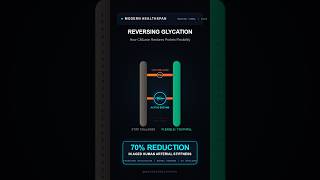
This video discusses a groundbreaking study published in Nature Communications that challenges the long-held belief that aging damage caused by glycation is irreversible. Researchers used directed bacterial evolution to create a novel enzyme called CMLase, which successfully removed glycation damage in human tissues, marking a potential shift from slowing aging to actively reversing it.
Glycation is a process where sugars bind to structural proteins over time, forming advanced glycation end products (AGEs), which cause stiffening and inflammation.
A pioneering study in Nature Communications demonstrated that glycation damage is not irreversible, contrary to previous beliefs.
Through five rounds of directed bacterial evolution, scientists created a new enzyme called CMLase, which removed glycation damage by 70% in arteries and 55% in skin of aging human tissues.
Even if systemic aging is reversed through exosomes or epigenetic reprogramming, processes like AGE formation still need to be addressed, making this research crucial.
The video asks whether we can officially transition from slowing aging to actively reversing it, inviting viewers to share their thoughts.
The research represents a significant early step toward reversing aging damage, though it is still in very early stages. The ability to reverse glycation damage could be essential for comprehensive anti-aging therapies.
What are AGEs?
Advanced glycation end products formed when sugars bind to structural proteins, causing stiffening and inflammation.
00:03
What enzyme was created to reverse glycation damage?
CMLase, created through five rounds of directed bacterial evolution.
00:31
By what percentage did CMLase reduce glycation damage in arteries?
70%.
00:31
In which journal was the study published?
Nature Communications.
00:17
Why is reversing AGE formation important even if systemic aging is reversed?
Because processes like AGE formation still need to be addressed for comprehensive anti-aging therapy.
00:45
Reversing Irreversible Damage
Challenges a long-standing scientific assumption, opening new avenues for anti-aging research.
00:17CMLase Efficacy
Provides concrete data on the enzyme's effectiveness in human tissues.
00:31Complementary Approach
Highlights the need for multiple strategies in aging reversal.
00:45[00:03] повреждения, вызванные старением клеток. На протяжении десятилетий наука о долголетии сталкивалась с огромным препятствием — гликированием. В этот момент сахара со временем связываются со структурными белками , образуя конечные продукты гликирования, или AGEs. Они вызывают уплотнение
[00:17] воспаление. Однако новаторское исследование, опубликованное в журнале Nature Communications, развеяло убеждение в том, что этот ущерб необратим. С помощью пяти раундов направленной бактериальной эволюции ученые создали совершенно новый фермент, получивший название
[00:31] CMLase. В стареющих тканях человека CMLase удаляла повреждения, вызванные гликированием, на 70% в удаляла повреждения, вызванные гликированием, на 70% в артериях и на 55% в коже, уменьшая повреждение кожи. Несмотря на то, что это очень ранняя стадия разработки, она имеет решающее значение. Даже
[00:45] если мы найдем способ обратить вспять системное старение с помощью экзосом или эпигенетического перепрограммирования, нам все равно нужно будет обратить вспять такие процессы, как образование конечных продуктов гликирования (AGEs). Можно ли официально перейти от простого замедления старения к его активному обращению вспять? Поделитесь
[00:59] aging to actively reversing it? Let me know your thoughts.




⚡ Saved you 0h 01m reading this? Transcribe any YouTube video for free — no signup needed.