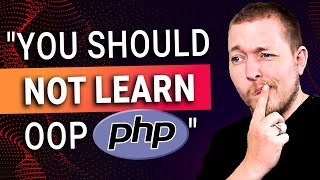

Procedural vs OOP: The Visual Difference
45sShows a clear side-by-side code comparison that visually demonstrates the difference between procedural and object-oriented PHP.
▶ Play Clip"The title accurately reflects the content: a balanced discussion on whether to learn OOP PHP, not a biased recommendation."
The video compares procedural and object-oriented PHP, explaining their differences, pros and cons, and arguing that neither is inherently better; the choice depends on the project's complexity and scalability needs.
The creator addresses comments debating whether object-oriented or procedural PHP is better, noting that both styles have their place.
Shows a basic login form example: procedural uses functions in separate files, while OOP uses classes with properties and methods.
Procedural code has one file handling the request and another file with functions for authentication, reusing code via functions.
OOP uses a class file that encapsulates properties and methods for login, allowing instantiation of objects with specific data.
OOP provides encapsulation, code organization, scalability, and the ability to restrict access to sensitive code via class inheritance.
Some argue procedural is simpler, less complex, and easier to read for small projects; OOP can overcomplicate simple tasks like a contact form.
The choice depends on the application: for complex, scalable projects, OOP is beneficial; for simple, one-off features, procedural is sufficient.
OOP has a steeper learning curve and slight performance overhead, but offers better organization and scalability. Procedural is simpler but less maintainable for large projects.
Critics say OOP code can be harder to read if not well-organized, and splitting code into many files can be confusing for beginners.
There is no 'better' paradigm; consider the project's future scalability and choose accordingly. The creator offers both procedural and OOP PHP courses.
Neither procedural nor object-oriented PHP is universally better; the choice should be based on the project's complexity and scalability requirements.
What is the main difference between procedural and object-oriented PHP in terms of code organization?
Procedural uses functions in separate files, while OOP uses classes with properties and methods to encapsulate related code.
3:14
What are properties and methods in OOP compared to in procedural programming?
Properties are like variables, and methods are like functions, but they belong to a class.
4:00
What is a key benefit of using classes in OOP?
Encapsulation: you can group related code and restrict access to sensitive code via class inheritance.
6:18
Why might someone prefer procedural PHP over OOP for a simple contact form?
OOP can overcomplicate simple features; procedural is simpler and more straightforward for small tasks.
8:44
What is a performance concern with OOP compared to procedural?
OOP has slight performance overhead due to encapsulation and class instantiation.
12:18
According to the video, what should determine whether to use procedural or OOP?
The specific application's complexity and future scalability needs.
9:00
What is a common criticism of OOP regarding code readability?
OOP code can be harder to read if not well-organized, with many files and classes to navigate.
11:20
Encapsulation in OOP
Explains a core OOP concept: grouping code into classes and controlling access via inheritance.
6:18Context-dependent choice
Emphasizes that neither paradigm is universally better; the project's needs dictate the choice.
9:00No 'better' paradigm
Reinforces the main takeaway: avoid bias and choose based on project requirements.
12:28[00:00] so occasionally I do get comments
[00:02] discussing whether or not object or into
[00:03] PHP is better than procedural PHP and
[00:06] this is something I will get because I
[00:07] do have a optic oriented PHP cores and I
[00:10] do also have some project videos where I
[00:12] have a object-oriented version and I
[00:14] have a procedural version and sometimes
[00:16] I get people jumping into one of those
[00:18] project videos not really to watch the
[00:19] video but to let everyone know that you
[00:21] should not learn after you go into PHP
[00:23] so figured why not do a short video just
[00:25] kind of going over what exactly are some
[00:27] of the benefits and you know we call
[00:30] those pros and cons when it comes to
[00:31] learning object-oriented PHP versus
[00:33] learning procedural PHP what exactly is
[00:35] the difference between procedural and
[00:37] object under PHP and is it something you
[00:39] should learn you know what are the pros
[00:41] and cons to learning each of these
[00:42] different styles of coding and of course
[00:44] there's going to be a lot of people
[00:45] watching this video who do already have
[00:47] a lot of years of experience when it
[00:48] comes to optic oriented versus
[00:50] procedural and just knowing the
[00:51] differences but there's also a lot of
[00:53] new people watching so I figured why not
[00:55] just do one for them you know so they
[00:57] know a little bit about okay so there's
[00:59] something called procedural there's
[01:00] something called object oriented and
[01:02] should you listen to people who tell you
[01:04] not to learn object oriented like what
[01:05] exactly is that all about so the first
[01:07] thing I want to point out here is well
[01:10] point out I can actually show you
[01:12] because I set up this very basic example
[01:14] here but as you can see inside my code
[01:17] editor here my my visual studio code I
[01:19] have a example of using procedural PHP
[01:21] and I do also have an example using
[01:23] object-oriented PHP and these are very
[01:25] very bone examples okay again it's just
[01:28] an example to kind of prove a point here
[01:29] so the code inside my editor is not
[01:31] going to make any sort of sense it's not
[01:33] going to do anything it's just so that
[01:35] beginners can see the difference when it
[01:36] comes to the visuals of how procedural
[01:38] looks like when it comes to object
[01:40] oriented okay so inside my editor here I
[01:43] do have an example of procedural
[01:45] programming and again this is going to
[01:46] carry over into JavaScript if you're
[01:48] interested in JavaScript so again it's
[01:50] just basically procedural versus object
[01:52] oriented it doesn't really matter with
[01:54] the language itself so inside my editor
[01:56] I have a index page and inside my
[01:58] website I would like for a person to go
[02:00] in and be able to type in something
[02:02] inside this particular input here in
[02:04] this case it's just a username and a
[02:05] password and that basically means when
[02:07] they type it in they're going to send
[02:09] this information to another page inside
[02:11] our website in this case here I'm
[02:13] sending it to a
[02:14] formhandler.ink.php and if I were to
[02:16] take a look at that page you can
[02:17] actually see when it comes to procedural
[02:19] PHP again PHP in this example here if I
[02:22] were to go in here you can see that we
[02:24] basically just go in we check for a
[02:26] request method to make sure that this
[02:27] was submitted by a form then we go down
[02:30] we grab the data and then we actually do
[02:32] something with it in this case if you
[02:34] authenticate the user by doing a
[02:36] authentication function that we have
[02:38] somewhere inside our code and that code
[02:40] could for example be inside a file
[02:43] called login.link.php which basically
[02:45] just have a basic function that goes in
[02:48] and does some sort of authentication
[02:49] again the code doesn't make any sort of
[02:51] sense but just to kind of show how we
[02:53] split up the tasks inside our code into
[02:56] different functions maybe inside a
[02:58] separate page so that we don't have to
[03:00] to rewrite code all the time and we can
[03:02] reuse our code and it's just a much
[03:04] better solution so that's why we use
[03:06] functions inside our code again this is
[03:08] very basic programming this is something
[03:10] you'll learn almost immediately in any
[03:12] sort of course so the basic idea here is
[03:14] that you have this one file that takes
[03:16] care of the actual request from the user
[03:18] in this case you're logging in into the
[03:20] website and then you just have a
[03:22] separate file that has a bunch of
[03:23] functions that might be related to a
[03:25] login system so that is how you would do
[03:28] that but when it comes to optic oriented
[03:30] PHP you would do it slightly different
[03:32] so if I were to go inside my object or
[03:34] insert example here and go inside my
[03:36] formhandler.ink.php you're going to see
[03:38] that it looks a little bit different we
[03:40] do still go inside and check is this
[03:42] actually accessed by posting the login
[03:45] form and if so then we go in and grab
[03:47] the data but then we also go in and we
[03:49] want to include a file which is going to
[03:51] be a class file so in this case you're
[03:53] not a file that is full of functions but
[03:55] a class that has login specific
[03:57] properties and methods so people who's
[04:00] never done object oriented before
[04:02] properties and methods are kind of the
[04:04] same thing as a variable and functions
[04:07] but not quite but just to give a very
[04:09] what should you say like comparative
[04:11] thing to make people understand what
[04:13] exactly it is that is what we're going
[04:14] to pretend it is and this particular
[04:16] class file is going to look something
[04:17] like this so we go inside a another file
[04:20] and instead of having a bunch of
[04:22] functions we actually have a class which
[04:24] is going to encapsulate a bunch of
[04:26] properties and methods that has a
[04:29] specific purpose so in this case here we
[04:30] have a property or we have two
[04:32] properties actually these are called
[04:34] Fields if you have to be very specific
[04:36] here then we go in and we actually say
[04:38] we want to assign some data to these
[04:40] fields so when we actually call upon
[04:42] this class here and create a object
[04:44] based off of this class or this
[04:46] blueprint we have here then we can
[04:48] assign data to the object by passing in
[04:50] data into the class when we actually
[04:53] instantiate it and then we have a method
[04:55] inside the class itself that is kind of
[04:57] like a function again just to use some
[04:58] comparative words for people who's never
[05:00] done it before to understand what this
[05:01] is this is kind of like a function where
[05:03] you go and then you just do the
[05:05] validation and authentication like you
[05:07] would inside that other function inside
[05:09] the previous example so what you then do
[05:11] inside the form Handler when you call
[05:12] upon this file is to create a object
[05:15] based off the class because a class is a
[05:17] blueprint where we can create a object
[05:20] that has all the information that is
[05:21] inside this class but the object is
[05:24] going to change depending on what we
[05:25] pass into the class when we actually
[05:27] instantiate this class here this is not
[05:29] supposed to turn into a tutorial annual
[05:31] okay we're not we're not supposed to
[05:33] teach about classes in this video but
[05:35] just to give an idea about how it is
[05:37] different so basically instead of having
[05:39] just a bunch of functions inside a file
[05:41] where the file is named according to
[05:44] what the functions are supposed to do so
[05:46] all of a sudden we have all these
[05:47] different files with different functions
[05:49] in it we instead create a class file
[05:51] that has properties and methods inside
[05:53] of it that has basic information about
[05:55] this particular feature you might have
[05:57] inside your website so you can have a
[06:00] you can have a class here in this case
[06:02] we could call you so we could also call
[06:04] it login so it's more specific to the
[06:06] login system where you just basically go
[06:08] and you have all this information like
[06:09] typically would with functions as well
[06:11] inside this class here but now using
[06:14] classes is also going to give you a
[06:16] bunch of different good things about it
[06:18] for example that you encapsulate all the
[06:20] different you know features that you
[06:22] have inside all the different code into
[06:24] different classes that can then extend
[06:26] to each other in order to only be able
[06:27] to access certain classes if it comes
[06:29] from another class which means that we
[06:31] can take more sensitive code and put it
[06:34] inside a sensitive class that should
[06:36] only be accessible to certain other
[06:38] classes and in disorder sense when we
[06:40] have very sensitive code we can make
[06:42] sure it only gets run under certain
[06:44] conditions where some classes can access
[06:46] it so like there's a bunch of things
[06:48] here when it comes to classes and I can
[06:50] talk about this forever but there's a
[06:51] lot of benefits to using optic or into
[06:53] PHP versus procedural PHP so why do
[06:57] people not like object oriented PHP
[06:59] versus procedural why do some people
[07:01] fight so heavily for doing procedural
[07:04] PHP inside a website I think the first
[07:07] thing that needs to be pointed out here
[07:08] is that the mindset of having procedural
[07:11] PHP being better than Arctic down to PHP
[07:13] or object or into PHP being better than
[07:15] procedural PHP is kind of a wrong
[07:18] mindset to have I can completely
[07:20] understand that some people they have a
[07:22] preference to watch one or the other but
[07:23] it is also important to keep in mind
[07:25] that these are just tools that are used
[07:26] in order to do something inside your
[07:28] application in this case here a website
[07:31] so in some cases where you might have a
[07:33] certain website that only needs one
[07:35] little feature using PHP for example
[07:37] just a contact form you know of course
[07:39] you wouldn't be using object or into PHP
[07:41] in order to do that because it is just a
[07:43] contact form there's no extensive
[07:45] features that are planned in the future
[07:47] so there's not really any reason to over
[07:49] complicate the code and that's really
[07:50] one of the key points that I also have
[07:52] to talk about when it comes to optic
[07:54] oriented PHP because yes object oriented
[07:57] PHP is much more complex than just doing
[07:59] procedural for the beginners watching
[08:01] this video essentially what procedural
[08:03] is is when you have a place inside one
[08:06] of the pages inside your website where
[08:07] you need a certain piece of code then
[08:09] you go into that place inside the page
[08:12] for example inside this index page here
[08:14] let's say I need to add a contact form
[08:15] at the bottom here I would just go in
[08:17] create my PHP tags and I'll just start
[08:19] creating all the code for my contact
[08:21] form that is a procedural PHP mindset
[08:24] but when it comes to object oriented PHP
[08:26] we all of a sudden take this code and we
[08:29] split it apart and we encapsulate it
[08:31] into different files and different
[08:32] classes and all of a sudden we have many
[08:34] different codes spread out all over the
[08:37] place which is going to make things a
[08:39] little bit more organized and scalable
[08:40] when it comes to larger applications but
[08:43] when it comes to just a small feature
[08:44] like for example a contact form yes you
[08:47] should most likely not over complicate
[08:48] things by spreading everything out into
[08:50] different classes so there is no such
[08:52] thing as procedural PHP or Optic or into
[08:55] PHP being better than the other you have
[08:57] to look at the specific application
[08:58] you're sitting with and from that you
[09:00] can determine is one of them going to be
[09:02] better because yes for example when it
[09:03] comes to a login system I think
[09:05] personally we're moving into a area
[09:07] where it gets a little bit more complex
[09:09] with the PHP application what we need to
[09:11] make sure that we can actually scale
[09:13] things properly and have everything
[09:14] organized when it comes to the code so
[09:16] in those sort of situations I do not
[09:18] think that procedural PHP is going to be
[09:20] a benefit because now we're moving into
[09:22] a more complex PHP application for your
[09:25] website in order for more advanced
[09:28] features when it comes to using a
[09:30] back-end language inside your website
[09:32] and yes there is pros and cons when it
[09:34] comes to using both procedural and
[09:36] object-oriented php's I can for example
[09:37] give you a small list here of things
[09:39] that is pros and cons to both of them so
[09:41] again it really depends on the
[09:44] application you're sitting with and you
[09:45] have to determine which one is going to
[09:47] be better for your particular project
[09:48] for example if you have a certain
[09:51] application that is going to have a lot
[09:52] of performance critical applications
[09:54] inside of them then you may consider
[09:56] some aspects of your application being
[09:57] procedural Sims object oriented is it
[10:00] slightly more complex when it comes to
[10:02] Performance so again there is pros and
[10:04] cons for both different types and you
[10:06] have to look at the individual thing or
[10:08] the the thing the application you're
[10:10] sitting with and of course that is not
[10:11] going to stop people from just being
[10:13] heavily biased when it comes to for
[10:14] example being against or for object
[10:16] oriented PHP people will still come
[10:18] inside some videos or maybe underneath
[10:20] this video here heavily arguing for why
[10:23] object oriented PHP is just complete
[10:25] garbage or why procedural PHP should
[10:27] never be used and this opinion can come
[10:29] from many different reasons for example
[10:30] some people just think the learning
[10:32] curve to learn object or into PHP is too
[10:34] big and they don't want to get into it
[10:35] because it's very complex which is going
[10:37] to lead to some biased opinions when it
[10:39] comes to you know arguing against optic
[10:41] oriented PHP we do also have people who
[10:44] just thinks that it is much more complex
[10:46] when it comes to optic oriented PHP
[10:48] because the code all of a sudden gets a
[10:50] little bit more less hard to read if
[10:51] you're not careful about it you need to
[10:53] make sure you organize things properly
[10:54] inside object or into PHP to make sure
[10:56] the classes make sense and there's
[10:58] comments explaining what exactly things
[11:00] do because when you start taking apart
[11:02] code and splitting it out into different
[11:03] files and different classes you need to
[11:06] make sure that there is a system going
[11:08] so people can actually look look at
[11:09] these and understand where the code is
[11:11] and to some people this organization
[11:13] here or the mindset of splitting things
[11:15] into different files instead of just
[11:16] having everything in one place is going
[11:18] to be something to have a hard time
[11:20] grasping because if you have to be
[11:22] honest here I can see where that opinion
[11:23] is coming from I can definitely see how
[11:26] a certain mindset where you say okay
[11:28] well I need a contact form right here so
[11:30] therefore this is the place inside my
[11:32] website inside that particular file that
[11:35] I'm going to put my PHP code for that
[11:37] particular application so all of a
[11:39] sudden when you start splitting code
[11:40] into different files all of a sudden
[11:41] you're going away from this very simple
[11:43] mindset of this is where the code needs
[11:45] to be so therefore this is where it is
[11:47] going to be inside my file to okay so
[11:49] now we have a file for contacting the
[11:52] database and we have a file for
[11:54] performing actions when the user submits
[11:56] data and then we have another file
[11:58] that's showing something inside the
[11:59] website all of a sudden we have all
[12:01] these tasks split out and that can be a
[12:03] hard thing to grasp especially as a
[12:05] beginner some people are also going to
[12:07] give more geeky
[12:09] key
[12:10] technical concerns about object-oriented
[12:13] PHP which could for example be
[12:15] performance because yes optic run to PHP
[12:18] is slightly more performance heavy when
[12:20] it comes to the code because there's a
[12:22] encapsulation and you have to
[12:24] instantiate classes and that kind of
[12:25] thing so again the important Point here
[12:28] that I'm trying to make is there's no
[12:30] such thing as one of them being better
[12:32] than the other it is much about what
[12:34] exactly are trying to build inside this
[12:35] website here and do you actually plan
[12:37] for this to be more scalable in the
[12:39] future do you plan to add more features
[12:41] to this website because if you do then
[12:44] maybe you should start out with object
[12:46] oriented PHP so you do have a
[12:49] foundational system that you can
[12:50] actually build upon in a much more
[12:53] practical sense so again just a small
[12:55] rant here to give my personal take on
[12:57] this because I do know that a lot of
[12:58] people have a very strong opinion about
[13:00] one or the other and I do see a lot of
[13:02] these opinions a lot inside my videos
[13:04] which by the way small advertisement
[13:06] here I do have a object oriented PHP
[13:08] course and I do also have a procedural
[13:10] PHP course which I just updated so if
[13:13] you're interested in learning PHP I do
[13:15] have different
[13:16] what is it called playlist that you can
[13:19] watch so we do have something inside
[13:20] this channel here that is going to be
[13:21] very beneficial for people so with that
[13:23] said I hope you all enjoyed this video
[13:25] here and I'll see you guys next time
[13:31] foreign
[13:34] [Music]


⚡ Saved you 0h 13m reading this? Transcribe any YouTube video for free — no signup needed.